
 Taiwan's Feng Chia University has succeeded in boosting the production of hydrogen from biomass to 15 liters per hour, one of the world's highest biohydrogen production rates, a researcher at the university said Friday. The research team managed to produce hydrogen and carbon dioxide (which can be captured and stored) from the fermentation of different strains of anaerobes in a sugar cane-based liquefied mixture. The highest yield was obtained by the Clostridium bacterium.

Petrobras may buy ethanol tankers from Sermetal shipyard
 As Brazil steps up its ethanol output and is becoming a global supplier of biofuels, it needs investments in infrastructures to create a smooth logistical chain. A network of dedicated ethanol pipelines is already under construction and now Petroleo Brasileiro SA, Brazil's state-controlled oil company, says it may purchase tankers from Brazilian shipyards to export ethanol as the company moves to quadruple foreign sales of the biofuel.
The ships would expand a plan to build 42 vessels for Rio de Janeiro-based Petrobras's fleet of tankers as increased oil, gas and biofuels production transforms Brazil from an energy importer into an energy exporter, said Sergio Machado, head of Transpetro, the company's transportation unit.
A tropical Saudi Arabia
"We have the land, the sun and the water to become the Saudi Arabia of ethanol," Machado said in an interview at Rio de Janeiro's Sermetal shipyard. "We need to have our own ships to export our output too."
Machado expects the first such ethanol tanker, which would likely be a 75,000 metric-ton, Panamax-class fuel tanker treated to resist the biofuel's corrosive effect on steel, to be built by 2011. Each Panamax-size ethanol tanker would cost about US$130 million to build, the same price as a normal gasoline or general-fuels tanker, he said:
 bioenergy :: biofuels :: energy :: sustainability :: ethanol :: shipyard :: tanker :: export :: Brazil ::
 Reviving ship building
Petrobras is in the middle of a US$2.5 billion plan to build 26 tankers for oil, natural gas and other fuels with the first deliveries scheduled for 2009. The plan is part of Brazilian president Luiz Inacio Lula da Silva's plan to revive the country's shipbuilding industry, which in the early 1980s was the world's second largest.
Transpetro expects to complete contract negotiations with Brazilian shipyards and Brazil's state development bank, BNDES, for 16 more ships by the end of May. The bank is supplying subsidized loans for up to 90 percent of the costs for the domestically built ships.
Petrobras, which is building ethanol pipelines for export, is also considering plans to ship ethanol on barges using the country's river systems, Sillas Oliva Filho, Petrobras' ethanol sales chief, said in an interview March 27.
Article continues
posted by Biopact team at 4:38 PM
0 comments
links to this post


 Both Hugo Chavez and Fidel Castro heavily criticized the ethanol deal between the US and Brazil for, it seems, purely political reasons. Venezuela and Cuba had already signed an ethanol cooperation agreement amongst themselves
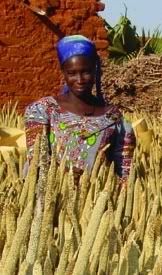 A dangerous myth thriving amongst some NGOs and environmentalists is that Africa can not feed itself because it is overpopulated, its agricultural potential has been completely tapped and it faces water shortages. The contrary is true: Africa has a staggering abundance of land and potential to produce rainfed crops, so much in fact that in theory it can feed the entire continent's rapidly growing population
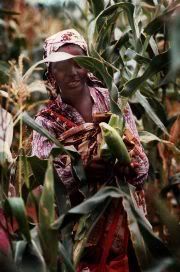 The global transition towards biofuels and bioenergy is much more than a mere agricultural revolution. It is a complex process of change with impacts on a large number of socio-economic factors. In this respect, we have stressed many times that biofuels and bioenergy projects can go different ways: if implemented in a bad way, they can perpetuate existing economic patterns that lead towards more inequality, environmental degradation and poverty (
 Earlier we reported about British researchers who went on an expedition in Asia to collect different varieties of miscanthus, in order to analyse their potential for use as a bioenergy feedstock (
 The goal of this research is to study whether the drought tolerant crop can be made to adapt to the dry but relatively warm climate of South-West Germany. In the tropics, sorghums (
 A study by an independent Norwegian research organisation, the SINTEF Group, shows that, contrary to common perceptions, bigger roads are 'good for the environment'. The issue of expanding road infrastructures is a major point of debate in the EU's drive towards a sustainable and
 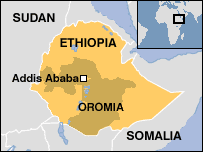 The biofuel opportunity is reaching some of the least accessible and poorest regions of the planet, namely the Oromia region in central Ethiopia. German company
  Farmers, especially smallholders, and the rural poor of six nations stand to benefit from a new program that aims to foster cross-border trade and investment in agriculture, contribute to food security and poverty reduction, and promote environmental protection and sustainable use of natural resources in the Greater Mekong Subregion (GMS).
 Germany based AB Enzymes has
  Several companies have contacted us lately with requests on where to secure biomass supplies or whether we own plantations ourselves (!) or sell seeds of particular crops. Needless to say, the Biopact is not a commercial enterprise so we do not trade any feedstocks, neither is it our intention to act as an intermediary. We do not sell any bioconversion technologies or agricultural inputs. And 'owning' or acquiring energy plantations is the last thing on our mind - we are a tiny volunteer organisation that merely wants to discuss the complexities of biofuels and highlight some of the chances the sector offers to the developing world...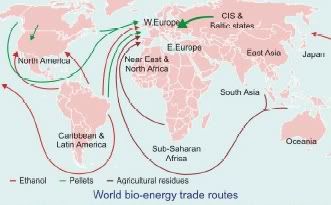
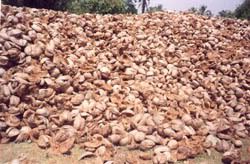 One example of a company's request illustrates how these factors come together and result in problems. The company in question is a bioenergy start-up in an EU member-state that is utilising solid biomass in a small district-heating system. Because it has not been able to secure enough local supplies, it wants to import miscanthus/wood chips/or cheap tropical residues with a particular heating value (cocoa/coconut husks) in bulk - at once, from anywhere, no questions asked, only a quote needed. Local biomass prices there apparently have skyrocketed, so the company searches 'globally'. This detail shows that business is rushing ahead of policy frameworks with regards to sustainability rules (in the case of miscanthus, the problem is probably not that outspoken). In the meantime, the capital cost of the venture is mounting; the investment has been made and must deliver on its potential today, and we quote: "but until this country is up and running in terms of production I will need to import". We have received numerous similar requests, showing similar difficulties.
 Planting trees which trap and absorb carbon dioxide as they grow can help to remove carbon dioxide from the atmosphere. But a new study suggests that, as a way to fight global warming, the effectiveness of this strategy depends heavily on where these trees are planted. In particular, forests in the tropics are very efficient at keeping the Earth at a cool temperature, because not only do they store carbon, they also produce clouds that act like a mirror, reflecting sunlight back into the atmosphere. Planting trees in snowy areas on the other hand may worsen global warming as their canopies absorb sunlight which would otherwise be reflected by the snow, the study suggests. However, while the forests of Europe, Siberia and Canada may contribute to warming, the authors stress they are not advocating chopping down trees.
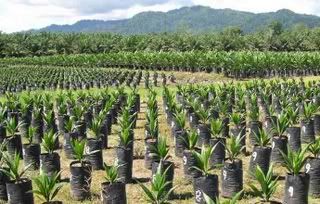 Here at the Biopact, we were surprised to find an in-depth and very nuanced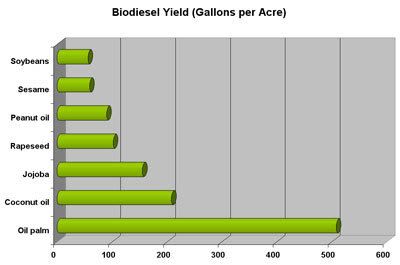
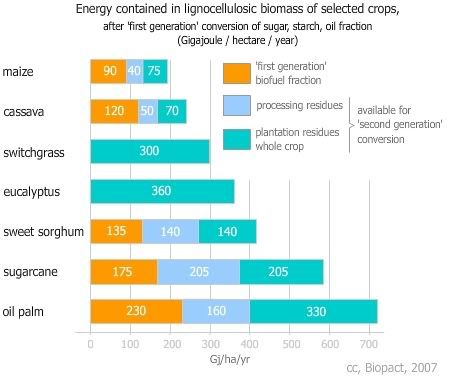
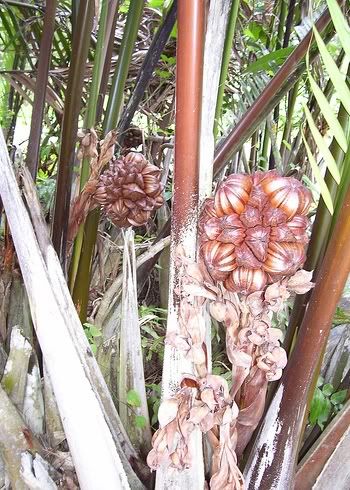 Fresh news about that 'mysterious' energy crop called
 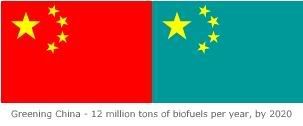 Researchers from the
  The goal of
 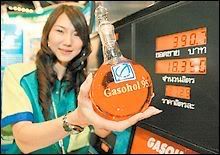 From Thailand comes an interesting story on how the new green fuel paradigm that is conquering the world is going through birth pains. Lack of planning, weak policy frameworks, and a steep learning curve to understand market drivers are typical for emerging industries. Local ethanol producers in Thailand, for example, have
 The European Union has been subsidizing sugar farmers in Africa, the Caribbean and the Pacific (so-called ACP countries) for decades. Under the
  The biogas sector is undergoing a rapid transformation in Europe. Whereas green gas production used to be an activity associated with individual farms and community waste management programs, it has been scaled up to become an industry that produces quantities large enough to be fed into the main natural gas grid. More and more, dedicated biogas crops (such as specially bred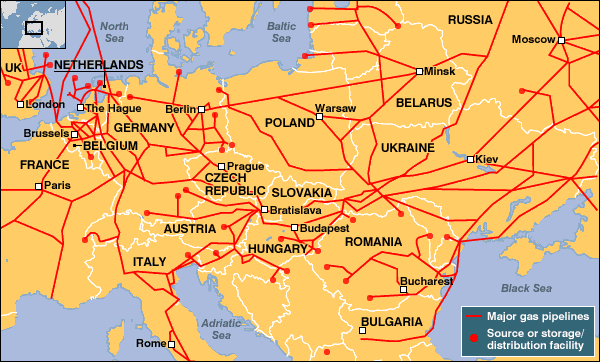








Saturday, April 14, 2007
Two doctoral theses look at carbon capture and storage options
As part of the same program, Dr Saikat Mazumder defended his thesis at the Delft University of Technology on how to better predict routes of the 'underground highways' along which gasses like carbon dioxide (CO2) and methane (CH4) will move during storage operations. He found coal to be highly suitable for filtering carbon dioxide out of waste gasses and storing it.
Both works are highly interesting additions to the growing body of research into CCS, which we track because the technology promises the creation of carbon netgative energy systems based on the utilisation of biomass (socalled 'Bio-Energy with Carbon Storage').
'Major potential'
According to Dr Damen, CO2 capture and storage can make a major contribution to CO2 reduction in the Netherlands. By the mid-21st century 80 to 110 million tonnes of CO2 per year could be avoided in the sectors energy, industry and transport. This is half of the current CO2 emission. Moreover, this can be realised against acceptable costs, the researcher concluded.
To realise such reductions in CO2 emission, a clear and internationally-oriented vision and bridging strategy is necessary, so that the storage capacity that is released over the next few decennia can actually be used for CO2 storage says Damen. He investigated the technical possibilities, costs and risks of CO2 capture, transport and underground storage:
Electricity greatest potential
In 2020 15 million tonnes of CO2 per year could be avoided by capturing CO2 in the new coal-fired power stations yet to be constructed. Moreover, existing pulverised coal-fired power stations may also be equipped with CO2 capture installations, although the costs of this are relatively high. In 2050 the reduction potential is estimated to be 60 to 84 million tonnes of CO2 per year, for a scenario in which the electricity production is doubled.
By capturing CO2 in industrial processes a further 16 million tonnes of CO2 per year can be avoided. Further if cars are run on hydrogen or synthetic diesel produced from fossil fuels combined with CO2 capture then this could eventually lead to a difference of more than 10 million tonnes of CO2 emission per year. For the production of hydrogen in the transport sector, Damen investigated the thermodynamic performance and costs of decentralised membrane reformers. This new technology makes it possible to capture CO2 against relatively low costs.
CO2 transport and storage
Damen calculated the costs of the pipelines necessary to transport the captured CO2 to underground storage reservoirs. Gas fields are, in addition to deep saline aquifers and coal seams, the most suitable reservoirs for CO2 storage in the Netherlands. The capacity that becomes available for CO2 storage can, however, be limited by a series of geological factors, including the risk of CO2 leakage via wells and faults. Although the mechanisms of CO2 leakage are known, quantifying the risks is still a challenge. Additionally CO2 storage could compete with the underground storage of natural gas, especially if the Netherlands develops into an international gas 'roundabout'. If the Netherlands has to maximise its efforts on CO2 capture and storage then eventually one of the 'mega storage reservoirs’ will have to be released, for example, the Groningen gas field or large structures in the British or Norwegian part of the North Sea.
CO2 storage in coal can be predicted better
Saikat Mazumder for his part made it possible to better predict routes of the 'underground highways' along which gasses like carbon dioxide (CO2) and methane (CH4) will move. Moreover, he found that coal might be highly suitable for filtering carbon dioxide out of waste gasses and storing it.
The ‘Enhanced Coalbed Methane process’ kills two birds with one stone: carbon dioxide (CO2) is stored in coal seams in the ground and at the same time methane (CH4) is obtained from the process. To optimise this process it is important to know how coal retains and stores some fluids and gasses whilst allowing others through. The network of cracks is essential for this. Mazumder developed a measuring technique using CT scans that led to an improved understanding of the patterns of cracks. He also did experiments with waste gas and pure CO2 to determine the uptake capacity of single and multi-component gasses. In both wet and dry experiments, CO2 was strongly absorbed and CH4 was released. This methane production in a coal seam can vary over the course of time. Mazumder developed two estimating methods to gain a better understanding of this. When used together these could generate good predictions.
Problems due to swelling
The research revealed that a considerable quantity of CO2 could be removed from waste gas by allowing it to be adsorbed onto coal under high-pressure. According to Mazumder this means that the injection of waste gas into coal seams can be applied to filter out CO2 on an industrial scale and to retain it. Mazumder also carried out a preliminary study into the decrease in porosity and permeability as a consequence of coal swelling due to the injection of CO2. The decrease in the permeability can give rise to serious injection problems in the area of the well into which CO2 is injected.
More information:
NWO: CO2 storage in coal can be predicted better - April 10, 2007.
NWO: Prepare CO2 capture and storage now for greater environmental benefit later - April 10, 2007.
Article continues
posted by Biopact team at 7:11 PM 0 comments links to this post
