- In the waters off Naples, Italy, a single 75-minute raid by poachers can net nearly 1,000 sea urchins, an in-demand ingredient in a dish popular with tourists. A haul like that can deal a significant blow to the local urchin population.
- In a healthy marine ecosystem, fish like sea bream feed on urchins, keeping populations in check. When poachers decimate sea urchin colonies, commercial fish move elsewhere to find food, threatening legal fishers’ livelihoods.
- Experts say Italy’s marine protected areas are particularly vulnerable. Although they have criminal penalties to deter poachers, the surrounding waters have been completely stripped bare of urchins, making them attractive targets.
- Now, scientists are collecting data from law enforcement operations to raise awareness and drive regulatory changes.
NAPLES — On a warm, moonlit night in May, Maurizio Simeone sat in an ambush at his desk about 10 kilometers (6 miles) south of Naples, Italy. The marine scientist and director of the Marine Protected Area (MPA) Gaiola Underwater Park was watching the grainy live feed from cameras surveilling the MPA as poachers descended on the seafloor.
“It was midnight. Here they were again,” Simeone told Mongabay. The poachers had come a few nights before to scout the area. Then a second time. This time, Simeone was waiting for them. He rushed to alert the Coast Guard.
The poachers operated with ruthless efficiency, using a dangerous illegal method known as the hookah system. A compressor on a small boat pumps air through a hose to a diver, allowing them to stay underwater for hours and systematically strip the seabed. Every 20 minutes, the diver resurfaced to hand over a net full of purple sea urchins (Paracentrotus lividus), grab an empty net and then dive back down. When the authorities moved in, the two men on the boat began dumping hundreds of sea urchins and their gear into the sea, as the diver quickly resurfaced.
The three men were old acquaintances of Simeone’s. “They are repeat offenders. It’s not the first time we’ve caught them,” Simeone said.

During a previous bust a year earlier, the vessel was apprehended with a staggering haul: 976 sea urchins pulled from the seabed in just 75 minutes. This time, Simeone counted about 500 individuals harvested in less than an hour.
Purple sea urchins are small spherical creatures, about 5-7 centimeters (2-3 inches) in diameter in adulthood. They range in color from purple to dark black and are covered in awfully sharp spikes, but their creamy, orange roe makes a decadent dish called spaghetti ai ricci.
These “frenzied raids” on sea urchins, as Simeone called them in recounting the busts to Mongabay, are transforming some areas of the Mediterranean into an underwater biodiversity desert. Now, scientists are collecting data from law enforcement operations to raise awareness and push for regulatory changes.

Sea urchins promote biodiversity
Sea urchins are important indicators of ecosystem health. These spiny herbivores influence biodiversity. By grazing on algae, they prevent monocultures from over-running the seabed, thereby maintaining the structure that allows a wide array of other marine species to thrive.
In a balanced system, urchins are kept in check by natural predators, including fish like sargo (Diplodus sargus) and sea bream (Sparus aurata). When overfishing removes these predators, urchin populations can explode, leading to overgrazing. On the other hand, when poachers or disease decimate sea urchin colonies, predatory fish populations decline or move elsewhere to find food, leaving the nets of legal, small-scale fishers empty.
“When the poachers strip the rocks of every single urchin, the fish have no reason to stay in our waters,” one fisher told Mongabay as he tended nets on his boat docked at Marechiaro, a seaside hamlet in Naples’ Posillipo district. “It’s an unfair fight,” complained another fisher, referring to the profits poachers make through the black market.
“These people have nothing to lose. They factor the fines into their costs and keep going,” Roberto Larocca, commander of the Coast Guard in Naples, told Mongabay.
In other Italian regions such as Sardinia, Puglia and Sicily, sea urchins have been part of the culinary tradition for centuries, but they have only recently made their way onto restaurants’ menus in Campania. “TV cooking shows and an influx of tourism in the past years have spread the culinary trend to other regions. Now local poachers have taken control of the Neapolitan coast, causing huge damage,” Simeone said.
Under a national law dating back to 1995, sea urchin harvesting is strictly prohibited in May and June to protect the species during its spawning season. This is precisely when the Gaiola MPA faces its highest risk, as demand increases with the arrival of summer tourists.

‘We must protect the MPA’
Giulia Mazzero, a marine biologist at the Gaiola MPA, spends these nights with eyes strained, guarding the live surveillance feeds for the tell-tale bubble trails left by small boats motoring within the MPA. “The sea urchin poaching season has started. The richness of the protected area makes it a primary target, so we’ll have to take turns to intensify patrol nights,” she told Mongabay.
“We must protect the MPA tooth and nail,” Simeone agreed.
However, catching these ghost divers can be difficult. Larocca said poachers operate in the darkness of the night; they can arrive by boat or crawl down from the rocky shore. If they catch sight of a patrol vessel, they quickly jettison their illegal haul back into the sea or sink their gear, leaving authorities with no physical evidence to justify a fine.


The Gaiola MPA staff have begun collecting data on illegal sea urchin harvesting. Every time authorities catch poachers, the Gaiola team counts, measures and weighs the looted urchins and shares the data with the environment ministry to bring attention to the severity of a crisis that remains heavily underestimated.
From the 2025 sample, they estimated poachers could harvest approximately 1,500 urchins in two hours, which is about 17% of the Gaiola MPA’s population. “This is a very high percentage taken in a very short time, endangering years of management and conservation,” Simone Farina, a marine ecologist at the Stazione Zoologica Anton Dohrn’s marine research center in Genoa, told Mongabay. Farina is the lead researcher for the URCHIN Project (Underwater Research Coralligenous Habitat in Naples), which is studying highly sensitive coralligenous habitats and purple sea urchins within the Gaiola MPA.
Data collected during law enforcement operations should be used as a scientific tool, he said. However, it’s often too heterogeneous to be useful for scientific models, making it “really necessary to standardize the collection of seizure data to understand the true impact of illegal fishing,” Farina said.
“Illegal fishing can account for 80-90% of the total sea urchin removal. If management models only rely on legal catch logs, these management tools become useless,” he said. “Without a shift toward standardized, data-driven scientific monitoring of illegal fishing, the ecological balance and the economic viability of the fishing industry are at high risk.”
The trade of sea urchins in Naples is completely illegal. Larocca said not a single commercial license for sea urchin harvesting has been issued in the wider Campania region, which means that every single dish of fresh sea urchin is illicit. “It all happens through the black market. You won’t see sea urchins at the fish market. Poachers work under commission from restaurant owners,” he said.
A similar trend occurs in Sicily. Authorities confirmed that only one license has been issued across the entire west side of the island. “It cannot justify the amount of sea urchins on the market,” Antonio Indelicato, commander of the Coast Guard in the Sicilian capital of Palermo, told Mongabay.

Urchin harvest laws ‘based on random numbers’
Italy’s national legal framework governing urchin harvest is dangerously outdated, leaving MPAs as isolated oases in a marine desert, Simeone said. “The current national law is ridiculous; it is based on random numbers,” he said, noting that while MPAs have criminal penalties to deter poachers, the surrounding waters have been completely stripped bare of urchins. “They come to the MPA because it’s the only place left where they can actually find them. But when you consider how small these protected areas are…” he said, leaving the sentence unfinished.
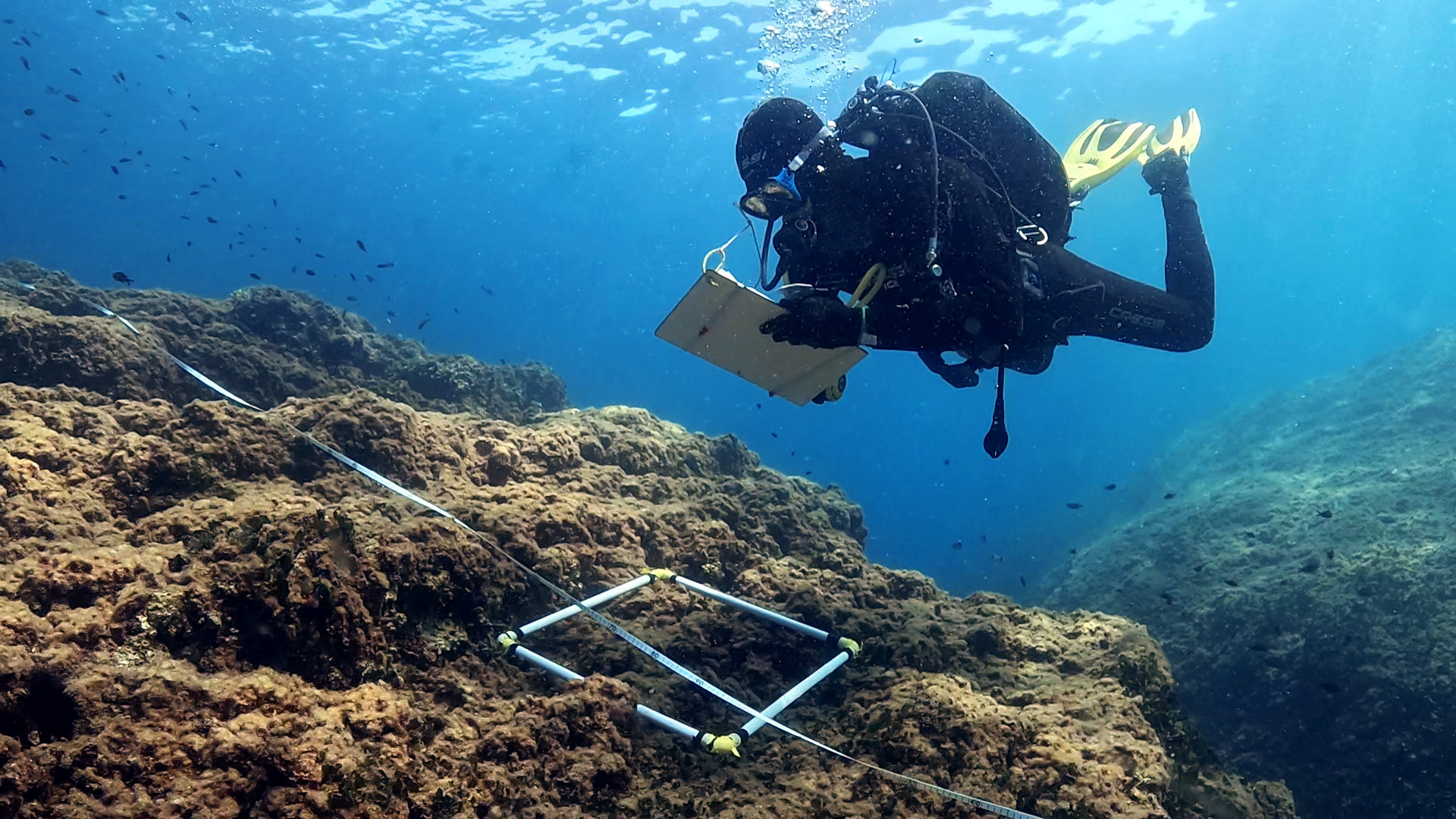
Prior to the May 2025 bust, Simeone and Farina’s team had monitored the sea urchin population within and outside the Gaiola MPA for a year. They found that densities could exceed 90 individuals per square meter (1.2 square yards) in the most protected zone of the MPA, and drop as low as 0.2 individuals per square meter in unprotected areas outside the MPA. “The regulation must change not for the MPA but for the areas outside of it,” Simeone said. “There should be a total ban [of urchin harvest] along the entire Italian coast.”
To combat overharvesting, in February 2022, Sardinia’s regional government passed a total ban on local sea urchin fishing for four years, and it’s now tightly regulated and monitored. In March 2023, Puglia’s regional government followed suit. “We may eventually need similar political measures in Campania,” Larocca said. But Simeone argued that regional bans create a domino effect of exploitation. When Puglia enacted its ban, its fishers simply crossed over to deplete the coasts of Campania and Calabria, he said.
Instead, Simeone is calling for a nationwide moratorium on urchin fishing and a complete overhaul of the law. Even the legal allowance for personal consumption, 50 urchins per person, is unsustainable, he said. “Imagine a crowded beach in the summer. If every person takes 50 urchins, they’re gone instantly. These numbers were just pulled out of thin air. We need a centralized, national policy that protects the species based on weighted, scientific data, rather than a patchwork of regional rules,” Simeone said.
In the meantime, the rule of thumb is this, he said: “If you see ricci di mare in a restaurant, it’s either a preserved product from other regions, or, if it’s fresh, it has more likely been caught illegally.”
Banner image: A purple sea urchin on the Gaiola MPA sea floor. Image courtesy of Maurizio Simeone.
Correction 6/16/26: The original version of this story referred to the Port Authority as taking action against urchin poachers. In fact it is the Coast Guard. Likewise Roberto Larocca and Antonio Indelicato are commanders with the Coast Guard in Naples and Palermo respectively, not the Port Authority. We have updated the story. We regret the errors.
Conservationists aim to save critically endangered European eels on Italy’s Po River
FEEDBACK: Use this form to send a message to the editor of this post. If you want to post a public comment, you can do that at the bottom of the page.
Credits