- With the support of President Luiz Inácio Lula da Silva, essentially all of Brazil’s government outside of the Ministry of Environment and Climate Change is promoting actions that push us toward tipping points, both for the Amazon Rainforest and the global climate.
- Crossing any of these tipping points would result in global warming escaping from human control, with devastating consequences for Brazil that include mass mortalities.
- The question of whether Brazil’s leaders understand the consequences of their actions is relevant to how they will be judged by history, but the climatic consequences follow automatically, regardless of how these actions may be judged, a new op-ed argues.
- This post is a commentary. The views expressed are those of the author, not necessarily of Mongabay.
We all know that “ignorance of the law is no excuse,” but in daily life, ignorance of the consequences of one’s actions is, indeed, an excuse that shields us from our own discomfort or from condemnation by others, even for the most serious of offenses. One is reminded of Jesus Christ on the cross asking the Lord to forgive the Roman soldiers who were in the act of killing him, “for they know not what they do.”
When it comes to climate change and Amazonia, denial and claimed ignorance are commonplace. If global warming escapes from human control with the crossing of a tipping point within the global climate system, Amazonia (and Brazil as a whole) would be devastated. Not only would the Amazon Rainforest and its vital environmental services be lost, but much of the region’s human population would perish during unprecedented heat waves (see here, here, here, here and here).
Tipping points in the global climate and for maintaining the Amazon Rainforest are interconnected. If the Amazon collapses, the resulting release of greenhouse gases would push the global climate past its tipping point, and if global warming escapes from control due to continued burning of fossil fuels, the Amazon would soon succumb. One would therefore expect Brazil’s leaders to be laser-focused on preventing these tipping points from being passed. But instead, with the exception of the efforts of the Ministry of Environment and Climate Change (MMA) to control illegal deforestation (note: only that which is illegal), essentially all of the rest of the government is working to increase emissions.

The assumption is always that our leaders act as they do because they do not know the consequences if their actions. The question of whether President Luiz Inácio Lula da Silva will wake up to the climate crisis assumes this, as does the question of his actions on facing the causes of Amazon deforestation, as opposed to merely counting on MMA to repress the symptoms through inspections and fines.
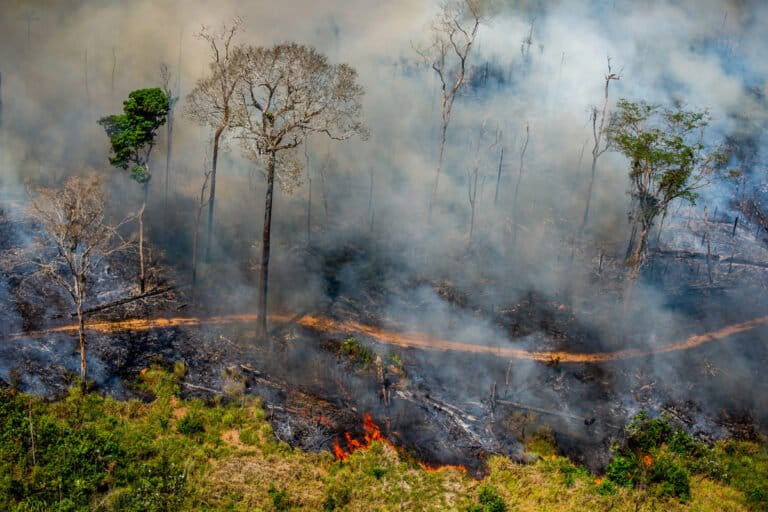
Underlying causes include building highways such as BR-319 and associated side roads (see here and here), legalizing (“regularizing”) land grabbing and invasion of government land (see here, here and here), subsidizing pasture and soy in Amazonia, and subsidizing the transformation of pasture to soy throughout Brazil, thus facilitating the cattle ranchers who sell their pastureland to soy planters and then purchase much larger areas of cheap Amazon forest to clear for pasture. In addition to deforestation, the government also promotes Amazon forest degradation through logging (under the guise of “sustainable” forest management) and associated increases in forest fires.
The importance of all of these drivers has been known for some time. Could it be that the leaders are unaware of this? When the impacts are not denied by claiming that all will be controlled by “governance” (see here and here), the most common reaction is that the government positions are political decisions, and that all else must simply conform to them. Unfortunately, no politicians or other humans command the climate, and the consequences of crossing a tipping point simply follow automatically once the point is crossed.
In addition to facing the causes of deforestation, the other elephant in the room is Brazil’s position on fossil fuels. Since we are already at a tipping point for global climate (see here and here), there is no leeway to continue emitting greenhouse gases. But the position of Brazil’s leaders is that the country can continue emitting essentially forever. The minister of mines and energy states that “Brazil will extract petroleum until it achieves the [economic] level of a developed country.”
President Lula states with reference to the proposed mouth-of-the-Amazon offshore oilfields that “we will not throw away any opportunity to make this country grow.” Since the country will always want to grow, this represents a license to drill forever. The assumption is that there is always room for one more oilfield. The question is seen as a “political” decision. Unfortunately, here, too, politicians do not command the climate.
Does President Lula understand this? Ignorance is an essential protection here, because if he does indeed understand the consequences of these political decisions, history would be much harsher in its judgement. But the consequences follow automatically, they do not depend on how the decisions today will be judged.
Philip M. Fearnside is a research professor at the National Institute for Research in Amazonia (INPA), Manaus, Amazonas, Brazil.
This article is an updated translation of a text by the author that is available in Portuguese on Amazônia Real.
Related audio from Mongabay’s podcast: Author and storytelling expert Tsering Yangzom Lama discusses how to shape narratives to change society and the environment, listen here:
Banner image: Brazil President Luiz Inácio Lula da Silva’s government has been moving to open areas of the Amazon to oil drilling while talking about curbing climate change. Image by Ricardo Stuckert/PR.
See related coverage:
Across the Amazon, impunity among politicians remains chronic
How a ‘green gold rush’ in the Amazon led to dubious carbon deals on Indigenous lands
Heading into COP, Brazil’s Amazon deforestation rate is falling. What about fires?
Citations:
Barni, P. E., Rego, A. C. M., Silva, F. C. F., Lopes, R. A. S., Xaud, H. A. M., Xaud, M. R., … Fearnside, P. M. (2021). Logging Amazon forest increased the severity and spread of fires during the 2015-2016 El Niño. Forest Ecology and Management, 500, 119652. doi:10.1016/j.foreco.2021.119652
Carrero, G. C., Walker, R. T., Simmons, C. S., & Fearnside, P. M. (2022). Land grabbing in the Brazilian Amazon: Stealing public land with government approval. Land Use Policy, 120, 106133. doi:10.1016/j.landusepol.2022.106133
Fearnside, P. M. (2017). Deforestation of the Brazilian Amazon. In H. Shugart (Ed.), Oxford Research Encyclopedia of Environmental Science. Oxford University Press, New York. doi:10.1093/acrefore/9780199389414.013.102
Fearnside, P. M. (2022). Amazon environmental services: Why Brazil’s Highway BR-319 is so damaging. Ambio, 51, 1367-1370. doi:10.1007/s13280-022-01718-y
Fearnside, P. M. (2025). Uma utopia amazônica com ressalvas. In M. Colón (Ed.), Utopias Amazônicas. Ateliê Editorial, Cotia, SP, Brazil. Retrieved from https://philip.inpa.gov.br/publ_livres/mss%20and%20in%20press/Fearnside-2025-An_Amazonian_Utopia_with_caveats-Translation.pdf
Ferrante, L., Andrade, M. B. T., & Fearnside, P. M. (2021). Land grabbing on Brazil’s Highway BR-319 as a spearhead for Amazonian deforestation. Land Use Policy, 108, 105559. doi:10.1016/j.landusepol.2021.105559
Flores, B. M., Montoya, E., Sakschewski, B., Nascimento, N., Staal, A., Betts, R. A., … Hirota, M. (2024). Critical transitions in the Amazon forest system. Nature, 626, 555–564. doi:10.1038/s41586-023-06970-0
Hansen, J. E., Kharecha, P., Sato, M., Tselioudis, G., Kelly, J., Bauer, S. E., … Pokela, A. (2025). Global warming has accelerated: Are the United Nations and the public well-informed? Environment: Science and Policy for Sustainable Development, 67(1), 6-44. doi:10.1080/00139157.2025.2434494
Matthews, T., Ramsay, E. E., Saeed, F., Sherwood, S., Jay, O., Raymond, C., … Forrest, A. (2025). Humid heat exceeds human tolerance limits and causes mass mortality. Nature Climate Change, 15, 4-6. doi:10.1038/s41558-024-02215-8
McKay, D. I. A., Staal, A., Abrams, J. F., Winkelmann, R., Sakschewski, B., Loriani, S., … Lenton, T. M. (2022). Exceeding 1.5°C global warming could trigger multiple climate tipping points. Science, 377, eabn7950. doi:10.1126/science.abn7950
Raymond, C., Matthews, T., & Horton, R. M. (2020). The emergence of heat and humidity too severe for human tolerance. Science Advances, 6, eaaw1838. doi:10.1126/sciadv.aaw1838
Sherwood, S. C., & Ramsay, E. E. (2023). Closer limits to human tolerance of global heat. Proceedings of the National Academy of Sciences, 120(43), e2316003120. doi:10.1073/pnas.2316003120
Yanai, A. M., Graça, P. M. L. A., Ziccardi, L. G., Escada, M. I. S., & Fearnside, P. M. (2022). Brazil’s Amazonian deforestation: The role of landholdings in undesignated public lands. Regional Environmental Change, 22, 30. doi:10.1007/s10113-022-01897-0
Credits