
 PolyOne Corporation, the US supplier of specialised polymer materials, has opened a new colour concentrates manufacturing plant in Kutno, Poland. Located in central Poland, the new plant will produce colour products in the first instance, although the company says the facility can be expanded to handle other products. In March, the Ohio-based firm launched a range of of liquid colourants for use in bioplastics in biodegradable applications. The concentrates are European food contact compliant and can be used in polylactic acid (PLA) or starch-based blends.

India to roll out real-time data on all standing crops - towards 'planetary biomass management'
 The bioeconomy has the theoretical potential to replace a large amount of fossil fuels. Multiple analyses and projections indicate that global sustainable biomass potentials equate to a maximum of around 1400 Exajoules per year by 2050 (earlier post). Currently, the world consumes around 380EJ of fossil energy. However, in order to tap this potential efficiently, new technologies and policies have to be implemented. Interventions will have to occur in a broad range of sectors, from the way livestock is produced to the manner in which biomass is converted into fuels and energy; from carbon management to trade reform.
One of the crucial strategies needed to ensure that biomass trade between countries and continents happens in a sustainable, carbon-reducing and efficient way is to monitor land-use and emission patterns globally. In a globalized world and in the era of intercontinental biomass trade, the use of green fuels in one region can have a range of unintended social, economic and ecological effects in other places.
Ideally, earth observation data on land use, greenhouse gas emissions, and water use in forestry and agriculture would be combined and inform a kind of 'planetary biomass management' strategy (ealier post). A large amount of this kind of data gathered by different countries and institutions is already available - now it needs to be integrated into a more coherent framework. However, most data are being acquired by highly developed countries, whereas developing nations urgently need access to similar data as they stand to become the largest bioenergy producers.
India is taking a first step towards this aim, and interestingly it is relying on an open source platform to do so. The country's Department of Science and Technology (DST) intends to roll out a mechanism to collect real-time satellite data on the health/stress status of all standing crops in the country, and to advise state governments and other stakeholders on how best to deal with the data.
The real-time monitoring of crops will be an invaluable input to the central and state governments to make timely interventions through critical decisions on support prices, credit availability, import and export policies, insurance schemes, irrigation schedules and, indeed, the use of biomass for energy. All agricultural crops have been mapped for the purpose and a 'biomass index' has been developed:
 energy :: sustainability :: biomass :: bioenergy :: biofuels :: agriculture :: forestry :: earth observation :: satellite :: land use :: India ::
 This will enable us to monitor crops and take critical decisions. We would also be able to advise the farmer on inputs required to ensure that his crop stays healthy. We believe that informed decision-making in this manner would ultimately leave more money in the farmer’s hands. - Kapil Sibal, Minister for Science and TechnologyData on biomass is collected from a range of remotely sensed data of a number of satellites, both Indian and foreign. There are a number of bands in each satellite which picks up data of biomass on a village-to-village basis. Each band of each satellite has different characteristics.
A DST team has worked on these bands using a technique called 'principal component analysis' to arrive at a composite digital image which combines data from different bands of different satellites. The biomass index has been developed based on this composite digital image.
This provides a complex computational challenge involving the development of suitable algorithms. The biomass index so developed is a numerical quantity, which can be used to identify crops, assess acreage and determine the health or stress of crop.
"It’s all basically collection of data [...] and using an algorithm for the purpose of determining various parameters to come to certain conclusions," Sibal said.
This will be a very innovative method of assessing crop composition, crop productivity and crop health on a weekly basis. It is possible to have almost complete data at the village level. The method has been tested and validated on a pilot basis.
The methodology makes use of data from a variety of satellites and most of this is in public domain and freely available. It is, therefore, cheap and has the advantage of being based on an 'open source' platform.
References:
Business Line: DST plans real-time mapping of standing crops - October 1, 2007.
Biopact: Satellites play vital role in understanding the carbon cycle - April 26, 2007
Article continues
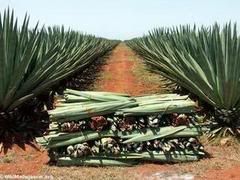 Tanzania has registered considerable success in
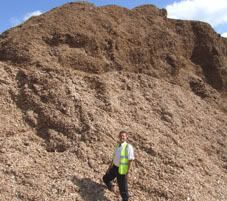 A huge mountain of wood chippings from Dorset, in the UK, is







Tuesday, October 02, 2007
Dynamotive to invest $105 million to develop second-generation biofuel and electricity complexes for rural Argentina
Each complex will be comprised of a 15.7 megawatt electricity generating station powered by the majority of the fuel output of two 200-ton-per-day modular plants producing bio-oil from wood waste and residues from nearby forests and other biomass residue. Excess bio-oil produced at these facilities will be sold into commercial and industrial fuel markets.
Development and construction of the complexes will be implemented by Dynamotive, jointly with TECNA, a major Argentine engineering firm, and financing will be provided by a group of banks and other private sources. When fully operational late next year, the complexes will have available approximately 340,000 dry tons of biomass annually, providing opportunity for further expansion.
Dynamotive said a joint focus of the development of the complexes is to tackle environmental issues arising from vast stockpiles of decomposing wood waste and substantially increase electricity generating capacity in this forested region of Argentina.
The announcement was made in the city of Gobernador Virasoro by Vice President Raúl Parisi of Dynamotive Latinoamericana and Governor Arturo Colombi of Corrientes Province, at a gathering that included city and provincial officials, including Mayor Rodolfo Fernández and members of the provincial and local cabinets.
The biomass-to-energy facilities are expected to foster progress in the region with widespread positive impact on the provincial economies, the local job market and the environment.
In a development not related to the plans in Argentina, but of interest to the bioenergy community, Dynamotive is also experimenting with biochar ('agrichar', 'terra preta') which could lead to the production of carbon-negative fuels (more here and here). By storing a carbon-rich fraction of the pyrolysed biomass in agricultural soils, a low-tech carbon sequestration technique can be developed. The process has shown to result in increased yields for the (energy) crops that are planted on such improved soils.
References:
Biopact: Dynamotive demonstrates fast-pyrolysis plant in the presence of biofuel experts - September 18, 2007
Biopact: Carbon negative biofuels: Dynamotive to test biochar to boost crop yields, water quality, and sequester carbon - May 30, 2007
Biopact: Dynamotive plans to build 6 bio-oil plants in Argentina - April 30, 2007
Biopact: Dynamotive begins construction of modular fast-pyrolysis plant in Ontario - December 19, 2006
Article continues
posted by Biopact team at 11:14 PM 1 comments links to this post