


- Amazon biodiversity protection depends on more than keeping forests standing; a forest can remain on the map while losing ecological function, governance protections, enforcement capacity, or public support.
- Six connected gaps shape Amazon conservation: finance and forest economy, governance, enforcement, forest function, Indigenous rights, and narrative.
- Progress is possible. Brazil has reduced deforestation before, satellite alerts can strengthen enforcement, Indigenous land rights can protect forests, and better finance and monitoring can make protection more durable.
- The central challenge is making the systems around the forest pull in the same direction: finance that favors protection, governance that reduces impunity, enforcement with consequences, rights that hold on the ground, monitoring that reveals what tree cover hides, and stories that show where action is possible.

In the Amazon, a forest can remain on the map while losing much of what makes it function.
The Amazon rainforest is often discussed through a few familiar measures: deforestation, carbon, protected areas, and tipping points. Each is useful. But they do not fully explain why biodiversity continues to decline even where maps still show forest, laws exist, and international pledges sound ambitious. A territory can be recognized and still be invaded. A satellite can detect illegal clearing and still fail to trigger a penalty. A story can describe crisis and still leave readers unsure what can be done.
Six gaps help explain the problem: finance and forest economy, governance, enforcement, forest function, Indigenous rights, and narrative. They overlap in ways that make each harder to close.
The finance and forest-economy gap
Protecting forests costs money every year. It requires staff, transport, monitoring, community work, legal support, fire control, restoration, and the ability to respond when illegal actors arrive. Yet the money available for those tasks remains far below the scale of the problem.
Globally, UNEP estimates that forest investments need to reach about $300 billion a year by 2030 to meet climate, biodiversity, and land-degradation targets. The report also notes that this figure excludes some enabling conditions, including governance and law enforcement, which means the true need is probably higher.
The Brazilian Amazon shows the imbalance more clearly. WWF and Conservation Strategy Fund estimate that Brazil needs about $12.8 billion a year to meet forest policy goals. Current positive forest finance is roughly $408 million. That leaves an annual gap of about $12.4 billion. Meanwhile, forest-negative finance, including loans and subsidies that support agricultural expansion in forest areas, is about eight times larger than forest-positive finance.
The figures are clearest for Brazil, where data are comparatively strong. Across the wider Amazon, the same imbalance is harder to quantify but familiar in practice: conservation money is often short-term, while the incentives behind clearing are built into credit, roads, land markets, and commodity supply chains.
This is not simply a question of asking donors for more money. The problem is that money often moves in opposite directions. One stream pays for protection, restoration, sustainable use, and Indigenous stewardship. Another, much larger stream helps make forest conversion profitable. Closing the gap therefore involves more than increasing grants. It also means looking at the subsidies, credit lines, procurement rules, and investment incentives that shape land-use decisions.

There is a related economic problem. Paying for protection is not the same as making forest-compatible economies viable. In many places, the easiest routes to income still run through cattle, mining, timber, land speculation, or low-margin agriculture. Forest protection is easier to sustain when standing forests also support local livelihoods, municipal revenues, and political constituencies.
That includes agroforestry, sustainable fisheries, restoration work, community enterprises, non-timber forest products, public procurement, technical assistance, and markets that reward verified forest stewardship. None can easily replace the income people get from clearing land, mining, logging, or speculation. But together they point to a different development question: not only how to fund conservation, but how to make forest-compatible land use competitive with the activities that replace forests.
Brazil has tools to build on. Conditional rural credit has already shown that finance rules can reduce deforestation when borrowers have to demonstrate compliance with environmental and land-tenure regulations. The Amazon Fund, ARPA, green bonds, debt-for-nature swaps, and Brazil’s proposed Tropical Forest Forever Fund all point to a broader lesson: forest finance works best when it covers the recurring costs of protection, not only short-term projects.
The governance gap
Finance and enforcement depend on a more basic question: who has the authority to decide what happens on the land?
In parts of the Amazon, that question is clouded by unclear tenure, overlapping claims, weak registries, illegal occupation, and the expectation that land grabbing may later be regularized. In those places, forest loss is not only an environmental violation. It can also be a way to manufacture a property claim.
Infrastructure decisions can deepen the problem. Roads, ports, dams, transmission lines, and settlement schemes change land values, access, and enforcement costs long before the first tree is cut. Once those incentives shift, conservation agencies are often left responding to pressures that planning decisions have already set in motion.

Land-use planning, property records, concession registries, environmental licensing, anti-corruption work, and interagency coordination may sound bureaucratic. In the Amazon, they often determine whether protection holds. A protected area or Indigenous territory may be strong in law, but vulnerable in practice if surrounding land markets, infrastructure plans, and political incentives push steadily toward conversion.
In some parts of the Amazon, governance is also a question of safety. Illegal mining, logging, land grabbing, and wildlife trafficking can be tied to organized crime, corruption, and violence. Agencies and communities cannot enforce rules if doing so makes them targets without protection. In such places, biodiversity protection depends not only on environmental policy, but on the credibility of the state itself.
The enforcement gap
The enforcement gap is not mainly about knowing where deforestation is happening. Brazil and other Amazon countries now have increasingly sophisticated monitoring systems. The harder problem is turning detection into consequences.
Brazil’s DETER system showed what is possible when near-real-time satellite alerts are connected to law enforcement. By helping authorities find new clearings quickly, DETER increased the chance that officers could catch offenders in the act and apply penalties with real force, including seizure of equipment. Researchers found that monitoring and enforcement curbed deforestation; one estimate suggested that without those efforts, deforestation between 2007 and 2016 would have been nearly five times higher.
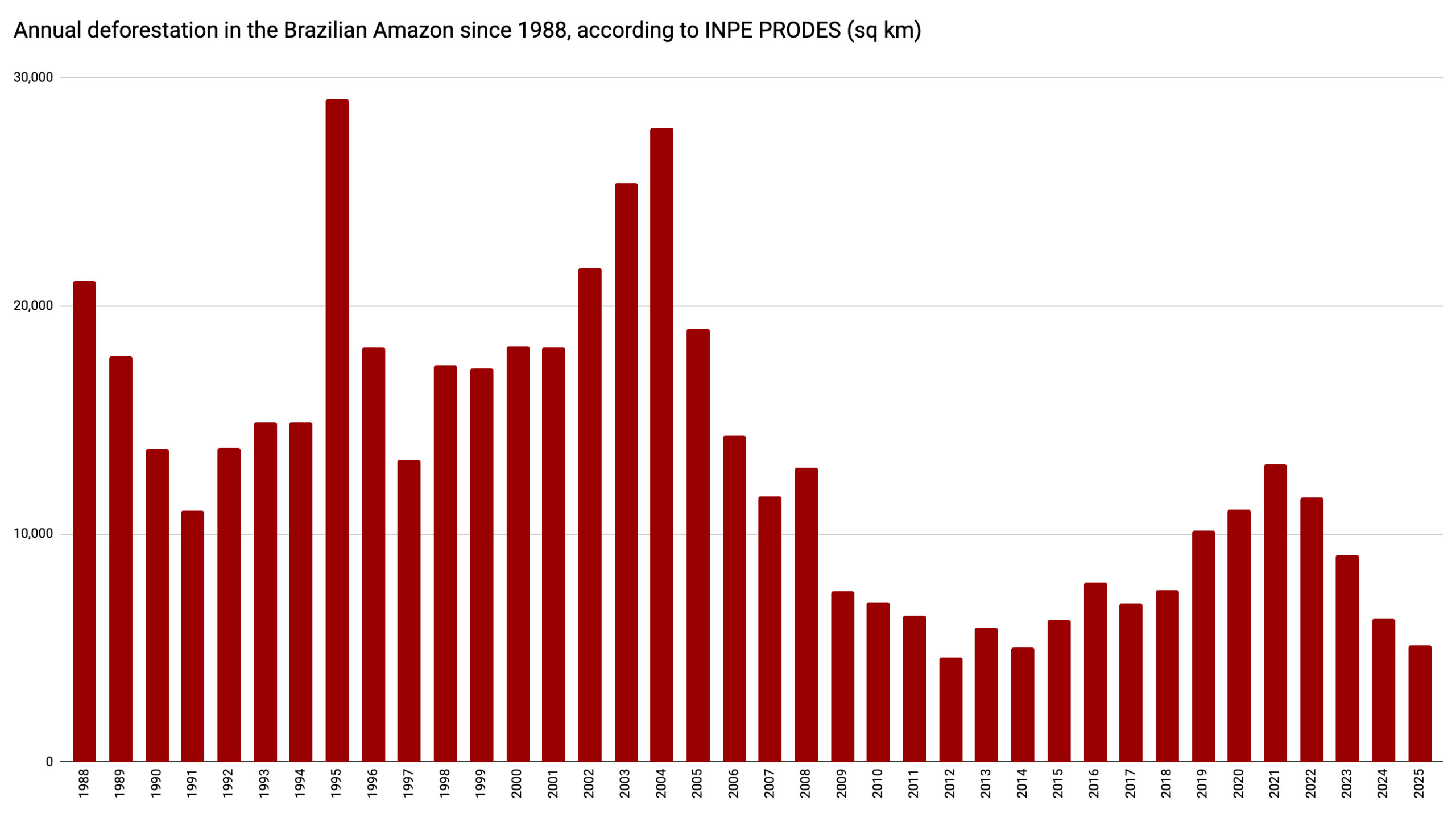
The DETER experience also shows the limits of technology alone. Satellites do not save forests on their own. Alerts only have force when someone has the authority, budget, safety, and political backing to act on them. Enforcement fails when fines are delayed, penalties are overturned, agencies are underfunded, or illegal actors assume that clearing forest carries little risk.
More patrols may help, but they are only part of the picture. Better targeting, faster administrative procedures, secure budgets for agencies, stronger prosecutors, public registries of sanctions, and monitoring that communities can use all help determine whether laws have force on the ground. In the Peruvian Amazon, a randomized study found that Indigenous communities given satellite deforestation alerts, training, and incentives for patrols saw the largest reductions in forest loss where threats were greatest. The results were imprecise, but they suggest that state capacity and local authority can work together rather than separately.
The forest-function gap
Falling deforestation rates are essential, but they do not by themselves stabilize the forest. The same problem applies to degradation, which is harder to see than clear-cutting. A major Science review estimated that about 2.5 million square kilometers of Amazon forest are degraded by fire, edge effects, timber extraction, and extreme drought. That represents 38% of the region’s remaining forests. The authors found that degradation can cause carbon emissions comparable to deforestation and can bring as much biodiversity loss as deforestation in human-modified landscapes.
Degradation is harder to police than clear-cutting because the signal is less binary. A logged forest, a burned understory, or a fragmented edge may still appear as forest in many monitoring systems. Protecting those forests requires several kinds of evidence at once: satellite data, field inspection, fire records, timber permits, road maps, acoustic monitoring, camera traps, biological surveys, and local reporting.
Illegal logging, escaped fire, road-building, mining, hunting, fragmentation, and drought-driven forest stress all erode biodiversity before a forest disappears from a map. The earlier those pressures are detected, the better the chance of responding before the damage becomes permanent.

Measurement lags behind the problem. Forest cover is easier to track than biodiversity. A landscape can retain canopy while losing large mammals, seed dispersers, pollinators, fish, amphibians, or understory birds. Better biodiversity monitoring would not replace satellite data, but it would make conservation claims harder to base on tree cover alone.
Protection is only part of the work. In many landscapes, biodiversity will also depend on restoring degraded forests, reconnecting habitat, protecting river corridors, and allowing secondary forests to recover. The question is not only how much forest remains, but whether enough of it is connected and functional to support viable populations over time.
The Indigenous rights gap
The Indigenous gap is often discussed in terms of rights and justice. It is also a practical problem for conservation. Indigenous peoples and local communities are among the Amazon’s most effective forest stewards, yet they often receive little direct finance, limited protection, and too little authority over decisions affecting their territories.
The evidence is strongest where rights are formalized. In Brazil, a study of Indigenous territories found that deforestation falls significantly inside territories once full collective property rights are granted. Recognition, in that sense, is not only symbolic. It changes who has legal authority to defend the forest. The authors argue that recognizing Indigenous land rights is not only a human-rights obligation, but also a cost-effective way to protect forests and reduce emissions.
Recognition alone is not enough. Rights have to be demarcated, enforced, financed, and defended. Communities need legal support, safety systems, monitoring tools, communications infrastructure, and direct access to funding. They also need a role in setting priorities, rather than being asked to carry out programs designed elsewhere.
That distinction is important because the Amazon is not empty land awaiting management. It is home to peoples with their own institutions, knowledge systems, languages, economies, and obligations to place. Conservation strategies that treat them mainly as beneficiaries lose both legitimacy and effectiveness.

The finance system reflects this mismatch. UNEP notes that Indigenous peoples and local communities are vital to forest protection, restoration, and sustainable management, but only a small share of international public forest finance is directed to projects related to them. An even smaller share is likely to reach Indigenous- and community-led initiatives directly.
In practice, closing this gap points to tenure security, direct finance, free, prior, and informed consent (FPIC), Indigenous-led monitoring, community media, safety funds, and shared governance. Indigenous stewardship is not just one conservation tactic among many. It is one of the foundations on which Amazon biodiversity protection already depends.
The narrative gap
The narrative gap is less tangible than the others, but it shapes all of them. People do not act on biodiversity loss simply because more information is available. They act when a problem feels relevant, credible, and connected to decisions they can influence.
Too much Amazon communication has been built around distant catastrophe. That is understandable; the risks are severe. But crisis without agency can lead to avoidance, fatalism, or polarization. The point is not to soften the science, but to show what can still be done.
That can involve moving from broadcast to co-creation, especially with people whose lives and territories are directly tied to the forest. It can mean replacing doom with disciplined optimism: not easy reassurance, but evidence that action can work. It also means using trusted local voices and languages, and speaking to audiences beyond the usual environmental constituencies. Farmers, traders, urban consumers, mayors, nurses, clergy, and small-business owners all have reasons to care about how the forest affects rainfall, health, food prices, safety, and economic stability.

People do not all value the Amazon in the same way. The same forest can be a climate regulator, a homeland, a source of water, a public-health shield, a storehouse of species, a cultural landscape, a legal territory, and an economic asset. These frames need not compete. Used carefully, they can reach different audiences without diluting the underlying truth.
The strongest stories are often those that show where action is possible. They can do more than describe loss. They can explain who has power, where money flows, which laws are not enforced, which communities are succeeding, and what decisions would change outcomes. Public maps, enforcement trackers, concession registries, supply-chain tools, and rights explainers can make information useful to prosecutors, journalists, Indigenous federations, farm cooperatives, and policymakers.
In practice, that could mean fewer stories that end with catastrophe and more that follow the chain of decisions behind it: who financed the road, who benefits from the clearing, which agency can intervene, which community is monitoring the damage, and what happened when a similar pressure was stopped elsewhere.
Closing the gaps together
In practice, the six gaps run into one another. More finance without enforcement may subsidize promises rather than results. Better land-use planning can be overwhelmed if illegal occupation is later rewarded. Enforcement without rights can become abusive or illegitimate. Rights without finance can leave communities recognized on paper and exposed on the ground. Ecological monitoring without policy consequences can document decline without changing it. Better narratives without institutions can raise attention without changing incentives.
The strongest approaches are likely to connect them. Finance can reward standing forests while reducing support for activities that drive their destruction. Governance can clarify land rights, reduce perverse incentives, and make infrastructure decisions less damaging. Enforcement can make illegality costly. Ecological monitoring can show whether forests are still functioning, not only whether they remain standing. Indigenous rights can be secured, funded, and treated as central to conservation strategy. Communications can make the forest relevant to the people whose decisions shape its future.

There is reason to be cautious about simple answers. The Amazon’s biodiversity crisis is driven by roads, cattle, land speculation, mining, timber, fire, drought, weak institutions, global demand, local poverty, political violence, and climate change. No single fund, law, technology, campaign, or protected-area target can solve that.
But the crisis is not unknowable. The evidence offers some direction. Brazil has reduced deforestation before. Indigenous property rights can protect forests. Satellite alerts can strengthen enforcement when tied to action. Forest finance can be redesigned. Land governance can reduce the rewards for clearing. Better monitoring can reveal degradation before forest loss becomes irreversible. Narratives can widen the coalition for protection by connecting the Amazon to daily life.
The Amazon’s biodiversity crisis is not only something to document. Durable protection will depend on whether the forces around the forest begin to pull in the same direction: finance that favors protection, governance that reduces impunity, enforcement that carries consequences, rights that hold on the ground, monitoring that reveals what tree cover hides, and stories that help people see where action is possible.
Header image: Amazon rainforest canopy. Photo by Rhett Ayers Butler.
Citations:
- WWF & Conservation Strategy Fund. (2025). The billion dollar black hole in forest finance. WWF.
- United Nations Environment Programme. (2025). State of finance for forests 2025: Unlock. Unleash. Realizing forest potential requires tripling investments in forests by 2030. United Nations Environment Programme. https://wedocs.unep.org/20.500.11822/48718
- Gandour, C. (2021). Public policies for the protection of the Amazon forest: What works and how to improve. Climate Policy Initiative.
- Baragwanath, K., & Bayi, E. (2020). Collective property rights reduce deforestation in the Brazilian Amazon. Proceedings of the National Academy of Sciences, 117(34), 20495–20502. https://doi.org/10.1073/pnas.1917874117
- Assunção, J., Gandour, C., & Rocha, R. (2023). DETER-ing deforestation in the Amazon: Environmental monitoring and law enforcement. American Economic Journal: Applied Economics, 15(2), 125–156. https://doi.org/10.1257/app.20200196
- Slough, T., Kopas, J., & Urpelainen, J. (2021). Satellite-based deforestation alerts with training and incentives for patrolling facilitate community monitoring in the Peruvian Amazon. Proceedings of the National Academy of Sciences, 118(29), e2015171118. https://doi.org/10.1073/pnas.2015171118
- Pascual, U., Adams, W. M., Díaz, S., Lele, S., Mace, G. M., & Turnhout, E. (2021). Biodiversity and the challenge of pluralism. Nature Sustainability, 4, 567–572. https://doi.org/10.1038/s41893-021-00694-7
- Shreedhar, G., & Thomas-Walters, L. (2022). Experimental evidence of the impact of framing of actors and victims in conservation narratives. Conservation Biology, 36(6), e14015. https://doi.org/10.1111/cobi.14015
- Lapola, D. M., Pinho, P., Barlow, J., Aragão, L. E. O. C., Berenguer, E., Carmenta, R., Liddy, H. M., Seixas, H., Silva, C. V. J., Silva-Junior, C. H. L., Alencar, A. A. C., Anderson, L. O., Armenteras, D., Brovkin, V., Calders, K., Chambers, J., Chini, L., Costa, M. H., Faria, B. L., … Walker, W. S. (2023). The drivers and impacts of Amazon forest degradation. Science, 379(6630), eabp8622. https://doi.org/10.1126/science.abp8622
Brazil has protected much of the Amazon. It now has to pay for it.
Cite this article
Rhett Ayers Butler (2026). The Amazon’s path from crisis to durability. Mongabay Conservation news. DOI: https://doi.org/10.66709/news-320267Credits


