- The transition from deforestation to reforestation will rely on local resource ownership, because this ownership is an unavoidable prerequisite for the financing of carbon sequestration and other ecosystem services provided by forests, the authors of a new op-ed argue.
- “From Himalayan foothills to reforested cattle ranches in Central America, individuals and communities that own tree-covered land are being paid to safeguard forest ecosystem services. But even where conservation payments are not on the table, property rights, alone, make environmental improvement more rewarding for those individuals and communities,” they write.
- This post is a commentary. The views expressed are those of the authors, not necessarily of Mongabay.
Having receded by 350 million hectares (almost 865 million acres) since 1850, trends in Latin American forests are now inflecting away from further losses of tree-covered habitats and toward their recovery. As we explain in our book Reversing Deforestation, published by Stanford University Press in December 2024, this change stems from reduced population growth and the continuing improvement of agricultural yields. But as we also point out, the transition from deforestation to reforestation will hinge during the years to come on local resource ownership, not least because this ownership is an unavoidable prerequisite for the financing of carbon sequestration and other ecosystem services provided by forests.
Mainly because it causes the demand for food to go up, demographic expansion adds to the displacement of natural habitats by farms and ranches. Forest loss in Latin America during the last 175 years, when human numbers in the region rose from 30 million to 650 million or more, is a clear example. However, human fertility has plunged in the region, from 5.9 births per woman in 1960 to 1.9 births per woman today, so annual natural increase (equal to the birth rate minus the death rate) has declined from nearly 3% to less than 1%.
Human fertility has fallen more in Latin America than in sub-Saharan Africa, where women still bear more than four children, on average, and natural increase remains above 2% a year. This difference in demographic trajectories is a major reason why annual forest losses in the two regions are now comparable, which was never the case before the turn of the 21st century.

Not just a matter of human numbers, the spread of crop and livestock production at the expense of natural habitats also depends on agricultural productivity, as reflected in crop and livestock yields. No less an authority than Norman Borlaug, who received a Nobel Peace Prize for his contributions to the Green Revolution, underscored this linkage. Beginning in the 1960s, he contended, forests were saved as per-hectare output of staple grains rose in Asia and Latin America.
Soybean trends in Brazil appear to contradict Borlaug’s argument. Since 1961, when soybean production was negligible in the South American nation, yields have gone up steadily by 1.7% a year. But harvested area has increased faster, at an annual rate of 9.1% up until 2005, and by 4.3% a year since then.
A couple of things should be kept in mind about these trends. First, a large portion of Brazil’s soybeans are harvested in the Cerrado, which has forests as part of its extensive savannas.
Second, Brazil and neighboring countries have become the world’s leading source of soybeans converted into products such as meal (fed to chickens, hogs and other livestock) and oil (for human consumption). Consider China, which purchases more than three-fifths of all global soybean exports. More than 70% of its imports come from Brazil. Thus, tree-covered habitats have remained intact in the second-most populous nation in the world, as soybean production and exports from South America have increased. [Editor’s note: the Cerrado itself faces ongoing deforestation for soy cultivation, an issue that Mongabay has regularly covered.]

The environmental argument Borlaug offered for gains in agricultural productivity makes economic sense. Those gains have caused food supplies to increase at any given price. Since slower population growth simultaneously has reduced food consumption at any price, inflation-adjusted (or real) prices of farm products are measurably lower now than they were 50 to 65 years ago. Reduced prices in turn have weakened incentives for the geographic expansion of agriculture, which has resulted in forest recovery in places where resource ownership is secure.
One of those places is Costa Rica. For many years after World War II, the country suffered widespread deforestation, primarily due to the expansion of cattle ranching. As a rule, however, ranchers who cleared away trees and other natural vegetation received titles of ownership. Forests consequently grew back on many holdings beginning in the 1980s, when foreign demand for Costa Rican beef contracted. And since 1997, when a national system of payments for environmental services was established, properties formerly used to supply hamburger meat now make money for their owners by sequestering carbon, harboring biodiversity, and protecting water sources.
Private property is not the only way to satisfy the institutional prerequisite for habitat conservation, generally, and conservation payments, specifically. In Mexico, traditional holdings belonging to rural communities rather than individuals are enrolled in a national program like Costa Rica’s of payments for environmental services. No less than private property, this group ownership, or common property, is vastly superior to the effective absence of ownership, which occurs where governmental authorities with extensive claims on natural resources cannot really control access to those resources.
The environmental consequences of this imbalance, which economists refer to as open access, are often disastrous. For example, Nepali authorities nationalized all village forests in 1957, even though they were in no position to control the collection of construction materials, firewood and other products. The ensuing destruction of natural habitats, which increased the frequency of floods and landslides, did not abate until the 1980s, when the old system of village forests was reinstated.
This reinstatement has been followed by payments made to rural communities in exchange for their removal of combustible material — payments made possible by donations from international organizations aiming to reduce forest fires. Along with other stakeholders, those organizations have reason to support the combination of local resource ownership and conservation payments: tree cover has spread in Nepal, from 26% in 1992 to 45% in 2016, for example.
From Himalayan foothills to reforested cattle ranches in Central America, individuals and communities that own tree-covered land are being paid to safeguard forest ecosystem services. But even where conservation payments are not on the table, property rights, alone, make environmental improvement more rewarding for those individuals and communities. As documented in our book, this connection between resource ownership and conservation is fundamental, throughout Latin America and around the world.
Douglas Southgate and Brent Sohngen are professor emeritus and professor, respectively, at Ohio State University, and authored the recent book Reversing Deforestation: How Market Forces and Local Ownership Are Saving Forests in Latin America.
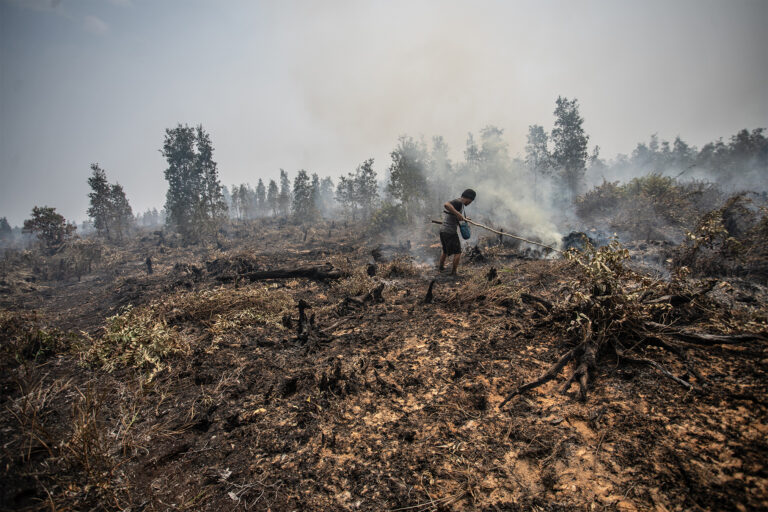
Banner image: Deforestation for an oil palm plantation in Borneo, Indonesia. Image by Rhett A. Butler/Mongabay.
Related audio from Mongabay’s podcast: A conversation with Yale University professor and author Sunil Amrith about the past 500 years of human history, colonization and empire, and the impact of these on ecological systems, listen here:
See related coverage:
Where there’s political will, there’s a way to stop tropical deforestation, study finds
Deforestation from soy shows no sign of stopping in Cerrado, report says
Paying to prevent deforestation is positive & not ‘nothing’ (commentary)
Cite this article
Brent Sohngen, Douglas Southgate (2025). Reversing deforestation relies on resource ownership (commentary). Mongabay Conservation news. DOI: https://doi.org/10.66709/news-303773Credits