- Following his earlier essay tracing possible futures for the world’s forests, Mongabay founder and CEO Rhett Ayers Butler turns from diagnosis to design—asking what concrete interventions could still avert collapse. This piece explores how governance, finance, and stewardship might evolve in a second act for tropical forests.
- The essay argues that lasting protection depends structural reform: securing Indigenous land rights, treating governance as infrastructure, and creating steady finance that outlasts election cycles and aid projects.
- Butler also examines overlooked levers—from restoring degraded lands and valuing forests’ local cooling effects to rethinking “bioeconomies” and building regional cooperation across borders. Each points toward a shift from reactive conservation to deliberate, sustained design.
- This article is a commentary. The views expressed are those of the author, not necessarily of Mongabay.
Heading into COP30, where tropical forests are set to be a central theme, it seemed worth looking today’s trajectories a little further forward and imagine where they might lead. Part 1 looked at possible fates of tropical forests.
The first act of the forest crisis was destruction. The second, if there is to be one, must be design—deliberate, structural, and sustained. The world already knows what is burning; what it hasn’t decided is whether it truly wants to stop it.
Last year’s fires tore through more than three million hectares of tropical primary forest, most of it in South America. Drought and El Niño played their part, but so did the same chronic weaknesses: fragmented governance, cheap credit for land clearance, and a market that rewards destruction faster than it rewards restraint. The causes are structural, which means the solutions will have to be as well.
Power to those who already protect
More than a third of the world’s intact forests lie on Indigenous and community lands. Where rights are recognized, deforestation typically drops. The logic is simple. People with secure tenure have reason to manage land for the long term. Yet only a fraction of community lands in the tropics have legal title. Recognition processes crawl through bureaucracy, while investors and speculators tend to advance quickly.
A first-order intervention, therefore, is legal rather than technical: accelerating the transfer of rights. That means repairing broken land registries: mapping who actually owns what and granting legal title to the communities already protecting the forest. It also calls for patient finance including grants that fund paralegals, local land registries, and administrative capacity. For donors, funding legal sovereignty may seem unglamorous, but it can be decisive.
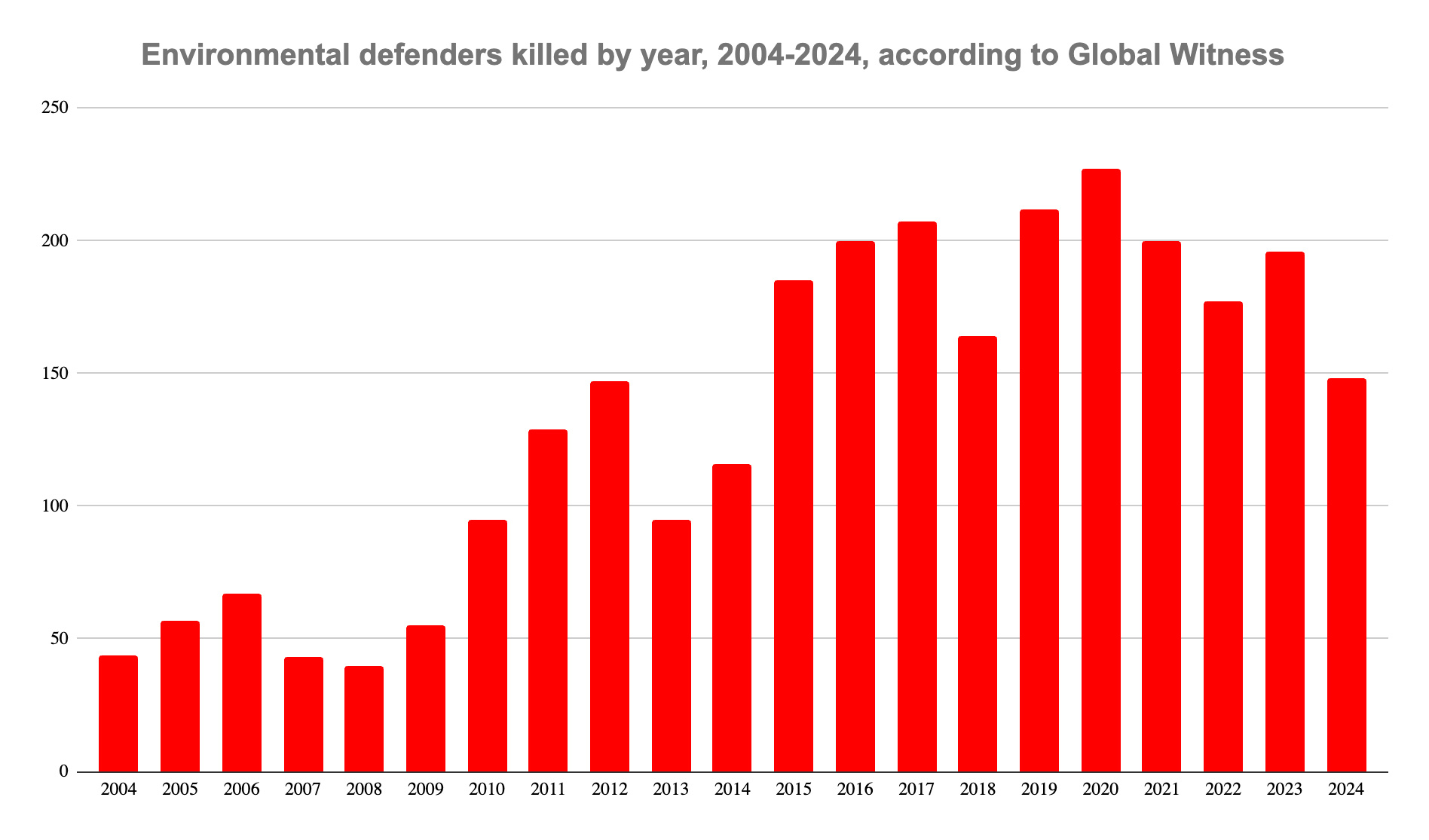
None of this matters, however, if the people defending forests are not safe. Scores of rangers, Indigenous leaders, and environmental defenders are killed each year, often with impunity. Strengthening protection mechanisms, legal aid, and rapid-response systems for at-risk communities is not charity: it’s the cost of maintaining governance where the state has retreated.
Governance as infrastructure
While fires raged across the Amazon in 2024, Brazil cut tree-felling across the region nearly in half. Indonesia accomplished something similar through fire-prevention patrols and permit crackdowns. Both show that political will can work, if it’s present. Gains can evaporate when governments change, budgets shrink, or enforcement lags.
Treating governance as infrastructure makes sense: a public good that needs steady investment and upkeep. That requires stabilizing funding for environmental agencies, professionalizing ranger corps, and insulating regulators from political cycles. It also involves digitizing permitting systems to reduce corruption and linking them directly to trade data, so illegal timber or beef cannot quietly enter supply chains.
Infrastructure with accountability is equally important. Roads and ports can knit regions together—or open frontiers to illegal clearing. Development finance can make new infrastructure contingent on transparent environmental assessments and active land-use monitoring. Linking transport and credit projects to forest-protection benchmarks may turn today’s deforestation corridors into sustainable production hubs and trade routes.
It may be worth looking at politics itself as climate infrastructure. Where deforestation slows, it’s often because broad coalitions—farmers, financiers, Indigenous groups—find common cause. Brazil’s progress under President Lula’s administration came not from policy alone but from aligning agricultural and conservation interests. Replicating that political alignment elsewhere could prove as important as any technology or treaty.
If climate finance worked more like defense budgets—funding prevention instead of cleanup—fires and clearing could drop within months. But many donors still prefer pilot projects to paying for the people who keep the system running, and results they can count on from institutions they must trust to deliver.

Productivity before expansion
Much of the land driving deforestation is barely productive. In the Brazilian Amazon, half of cleared areas are degraded pasture yielding a fraction of potential output. Raising productivity on these lands—through better soil management, silvopastoral systems, and credit for sustainable intensification—can break the link between growth and clearance. Research institutions have shown that improving degraded soils can double or triple yields while freeing space for reforestation. Making such practices viable for smallholders through secure tenure and low-interest loans could deliver climate gains larger than any single restoration project.
Restore mosaics, not monocultures
The global fetish for tree-planting has produced seas of eucalyptus and acacia, fast-growing, water-draining monocultures that do little for biodiversity or livelihoods. But mosaic restoration offers an alternative approach.
These landscapes blend natural regeneration, agroforestry, and community-managed production forests. They restore ecological function while keeping people on the land. In Brazil’s Atlantic Forest, such mosaics have revived pollinators and reduced erosion. In the Philippines, mixed native plantings around farms have boosted income and bird diversity alike.
Restoration also has lessons from the past. Ancient Amazonian societies enhanced poor soils by adding charcoal and organic waste, creating terra preta—black earth that remains fertile centuries later. While modern attempts to scale such biochar systems have struggled, understanding their limits could inform low-cost soil-restoration methods rooted in traditional knowledge rather than hype.
Financing remains the bottleneck. Commercial investors still want predictable returns; aid agencies demand measurable outputs. Yet the benefits of mosaic restoration are scattered and take time to appear in the data. One fix is to link payments to verified ecosystem services—water retention, soil carbon, flood mitigation—rather than just tons of biomass. Another is to subsidize patient capital: 15-year loans, not three-year grants.
The forest as an economy, not a museum
Long-term protection also requires income from standing forests if the world is not willing to fund them in their own right. A “bioeconomy” built around non-timber products—such as açaí, Brazil nuts, essential oils, and medicinal plants—links conservation to livelihoods, at least in theory. But these models have often struggled to deliver consistent returns. Most remain viable only with external subsidies or niche markets, and when they do succeed commercially, they tend to be industrialized, concentrating profits and weakening ecological safeguards.
Still, small-scale forest enterprises can strengthen local economies and give communities a tangible stake in conservation—if markets are managed for sustainability rather than scale. Pairing scientific research with traditional knowledge can improve yields and traceability without repeating the extractive patterns they aim to replace.

Data that democratizes
Technology can vastly expand transparency, though it can just as easily be used to conceal. Satellite monitoring, eDNA surveys, and AI-assisted analytics have transformed how forests are measured, but control of the data is often concentrated in corporate and governmental hands. Communities may have no access to the information collected about their own territories.
A new generation of open-source monitoring tools that blend satellite and ground data could begin to change that dynamic. The idea is not merely transparency, but parity: enabling local actors to contest official data and document their stewardship. Some Indigenous groups in the Amazon are already building encrypted data cooperatives to store forest information under community governance. If scaled and legally recognized, these could form the backbone of a truly bottom-up accountability system.
Over time, control over data could prove as important as control over land itself. In some contexts, whoever controls the map controls the policy.
Money that stays put
The economic imbalance is staggering. Subsidies for industrial agriculture outweigh global forest finance by hundreds to one, according to the Forest Declaration Assessment. Until that ratio shifts, conservation will remain a niche enterprise trying to compete with some of the most profitable destruction in human history.
Rebalancing will not come from carbon markets alone; those are dormant and struggling to regain credibility. What could work is a combination of conditional debt relief, redirected subsidies, and long-term trust funds for forest nations. A few pilots, like debt-for-nature swaps, hint at what is possible. But they remain small, episodic, and bound by donor caution.
Forests also deliver economic value that rarely appears in budgets. They don’t just store carbon—they cool the air. Tropical canopies create a local climate, lowering temperatures by several degrees and keeping nearby farms viable. If governments accounted for the economic cost of lost shade—fewer working hours, lower yields, rising heat stress—they might see clearing forests for short-term gain as fiscal self-sabotage. Full-cost accounting of deforestation’s impacts could change the arithmetic of development policy.
What’s missing is stability. Forest ministries and communities cannot plan when financing expires with each grant cycle. Endowment-style mechanisms, managed transparently and replenished through levies on high-emission sectors, could provide the stability that short-term aid cannot.

Forests without borders
Rainforests do not respect borders, but forest policy still does. The Amazon, Congo, and Mekong basins are continental systems, yet each is governed as a patchwork of national mandates and ministries. Smoke from one jurisdiction drifts into another; rivers cross borders.
Regional cooperation remains rare, but not impossible. The Kavango–Zambezi Transfrontier Conservation Area (KAZA) in southern Africa links five countries in a single landscape-scale management system. The Heart of Borneo initiative, shared by Indonesia, Malaysia, and Brunei, has likewise shown that political rivals can collaborate when watersheds and wildlife connect them. In the Amazon, a revived basin-wide alliance, perhaps emerging from the revised Amazon Cooperation Treaty Organization, could do the same for fire control, early-warning systems, and coordinated trade standards.
No country can defend a rainforest alone. The same logic that once united the world around the ozone layer applies here: shared threats demand shared restraint. Forest diplomacy, done well, can be considered climate policy or conservation policy by another name.
Narratives that sustain
Despair can raise money but doesn’t build systems. The public needs stories that connect progress to possibility. Conservation succeeds more often than the headlines suggest: deforestation in Indonesia has dropped, saiga populations in Central Asia have rebounded, and Colombia has recognized Indigenous sovereignty over vast areas of the Amazon and launched large-scale community forestry programs.
When people see real improvement, they’re more likely to stay engaged. In forest protection, progress is measured in years, not days. Hope grounded in evidence isn’t sentiment; it’s what carries the work forward after the headlines pass.

Knowing when to stop
None of this requires new science. It demands reordering priorities: law before offsets, tenure before technology, transparency before trade. The forest crisis is not a mystery of biology but a failure of governance and imagination.
Collapse is still avoidable. The next decade will determine whether the world’s great forests continue to regulate the climate or slide into chronic degradation. We know the remedies; we’ve yet to apply them in the right order—or prove we have the will to make hard choices.
First, protect those who already protect. Then build the systems—legal, financial, informational—that let them endure after the spotlight moves on.
That, in the end, is how collapse is averted: not through breakthroughs or bold gestures but through the slow, steady work of keeping promises.
Credits