- Nepal’s rhesus macaques are raiding crops across the mid-hills. A 2026 study found nearly half their diet in one region came from cultivated crops, and farmers bearing losses largely uncompensated.
- Researchers are testing AI-based detection systems, with one achieving around 88% field accuracy.
- Nepal’s compensation and relocation policies have struggled to keep pace with the conflict, and a 15-member government task force formed in May 2026 has yet to report, leaving farmers to guard their fields at dawn in the meantime.
KATHMANDU — At dawn in Birta Deurali village of Kavrepalanchok in central Nepal, maize fields aren’t quiet. Farmers stand guard, scanning the trees for movement, but they aren’t the only ones there.
“If you leave even for a short time, the monkeys do considerable damage,” said 46-year-old Sagar Tamang, a resident of Birta Deurali. Villagers take turns guarding fields every two hours, beating drums and sending dogs to chase them away.
Nepal’s macaque crop raids are making national headlines, and the country’s researchers are testing artificial intelligence-based detection and deterrence systems, though even the scientists building them admit the technology isn’t yet a reliable fix.
“We even hide food indoors, but they still find their way in,” Tamang said. “Only fire scares them now,” he added, referring to the burning sticks villagers’ wave to keep the monkeys at bay.
For farmers such as Sunmaya Lama, 32, of the same village, the losses are adding up. “We lost maize worth 30,000 rupees (about $230) this year,” she said. “Over the past three years, it has reached around 90,000 rupees (about $670).”
When she approached the local government, she said she was told there was no provision for compensation. “So we just bear the loss ourselves,” she said.

A brewing crisis across the country
The scale of the problem extends beyond the village. A 2022 nationwide analysis published in the Journal of Environmental Management used species distribution models to map human-rhesus macaque conflict across Nepal. It found that nearly 44% of the country’s land area contains suitable macaque habitat, with less than 8% of that within protected national parks. About 15% of all land where human settlement is permitted is characterized by moderate or high rates of conflict.
More recent research illustrated another trend. A 2026 study in the American Journal of Primatology, based on a year-long field study of a macaque troop in central Nepal, found that nearly half of their diet now comes from cultivated crops. From the moment a seed sprouts until it reaches the storage, researchers said, monkeys can damage crops at every stage.
AI enters the field
In response, researchers are testing whether technology can keep pace with the problem.
At Madan Bhandari University of Science and Technology, researcher Progress Jung Thapa is working on a system that uses AI to detect monkeys in real time and interpret their behavior. The work, carried out between 2024 and 2025, is designed for use in rural farming environments. “The monkey mind is often described as restless,” Thapa said. “But what I observed is the opposite. They are extremely present.”
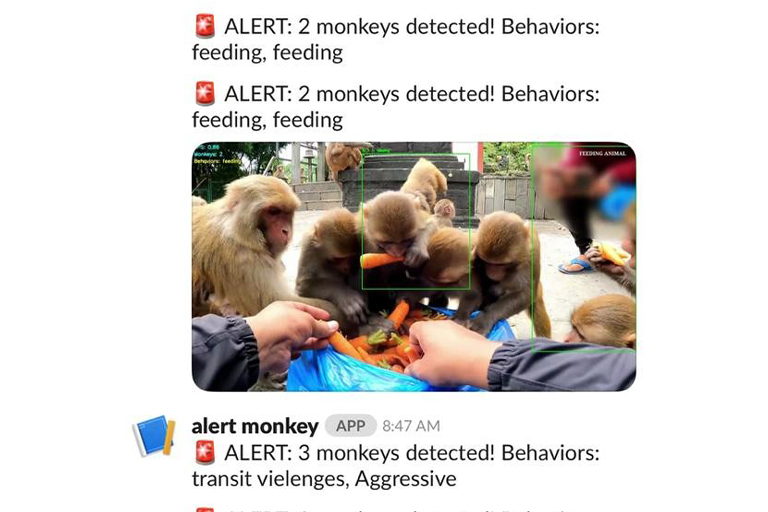
The system, built on cameras and lightweight computing devices, paired a detection model with a second layer trained to interpret behavior, allowing it to classify actions such as movement, vigilance and feeding. Trained on more than 4,000 annotated images, it achieved around 88% accuracy across 28 field sessions. “If a monkey is still watching, the farmer has time,” Thapa said. “If it is already feeding, the response has to be immediate. A machine can detect. But a human decides.”
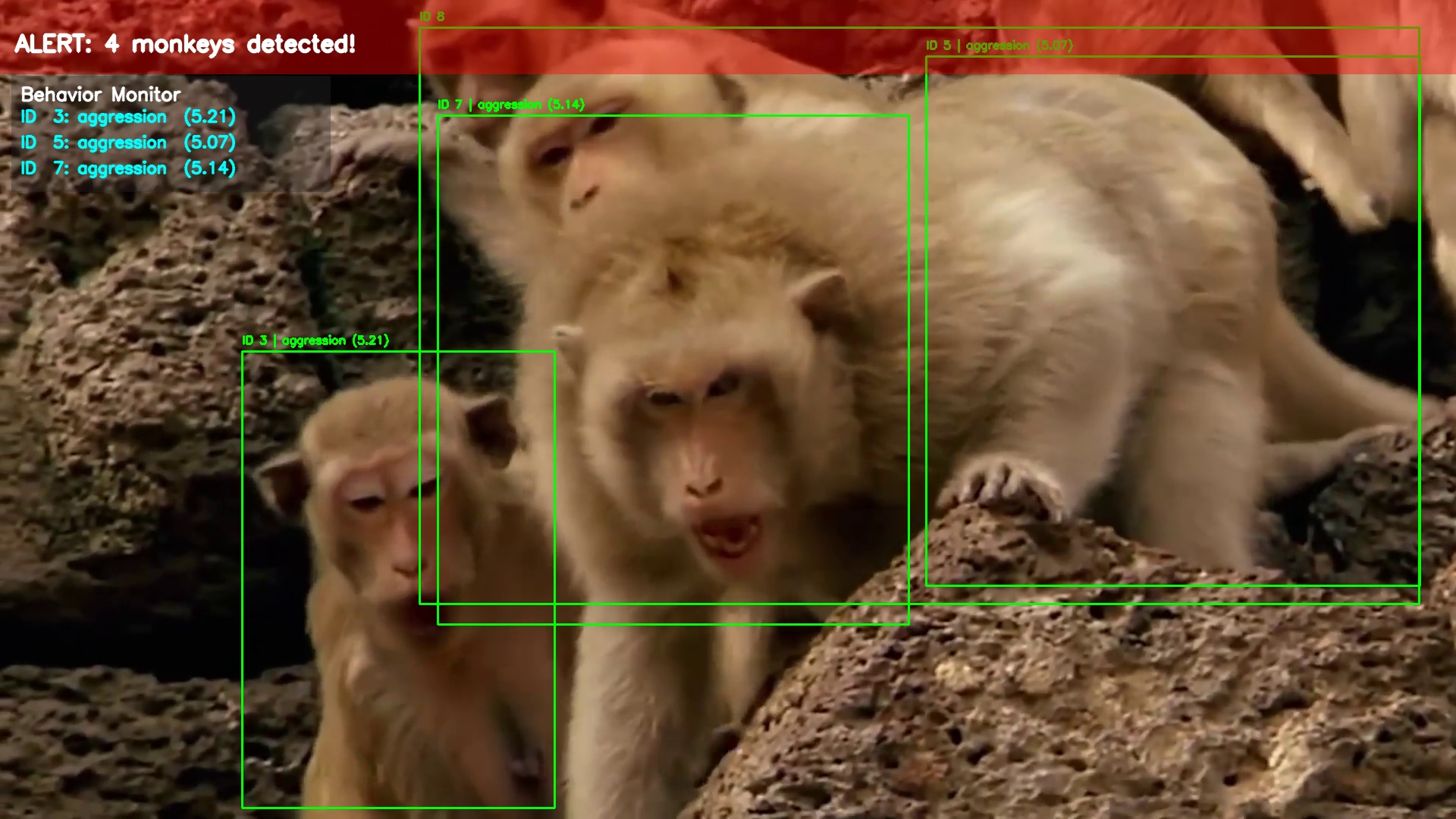

Beyond the field-accuracy figure, the underlying detection model has posted strong results: Roughly 91.7% mAP (a standard measure of detection accuracy), running at 15 to 22 frames per second on the low-cost hardware the team used. The numbers suggest the core detection technology itself is maturing quickly, even if translating that into consistent field performance remains a separate challenge.
A camera watches the field constantly, like a security camera, and a computer program checks each frame and asks, “is that a monkey?” It learned to recognize one the same way a child learns to recognize a dog by being shown thousands of photos beforehand. It also tries to guess what the monkey is doing: Watching or actively feeding. That distinction matters, since a monkey that’s just watching gives the farmer a few extra seconds, while one already eating needs an immediate response. Once the system flags a real threat, it sends an alert straight to the farmer’s phone.
At Pulchowk Campus, Institute of Engineering, Tribhuvan University, a separate group has taken a similar approach. Led by assistant professor Santosh Giri, the team has paired detection with an ultrasonic deterrent designed to repel monkeys once they are identified.
Their model was trained on a smaller dataset of fewer than 1,000 images collected from sites such as Swayambhunath and Pashupatinath in Kathmandu. While early results suggest strong detection capability, the deterrent system itself remains at a prototype stage and has yet to be tested in working farm environments.
“Agricultural environments are much more complex,” Giri said. “Lighting conditions, vegetation and partial visibility of animals can all affect performance. ”
He added that behavior poses a deeper challenge. “Rhesus macaques are highly adaptive,” he said. “Any single deterrent can lose effectiveness once animals become used to it.” To address this, his team is exploring ways to vary responses over time.
Giri’s system detects monkeys the same way, but instead of alerting a person, it fights back directly: Once a monkey is spotted, a small circuit emits a high-pitched sound above human hearing, irritating to monkeys, similar to a dog whistle, so the machine reacts instantly instead of a farmer having to run out. So far, the sound-emitting part has only been tested on a workbench, not in an actual field, so it remains unproven under real growing conditions.
Both Thapa and Giri acknowledge that translating these systems into everyday farm use has proven more difficult than early results suggested. Performance tends to drop when visibility is poor during rain, low light, or when monkeys move through dense crops or vegetation.
A 2025 systematic review of 105 studies on AI and human-wildlife conflict published in Science Progress found that while AI improved monitoring outcomes in 65% of cases, community engagement improved in only 39%, suggesting that technical performance and on-the-ground effectiveness remain distinct challenges.
Zoologist Laxman Khanal sees the core limitation clearly. “AI-based systems open new possibilities,” he said. “But if they only alert farmers, they may not be effective.”
In many villages, labor shortages already limit the ability to respond. “There are not enough people to chase monkeys,” he said. “Any system must be able to deter animals directly.”
Both Thapa and Giri said the next phase of their work is aimed directly at that gap. “In the future, AI should not just detect monkeys,” Giri said. “It should also decide how to respond.”
Experts urge caution
Naresh Subedi, a wildlife researcher, said such approaches are promising but remain uncertain. “Monkeys are highly adaptive,” he said. “If deterrents do not represent real risk, they may eventually stop responding.”
Shashank Poudel, head of wildlife programs at WWF Nepal, agreed that no single fix works alone. “A combination of methods — physical barriers, crop changes, community vigilance, and relief measures — has been more effective,” he said.
Back in Birta Deurali, this kind of caution matters more than it might in a lab. The systems Thapa and Giri are building have not yet reached villages like this one for now, guarding fields at dawn remains the only option Tamang and Lama have.
Policy gaps and uneven responses
The problem has long been recognized at the policy level, but progress has remained uneven. Conservation officer at NTNC Gobinda Prasad Pokharel said that repeated efforts, from parliamentary recommendations to government committees, have struggled to produce lasting results, often due to weak coordination and a lack of site-specific strategies. Relocation, often used as a management response, has repeatedly shifted the problem rather than resolving it.
A 2026 review of Nepal’s relief policies for wildlife-induced damage, published in Banko Janakari, found that compensation mechanisms have struggled to keep pace with the scale of conflict, with provisions unevenly applied and often inaccessible to the communities most affected.
On May 18, 2026, Nepal’s Ministry of Agriculture, Forests and Environment formed a 15-member technical task force to address human–wildlife conflict, joining the parliamentary recommendations and past committees that have previously tackled the issue. According to Shila Gyawali, under-secretary at the ministry and the member responsible for coordinating the task force, the group includes representatives from key government agencies, universities and conservation organizations, along with subject experts.
It has been tasked with reviewing existing policies, research and compensation systems, and recommending short-, medium- and long-term measures. The task force is collecting feedback from government bodies, experts and farmers, and is expected to submit its report within three months, including options to improve relief mechanisms and test pilot interventions in affected areas.
The IUCN, in its guidelines on human-wildlife conflict and coexistence, emphasizes that there is no single definitive solution, and that responses must be tailored to local ecological and social conditions — a conclusion that has repeatedly proven true in Nepal.
Back in Birta Deurali, Tamang and Lama face another season. Each morning begins with scanning the trees, listening for movement, hoping the crops survive another day. A few hundred meters away, the macaques are making the same calculations they always have, moving toward the easiest food source available.
Banner image: A rhesus macaque eats an orange in Kathmandu. Image by Rachid H via Flickr (CC BY-NC 2.0).
After Sri Lanka, Nepal debates exporting its ‘problematic’ monkeys
Most wildlife AI focuses on the ground. This model looks up in the trees
Citations
Koirala, S., Baral, S., Garber, P. A., Basnet, H., Katuwal, H. B., Gurung, S., Rai, D., Gaire, R., Sharma, B., Pun, T., & Li, M. (2022). Identifying the environmental and anthropogenic causes, distribution, and intensity of human rhesus macaque conflict in Nepal. Journal of Environmental Management, 316, 115276. doi:10.1016/j.jenvman.2022.115276
Rai, S., & Rai, R. (2024). Monkey menace in Nepal: An analysis and proposed solutions. Journal of Multidisciplinary Sciences, 6(1), 26–31. doi:10.33888/jms.2024.614
Koirala, S., Garber, P. A., Somasundaram, D., Katuwal, H. B., Ren, B., Huang, C., & Li, M. (2021). Factors affecting the crop raiding behavior of wild rhesus macaques in Nepal: Implications for wildlife management. Journal of Environmental Management, 297, 113331. doi:10.1016/j.jenvman.2021.113331
Rai, D., et al. (2026). The crop feeding behavior of rhesus macaques in a forest-farm mosaic in central Nepal: Implications for human–wildlife coexistence. American Journal of Primatology, 88, e70141. doi:10.1002/ajp.70141
Ojija, F., Ogwu, M. C., Ally, J., John, J. P., Stephano, A., Felix, N., & Tekka, R. (2025). Artificial intelligence-driven solutions for mitigating human-wildlife conflict in biodiversity hotspots. Science Progress, 108(4). doi:10.1177/00368504251394584
Giri, S., Adhikari, B., Basnet, B., K.C., B., & Subedi, R. Design and development of an AI-driven solution for rhesus macaque. Journal of Advanced College of Engineering and Management, 12, 73–87. doi:10.3126/jacem.v12i01.93908
Thapa, P. J., Lamsal, R. R., Subba, R., Gautam, B. P., & Manandhar, S. Edge. YOLO: Real-time YOLO-based monkey detection with Slack alerting for crop protection in Nepal. Madan Bhandari University of Science and Technology. https://ieeexplore.ieee.org/abstract/document/11485402
Cite this article
Praveen Kumar Yadav (2026). Monkey vs machine: Nepal tests AI to fight crop-raiding macaques. Mongabay Conservation news. DOI: https://doi.org/10.66709/news-323193Credits