- The West Asia conflict unexpectedly redirected Norway’s state-of-the-arts Fridtjof Nansen research vessel to Sri Lanka after a planned survey in Oman was disrupted.
- The month-long expedition surveyed Sri Lanka’s marine ecosystems, fish stocks biodiversity and ocean conditions using advanced acoustic and oceanographic methods.
- Scientists documented around 800 species, including about 125 that may be new records from Sri Lankan waters, along with a few species that could be new to science, pending further detailed analysis of the collected specimens.
- The survey revived a previously cancelled mission due to approval delays and offered Sri Lankan researchers some rare hands-on training aboard the United Nations-flagged research vessel.
COLOMBO – Sri Lanka’s marine research efforts have benefited in a rare instance where geopolitical unrest owing to the ongoing conflict in West Asia created an unexpected scientific opportunity.
A United Nations-flagged Norwegian research vessel Fridtjof Nansen was redirected to Sri Lankan waters after security concerns forced the cancellation of a planned survey in Oman, giving the country a second chance to conduct a long-awaited study of its marine ecosystems and fishery resources.
The Norwegian research vessel was originally scheduled to carry out a marine survey in the Sri Lankan waters last year as part of its planned scientific program. However, delays in granting national approvals meant the expedition could not proceed as intended. The vessel canceled the Sri Lanka leg of the voyage scheduled for 2025, an important opportunity lost in marine research efforts.
The Nansen Program is a long-running international marine research initiative led by the Food and Agriculture Organization FAO) of the United Nations in partnership with Norway. Established in 1975, it operates through the research vessel Dr Fridtjof Nansen, named after Norwegian explorer, scientist and humanitarian Fridtjof Nansen who won the Nobel Peace Prize in 1922 for his extraordinary humanitarian work during the First World War.

The Nansen missions survey marine ecosystems in developing countries to support sustainable fisheries management combining oceanographic research, fisheries stock assessment, and ecosystem monitoring while building scientific capacity in the participating countries through training and collaboration.
Scientists from the National Aquatic Resources Research and Development Agency NARA led the scientific work in the recent survey in close collaboration with Sri Lankan institutions, and supported by experts and crew from the Bergen-based Norway’s Institute of Marine Research (IMR) that operates the vessel and is responsible for the scientific activities and training aboard.

Surveying island’s changing seas
The recent Nansen research mission marks the fifth scientific survey conducted in the Sri Lankan waters, building on previous expeditions conducted between 1978 and 1980 and most recently in 2018. The survey followed many of the same standardized scientific methods used during earlier Nansen expeditions in Sri Lankan waters in 1978, 1980 and 2018, says Prabath Jayasinghe, a scientist at NARA who served as the co-cruise leader heading the scientific team aboard the research vessel.
Jayasinghe, who was also the leader of the 2018 expedition, said the continuity of missions allows scientists to directly compare decades of data and identify long-term changes in fish stocks and marine ecosystems. The vessel spent 32 days surveying Sri Lanka’s Exclusive Economic Zone (EEZ), gathering crucial information on fish stocks, biodiversity, pollution, and oceanographic conditions, Jayasinghe added.
Through the Nansen vessel, scientists also conduct hydro-acoustic surveys to estimate the abundance and distribution of pelagic and demersal fish stocks while also studying biodiversity, pollution, and oceanographic conditions.
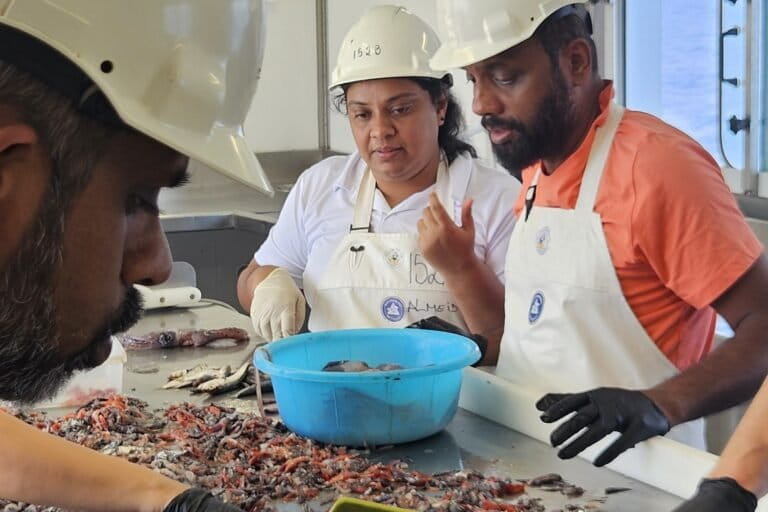
Methods such as scientific trawling, using nets to sample marine organisms from the seafloor, midwater, and the open ocean at different depths, and the use of plankton nets to collect smaller organisms have been used in the surveys. The expedition captured over 800 different species while surveying different parts of Sri Lankan waters, highlighting that Sri Lanka’s oceans have high biodiversity, Jayasinghe told Mongabay.

The collected species still require further analysis, but according to Jayasinghe, at least 125 of the species recorded during the survey are likely first-time records in the Sri Lankan waters. He added the findings are even more significant because an estimated 5-10 species could be completely new to science. The scientist added that these results highlight how little is still known about the country’s deeper marine biodiversity, highlighting the need for more research.
Previous analyses from the 2018 survey revealed some worrying trends. A comprehensive study based on the 2018 expedition documented 620 marine species from Sri Lanka’s continental shelf but also highlighted regional variations and signs of pressure on fish stocks. This time too, different variations have been found, Jayasinghe added.
Building local scientific capacity
Beyond the scientific surveys, the voyage served as a floating classroom for Sri Lankan researchers. A total of 16 scientists working on different areas had the opportunity to participate in the voyage, getting to work directly onboard, operating equipment, collecting samples, and participating in real-time analysis of fish stocks, ocean conditions, and marine biodiversity.
During the 2018 survey, 20 local scientists had the same opportunity. This time, scientists also got hands-on experience in hydro-acoustic surveys, trawling methods, oceanographic sampling, and data interpretation, skills that are difficult to build without access to a research ship of this scale, Jayasinghe told Mongabay.
Sri Lanka’s fisheries sector supports hundreds of thousands of livelihoods and contributes significantly to national food security. Yet many commercially important fish stocks remain poorly assessed. Climate change adds further uncertainty. Ocean warming, changing currents, deoxygenation, and shifting species distributions are already affecting fisheries across the Indian Ocean.
In this backdrop, updated data from expeditions like this support evidence-based fisheries management, marine conservation planning, and Sri Lanka’s international reporting obligations related to marine biodiversity and sustainable seafood exports contributes to greater understanding, says Susantha Kahawatta, director general of the Department of Fisheries and Aquatic Resources in Sri Lanka (DFAR).

Elasmobranch in Nansen survey
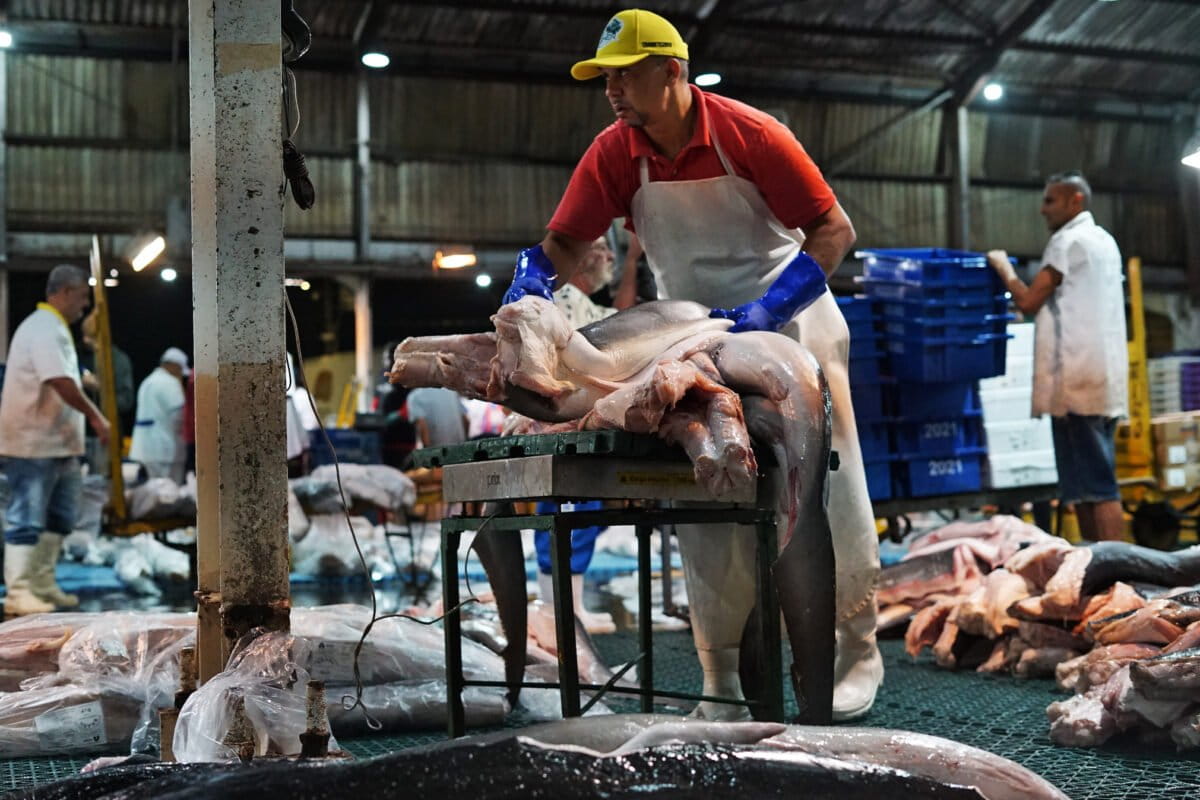
Presenting findings from the 2018 Nansen ecosystem survey in Sri Lankan waters, Thejani Balawardana, also a scientist with NARA, said the study has documented 40 elasmobranch taxa (a subclass of cartilaginous fish) including sharks and rays from 88 trawl samples collected across the continental shelf and slope.
The research showed a highly uneven species distribution, with deep water catsharks dominating catches by number, accounting for nearly 60% of total abundance. However, larger ray species such as whiprays (Maculabatis gerrardi) and stingrays (Pastinachus species) contributed to the highest biomass. Although only a few species were abundant, most of these organisms were rare and infrequently encountered, underlining the ecological significance of deep-water habitats, Balawardana said.
The study also found that elasmobranch diversity in Sri Lankan waters increased with depth, with the richest communities occurring below 300 meters (985 feet).

According to the analysis, depth and environmental conditions were the primary factors shaping species composition rather than geographic region, highlighting the importance of continued monitoring and protection of vulnerable deep-sea ecosystems in the Sri Lankan waters.
While 2026 survey results are yet to be fully analyzed, it appears to be more interesting, Balawardhana told Mongabay. These types of independent ecosystems surveys are important to study different marine habitats and depth ranges to identify ecologically important cartilaginous fish species and to support evidence-based fisheries management and conservation measures in Sri Lanka, she added.
As Sri Lanka grapples with balancing economic recovery and environmental sustainability, the knowledge gathered by the Fridtjof Nansen could shape marine policy for years to come, Jayasinghe told Mongabay. “In an era where wars more often bring destruction than opportunity, the vessel’s unexpected arrival stands as a reminder that even global crises can occasionally produce an unlikely scientific silver lining for a small island nation like ours,” he added.
Banner Image: Limited knowledge exists on the ocean’s mesopelagic zone, often called the “twilight zone.” Among species sampled from the depths of the ocean were scarlet shrimps (Acanthephyridae), lanternfish (Lampanyctus indicus), slender hatchetfish (Argyropelecus affinis), viperfish (Chauliodus pammelas), and leptocephali — the larval stage of eels and related fish species. Image courtesy of Cruising with Dr. Fridtjof Nansen Facebook page.
Credits