- Coral reefs absorb incoming waves, protecting shorelines from tropical storms.
- A recent Earth’s Future study examines flood risks from tropical storms to communities in Florida, if coral reefs keep degrading at current rates.
- The study finds that future coral reef degradation will increase the annual risk of flooding to people by 42% and to buildings by 47%.
- This increased degradation would predictably cause $412.5 million in damages to structures and economic disruption of $438.1 million annually.
Healthy reefs aren’t just about colorful fish — they also shield shorelines from intense tropical storms. If Florida’s reefs keep degrading, flooding during tropical storms could get much worse, increasing risks to people and costing nearly a billion dollars a year in damage to buildings and economic disruption annually, a new Earth’s Future study finds.
Coral reefs act as natural breakwaters, absorbing up to 97% percent of an incoming wave’s energy, with the top of the reef taking the bulk of the impact. Globally, around 200 million people benefit from this kind of natural flood protection, according to a 2014 Nature Communications study.
But around the world, coral reefs are in trouble. The most recent bleaching event, driven by record temperatures, hit more than 80% of reefs. Reefs are also battling coral diseases, pollution, microplastics, physical damage and other threats. In the Florida Keys, live coral cover has declined by about 90%, over the last 40 years, according to the U.S. National Oceanic and Atmospheric Administration (NOAA).
Degraded reefs aren’t as strong, and crumbling coral means they aren’t as able to cushion the impact of waves. As waves become more forceful, they erode sediment, deepening the seafloor closer to shore.
“Waves break relative to their water depth. … Now, all of a sudden, you make that water deeper, that means a bigger wave can come in closer to shore,” says Curt Storlazzi, a researcher at the United States Geological Survey (USGS) and the study’s first author.
In a previous study, researchers from USGS and the University of California, Santa Cruz (UCSC), looked at the flood protection value of all U.S. reefs.
In the new study, researchers zeroed-in on Florida, where high-density and high-value properties and infrastructure line the reef-fringed coast. The study finds if Florida’s coral reefs continue to degrade, the annual flood risks to people will increase by 42%, and the risk to buildings will increase by 47%. The researchers estimate the increased flooding would cause $412.5 million in damages to structures and result in at least $438.1 million in economic disruption each year.
Coral reefs protect people, property and infrastructure, says study co-author Michael Beck, director of UCSC’s Center for Coastal Climate Resilience.
“Even in a place where they’re degraded, we can quantify that [additional degradation] is going to further and significantly increase risk, and we believe that this helps highlight that there can be cost-effective solutions,” Beck tells Mongabay.
The study examined flood risk from tropical storms along the coast from now until the end of the century. First, the researchers ran coastal engineering models to look at flood risk for storms of various intensities, from low-grade tropical storms up to extreme 100- and 500-year storm events. Then they looked at what would happen if reefs continued to degrade at current rates. The modeling shows that as reefs degrade, storms would lead to flooding farther inland. Finally, they calculated the economic cost of this increased flooding, using 2010 census data.
Along 17% of Florida’s coast, damage and economic disruption could cost more than $1 million per kilometer, according to the study’s results. The researchers find that some parts of the coast stand to be more affected than others; the greatest flood risks are along low-lying coastlines protected by narrow reefs. The study also finds that economically disadvantaged communities — which are currently situated inland and out of harm’s way — would start to see more flooding if reefs continue to degrade.
The economic valuation along with granular data on which places are most vulnerable could be useful to reef managers who make decisions about conservation or restoration, Storlazzi says.

“We can say, ‘If we protect this reef, it’s going to protect those people and those buildings.’ There’s a very direct linkage,” Storlazzi tells Mongabay.
The study brings a fresh perspective, and shows how reef restoration can be framed as an opportunity to protect coastlines and infrastructure, says Melanie McField, director of the Healthy Reefs for Healthy People program at the Smithsonian’s National Museum of Natural History, who was not affiliated with the study.
“This is exactly what we need, for us to guide science, but also for the public to understand, ‘Here’s quantification of these impacts and how the reef and the degradation of a reef can affect you — even if you don’t care about biodiversity at all,’ McField tells Mongabay.
So far, much of the discussion around coastal flooding has focused on sea level rise, according to Beck. But, he says, the ramifications of reef degradation, in terms of flood risk, are a “much more significant problem than people realize.”
Both Beck and Storlazzi say their findings are likely on the “conservative” side, meaning that future coastal flooding — and the economic cost — may be even more severe than the study suggests. There could be other variables, like sea level rise or increases in storm intensity or wave energy that change flooding, Beck says. Plus, people are still building in risky areas, he adds.

Safeguarding coral reefs could be a way to assuage these impacts, the authors write. The findings also show that even degraded reefs offer coastal protection, Beck adds.
“We really have to regard these habitats as essential,” Beck says.
Reefs are already highly valued for contributions to livelihoods, with coastal protection sometimes taking a back seat, McField says.
“We don’t talk about coastal protection as much as we talk about fisheries and livelihoods and tourism,” McField says. “But every time a storm comes, every few years, when people are packing up and sheltering in place and waiting out a hurricane, then they really think about it.
“This is something we need to talk about more, not just when the hurricane is barreling towards you.”

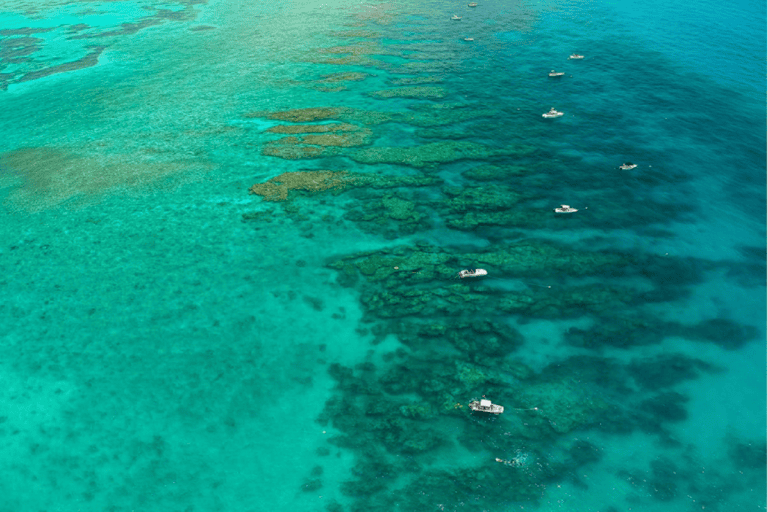
Banner image: Corals in the Florida Keys National Marine Sanctuary. Reefs in Florida and elsewhere in the world face many threats including heat waves (which causes coral bleaching), diseases like stony coral tissue loss disease, invasive species, pollution, physical damage and more. Image by National Marine Sanctuaries via Wikimedia Commons (Public domain).
Citations:
Storlazzi, C. D., Reguero, B. G., Yates, K. K., Alkins, K. C., Shope, J. B., Gaido-Lasserre, C., … Beck, M. W. (2026). Coral reef protection may help avert risks to people, property, and economic activity caused by projected reef degradation. Earth’s Future, 14(1). doi:10.1029/2025ef006255
Ferrario, F., Beck, M. W., Storlazzi, C. D., Micheli, F., Shepard, C. C., & Airoldi, L. (2014). The effectiveness of coral reefs for coastal hazard risk reduction and adaptation. Nature Communications, 5(1). doi:10.1038/ncomms4794
Reguero, B. G., Storlazzi, C. D., Gibbs, A. E., Shope, J. B., Cole, A. D., Cumming, K. A., & Beck, M. W. (2021). The value of US coral reefs for flood risk reduction. Nature Sustainability, 4(8), 688-698. doi:10.1038/s41893-021-00706-6
Credits