- The Center for International Forestry Research (CIFOR) hopes new cookstoves that require less wood than traditional varieties will slow forest loss in Cameroon.
- Mongabay visited one of the villages where CIFOR’s project is taking place to talk to people who are involved in it.
- Long-term success rates for similar projects in Africa have often been low.
- CIFOR wants to break that trend by encouraging people to adopt the new cookstoves and keep using them.
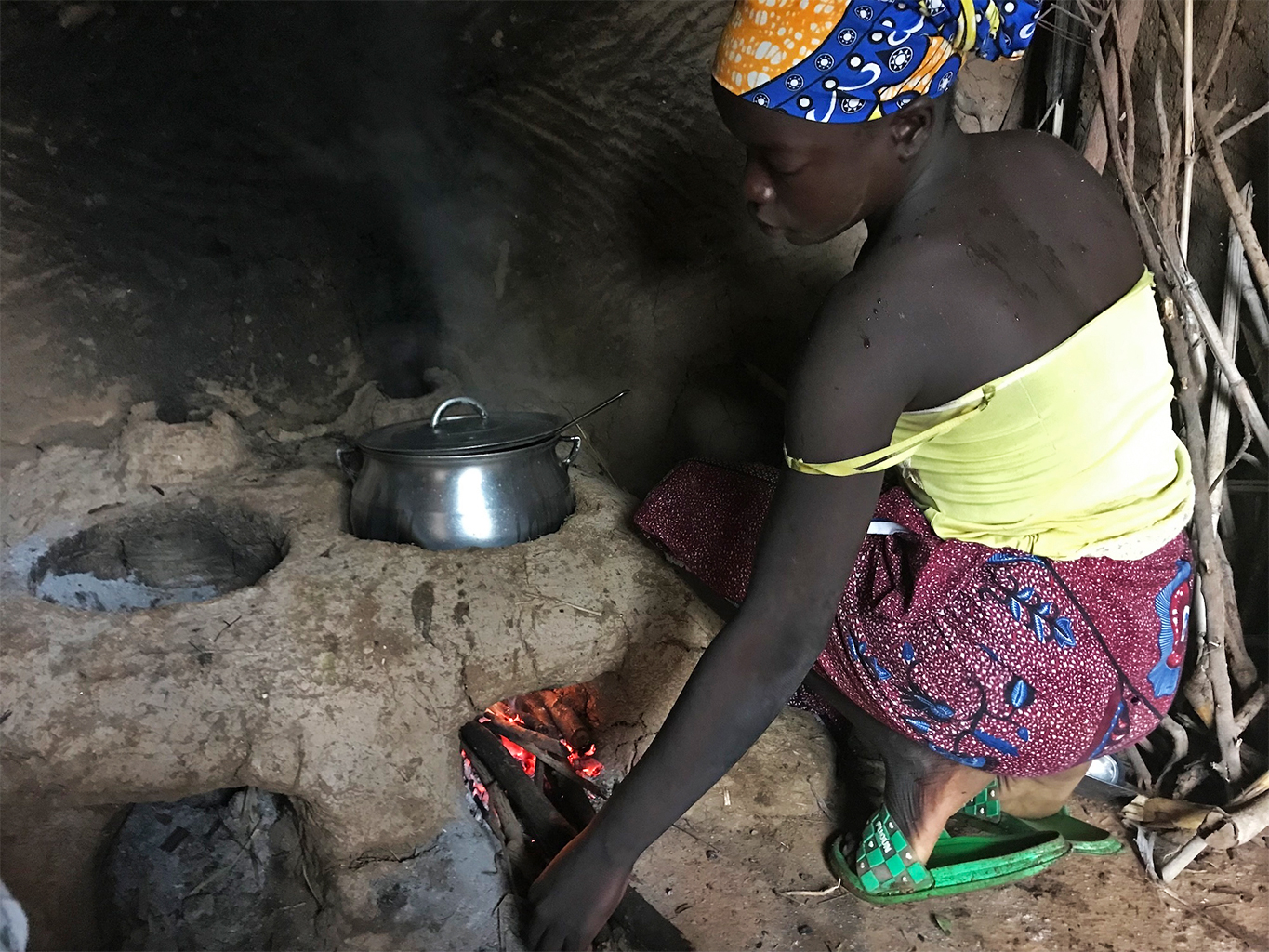
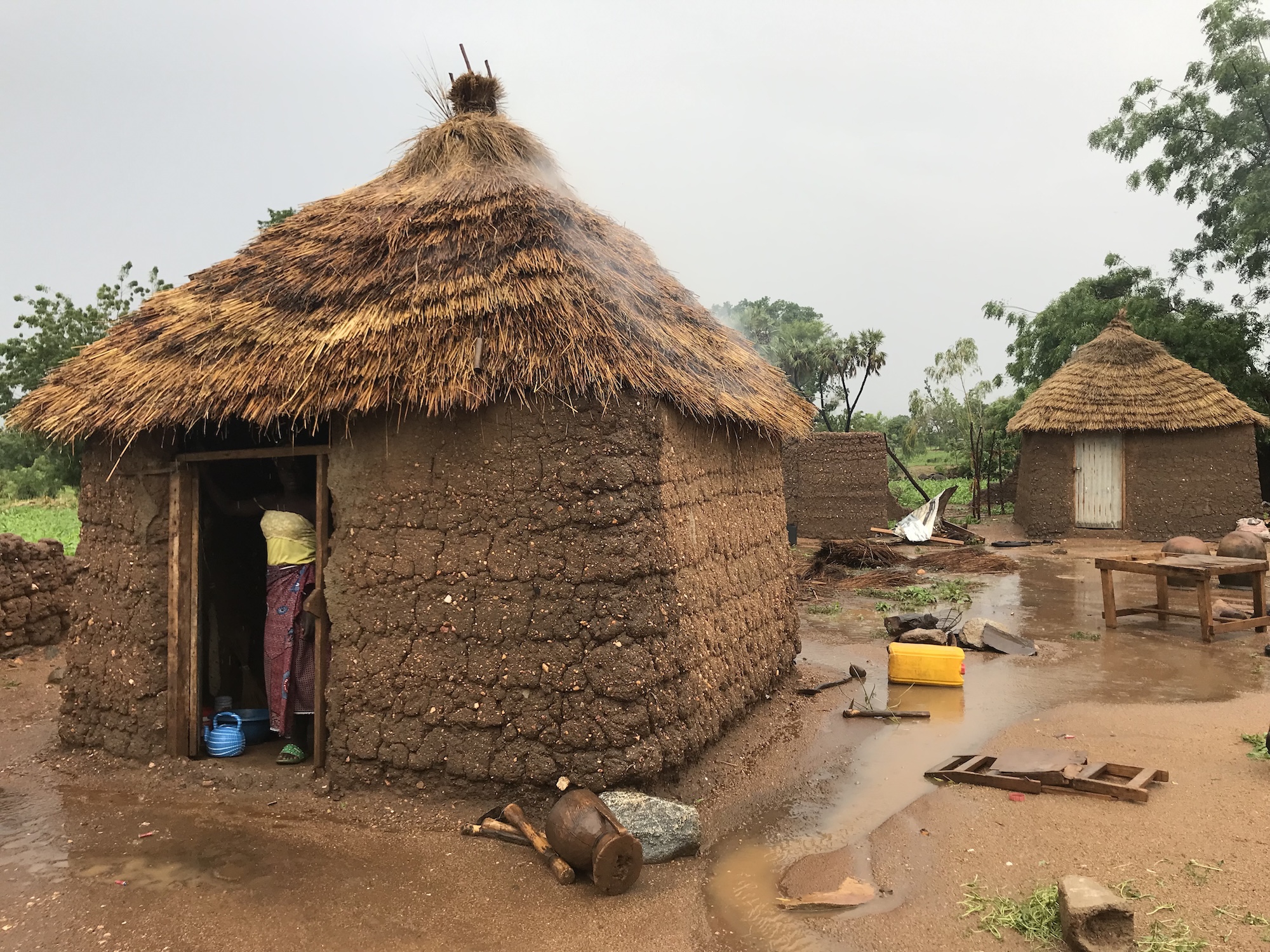
GAROUA, Cameroon — One morning during the July monsoon in Bang, a village of 3,000 in North Cameroon, people woke up to heavy rains. The Mayo Tefi, a small river which runs through the village, swelled as the water level rose. Astha Pabami, a mother of 11 in her 50s, could not go out to fetch firewood, as crossing the river would have meant being swept away. Instead, she used some of the wood stacked behind her hut, lighting a fire to prepare a meal on her new cookstove.
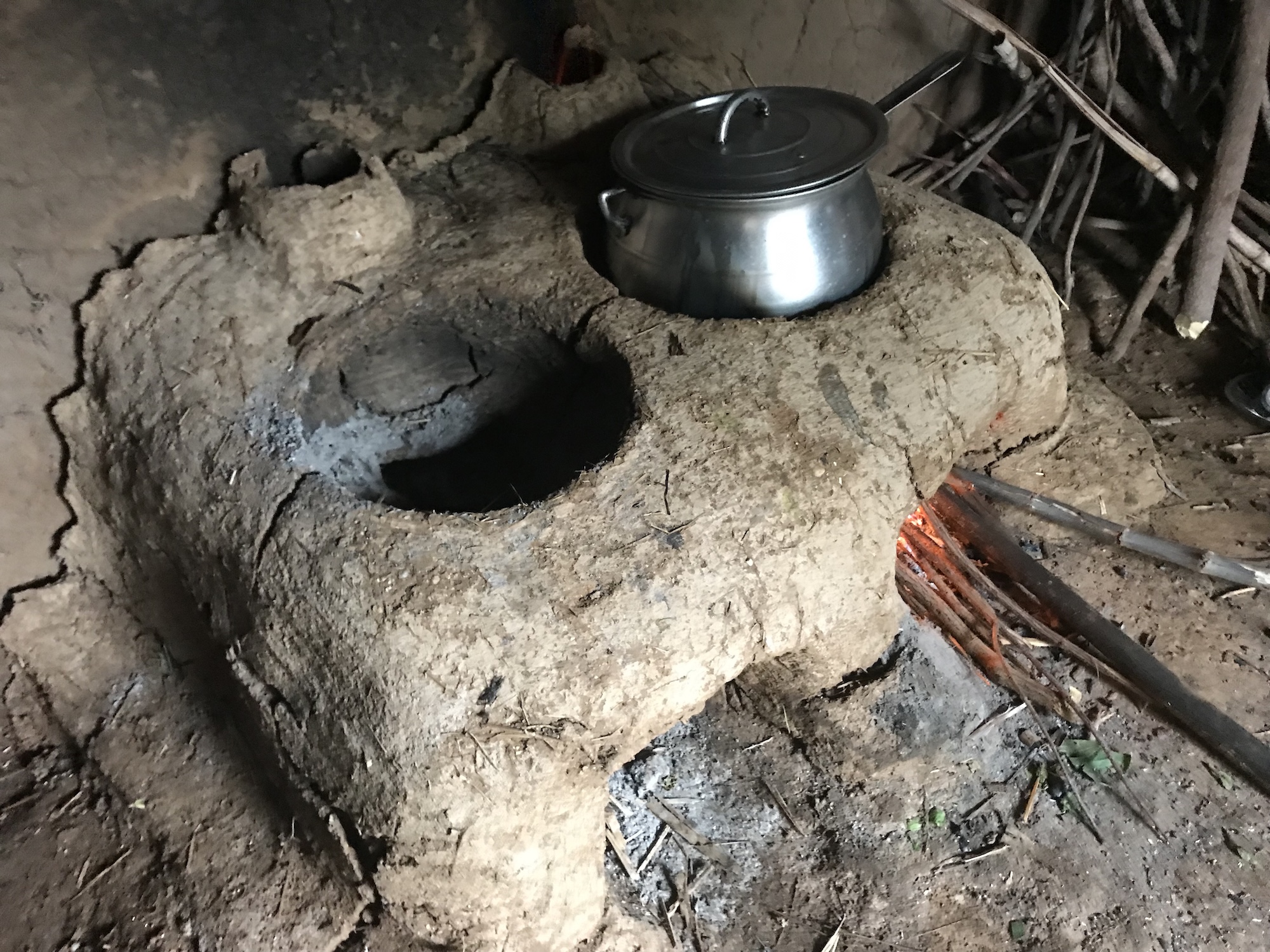
The cookstove looks like a traditional oven, with one opening for firewood and another for the pot. But it’s a big improvement over what she used to use: an open three-stone fireside.
Pabami is one of about 250 women in Bang who were using these stoves when Mongabay visited the town. They were distributed as part of a project run by the Center for International Forestry Research (CIFOR), with support from the European Union. The stoves are meant to burn cleaner and use less wood — saving forests and protecting people’s health in the process.
“The open fireside consumes more firewood and dirties our pots, and we inhale smoke. We could use about 8-10 pieces of wood to cook a meal; presently, a maximum of four pieces of wood is enough,” Pabami tells Mongabay.
Since the improved stoves need less firewood, she doesn’t have to collect as much during the dry season, and what she puts into storage behind her hut lasts longer.
“The time we spent in the past searching for firewood has lessened; we rest more and concentrate on farmwork and house chores,” Pabami says.
The community here in Bang, like others in northern Cameroon, relies on firewood to cook. But that wood comes from the forest nearby. Harvesting it can deplete the forest, making the town vulnerable to floods and high winds.
According to the World Health Organization, around 2.4 billion people depend on solid fuel like wood to cook their food. But burning it pollutes the atmosphere, emitting “black carbon,” more commonly called “soot.” But burning these fuels can damage human health and the environment. More than 3.2 million premature deaths every year are attributable to household air pollution like black carbon.
Black carbon also affects local climate patterns. The amount of time that soot particles stay in the atmosphere is short — typically only a few days — unlike carbon dioxide emissions from fossil fuel burning, which can linger for centuries or longer. Still, during the period it stays in the atmosphere, it’s the second-largest contributor to climate change.
Twenty-five percent of global black carbon emissions are caused by burning solid fuels like firewood. Improved cookstoves like the one Pabami is now using could bring what one study called “substantial” climate benefits — if they catch on.
“Improved cookstoves consume less firewood and are a relatively clean energy technology that emits low carbon into the atmosphere compared to the traditional cookstoves used by the majority Indigenous population of the North region of Cameroon,” says Julius Tata Nfor, a climatologist at the University of Dschang in Cameroon.
Improved cookstoves, protecting trees
“Every time you build an improved cookstove, you protect a tree,” says Colette Maba, a researcher with CIFOR. This is the message she shares with communities like Bang when she introduces the improved cookstoves.
Aoulasa Balandine Dipeleng, 25 years old and the youngest wife of the lawan (chief) of Bang, is one of 30 women whom CIFOR trained to promote the project. They travel to villages in the region, teaching women to build the improved cookstoves.
“We tell them the improved cookstove is a good innovation, and it is important for all of us to use it,” Dipeleng tells Mongabay.
“We search for cow dung, [soil] from the termite mound and straw. We mix and cover. After seven days, we use the mixture to build the [cookstove], which can last more than five years,” she explains.
If there are cracks that develop through everyday use, the stoves are fixed with the same mixture.
“Improved cookstoves assist in relieving strain on the trees in the community, where firewood is difficult to obtain,” Maba tells Mongabay.
Firewood harvesting is a major contributor to deforestation across Africa.
“The fight is to lower the pressure on the trees,” she says.
Dipeleng’s husband, Lawan Bahar Daway, emphasizes how the new stoves, which use less wood, have improved life for women in the village. “Women now can go to fetch wood once a week.”
The trick is to make sure the new stoves are used consistently. Offering improved cookstove techniques in communities like Bang isn’t a new idea — similar projects have been tried for decades, and the results have not met once-lofty ambitions. Despite initial excitement in towns where these projects are implemented, long-term adoption rates can be dismal.
Researchers from CIFOR told Mongabay they hope the project’s design will help it avoid that outcome. The cookstoves are made from locally available materials that don’t cost money and can be easily fixed.
“Women notice the benefits of using improved cookstoves, including cleaner pots, better cooking, less smoke and reduced wood consumption, saving time,” says Ann Degrande, Cameroon coordinator for CIFOR.
The women who build the cookstoves periodically return to check if they are working well, she adds. In total, around 1,500 were built and distributed in towns near Bang.
A ‘wood park’ in Bang village
Along with the improved cookstoves, CIFOR is also trying to help set up alternative sources for firewood in order to reduce local deforestation.
“Here in Bang, we set up a 2-hectare [5-acre] space called the “wood park.” It is a space where we accompanied the villagers to plant a lot more neem trees (Azadirachta indica), baobab (Adansonia digitata) and gonakier (Acacia nilotica) so that they act as a hedge to protect the space at the request of the community,” Maba says.
In a few years, the villagers will harvest firewood from this park.
“This allows the community to protect the other trees in the village, to reduce the pressure on the trees cut all the time to make a fire,” Maba says.
According to Maba, 1,613 trees of four different species have been planted, although she couldn’t say how much wood the plot would produce and how much of the town’s fuel demand it would satisfy.
Cameroon’s dry season has proved to be a challenge for the wood park — women in Bang who are in charge of monitoring tree survival continuously replace dead trees, and cattle have broken in to graze, damaging saplings.
But Daway hopes those that survive will help protect other forests near the village.
“If there are no trees, the wind will cause damage, blow off the roofs and bring crops like corn and millet to the ground to be soaked in water,” he says. “The temperature increases without trees. This year, the heat was unbearable. So, if we plant trees, they will help us. We sit under trees for shade.”
Banner image: A woman uses a new cookstove in the village of Bang in the North region of Cameroon. Image by Leocadia Bongben for Mongabay.
Citations:
Garland, C., Delapena, S., Prasad, R., L’Orange, C., Alexander, D., & Johnson, M. (2017). Black carbon cookstove emissions: A field assessment of 19 stove/fuel combinations. Atmospheric Environment, 169, 140-149. doi:10.1016/j.atmosenv.2017.08.040
Brakema, E. A., Van der Kleij, R. M., Vermond, D., Van Gemert, F. A., Kirenga, B., & Chavannes, N. H. (2020). Let’s stop dumping cookstoves in local communities. It’s time to get implementation right. NPJ Prim Care Respir Med. Retrieved from https://pmc.ncbi.nlm.nih.gov/articles/PMC6954235/
Credits