


- Australia’s recent land use change has steadily reduced and degraded native vegetation, shrinking the amount of intact habitat available to wildlife and weakening ecosystem resilience.
- Clearing has been concentrated in productive regions, especially along the eastern seaboard and parts of the north, where agriculture, development, and resource extraction continue to reshape landscapes.
- The biodiversity impacts are not only about area lost: fragmentation breaks habitats into smaller, drier, more isolated patches, making populations more vulnerable to fire, heat, invasive species, and local collapse.
- Conservation tools like protected areas and restoration help, but they struggle to keep pace when habitat loss continues through thousands of incremental decisions across overlapping state and federal systems.
Mongabay recently launched the Australian Biodiversity Special Reporting Project, which will produce sustained, high-quality journalism on Australia’s unique wildlife, ecosystems, and the threats they face—including habitat destruction, invasive species, climate change, and extractive industries. Journalists interested in being involved can learn more via Mongabay.org.
Australia likes to think of itself as a country with space to spare. On maps it is a continent with most of its people pressed into a thin coastal rim, leaving a vast interior that looks empty. Ecologically, that impression is misleading. Much of Australia’s biodiversity is concentrated in habitats that sit close to where people farm, build, log, and dig. Over the past 20–30 years, land use change has continued to reshape those places. The result has been a slow narrowing of options for wildlife, even in a nation that prides itself on its natural heritage.
The basic story is not complicated. Native vegetation is cleared or degraded. Habitat becomes smaller, more fragmented, and less resilient. Populations thin out. Some disappear. Australia’s national environment reporting treats habitat loss and modification as one of the major pressures on biodiversity, alongside invasive species and climate change.
A continent of fragments
Australia has already lost a meaningful share of its native vegetation since European settlement, and the long-run trend is still reflected in modern landscapes. The 2021 State of the Environment report notes that native vegetation has been replaced across large areas by agriculture, cities, and infrastructure, with some vegetation groups losing a substantial portion of their original extent. That matters because Australia’s ecological communities are often locally distinctive. Losing a particular woodland type is not like losing one patch of generic forest. It can mean losing the only place a species can live.

In recent decades, clearing has not been evenly spread. It has tended to be concentrated in the more productive parts of the continent: the eastern woodlands and forests, northern savannas, and agricultural frontiers where pasture expansion still offers an economic return. The damage is therefore geographically targeted, even if the numbers are national.
Queensland’s arithmetic
Queensland sits at the center of Australia’s contemporary clearing debate for a simple reason: scale. Its monitoring program, the Statewide Landcover and Trees Study (SLATS), tracks woody vegetation change and reports substantial clearing in recent years, much of it associated with pasture development. The state’s own reporting shows that in 2021–22 alone, more than 230,000 hectares of threatened fauna habitat and more than 217,000 hectares of threatened flora habitat were cleared.

Those are not abstract hectares. They are places where threatened species are considered likely to occur. They include habitat for animals that need mature trees, connected canopies, or specific food plants. And they include regrowth that has become ecologically meaningful again. A common defense of clearing is that it involves “regrowth” rather than intact forest. But regrowth can still function as habitat, especially in landscapes where very little intact vegetation remains.
Queensland is not unique. It is simply the clearest case.
New South Wales and the creep of permanence
New South Wales illustrates a different pattern: clearing that is smaller in area than Queensland’s, but often more politically visible because it occurs in heavily settled landscapes. NSW State of the Environment reporting shows changes in clearing rates over time, with clearing driven largely by agriculture and land management decisions. In such places, the ecological cost of losing a patch can be disproportionate. When habitat is already fragmented, each additional loss breaks up corridors, isolates populations, and increases edge effects.
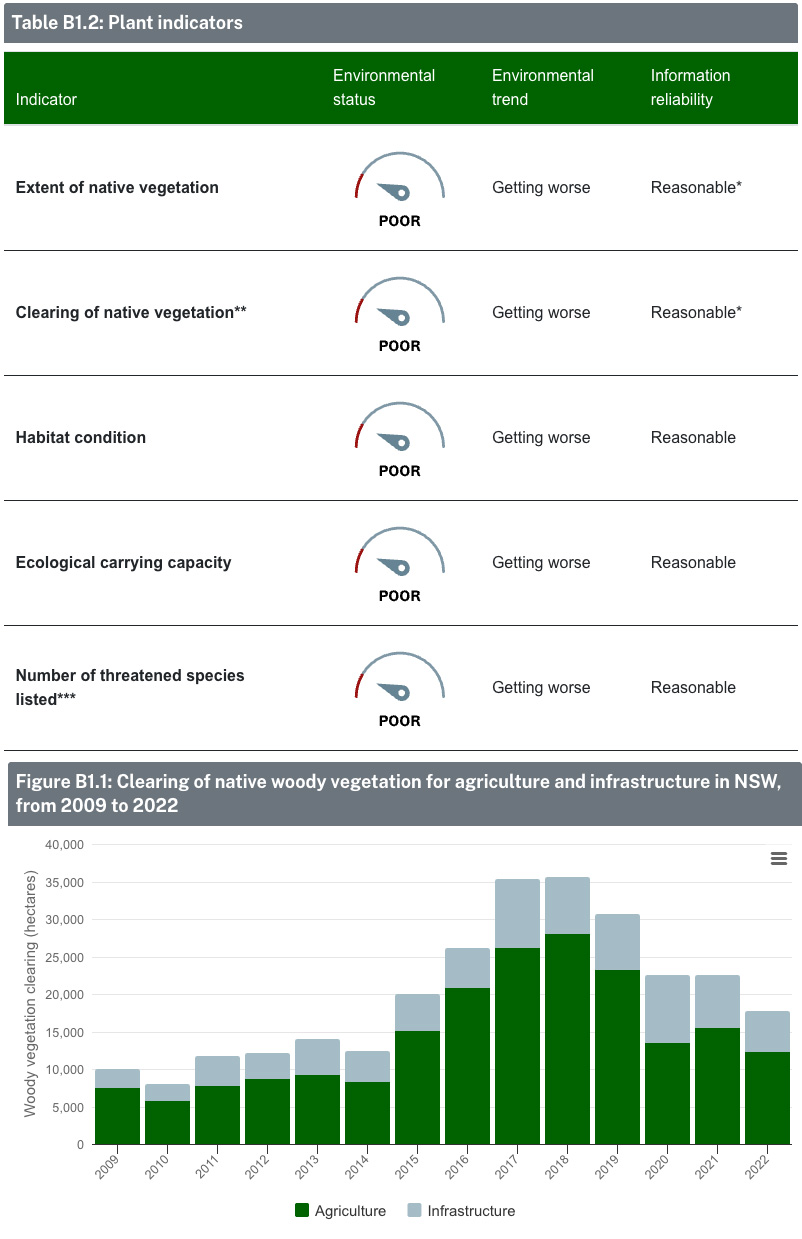
That is one reason biodiversity decline can feel incremental until it suddenly does not. A species can persist in a landscape for years while its living space is gradually chipped away. Then it crosses a threshold. Breeding fails. Fire hits the wrong season. A heatwave lands on an already stressed population. What looked stable turns out to have been fragile.
The koala as a case study
Koalas are often treated as a symbol of Australia’s biodiversity, partly because they are familiar and partly because they have become an index of broader habitat pressure on the east coast. Recent analysis reported that nearly two million hectares of koala habitat were cleared across Queensland and New South Wales between 2012 and 2021, and that most of the clearing occurred without federal assessment under national environment law.

The point is not only that koalas are losing trees. It is that the regulatory system can struggle to see habitat loss as a cumulative national problem when it is delivered as thousands of local decisions.
Why “fragmentation” is not a technicality
Habitat loss is often described as a matter of area. In practice, configuration matters almost as much. Clearing rarely removes a landscape in one neat block. It cuts it into pieces. Roads and fences carve up movement pathways. Small remnants become hotter and drier at their edges. Invasive weeds and feral predators move more easily through disturbed areas. Even where vegetation remains, it may no longer function as habitat in the way it once did.
Australia’s national reporting emphasizes that the condition of biodiversity is deteriorating in many places and that habitat loss and modification remain central pressures. This interacts with climate change in unhelpful ways. A connected landscape gives species room to move when rainfall patterns shift or temperatures rise. A fragmented one does not.
Logging, fire, and the argument about “use”
Land use change is not only about bulldozers turning woodland into pasture. It also includes ongoing extraction from native forests. Native forest logging has been politically contentious for decades, partly because it sits at the intersection of regional employment, carbon storage, water catchments, and habitat. Peer-reviewed research has documented the effects of forest degradation and fragmentation on biodiversity and ecosystem function, and has argued that some logging regimes increase fire risk by altering forest structure and fuel loads.

After the 2019–20 “Black Summer” fires, the interaction between land management and fire became harder to ignore. Climate conditions set the stage. Land management can shape what happens next.
A policy system built for arguments, not outcomes
Australia’s environmental governance is split across jurisdictions. States control much of the day-to-day regulation of land clearing. The federal government oversees matters of national environmental significance. In practice, this division can create gaps. The 2021 State of the Environment report notes that substantial habitat loss has occurred without referral under national law, even when threatened species habitat is affected.
That does not mean regulation is absent. It means it can be inconsistent, hard to enforce, and poorly suited to cumulative pressures. Clearing can be legal, yet still ecologically damaging. Offsets can be approved, yet still fail to replace what was lost in the time frame that matters for a species.
What conservation can realistically do
The conservation response is often framed as a choice between protection and development. In reality, it is a question of priorities and design. Expanding protected areas helps, especially when it protects intact habitat and climate refuges. Restoration can reconnect fragments, but it is slow work and rarely recreates old ecosystems quickly. Incentives for private land stewardship can be effective when they pay for long-term outcomes rather than short-term compliance.
None of these measures works well if clearing continues at a pace that outstrips repair. Australia’s national reporting suggests that the trajectory for biodiversity remains negative in many regions.

The country still has extraordinary nature. It also has a modern economy that depends on land and resources. Over the past 20–30 years, the contest between those two facts has mostly been managed through compromise and postponement. The hard part is that biodiversity does not negotiate. It responds to what is left on the ground.
Mongabay recently launched the Australian Biodiversity Special Reporting Project, which will produce sustained, high-quality journalism on Australia’s unique wildlife, ecosystems, and the threats they face—including habitat destruction, invasive species, climate change, and extractive industries. Journalists interested in being involved can learn more via Mongabay.org.
Header image: Mareeba rock-wallaby (Petrogale mareeba). Photo by Rhett Ayers Butler
Cite this article
Rhett Ayers Butler (2026). Australia’s land-use squeeze. Mongabay Conservation news. DOI: https://doi.org/10.66709/news-313300Credits


