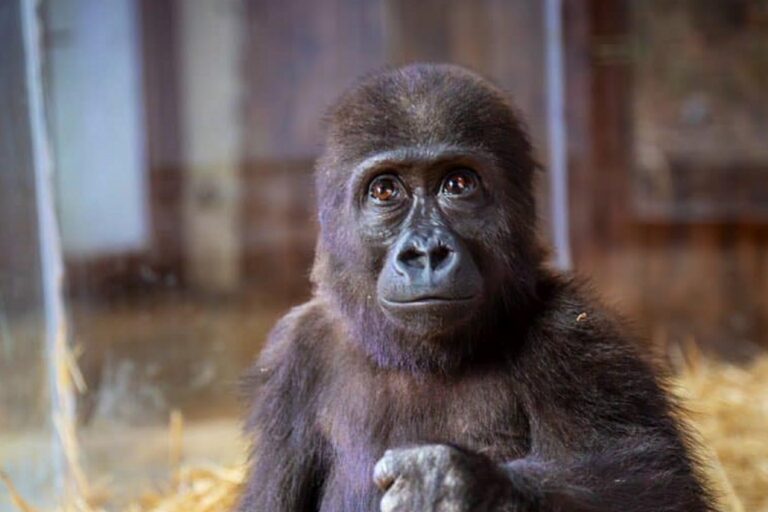
- As many as 35 critically endangered Tapanuli orangutans — 4% of the species’ total population — may have been wiped out in the catastrophic floods and landslides that struck the Indonesian island of Sumatra recently, scientists warn, after the discovery of a carcass.
- Satellite and field evidence show massive destruction of the western block of the Batang Toru ecosystem, with thousands of hectares of steep forest slopes destroyed — an “extinction-level disturbance” for the world’s rarest great ape.
- Conservationists have lost contact with monitored orangutans in the disaster zone, raising fears more individuals were killed or displaced as feeding areas and valleys were obliterated.
- The tragedy has renewed calls to safeguard the Batang Toru ecosystem by halting industrial projects and granting it stronger protection, as climate-driven disasters escalate across Sumatra.
JAKARTA — A Tapanuli orangutan, the world’s rarest great ape, has been discovered dead in mud and log debris in a village in northern Sumatra — a grim sign of how severely recent floods and landslides may have devastated the species’ fragile habitat.
A group of scientists has described the catastrophe as an “extinction-level disturbance” for the apes.
Humanitarian workers found the body on Dec. 3, a week after cyclone-driven storms triggered destructive floods and landslides across Sumatra, according to Panut Hadisiswoyo, founder of the Orangutan Information Centre (OIC). The carcass reportedly had the flesh torn from its face and that its condition was consistent with having been swept away by the cascading debris.
“It shows that the habitat has been impacted, and likely some individuals were swept away by landslides or floods. That is entirely possible,” Panut told Mongabay.
He said the landslide struck the western side of the Batang Toru ecosystem, a biodiversity stronghold that hosts one of three known Tapanuli orangutan (Pongo tapanuliensis) populations, as well as other vanishingly rare species such as the Sumatran tiger (Panthera tigris sumatrae) and Malayan tapir (Tapirus indicus).
“With the size of the western block being around 50,000-60,000 hectares [about 124,000-148,000 acres], it is very plausible that parts of the habitat collapsed, dragging orangutans along with it,” Panut said.
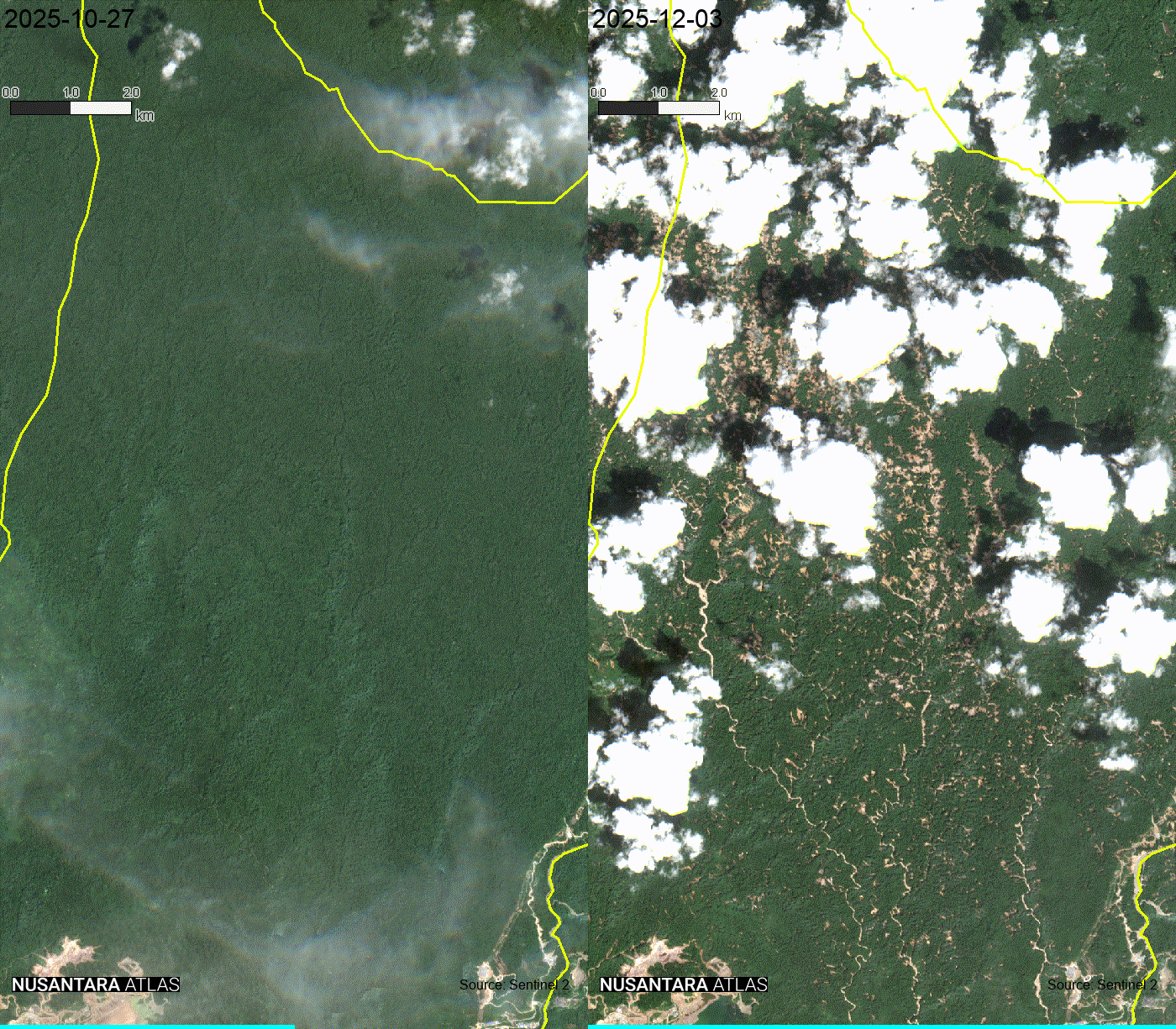
A spatial analysis by Erik Meijaard, managing director of Borneo Futures and one of the scientists who first described the Tapanuli orangutan as a new-to-science species, estimates that 4,800-7,200 hectares (11,900-17,800 acres) of forest on the mountain slopes in the western block — home to roughly 35 orangutans — appear to have been destroyed by the landslides.
Based on the scale of visible damage, “it wouldn’t surprise us if they are all dead,” Meijaard told the BBC.
Remote-sensing expert David Gaveau, founder of conservation tech startup TheTreeMap, said he was stunned by the before-and-after satellite images.
“I have never seen anything like this before during my 20 years of monitoring deforestation in Indonesia with satellites,” he told AFP.
Major blow
When the Tapanuli orangutan was first described by scientists in 2017, it was already the world’s most threatened great ape. With its frizzy cinnamon hair and wide face, the Tapanuli represents the oldest surviving orangutan lineage — descendants of the first ancestral apes that arrived in Sumatra more than 3 million years ago.
Over the last three generations, its population has fallen by an estimated 83%, driven by human-wildlife conflict, hunting, and habitat loss from agriculture and industrial projects, including a gold mine and a proposed hydropower dam. Today, only about 577-760 individuals remain in a patchwork of shrinking forest fragments in Indonesia’s North Sumatra province.
The potential death of all 35 individuals living along the landslide-hit western slopes would represent more than 4% of the total population — “a major blow,” Meijaard said.
Even small losses carry heavy consequences. Removing just 1% of the population a year would ultimately end in extinction, because orangutans only reproduce every six to nine years, Panut said.

Where are the apes?
Beyond the confirmed fatality, conservationists are increasingly worried about other Tapanuli orangutans whose home ranges lie near the disaster zone.
None of the 10 individual orangutans that OIC routinely monitors in the forest corridor linking the Sibualbuali nature reserve with the western Batang Toru block have been seen since the disaster.
“After the recent severe flood, what we noticed is this: we used to see orangutans next to the riverbank, we could also see siamangs, gibbons, civets or hornbills,” said OIC ranger Amran Siagian, as quoted by Reuters. “Now, after the disaster, whenever we walk, we don’t see them anymore.”
Panut said he hopes the animals have moved out of the affected area.
“We haven’t seen the individuals we regularly track. They may have moved to safer places, especially if their feeding areas were hit by landslides. They may have migrated elsewhere — that is entirely possible,” he said.
But their prolonged absence raises concern.
Serge Wich, a professor of primate biology at Liverpool John Moores University in the U.K. and another of the scientists who first described the species, noted that orangutans often respond to heavy rain by sheltering in trees until the storm passes.
“But this time, by the time the rain stopped it was too late: parts of their habitat — the slopes of valleys — were wiped out by landslides, which means there must have been consequences for them,” he said.
The orangutan is not the only wildlife casualty of the recent flooding and landslides.
Last week, images of a dead Sumatran elephant (Elephas maximus sumatranus) swept away by floods in Aceh province also went viral — another reminder that the island’s threatened species are exposed to escalating climate-driven disasters.
As of Dec. 12, the orangutan carcass remains where it was found, Panut said.
“We haven’t been able to go there for retrieval yet. Ideally, the remains should be recovered because the Tapanuli orangutan is a protected species, and the carcass has scientific value for further study. Hair samples, bones, the skull — all of that could be useful,” he said.
Retrieving the body would also help determine the exact cause of death, he added.

Wake-up call
Panut said the orangutan’s death should serve as a warning to the government to safeguard the Batang Toru ecosystem, which is under pressure from industrial development, including a hydropower plant and a gold mine.
Both operations have been temporarily halted by the environment ministry pending post-disaster reviews, with officials saying they had “contributed significantly to the pressure on the environment.”
Panut said the temporary suspension falls far short of what’s needed.
The government, he said, must designate Batang Toru as a strategic landscape under the national zoning plan to block future industrial activity that threatens both the orangutans and local human communities.
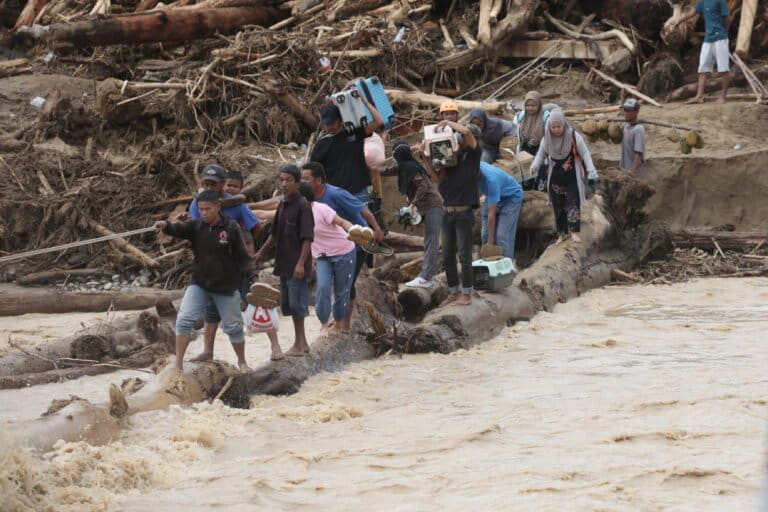
The storms that caused the landslides also killed nearly 1,000 people across Sumatra, underscoring the scale of the tragedy.
“With this disaster, the survival of both the species and the people in three districts requires national intervention,” Panut said. “If the government doesn’t take this seriously, disasters will continue to take lives, displace communities, and cause massive losses.”
Banner image: A mother and infant Tapanuli orangutan were directly sighted in the Lumut Maju peat swamp forest in North Sumatra. Image by Junaidi Hanafiah/Mongabay-Indonesia.
FEEDBACK: Use this form to send a message to the author of this post. If you want to post a public comment, you can do that at the bottom of the page.
Credits