- In April, Albanian authorities allowed bulldozers to tear through the protected Vjosa-Narta delta — home to flamingos, loggerhead sea turtles and the endangered Mediterranean monk seal — without permits or environmental review, sparking mass protests that have shaken the government of Prime Minister Edi Rama.
- The construction is linked to a luxury resort backed by Jared Kushner’s Affinity Partners, targeting one of the last intact river-delta wildernesses in the Mediterranean, where only 4% of deltas remain undisturbed.
- As Albania’s anti-corruption authority investigates and the EU warns the development could jeopardize the country’s 2030 membership bid, conservationists say the crisis exposes a pattern of broken promises around the celebrated Vjosa Wild River National Park.
VJOSA-NARTA, Albania — In late April, heavy machinery began moving into the Pishë Poro-Narta protected landscape on Albania’s Adriatic coast without permits or public notice. Bulldozers and excavators felled coastal pine trees, flattened sand dunes, and cut new roads through previously untouched habitat. Then, barbed wire fences went up along the shoreline.
The incursion was the realization of a luxury resort development backed by Jared Kushner, U.S. President Donald Trump’s son-in-law. The development plans of Kushner’s Affinity Partners, a private equity fund, stretch from the uninhabited Sazan Island into the Vjosa-Narta Protected Landscape, the delta region of Albania’s Vjosa River that includes Pishë Poro-Narta.
Roughly twice the size of Paris, the Vjosa-Narta area shelters flamingos, Dalmatian pelicans (Pelecanus crispus), loggerhead sea turtles (Caretta caretta) and more than 70 endangered species, among them the Mediterranean monk seal (Monachus monachus).
Neither Affinity Partners nor the office of the prime minister of Albania responded to Mongabay’s requests for comment.
Aerial drone video of demonstrators gathering at Dalan Beach on June 6 for a rally near the site of the original resort-construction site. Footage by Stefan Lovgren for Mongabay.
When protesters arrived at the site, security guards confronted them. Video of a demonstrator being dragged across the dunes on May 30 near the village of Zvërnec went viral. Soon demonstrations erupted in Tirana, the Albanian capital, in what has since been dubbed the Flamingo Revolution. The protests have grown larger every day, with tens of thousands demanding accountability for corruption, an end to environmental abuses, and the resignation of Edi Rama, Albania’s prime minister.
On June 6, hundreds of demonstrators made their way to Dalan Beach for a symbolic rally near the site of the original incursion. The barbed wire fences had been taken down a few days earlier and the machinery was gone. But no one there believed the battle was done.

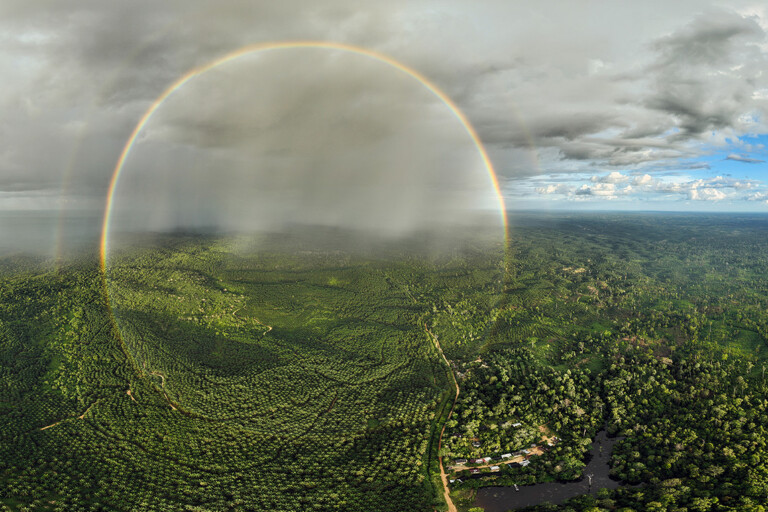
Vjosa-Narta is one of the last intact delta wildernesses in the Mediterranean. Only 4% of the region’s deltas remain in a relatively undisturbed state, and this is the largest and most biodiverse. More than 2,300 species have been documented across a mosaic of lagoons, reed beds, salt flats and coastal dunes that formed over millennia.
“I call it the place where I go to meet the gods,” Hanais Mhilli, a 36-year-old baker and part-time hiking guide living in Vlorë, a city south of the delta, told Mongabay as he joined other protesters there who were boarding a bus to the beach.
At the heart of the delta lies the Narta Lagoon, a vast, shallow body of brackish water stretching more than 40 square kilometers (15.4 square miles) where the Vjosa River meets the Adriatic Sea. It hosts more than 20,000 wintering waterbirds and ranks among the most important wetlands on the Adriatic Flyway, the migration corridor along which millions of birds travel each year between Africa and Europe.
“Here we are not just fighting for Albania’s natural heritage, we are fighting for the natural heritage” everywhere, Aleksandër Trajçe, executive director of the Protection and Preservation of Natural Environment in Albania, told Mongabay. “Italy and Spain have destroyed miles and miles of coastline and now they’re trying to restore what they lost. Albania doesn’t have to make the same mistakes.”

A biosphere reserve
For more than a decade, the Vjosa River — flowing from the Pindus Mountains in Greece through southern Albania to the Adriatic Sea — was at the center of one of Europe’s fiercest conservation battles. Though dammed near its headwaters in Greece, it runs entirely free through Albania, its channels shifting and braiding across gravel beds in patterns that once characterized rivers throughout Europe.
When the river faced a cascade of proposed hydropower projects, campaigners organized and won a landmark victory in 2023 as the Vjosa became Europe’s first Wild River National Park, pioneering a conservation model in which the river itself, not just the surrounding land, is protected from development.

But the delta was left out. Campaigners feared that pushing to include it would jeopardize the entire agreement, and it remained under a weaker designation, the Vjosa-Narta Protected Landscape. Where the national park carries the strictest level of protection under international conservation standards, the protected landscape category permits limited development and human use.
Warning signs quickly stacked up. Maps had already been redrawn to accommodate a new international airport near the lagoon. Then, in early 2024, the Rama government amended the law on protected areas to allow construction of what it vaguely describes as high-end tourism projects, even inside protected zones. Three weeks later, Kushner’s Affinity Partners announced its plans.
“The delta was intentionally left out of the national park,” Trajçe said. “It was part of a political agenda.”
Albania hopes to join the European Union by 2030, a goal that requires closing the environment chapter of accession negotiations. This in turn requires repealing the very amendment that created the high-end tourism exception.
What Trajçe and other conservationists see unfolding now is a race against that deadline. “It’s a rush for development before they change the law,” he said. “It defies the whole purpose of a protected area.”

In September 2025, the delta received an additional layer of protection when it was included in the newly designated Vjosa Valley UNESCO Biosphere Reserve, a status the EU had supported as part of Albania’s accession process. But in January, Ivanka Trump, Kushner’s wife, visited Albania with architects and met with Rama, a trip widely interpreted as a signal that the Kushner project was moving toward construction.
Rama has made his position clear. Speaking on the sidelines of the EU-Western Balkans Summit in Montenegro on June 5, he dismissed the international attention the project has drawn. “If it wasn’t Jared, they wouldn’t give a shit,” he told Politico.
From source to sea
Conservationists say the Albanian government has also failed to honor its legal obligations under the management plan for the wild river national park. While the park has delivered important results — most of all, stopping the dam projects — violations have mounted.
Large quantities of water have been diverted from the Shushicë River, a major tributary within the national park, for irrigation, in direct violation of the plan, with further plans to pipe its water to the coast for tourism development. Crude oil has spilled into the Vjosa near the town of Poçem, where 150 active oil wells line the river’s middle stretch.

Ulrich Eichelmann, a German conservationist who heads the Vienna-based NGO RiverWatch and was a key driver behind the park’s establishment, said the government has treated the designation primarily as a marketing tool. Almost none of the activities required under the management plan have been implemented, he told Mongabay. “All they focus on is getting more tourists into the area,” Eichelmann said. “Three years after the national park was created, the river system is in a worse state than before.”
The threat to the delta is part of a broader global crisis. Deltas are among the most biologically productive ecosystems on earth, the place where freshwater and saltwater mix to create conditions of great fertility. But many deltas have been relentlessly exploited, drained for agriculture and built over for ports and other infrastructure. A 2024 assessment of all 258 river deltas discharging into the Mediterranean found that no large delta — except those in Albania — still qualifies as relatively intact.
“The delta is an integral part of the wild river,” Besjana Guri, founder of LUMI and winner of a 2025 Goldman Environmental Prize for her work to protect the Vjosa River, told Mongabay. “Ecologically, you cannot divide them.”

Euro leverage
The Flamingo Revolution shows no sign of losing momentum. The demonstrations have remained largely peaceful, drawing people of all ages — young couples, parents with children, elderly Albanians who lived through decades of communist rule — united by something that has rarely mobilized this society before.
The movement has also attracted the attention of Albania’s anti-corruption authority. SPAK, the independent prosecutorial body that has pursued high-profile corruption cases since its establishment in 2019, has opened a formal investigation into the project, examining not only environmental violations but reportedly extending into questions of land ownership changes and government decisions made in 2024 that cleared the way for development in the protected area.
The EU’s position has sharpened significantly, too. The European Commission has publicly and repeatedly warned Albania that it must terminate the strategic investments law that gives favored projects fast-track treatment, bypassing environmental safeguards. Failure to do so, the commission made clear, could put Albania’s path to EU membership at risk.
“Can the EU really allow Albania to destroy this unique ecosystem on the last stretch before it becomes a member state?” asked Eichelmann before heading out to join other demonstrators on the ninth day of protests in Tirana. “I don’t think so.”
Banner image: A flock of flamingos wades in the Narta Lagoon, an important wintering site for the species. Image by Stefan Lovgren for Mongabay.
Citations
Miho, A., Bego, F., & Beqiraj, S. (2023). Overview of the Vjosa Delta (Pishe Poro – Narta Landscape Protected Area) – Natural Values and Threats. Albanian Journal of Natural and Technical Sciences, 59(XXVIII), 43–68.
Schwarz, U. (2024). Mediterranean Deltas: Assessment of General Intactness Based on Hydromorphological Criteria and Land Use Obstruction. EuroNatur & Riverwatch, Radolfzell/Vienna.
Schwarz, U. (2025). The State of Balkan Rivers 2025: Hydromorphological Assessment and 13-Year Trends. EuroNatur & Riverwatch, Radolfzell/Vienna.
Feedback: Use this form to send a message to the editor of this post. If you want to post a public comment, you can do that at the bottom of the page.
Credits