- A survey of mining records found dozens of requests for copper, manganese and nickel targeting land reform settlements in northern Brazil’s Carajás region in the last five years.
- The rush for critical minerals is creating potential “sacrifice zones” of contaminated waterways and declining fish populations in the Amazonian settlements.
- These minerals are vital for cars, batteries and war industries, linking increasing global demand to local Amazon conflicts and poverty, despite a local tax boost.
Leia em português.
PARAUAPEBAS, Brazil — On a dirt road that cuts through the Rio Novo settlement in the southeast of Pará state, battered motorcycles carry small loads of organic food to sell in the city, while passing trucks loaded with minerals for export.
Parauapebas, Brazil’s so-called “mining capital,” hosts numerous rural worker communities, including the 5,000 families of Terra e Liberdade, the largest landless encampment in Brazil. The city is also home to the largest open-pit iron ore mine in the world, in addition to other valuable deposits.
The scene of historical land conflicts, such as the Eldorado dos Carajás massacre, in which 21 people died after being shot by military police during a protest in 1996, southeastern Pará is now witnessing a new front of dispute.
Driven by the energy transition, mining companies are eyeing land in already established agrarian reform settlements, seeking deposits of three minerals essential to the arms and high-tech industries: copper, manganese and nickel. These elements are used in equipment such as chips, wind turbines, electric cars, military jets and warships.
An exclusive survey by Repórter Brasil in partnership with Mongabay, based on data from the National Mining Agency (ANM), identified 676 mining processes for copper, manganese and nickel in Carajás since 1969. A quarter of them (166) were filed in the last five years (2021–25).

Of the total number of requests, 292 (43%) relate to 82 agrarian reform settlements, distributed across nine municipalities in southeastern Pará. The analysis includes only valid mining applications, both in operation and in the planning phase. Some were filed before the settlements were formally established. All of them, however, are currently located on public land designated for agrarian reform, where 14,852 families of small-scale farmers now live, according to INCRA, the national land reform institute.
The findings are part of the Energy Transition Observatory, a data journalism project by Repórter Brasil, in partnership with INESC (Institute of Socioeconomic Studies) and PoEMAS (Research and Extension Group on Politics, Economics, Mining, Environment and Society), which monitors the impacts of renewable energy projects on conservation units, traditional peoples and agrarian reform settlements.
For this analysis, the report extracted the coordinates of rural settlements from the databases of INCRA and cross-referenced them with the geographic references of mining applications on the QGIS geoprocessing platform.
The analysis was conducted by Repórter Brasil with support from PoEMAS, a network of researchers from public teaching and research institutions.
The survey considered mining processes in operation (mining application, right to apply for mining and mining concession) and in planning (research application, research authorization and artisanal mining application).


Vale leads the search for critical minerals in Carajás
With an approximate area of 55,000 square kilometers (21,235 square miles), according to the Brazilian Geological Survey, Carajás concentrates some of the world’s largest mineral deposits, notably iron, gold, copper, manganese and nickel — the latter three considered strategic minerals for the energy transition and the defense and aerospace industries. They are also known as electrification minerals.
Copper is essential due to its high electrical conductivity, used in solar panels, wind turbines, electric vehicles and transmission networks. Manganese is fundamental to lithium-ion batteries and electronic equipment, as well as being used in alloys for armored vehicles and warships. Nickel is used in the composition of alloys for engines and structures of military jets, in addition to allowing for batteries with greater autonomy and being important for energy storage systems.
Brazil’s largest mining company, Vale (VALE3 in Brazil’s stock market), leads the race for these minerals in Carajás: There are 201 applications for copper, nickel and manganese, of which 80 (40%) currently overlap with rural settlements. The applications are in the name of the company and its subsidiaries Vale Metais Básicos, Salobo Metais and Mineração Onça Puma.
Last year, at an event attended by Brazil’s President Luiz Inácio Lula da Silva, the mining company launched the Novo Carajás Program, an initiative to expand the production of copper and high-grade iron. The projected investment is 70 billion reais ($13.5 billion) by 2030.
“In the medium and long term, critical minerals will have a relevance to the world just as oil has had in the last 100 years,” stated Gustavo Pimenta, CEO of Vale, at another business event held in June 2025.

When questioned about the impacts of mining on settlements, Vale stated that “the granting of a mining right does not mean the effective realization of a project, whose implementation depends on social, environmental, legal, regulatory, technical and economic viability.”
The mining company also said that the settlements “are established on rural properties that have been expropriated, acquired or reverted to public ownership because they do not fulfill their social function” and that it “complies with Brazilian legislation applicable to the subject.”
The mining company did not respond to how it acts to mitigate the impacts on the settlements.
In the Serra dos Carajás region, the activities of the Brazilian multinational are being questioned. Mineração Onça Puma, a subsidiary focused on nickel mining, is facing a lawsuit from the Federal Public Prosecutor’s Office (MPF) for suspected contamination of Indigenous people in the Xikrin do Cateté Indigenous Territory by heavy metals.
A study by the Federal University of Pará analyzed 720 Xikrin Indigenous people and found that 98.5% of them were contaminated. In Feb. 2026, the MPF requested the court to freeze 60 million reais (11.6 million) from Vale to finance technical studies on the contamination of the Cateté River and environmental remediation actions.
Vale has always denied any connection between its operations and the contamination of the Cateté River, claiming that studies conducted by a court in Pará indicated that Onça Puma’s activities are not the source of contamination. (Read more about Vale’s position).
In May 2024, Sumaúma news outlet reported that Vale bought, irregularly, 24,000 hectares (59,305 acres) of INCRA land that should be destined for land reform. The report also mentions that Vale pressured landless rural workers to demobilize social movements in the region.

Settlers fear contamination of river near copper mine
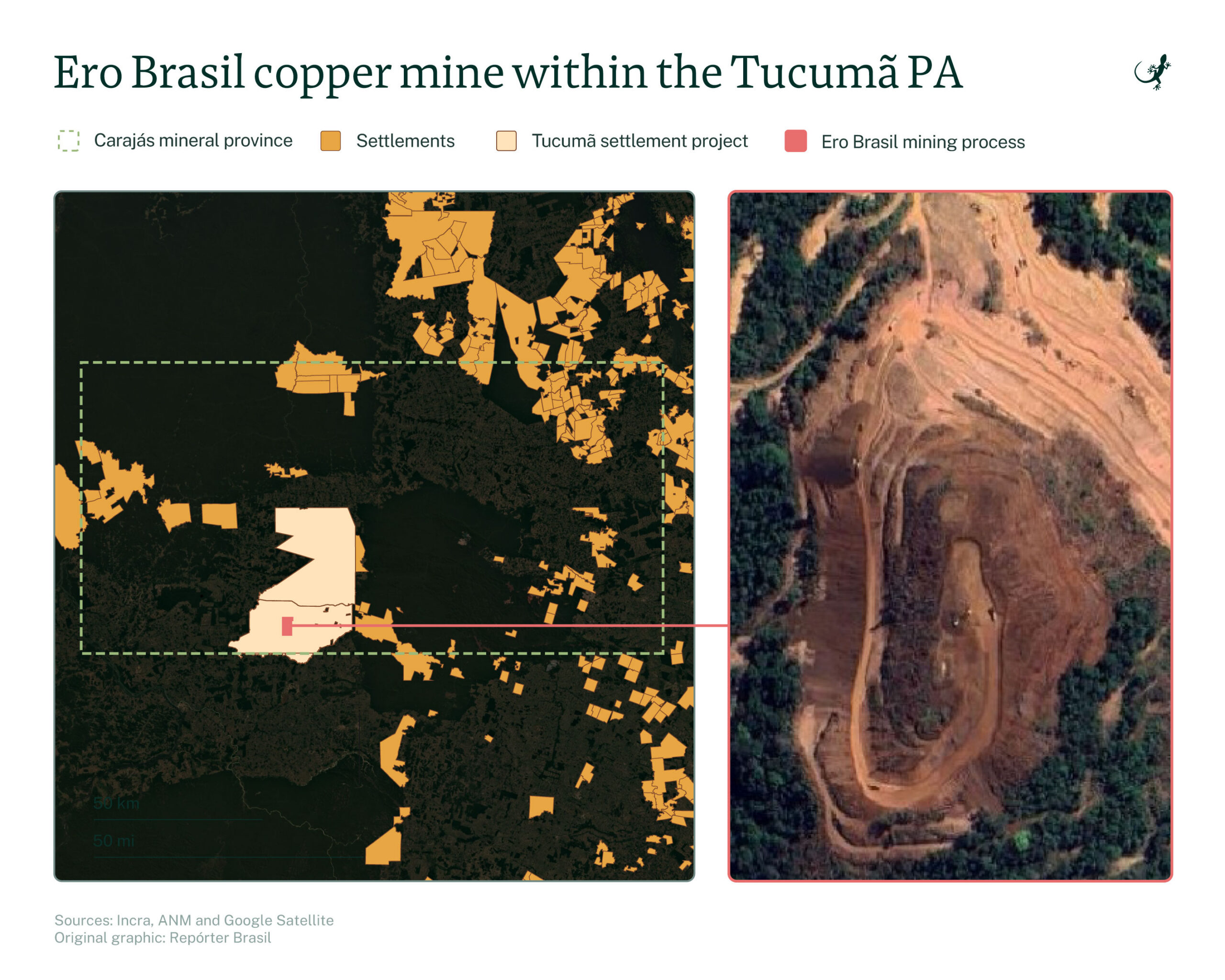
The Onça Puma operation takes place within the Tucumã Settlement Project, according to data from INCRA and ANM cross-referenced by the Energy Transition Observatory, a network of environmental organizations from Brazilian civil society.
Neighboring the Xikrin territory, the settlement is the agrarian reform area with the highest number of requests for electrification minerals in Carajás. There are 62 in total: 42 for copper and 20 for nickel.
In addition to Vale’s nickel operations, the area houses the copper mining venture of Ero Brasil, a subsidiary of the Canadian company Ero Copper.
In recent months, while copper prices reached record highs on the global market, driven by high demand and supply constraints — such as the drop in Chilean production caused by water scarcity — residents of the Tucumã settlement decried potential environmental impacts on the territory. Last December, images of large quantities of dead fish in the Carapanãzinho River circulated on social media, causing apprehension in the community.
Two settlers, who preferred to remain anonymous for fear of reprisals in the region, said they suspect that the river has become polluted due to the activities of Ero Brasil.

Copper extraction in Tucumã began in mid-2024 and plays a “critical role” in the company’s operations, according to the company’s sustainability report.
The document attributes the success of the undertaking to its “ability to work with communities.” Among its sustainability guidelines, the mining company highlights that it is “committed to the responsible management of tailings and mining waste in all its operations” and that it has a “proactive” stance to mitigate potential environmental impacts.
However, the settlers reported that the copper mine is causing problems such as constant dust, structural damage to houses (due to explosions), water scarcity and fish mortality. “When detonation happens, a cloud of dust covers everything,” one of the settlers said. “We can’t even see the mountain range.”
The residents interviewed for this report say that the Tucumã environmental agency collected fish and water samples, but it hasn’t released results yet.
They said that the mine operation initially brought hope for jobs and infrastructure to the region. However, they said the accumulated impacts have made life in the area unviable.
According to residents, a relocation plan for the P7 community is being discussed between Ero Brasil and the Tucumã City Hall, which would include compensation for the properties. However, the promise they heard is that this will only happen in 2027.
Ero Brasil and the Tucumã City Hall were questioned about the relocation plan and collection of fish and water samples, but haven’t responded.
“We are worried, because staying here for another two summers … we will suffer too much,” one of the settlers said. “We are waiting, without really knowing if anything will happen sooner, if it will only be within that timeframe.”
INCRA was also questioned about the relocation of settlers from the Tucumã Settlement Project, but did not respond.
Mining advances into areas that were ‘shielded’
Mineral extraction in agrarian reform areas was facilitated after a new norm that was published during far-right President Jair Bolsonaro’s (2019-22) government. The regulation relaxes rules for mining, energy and infrastructure projects in settlement areas.
The text establishes that a mining company must request approval from the regional INCRA unit, which must analyze the compatibility of the economic activity with the National Agrarian Reform Program, managed by INCRA, and establish conditions for coexistence between the activities.
In case of impacts on agrarian reform, the regulation provides for compensation to INCRA and settlers, profit sharing, infrastructure improvements, support for productive activities, resettlement or relocation of affected families, among other obligations.
The instruction defends “respect” for the rights of settlers, but does not establish any form of consultation with rural workers.
INCRA was questioned about mining activities within settlements, the impacts of the projects on communities, and ways to mitigate them. The federal agency stated only that “granting mining rights anywhere in the national territory is not within the purview of INCRA.”

“The fact that a regulation from the Bolsonaro government has not yet been revoked, even with the articulation of social movements, is quite worrying and revealing about the influence that mining has in the Lula 3 government,” assesses Maurício Angelo, director of the Mining Observatory, an investigative journalism center that covers mining, referring to Lula’s ongoing third term.
“They are advancing precisely into areas that until now were shielded from the market, such as community lands, border areas, conservation units, and agrarian reform settlements,” said Juliana Neves Barros, author of a book about mining conflicts in Carajás.
According to Bruno Malheiro, a geography professor at the University of the State of Pará, Carajás and the Amazon as a whole are at risk of becoming a “sacrifice zone” for the energy transition.
“Throughout history, mineral processes have always developed through the suspension of regulations, the deregulation of rules, and even the disobedience of the legal framework regarding mining and other regulations,” Malheiro said. “Now, with critical minerals, to expand extraction processes, the entire legislation is being changed.”

Impoverished population
Neighboring Tucumã, the municipality of Parauapebas has been the top collector of CFEM, a tax collected on mining activity, for at least 20 years. Only last year did it lose this title to its neighbor, Canaã dos Carajás. Both collected more than 1 billion reais ($193 million) in mining tax in 2025.
In 2021, at the peak of iron ore prices, Parauapebas had a per capita GDP which placed the city among the 40 richest in Brazil. Even with the fall in prices of its main mineral in the following years, in 2023 the city still ranked among the 300 richest, considering the per capita GDP of the 5,570 Brazilian municipalities, according to official data.
However, the high revenue is barely felt by a significant portion of the population.
In June 2022, a year after the municipality collected a record 2.4 billion reais ($464 million) in CFEM, 40,367 families in the city, with a population of 268,000 people, were registered in Brazil’s registry that identifies low-income families so they can access social programs.
Of these 40,367 families, 14,402 were in extreme poverty, while 7,223 were in poverty. The data is taken from a report from Territories in Network, an initiative of the Vale Foundation.
In August 2025, members of Brazil’s powerful Landless Rural Workers Movement (MST) held a protest in front of the city hall, demanding better conditions for rural education and repairs to a secondary road affected by mining activity.
“It’s frightening to think how a city so rich, which some even call the ‘mining capital,’ is so poor in public policies and benefits for the population,” Valbiane Thaís Pantoja da Gama, educator and MST representative, resident of the Terra e Liberdade encampment, said. “It’s our wealth that’s just going away. Only misery remains for the population.”
Banner image: Ibama (Brazilian Institute of Environment and Renewable Natural Resources) conducting an operation to combat illegal gold mining in Indigenous territory in the state of Pará, Brazil. Image by Ibama via Wikimedia Commons (CC BY 2.0).
Diego Junqueira, from Repórter Brasil, collaborated on editing and data analysis.
The Energy Transition Observatory project is supported by the INESC, Ford Foundation and the Pulitzer Center.
Copper rush pushes Vale to ramp up mining near Amazonian protected areas
FEEDBACK: Use this form to send a message to the author of this post. If you want to post a public comment, you can do that at the bottom of the page.
Credits