- Forests influence climate not only by storing carbon but by cooling the air, moderating extreme temperatures, and regulating water flows in ways that directly affect human well-being, concludes an academic review published this week in the journal Science.
- These effects are strongest at the local level: intact forests can make surrounding areas markedly cooler, stabilize rainfall, and create microclimates that support agriculture, health, and daily life.
- When forests are cleared, those protections can disappear quickly, often producing hotter, drier conditions and exposing large populations to increased heat stress and associated health risks.
- The greatest climate benefits occur where forests are native, underscoring that protecting and restoring natural ecosystems can be as important for adaptation to climate change as for reducing emissions, argues the paper.
For decades, a dominant argument for protecting forests has focused on carbon. Trees absorb carbon dioxide, store it in wood and soils, and slow the accumulation of greenhouse gases. A new scientific review suggests this emphasis overlooks other ways forests shape climate and human well-being. Forests, it argues, are not only a mitigation tool for the future climate. They also help people adapt to climate change today, shaping temperature, water and human well-being in ways that are felt locally.
The paper, “More than mitigation: The role of forests in climate adaptation,” synthesizes research on how forests regulate climate through physical processes as much as chemical ones. At local scales, trees act as thermal buffers. Canopies shade the ground and drive evapotranspiration, a process that converts heat into water vapor. Across nearly one hundred field sites, daytime temperatures inside forests were on average about 4°C lower than in nearby open areas, while nighttime temperatures were slightly higher. The result is a narrowing of extremes: cooler afternoons, milder nights.
These effects intensify in hotter climates. Tropical forests show the strongest cooling, often exceeding 6°C relative to cleared land. Even urban trees produce measurable relief, lowering air temperatures by roughly 1.5–1.7°C on sunny days. For people exposed to heat stress, the difference between forest shade and bare ground is not marginal. Apparent temperatures during heat events have been recorded as 6–14.5°C lower inside forests than outside.

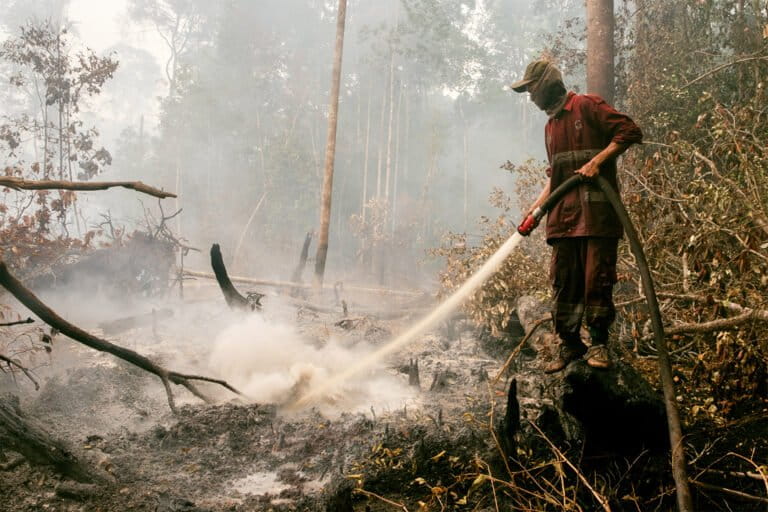
Deforestation therefore alters not just landscapes but living conditions. A related study from 2025 estimated that forest loss across the tropics has exposed hundreds of millions of people to higher temperatures and contributes to tens of thousands of heat-related deaths annually. Local warming from deforestation can rival or exceed the effects of global climate change over the same period.
Water is another big part of the story. Forests intercept rainfall, enhance infiltration and groundwater recharge, and return moisture to the atmosphere through evapotranspiration. In humid regions this can reduce flood risk and stabilize streamflows. But these benefits are not universal. In drier areas, expanded tree cover can reduce downstream water availability because more water is retained or returned to the air before reaching rivers.

The review emphasizes that context matters. Forests produce their greatest climate benefits where they would naturally exist. Introducing trees into ecosystems that evolved without dense canopy—such as tundra or certain savannas—can sometimes produce warming rather than cooling. Dark canopies absorb more sunlight than snow or grasslands, reducing surface reflectivity, or albedo. In high-latitude regions this effect can offset carbon gains. Globally, however, most areas capable of supporting substantial tree cover would still experience net cooling once carbon storage and other factors are considered.
At larger scales, forests influence atmospheric processes that are still poorly understood. They emit organic compounds that help form aerosols and clouds, altering how sunlight and heat move through the atmosphere. They also recycle moisture, contributing to rainfall far from where evaporation occurs. Small-scale deforestation can sometimes trigger local clouds, but extensive clearing tends to reduce precipitation regionally.
Evidence from places such as Borneo illustrates how these mechanisms play out on the ground. There, forest loss has been linked to rising daily temperatures, more frequent heat extremes and declines in rainfall, particularly in heavily deforested watersheds. Areas that retained most of their forests showed more stable conditions.

Taken together, the findings recast forests as a form of climate infrastructure. They moderate heat, manage water and shape local weather in ways that engineering alone cannot easily replicate. Yet these services remain underrepresented in climate policy, which still tends to measure forests primarily in tons of carbon.
The implications are practical as well as philosophical. Adaptation planning often focuses on seawalls, cooling systems and drought-resistant crops. Protecting existing forests—or restoring those that historically occupied a landscape—may deliver comparable benefits at lower cost while supporting biodiversity and livelihoods.
The review stops short of presenting forests as a universal solution. Poorly planned afforestation can strain water supplies or disrupt existing ecosystems. Nor can forests fully shield communities from the trajectory of global warming. Even under dense canopy, temperatures continue to rise as the broader climate warms.
Still, the authors’ central message is restrained but clear. Forests do not merely slow climate change; they help societies live with it. As heat waves intensify and rainfall patterns grow erratic, the value of that function becomes harder to ignore.
Banner image: A misty morning in Brunei. Photo by Rhett Ayers Butler
Citations:
- Josephine Elena Reek, Constantin M. Zohner, Gabriel Reuben Smith, Susan C. Cook-Patton, Pieter De Frenne, Paolo D’Odorico, Marius G. Floriancic, Robert B. Jackson, Julia A. Jones, James W. Kirchner, Marysa Laguë, Yuting Liang, Yuta J. Masuda, Robert I. McDonald, Luke A. Parsons, Benedict S. Probst , June T. Spector, Thales A. P. West, Nicholas H. Wolff, Florian Zellweger, and Thomas W. Crowther (2026). More than mitigation: The role of forests in climate adaptation. Science Vol 391, Issue 6786. DOI:10.1126/science.ads4361
- C. L. Reddington, C. Smith, E. W. Butt, J. C. A. Baker, B. F. A. Oliveira, E. I. Yamba & D. V. Spracklen (2025). Tropical deforestation is associated with considerable heat-related mortality. Nature Climate Change. Volume 15, 992–999. https://doi.org/10.1038/s41558-025-02411-0
- Clive A McAlpine, Alex Johnson, Alvaro Salazar, Jozef Syktus, Kerrie Wilson, Erik Meijaard, Leonie Seabrook, Paul Dargusch, Haziq Nordin and Douglas Sheil (2018). Forest loss and Borneo’s climate. Environmental Research Letters, 13(4), 044009. doi:10.1088/1748-9326/aaa4ff
Credits