- In 2024, scientists and conservationists documented a soft coral “slumping” event along the southern coast of South Korea’s Jeju Island, which led soft corals to lose their shape, droop, and even die in vast numbers.
- The event coincided with record heat and rainfall, which has led scientists to surmise, in a new paper, that the “slumping” resulted from a combination of thermal stress and changes to salinity and water quality.
- However, further research and testing is needed to determine the actual cause, researchers say.
- Scientists and conservationists say that while widespread slumping did not occur during 2025 or so far in 2026, the “Super El Niño” predicted for later this year could impact Jeju’s soft corals in a similar way.
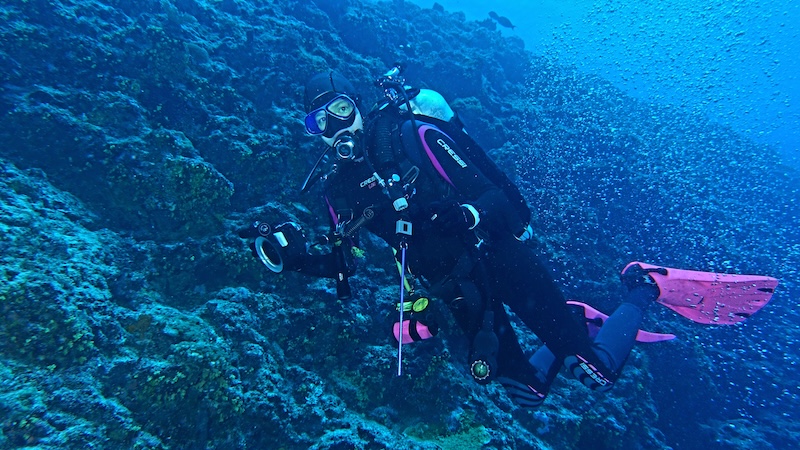
JEJU ISLAND, South Korea — In April 2025, I zipped myself up into a thick wetsuit and inched down a steep, rocky ledge toward the gray-blue water encircling Beomseom, a small island off the southern coast of Jeju Island in South Korea. Then I leapt into the chilly sea and wriggled into my scuba gear while floating on the surface.
In the water with me was Sanghoon Yoon, an adviser for Paran Ocean Citizen Science Center, a South Korean civil society group that advocates for the protection of the ocean. That day, Yoon was my scuba dive buddy.
Yoon and I sank beneath the dangling legs of snorkelers into a watery realm of rocks and kelp. Once in deeper water, I encountered gelatinous stalks of soft coral. The polyps appeared purple, pink, red, and even orange, depending on the light.


The soft corals I saw that day were healthy. But in 2024, soft corals around Beomseom Island and other parts of Jeju experienced what scientists are calling a “slumping” event — and what Yoon describes as “melting” — which saw soft corals losing their shape, drooping, and even dying. The event was widely reported in local media and attributed to marine heat as Jeju waters hovered above 30° Celsius, or 86° Fahrenheit, over the summer. Normally, sea temperatures average around 24°C (75°F) in this part of the world. 2024 was also the year that elevated sea surface temperatures triggered the fourth global coral bleaching event, which impacted reef-building hard corals around the world.
“We are aware that hard corals go through bleaching, but that’s a completely different scenario from what happens to soft corals,” said Yoon, who spoke to me through a translator, Eunhae Grace Jung, a board member of Paran, after our scuba dive.
“It was very shocking to see it,” he added. “We never imagined that something like that could happen.”
Anna Jöst Kim, a hard-coral ecologist and taxonomist at the Korea Institute of Ocean Science and Technology (KIOST), had also never seen anything like it. When Paran sent her photos of the drooping and dying corals in 2024, she began investigating the issue with her colleague and husband, Taihun Kim, who is also a coral researchers at KIOST as well as a professor of marine biology at the University of Science and Technology . Together, the Kims conducted a study, which was recently published in Nature Scientific Reports, proposing that soft corals may be declining due to warming and shifts in salinity and water quality.
“We want to make it public so people are aware of these problems,” Taihun Kim told Mongabay, “and people aren’t aware of this.”
He said they felt an urgency to publish this information since even a partial loss of Jeju’s soft corals would disrupt the local marine ecosystem, with cascading effects on fisheries, industry, and human livelihoods.


What exactly is a soft coral?
Located south of the mainland, Jeju is South Korea’s largest island, covering an area of 1,850 square kilometers (714 square miles) — about three times the size of the U.S. city of Chicago. There are also 50 uninhabited islands surrounding Jeju, including the islets of Beomseom, Seopseom and Munseom, which form part of the UNESCO-listed Jeju Island Biosphere Reserve.
Jeju’s waters support a rich array of marine life, from kelps and seaweeds to fish such as damselfish and wrasses, as well as invertebrates like abalone, sea urchins and sea cucumbers. Larger species, including the green sea turtle (Chelonia mydas), Steller sea lion (Eumetopias jubatus) and Indo-Pacific bottlenose dolphin (Tursiops aduncus), also visit these waters.
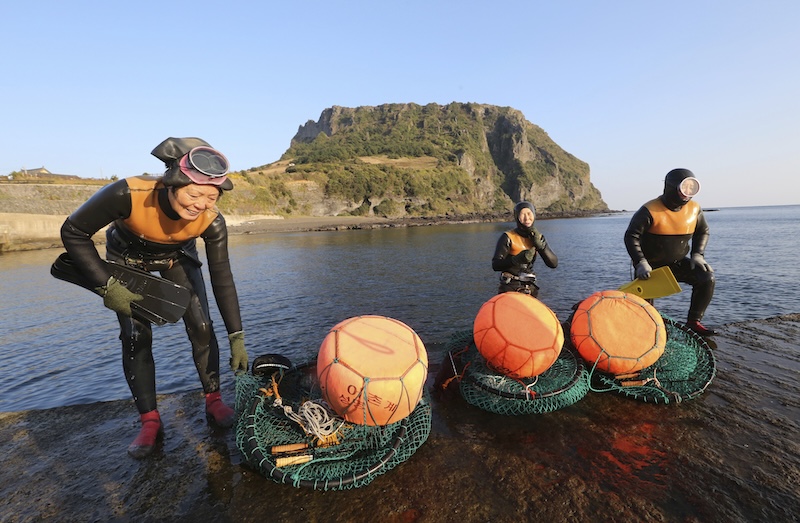
Jeju is famous for the haenyeo, a community of women who free-dive into the cold sea to harvest marine resources without the use of scuba gear. In 2016, UNESCO inscribed haenyeo culture on its list of Intangible Cultural Heritage of Humanity. Yoon of Paran is the son of a haenyeo, a detail that helps explain his strong connection to the sea.
Then there are the soft corals, which have become a major drawcard for tourists. For instance, a long-running submarine company takes tourists 40 meters (about 130 feet) underwater to see the soft corals around Munseom Island’s nature reserve.
Catherine McFadden, a professor of biology at Harvey Mudd College in the U.S., said researchers use the term “soft coral” in many different ways. For instance, some use it to define every species in a class of marine invertebrate known as Octocorallia, which includes gorgonians, sea pens and sea whips. Others take an even broader approach and describe as soft corals just about any marine invertebrate without a hard skeleton that is stationary as an adult, including sea anemones.

McFadden, who led one of the largest global surveys of soft corals, has a narrower definition: “To me, the soft corals are all the octocorals that don’t have an axis” — that is, a central supporting structure — “so they’re basically just fleshy, their skeleton is just hydrostatic. They pump themselves up with water and can contract down, squeeze out all that water. They don’t have any rigid structure that supports their branches.”
McFadden’s definition excludes species like sea fans and sea whips, which do have axes — but would include species like toadstool leather coral (Sarcophyton glaucum) commonly found in the Red Sea, or cherry blossom corals (genus Dendronephthya), found throughout the Indo-Pacific.
A 2022 study co-authored by Taihun Kim noted that there were at least 156 species of Anthozoa, a wide-ranging group of immobile marine invertebrates, in the region; of these, 89 are noted as soft corals. However, pinning down the exact number of soft coral species around Jeju is challenging, largely due to the inconsistencies in how soft corals are classified. Experts also say many soft coral species have yet to be formally identified or named.
While I was diving at Beomseom, I mainly saw coral species in the Nephtheidae family. But classification was far from my mind as I floated with Yoon through a forest of soft corals: polyp-studded, magenta-hued Dendronephthya gigantea, commonly known as carnation corals, and orange and yellow cabbage-like Scleronephthya gracillimum.


Soft coral ‘slumping’
I didn’t see any unhealthy soft coral on that dive, but Yoon later shared images and videos that showed corals in the same region “slumping” in 2024. Some of the soft corals had only begun to lose their shape; others sagged downward or lay flat across the seafloor. There are no data to determine whether the corals affected in 2024 later recovered, or whether soft coral abundance at Jeju has returned to previous levels, according to Anna Kim. What Kim did say conclusively was that there hadn’t been a widespread coral slumping event since 2024.
“That was the first time I witnessed that melting, and the first time ever recorded,” Yoon said.
In 2024, he said, Paran documented coral slumping along an 80-kilometer (50-mile) stretch of the southern coast of Jeju, an area about three-fourths as wide as the English Channel.
But this is just a rough measurement. Anna Kim said limited funding has prevented her team from determining exactly how many corals were affected by this slumping event, and whether soft corals at greater depths, and thus less accessible to divers, experienced similar impacts.
In their report, the Kims define five possible stages of the phenomenon: inflation, drooping, dangle, deflation, and disintegration. This cycle sees the corals initially swell up, then progressively lose structure, going from slightly drooping to hanging limp, then fully deflated, and finally breaking apart, their ultimate demise.
While the Kims theorize that thermal stress likely played a role, they also argue that changes in salinity were also a factor — namely, an increase of freshwater around Jeju, which would decrease salinity. The waters of Jeju are influenced by the plume of water that enters the ocean at the mouth of the Changjiang, or Yangtze, River. In 2024, mainland China not only experienced extremely high air temperatures, but also record rainstorms and flooding disasters, which were attributed to both the weather pattern El Niño and human-induced climate change. The increase in rain led to more freshwater from the Yangtze entering the waters around Jeju’s southern coast, which likely changed both the salinity and the water quality, according to the Kims.

“Personally, I think it is the salinity, because if we think about what those soft corals are, and what holds them standing is basically osmosis,” Anna Kim said. “And if you have changes in this equilibrium, then they deflate, or they inflate and eventually burst. But we need to test it.”
She added their research at this point is “purely observational and still largely hypothetical,” and that further testing is required, which she said was hindered by funding constraints.
Vianney Denis, a professor of marine biology at National Taiwan University, who has researched soft corals in Jeju but wasn’t involved in this study, told Mongabay that similar soft coral slumping phenomena have been documented elsewhere in the greater Pacific region, although researchers have described them using different terms, such as “melting,” “shrinking,” or simply “mortality.”
Denis said the Kims’ study makes an important contribution by drawing attention to the phenomenon and by exploring its potential causes. At the same time, he suggested that further work would be needed to strengthen the interpretation, particularly through quantitative data on the occurrence and extent of the phenomenon; longer-term data sets; and robust time-series analyses. He emphasized that continued documentation and monitoring are especially important in Jeju, where soft corals are foundational species supporting unique marine animal forest ecosystems.
“The persistence of these ecosystems may depend on our ability to identify the drivers of mortality and anticipate their consequences under future environmental scenarios,” Denis said.

‘There’s no management’
In addition to possibly contributing to the coral slumping, the rise in sea temperature is causing another problem for soft corals: Tropical hard corals are steadily expanding north into the waters around Jeju, and competing with soft corals for space.
“Some soft coral species are overgrown [with] encrusting hard coral,” Taihun Kim said.
Other pressures facing the corals are submarine tourism, diving and fishing, and pollution from local construction and agriculture, according to Yoon.
The mounting pressures have led Yoon and his colleagues at Paran to call for greater protection for Jeju’s soft corals.
Seoyeong Lee, a spokesperson for the South Korean government, told Mongabay in an email that the Ministry of Ocean and Fisheries designated the waters around Munseom and Beomseom islands as marine protected areas (MPAs) “to protect soft coral communities.” Lee added that these MPAs overlap with a “national monument” zone also established to protect soft corals.
However, Yoon referred to the MPA and national monument designations as “paper parks,” arguing that there’s no enforcement of their protection.
“As you saw, there are fishermen who go there to fish, divers go there, submarines go and destroy the habitat of corals,” Yoon told me. “The law is there, but there’s no management.”
Will soft coral slumping happen again?
So far, no other year has matched the scale of the slumping event of 2024. In 2025, Anna Kim said, she observed only “a few individual corals slumping within a garden of normal soft corals.” As for this year, Kim said it’s still too early to determine whether slumping will recur, as Jeju’s waters are still cool for this time of year.
However, there’s reason to believe Jeju’s soft corals could face another slumping event in the future, with a “Super El Niño” forecast for later in the year that could drive up temperatures and intensify rainfall and other weather events.
Yoon said he and his colleagues at Paran were closely monitoring forecasts for the upcoming El Niño, and that he would continue diving in Jeju’s waters to monitor the corals and track any signs of further decline.
“It is very devastating, but we can’t just be sad about it,” Yoon said. “There are a lot of things to do, and I consider it my duty to record the changes that no one is recording.”
Correction (06/10/2026): Language in this story has been clarified to reflect that species such as Steller sea lions visit but do not reside in Jeju waters; sea surface temperatures around Jeju exceeded 30°C in 2024; hard corals are expanding northward rather than migrating; and Kim’s 2022 study reported the number of soft coral species in Jeju, although this was not a key finding. In addition, the professional descriptions of Anna Jöst Kim and Taihun Kim have been expanded.
Banner image: Divers from the Paran Ocean Citizen Science Center diving with Dendronephthya gigantea, a soft coral in the family Nephtheidae. Image courtesy of Paran.
Elizabeth Claire Alberts is a senior staff writer for Mongabay and was a 2024-2025 fellow with the Pulitzer Center’s Ocean Reporting Network. Find her on Bluesky and LinkedIn.
Citations:
Jöst, A. B., & Kim, T. (2026). From rigidity to collapse in soft coral slumping within the world heritage coral gardens in Korean waters. Scientific Reports. doi:10.1038/s41598-026-54847-9
McFadden, C. S., Erickson, K. L., Lane, A., Nassongole, B., Aguilar, S., Dunakey, S. K., … Benayahu, Y. (2025). Biodiversity and biogeography of zooxanthellate soft corals across the Indo-Pacific. Scientific Reports, 15(15461). doi:10.1038/s41598-025-98790-7
Credits