- A new study finds that strategically restoring degraded forests could help reconnect fragmented habitat for the endangered Javan leopard, giving the species more room to move across densely populated Java.
- Researchers created the first islandwide model of habitat connectivity for the species, showing how targeted reforestation could help offset some of the barriers created by roads, railways and urban development.
- Conservationists say isolated leopard populations face increasing risks from habitat loss, human conflict, disease and inbreeding, with only an estimated 320 Javan leopards remaining in the wild.
- Experts caution that the model still needs to be tested with real-world tracking data, but say reconnecting forests will be essential for the long-term survival of Java’s last apex predator.
Reforestation done right could be key to helping rebuild habitat connectivity for Javan leopards on an island with one of the highest human densities on Earth, a new study says.
It frames strategic forest restoration — linking up fragmented patches of forest to create contiguous corridors — as offering a rare pathway to balance rapid infrastructure expansion with the conservation of the endangered big cat.
“And to implement this, strong commitment from various stakeholders is needed, given Java’s highly fragmented landscape; this will undoubtedly be a significant challenge,” study lead author Andhika C. Ariyanto, a Ph.D. candidate at the University of Twente in the Netherlands, told Mongabay by email.
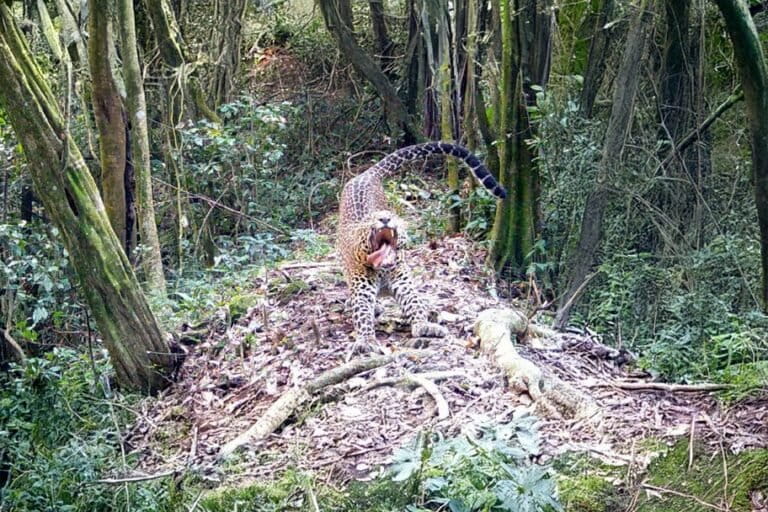
The study is the first to produce an islandwide model of habitat connectivity for the Javan leopard (Panthera pardus melas), offering conservationists a new tool to identify which forest corridors should be protected and restored as infrastructure development expands across Java, Andhika said.
By comparing the impact of new roads and railways with a scenario in which degraded forests were restored, Andhika and his colleagues found that replanting trees in key areas could help reconnect fragmented habitats throughout Java and give wildlife, including leopards, more room to move and survive.
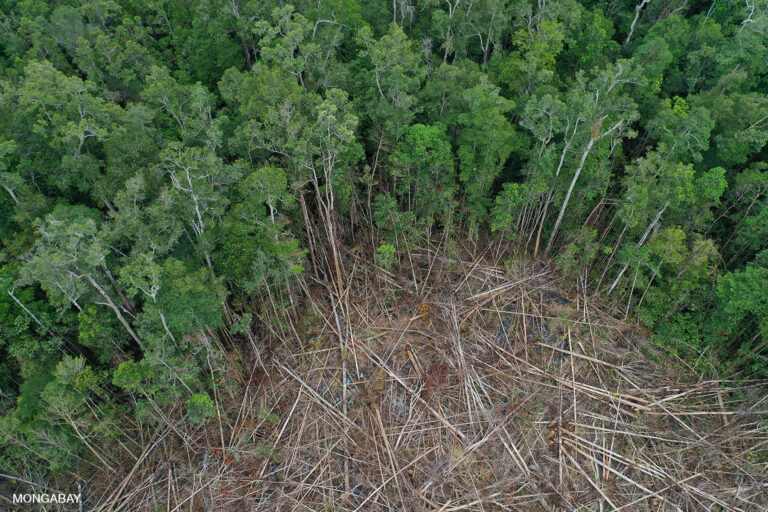
They looked at key forest areas used by leopards across Java, an island half the size of the U.S. state of Texas with five times its population. This high human population density has squeezed the island’s leopards into a scattering of national parks and mountain forests, which are increasingly broken apart by roads, development and human activity, leaving an uneven distribution of forest corridors across the island.
The researchers mapped how existing and planned roads and railways could affect wildlife movement across Java, then tested a restoration scenario in which degraded land was replanted to make it easier for animals to move between forests. They also measured whether the restored corridors would allow wildlife like leopards to travel more directly with fewer barriers across the landscape.
They found that restoring forests in strategically chosen parts of Java, especially in the western and central highlands, could make it easier for leopards to move between isolated habitats by creating safer and more connected wildlife corridors. While reforestation cannot fully remove the barriers created by highways and railways, the researchers say even relatively small restoration projects in key areas could help reconnect fragmented forests and reduce the risks faced by animals traveling across the island.
Andhika, who is affiliated with the Indonesian forestry ministry and whose Ph.D. studies are funded by the government, said conservation authorities haven’t yet had the opportunity to test out the model. He said the government and its conservation partners are currently still focused on population monitoring and genetic analysis under the Java-Wide Leopard Survey (JWLS). He added that analyzing habitat connectivity to facilitate genetic exchange, through the study’s methods, should be the next stage following the completion of the survey.
“It is at this stage that we can implement this method, with the caveat that the results of this study consist of simulations based on several scientific assumptions,” he wrote to Mongabay. “[T]he analysis was conducted at the island scale and can serve as a reference for implementation in specific areas at a more detailed scale (with further modeling).”
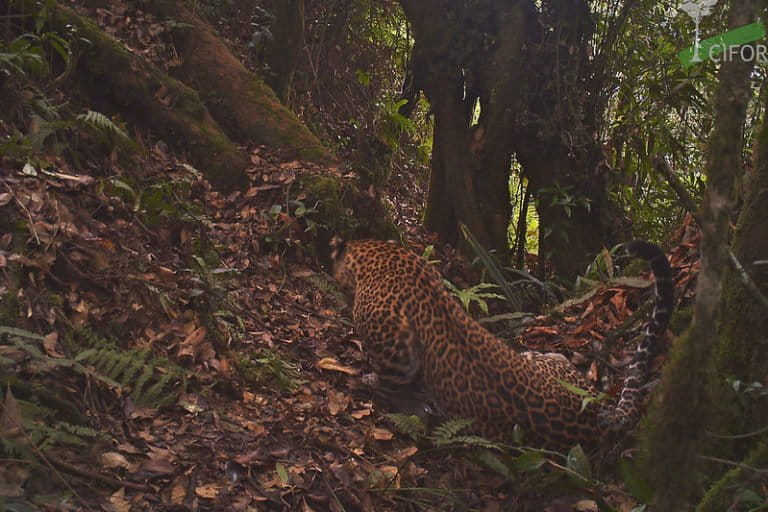
Much of Java’s forests have been broken into small, isolated patches by decades of road construction, urban expansion, farming and other development, leaving wildlife habitats increasingly disconnected. For the Javan leopard, this fragmentation reduces access to prey and other forest areas, increases encounters with humans, and threatens the long-term survival of isolated populations.
The new study provides useful insights for conservation planning, but its findings should be treated carefully because the model assumes the leopards will always choose the easiest route through the landscape, said Erwin Wilianto, co-founder and board member of the NGO Save Indonesian Nature & Threatened Species (SINTAS Indonesia) and project coordinator for the JWLS.
Erwin said Javan leopards need large and connected habitats to hunt, breed and maintain healthy populations. Isolated groups, he said, face growing risks from human conflict, disease and inbreeding. He also noted that when animals can no longer move between forest areas, declining genetic diversity can gradually weaken populations and increase the risk of extinction over time.
“To ensure the long-term survival of the leopard, habitat connectivity — both structural and functional — is one of the key requirements,” Erwin told Mongabay by email.
He added that combining the new model with real-world tracking data and previous leopard studies would give a more complete picture of how the subspecies actually moves through Java’s increasingly fragmented forests, and thus help guide future conservation and development policies.
The Javan leopard, the island’s last apex predator following the extinction of the Javan tiger, is under growing pressure from habitat loss, hunting and declining prey populations. Conservationists estimate that only around 320 of the leopards remain in the wild. A 2023 study found the subspecies lost large areas of suitable habitat over the past two decades, prompting calls for stronger forest protection, better conflict prevention, and efforts to reconnect isolated leopard populations.
“Reforestation and forest rehabilitation should become flagship programs,” Erwin wrote, “not only to protect habitat for the Javan leopard as recommended in the study, but also as part of broader climate change mitigation efforts.”

Basten Gokkon is a senior staff writer for Indonesia at Mongabay. Find him on 𝕏 @bgokkon.
See related story:
Rare Javan leopard sighting renews focus on conservation, monitoring efforts
Citations:
Ariyanto, A. C., Wang, T., Skidmore, A. K., Rahman, D. A., Ario, A., & Imron, M. A. (2026). Reforestation mitigates negative impacts of infrastructure by improving habitat connectivity for the Javan leopard. Ecological Indicators, 185. doi:10.1016/j.ecolind.2026.114800
As’ary, M., Setiawan, Y., & Rinaldi, D. (2023). Analysis of changes in habitat suitability of the Javan leopard (Panthera pardus melas, Cuvier 1809) on Java Island, 2000-2020. Diversity, 15(4), 529. doi:10.3390/d15040529
FEEDBACK: Use this form to send a message to the author of this post. If you want to post a public comment, you can do that at the bottom of the page.
Credits