- Of the approximately 350,000 vascular plant species in the world, only about 18% have been assessed by the IUCN Red List, and the situation is starker still if one looks at just tropical African species.
- Further, IUCN’s “not evaluated” category simply means a species has not yet been assessed against Red List criteria, and in practice, African conservationists often meet a more confusing reality: Many species are not on the global Red List at all but are still informally talked about as if they are NE.
- “Here’s a constructive way forward via “Red List + Reality” decision rules…A stronger system could combine global assessments with local intelligence,” a new commentary suggests.
- This article is a commentary. The views expressed are those of the author, not necessarily of Mongabay.
Many African conservation decisions such as funding, policy, species prioritization and nursery propagation implicitly treat the IUCN Red List as a complete map of extinction risk. It is not. For plants including trees, the biggest risk is not only that we mis-rank species, it’s that we overlook vast numbers of species that have never been globally assessed or have assessments that are decades old.
So, how much plant diversity is assessed? Globally, one widely cited synthesis notes that of about 350,000 vascular plant species, the IUCN Red List documents about 62,666 species, or roughly 18%. That means most vascular plant species worldwide have no global Red List category to guide action.
Africa illustrates the gap even more starkly. A comprehensive checklist of Mozambique’s vascular flora (compiled in July 2021) reported that although 1,667 taxa in the national checklist were registered on the IUCN Red List, the global extinction risk status for 76.5% of Mozambique’s vascular flora was not evaluated (including taxa explicitly categorized as not evaluated (NE) and taxa not listed on the IUCN Red List).
At a broader (tropical Africa) scale, one peer-reviewed analysis of 22,036 green plant species found that only 2,856 had full IUCN assessments available (about 13%), and only 2,009 (9.1%) had assessments published after 2001. In other words, 87% of species had their assessments published a quarter century, or longer, ago.
‘NE’ does not mean ‘safe’ & ‘not listed’ can be worse
On paper, IUCN’s category “ simply means a species has not yet been assessed against Red List criteria. In practice, African conservationists often meet a more confusing reality: Many species are not on the global Red List at all and are still informally talked about as if they are “NE.” Either way, formal NE or absent from the global list, there is no global extinction-risk signal.
The Mozambique checklist makes the operational problem explicit: It treats NE as a combined bucket covering both taxa marked NE and taxa absent from the IUCN Red List entirely, because for conservation planning, both cases create the same blind spot.
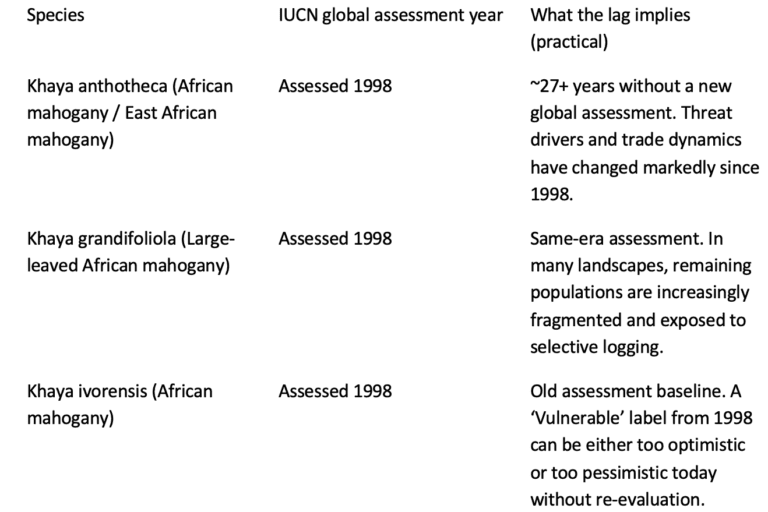
Assessment lag: The Khaya case
Assessment coverage is only half the problem. The second is assessment lag of species that are globally assessed but not reassessed for decades. This is especially risky for long-lived, slow-regenerating, high-value timber trees whose threat profile can change quickly with logging pressure, land conversion, pests and climate stress.
A hard truth for practitioners is that the Red List cannot substitute for field judgment. The practical failure mode is when a conservationist sees a species labeled LC/NT/VU long ago or sees nothing at all (NE/absent) and assumes the urgency is low even when they can see decline, extraction and recruitment failure in the field.
So, here’s a constructive way forward via “Red List + Reality” decision rules, and this is not an attack on the IUCN Red List. It is a call to treat it correctly – the best available global tool – but not a complete inventory. A stronger system could combine global assessments with local intelligence:
- Adopt a two-channel prioritization system: 1.) IUCN category and 2.) a simple “field-risk” score (e.g., 0-3) based on observed extraction, habitat loss and recruitment failure.
- Flag “assessment lag” as a risk factor: Any global plant/tree assessment older than 10 years should be treated as “stale” and prioritized for review, especially for exploited timber/medicinal species.
- Use checklists and herbaria to quantify the blind spot: Replicate the Mozambique approach in other countries and publish national checklists that explicitly state what percentage of flora is unassessed and which threatened taxa are missing or incorrectly ranged.
- Create practitioner-triggered reassessment pipelines: When nursery operators, foresters or botanists document rapid decline, trade pressure or new threats, there should be a clear pathway to submit evidence to Red List authorities and specialist groups.
- Stop letting markets define conservation collections: Build “open-door” living collections that accept regionally native species, whether or not they are fashionable, profitable or already assessed.

At Lukango Tree Conservancy, we operate an open-door policy for regionally native tree species that we do not yet hold, even while we emphasize threatened species. This is deliberate: Our nursery is not market-driven and remains noncommercial because conservation collections must not track profit signals more closely than biodiversity signals.
Equally, we recognize another uncomfortable question: When a species is assessed as threatened but remains unassessed again for decades, should conservation attention remain frozen at the old assessment level? Sometimes, yes, as threats persist. Sometimes, no, since conditions change.
The answer requires new data, not faith.
Victor Nsereko Wantate is the founder of Lukango Tree Conservancy (LuTreeCo), the African Tree Seeds Group (ATSG) and the initiator of Indigenous Tree Day, an annual, multicountry effort focused on Africa’s indigenous trees.
See related coverage:
Myanmar’s botanical data gaps risk its unique flora, collaborations could help, study says
Photos: Kew Gardens’ top 10 newly named plants and fungi for 2025
Citations:
Bachman, S. P., Brown, M. J., Leão, T. C., Nic Lughadha, E., & Walker, B. E. (2024). Extinction risk predictions for the world’s flowering plants to support their conservation. New Phytologist, 242(2), 797-808. doi:10.1111/nph.19592
Odorico, D., Nicosia, E., Datizua, C., Langa, C., Raiva, R., Souane, J., … Attorre, F. (2022). An updated checklist of Mozambique’s vascular plants. PhytoKeys, 189, 61-80. doi:10.3897/phytokeys.189.75321
Stévart, T., Dauby, G., Lowry, P. P., Blach-Overgaard, A., Droissart, V., Harris, D. J., … Couvreur, T. L. (2019). A third of the tropical African flora is potentially threatened with extinction. Science Advances, 5(11). doi:10.1126/sciadv.aax9444
Credits