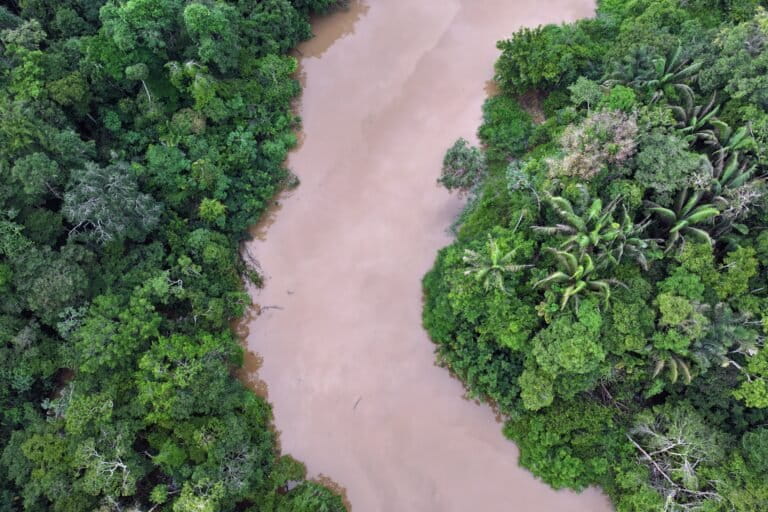
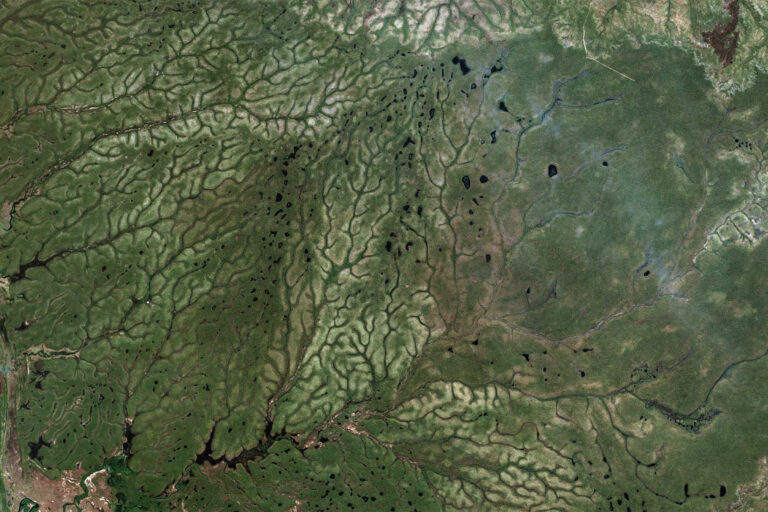
- The toxic legacy of gold mining in the Amazon Rainforest could finance its own remediation while creating more than 200,000 jobs that transform illegal extraction into a regulated industry, a new analysis explains.
- Across the Amazon Basin, informal and illegal gold mines degrade forests and rivers while using mercury to extract the ore in an outdated, toxic and inefficient process.
- If the leftover “tailings” of these outdated operations were treated with modern methods via formalized processing facilities, thousands of jobs could be created and watersheds could be saved from ongoing destruction.
- This post is an analysis. The views expressed are those of the author, not necessarily of Mongabay.
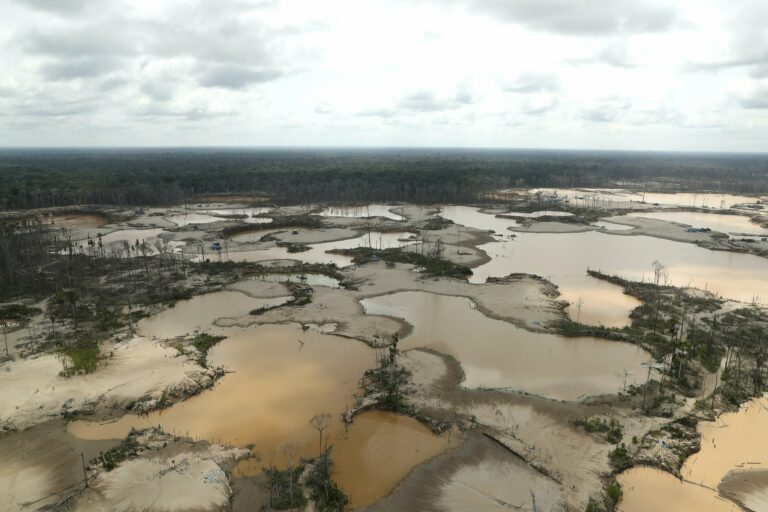
The wildcat gold mining boom that swept across the Amazon beginning in the 1970s left behind an environmental catastrophe of staggering proportions. At least 350,000 hectares (almost 865,000 acres) of forest and wetland habitat have been destroyed by placer mining operations across the Pan Amazon, with the actual figure likely far higher given the limitations of satellite monitoring for small-scale operations and river dredges.
In the Tapajós River Basin in Brazil’s Pará state, particularly the municipality of Itaituba, five decades of alluvial mining have devastated tens of thousands of hectares of riparian forest while releasing an estimated 200-500 metric tons of mercury annually into watersheds. Mercury contamination has become endemic: 75% of the population of the municipality of Santarém shows elevated mercury levels, with some residents carrying four times the WHO limit. The legacy extends far beyond the mining sites themselves, as methylmercury bioaccumulates through aquatic food webs, threatening riverside communities across millions of hectares of downstream habitat.
Yet hidden within this toxic legacy lies an economic opportunity that could finance comprehensive remediation while generating more than 200,000 formal-sector jobs. The garimpeiro (wildcat miner) reliance on mercury amalgamation technology is remarkably inefficient, because mercury captures only free gold particles through physical absorption, achieving recovery rates of 40-60% from alluvial placers. The remaining 40-60% of gold remains trapped in “tailings” as fine particles, bound in mineral matrices, or simply lost to processing inefficiency. Those tailings, an existing environmental catastrophe, contain an estimated 1,400-2,100 metric tons of recoverable gold worth $90 billion to $135 billion at current prices.

Technology transition and its implications
Cyanide-based heap leaching, the chemical extraction process employed by corporate gold miners, achieves 70-90% recovery rates from ore through chemical dissolution that liberates gold from mineral matrices. Applied to mercury-generated tailings, cyanide technology can recover an additional 30-40% of the original gold content left behind by mercury-based extraction technology. Medium-scale miners in the Philippines, Indonesia and Burkina Faso have already made this transition, establishing operations that reprocess old placer tailings from alluvial mining operations.
Introducing cyanide technology into the wildcat mining economy is, however, loaded with risk. The transition would require the reform (or displacement) of a mining sector that is blatantly illegal in multiple dimensions (tax, safety, health, labor, environmental). Introducing the new technology without reforming existing operators would lead to yet another, potentially more severe, environmental disaster.
The Minamata Convention on Mercury explicitly characterizes unregulated cyanide reprocessing of mercury-laced tailings as a “worse practice” because mechanical turnover tailings would mobilize trapped mercury, while cyanide would release other heavy metals and amplify toxicity. Moreover, chemical reactions between cyanide and mercury create methylmercury variants that accelerate bioaccumulation, which are already a major health crisis for Amazonian populations. These risks have motivated international agencies to warn against uncontrolled adoption of cyanide technology in artisanal mining landscapes. Consequently, most environmental advocates will vehemently oppose the proposed business model and sectoral reform, insisting instead on the complete eradication of wildcat gold mining as an economic activity.
The Minamata documentation that warns of these risks, however, also outlines proven techniques to minimize them. Physical and chemical methods can remove mercury from tailings before cyanide application, transforming what would be an environmental disaster into a genuine remediation solution.

Properly designed operations would include:
- Pretreatment to extract and sequester mercury;
- Controlled cyanide application using geomembranes and containment systems;
- Recycling of cyanide solutions to prevent discharge; and
- Stabilization and revegetation of processed tailings with native species appropriate to riparian zones.
Corporate gold miners already employ these technologies at industrial scale, investing substantial resources in recycling systems, isolation ponds and catchment reservoirs to isolate operations from surrounding watersheds. The challenge lies not in technical feasibility but in regulatory design by creating frameworks that mandate (and enforce) comprehensive environmental controls, rather than allowing the proliferation of unregulated operations that created the current crisis. This will require a cultural transformation of wildcat mining society whose entrepreneurs and labor force must be enticed (or coerced) into a system based on legality and sustainability.
The Tapajós Model: Economics at watershed scale
The Tapajós gold fields, concentrated in Itaituba municipality, represent Brazil’s most continuously active garimpo (an informal gold mining area) and an ideal proving ground for tailings remediation. Gold mining began in the late 1950s when garimpeiros discovered alluvial deposits on the Rio Crepori. Production exploded following construction of the BR-163 highway and the “Estrada Transgarimpeira” in the 1970s and 1980s, providing access for tens of thousands of wildcat miners to previously remote floodplains.
A 2013 analysis estimated the region had produced 758 metric tons of gold over 50 years, with a nominal value of approximately $25 billion. All those years of informal mining with minimal regulatory oversight, combined with substantial gold smuggling and continued operations through 2025, suggest the total historical production is probably between 1,000 and 1,200 metric tons. If mercury amalgamation recovered approximately 50% of the original gold content — a reasonable assumption given the technology’s limitations — then the existing tailings contain between 350 and 420 metric tons of potentially recoverable gold.
Not all tailings are economically viable to reprocess. Dispersion across thousands of small sites, mixing with river sediments, access constraints, and competing land uses limit practical recovery. A realistic target involves reprocessing the most concentrated tailings deposits, like those from larger operations, readily accessible sites, and areas with the highest gold grades. This represents perhaps 40-50% of total tailings, yielding 175-210 metric tons of recoverable gold worth $11 billion to $13 billion gross at current gold prices of $64,000 per kilogram.
The proposed business model must only operate through licensed mining companies subject to full regulatory oversight: environmental permitting, labor compliance, royalty payments and mandatory reclamation bonding. The reform should start with the renationalization of all unremediated tailings, which then could be leased to legally constituted entities with concessional rights to recover gold and execute approved remediation plans. Companies would be required to remove mercury before cyanide application, maintain zero-discharge containment systems, and revegetate processed sites with native riparian species.
Environmentally licensed cyanide-based operations processing 26,000 hectares (more than 64,000 acres) of Tapajós tailings piles over 15-20 years would require 15-25 medium-scale facilities. Based on corporate mining employment ratios, such operations would generate 9,000-13,000 total jobs: 3,500-5,000 direct mining and processing positions; 1,500-2,000 environmental remediation and revegetation jobs; 800-1,200 technical, administrative and support roles; and 4,000-6,000 indirect positions in suppliers, services and transportation. These formal-sector jobs would offer substantial advantages over informal garimpeiro labor, such as multiyear, full-time employment (rather than boom-bust cycles), occupational safety standards and health monitoring, formal wages averaging two to three times informal mining income, and legal protections for workers and families.

Pan-Amazon potential: From watershed to basin scale
The Tapajós represents approximately 15-25% of Pan-Amazon placer mining activity. Wildcat mining occurs across every major Amazon watershed, from the Madre de Dios in Peru through the Guiana Shield countries to the Brazilian states of Roraima, Mato Grosso and Rondônia. Current annual gold production across all regions totals approximately 120 metric tons, with an estimated 478,000 people dependent on wildcat mining for their livelihoods. Mercury pollution is estimated to range from 320-779 metric tons, with cumulative releases over four decades potentially exceeding 8,000 metric tons.
Estimating total historical gold production requires accounting for 50-70 years of mining activity depending on region, varying levels of documentation and regulatory oversight, and systematic underreporting for tax evasion. Using current annual production of 120 metric tons as baseline and assuming similar activity levels over 50 years (with lower early-period production balanced by higher recent output), total Pan-Amazon production approximates 4,000-6,000 metric tons. If mercury amalgamation recovered 50% of original gold, then recoverable gold of between 1,400 and 2,100 metric tons would be worth $89 billion to $134 billion.
Reprocessing and remediating 350,000 hectares (almost 865,000 acres) of tailings piles across the Pan Amazon would require 200-350 medium-scale operations distributed across hundreds of active and distinct mining landscapes. Employment would scale proportionally: 55,000-75,000 direct mining and processing jobs; 25,000-30,000 environmental remediation positions; 15,000-20,000 technical and administrative roles; and 75,000-100,000 indirect jobs (total Pan-Amazon employment: 170,000-225,000 formal-sector positions). Regional distribution would follow existing mining concentrations: Pará (42,000-55,000 jobs); Madre de Dios, Peru, (40,000-50,000 jobs); Guyana, Suriname and French Guiana (25,000-33,000 jobs); with remaining activity distributed across Roraima, Mato Grosso, Venezuela and Bolivia (60,000-80,000 jobs).
Political economy and the transformation of mining sectors
The economic potential revealed by these estimates could fundamentally alter the political economy of the so-called artisanal mining industry. A sector capable of generating $90 billion to $135 billion in gross revenues over 15-20 years while creating 170,000-225,000 formal jobs possesses sufficient scale to justify comprehensive regulatory frameworks, substantial infrastructure investment and rigorous environmental standards. Net revenues after processing costs, remediation expenses and royalties would likely reach $35 billion to $55 billion, an amount sufficient to finance removal and sequestration of 8,000 metric tons of mercury from the environment and the restoration of 350,000 hectares of degraded riparian habitat, while creating a formal mining sector generating stable tax revenues and transforming the informal livelihoods of hundreds of thousands of families into formal employment with occupational safety, health monitoring and legal protections.
Most critically, the economics would shift mercury contamination from an intractable environmental disaster to a financially viable remediation opportunity. Rather than attempting to prohibit wildcat mining — a strategy that has failed across five decades despite billions in enforcement spending — authorities can redirect the sector’s entrepreneurial energy toward cleanup. The gold remaining in tailings provides the financial incentive that carbon markets and conservation funding are incapable of achieving: immediate returns on capital sufficient to justify private investment at scale.
The political dynamic inverts when remediation becomes profitable rather than a cost. Garimpeiros who currently resist environmental compliance can be channeled into formal operations where their knowledge of local geology, processing techniques and supply chains becomes an asset rather than a liability. Hundreds of medium-scale companies investing millions in extraction facilities and remediation infrastructure could acquire powerful incentives to defend regulatory frameworks that protect their investments from informal competition. Municipalities receiving substantial royalty revenues — potentially $3 billion to $5 billion annually across the Pan Amazon — also can develop fiscal interests in maintaining formal-sector dominance.
The approach will not work everywhere or solve every problem, though. Wildcat miners will continue to invade protected areas and Indigenous territories, and these types of illegal activities can only be halted by vigorous police enforcement, followed by the judicial application of the penal code and incarceration of convicted criminals. New alluvial deposits will be discovered and these will attract wildcat miners who will attempt to use mercury; these too must be subject to police action and be immediately terminated. These, of course, are the solutions demanded by environmental and social advocates; however, frontier society would now have a more attractive alternative that can catalyze a cultural shift that ends the tolerance of criminal behavior.
In already devastated landscapes like Itaituba, where 46,000 hectares (more than 113,000 acres) of riparian forest have been reduced to barren moonscapes, mercury contamination threatens human health. Restoration through natural (passive) regeneration would take decades (or centuries) and leave mercury as a long-term (perhaps permanent) liability. In these landscapes, which exist across every major Amazonian gold field, a market-based approach that fuses economic incentive with environmental remediation offers a pragmatic path forward. The question is whether regulatory authorities and environmental advocates can embrace the complexity of using a properly regulated and rigorously enforced cyanide technology to address the toxic legacy of wildcat gold miners.

The Tapajós could serve as proving ground for this transformation. Southwest Pará possesses the infrastructure, regulatory capacity and market access necessary for medium-scale operations. The region’s gold production is already partially formalized, with cooperatives and licensed operators coexisting alongside informal miners. The municipality of Itaituba currently receives substantial royalty revenues and has fiscal incentives to expand the formal sector. Most importantly, the sheer scale of environmental damage and mercury contamination creates political space for experimental approaches that might face stronger opposition in less-degraded landscapes.
Success in the Tapajós would demonstrate that tailings remediation can operate at a commercial scale while meeting environmental standards. It would provide employment models for formal-sector mining that offer superior wages and working conditions. It would generate tax revenues and royalties sufficient to finance watershed-scale restoration programs. Vigorous and permanent police action enforcement would demonstrate the capacity of the state to enforce environmental law. It would prove that mercury contamination, currently viewed as a permanent legacy of the gold rush era, can be systematically removed from the environment, when the economics align properly.
The opportunity exists. The gold is there, trapped in tailings across a vast, degraded landscape. The technology is proven. The economic returns are sufficient to justify comprehensive environmental controls and worker protections. What remains is the political will to design regulatory frameworks that mandate proper mercury removal, enforce zero-discharge cyanide standards, require meaningful reclamation protocols, and create incentives for formal operators to defend those standards against both informal (illegal) competition and corporate attempts at regulatory capture.
If that political will can be mobilized — a substantial “if” — then the Amazon’s toxic mining legacy could finance its own remediation while creating more than 200,000 jobs that transform illegal extraction into a regulated industry. If not, the tailings will remain, mercury will continue leaching into watersheds, and another generation will ask why available solutions were not deployed to solve a problem that everybody agrees is intolerable and unnecessary.
Timothy J. Killeen is an ecologist and conservation biologist with a background in disciplines including genetics, botany and taxonomy. Since the 1980s, Killeen has studied the rainforests of Brazil and Bolivia, where he lived for more than 35 years. He is the author of A Perfect Storm in the Amazon.
Banner image: After burning mercury off, a relatively pure piece of gold is the result. Image by Thomas Graham for Mongabay.
Podcast: Author Timothy Killeen shares key insights from the second edition of his book “A Perfect Storm in the Amazon Wilderness,” plus what gives him hope, and his advice for up-and-coming conservationists, listen here:
See related coverage:
Formalizing small-scale gold mining can reduce environmental impacts & crime (commentary)
Resilient and resourceful, Brazil’s illegal gold capital resists government crackdown
Credits