


- European governments are pushing to delay and weaken the EU Deforestation Regulation, backing a one-year postponement to 2026 and major reductions in due-diligence requirements.
- The political shift is driven largely by Germany and supported by France, despite earlier European Commission rollbacks and opposition from only a few member states.
- Civil society groups warn that further delays would gut the law, punish early-compliant companies, and undermine the EU’s regulatory credibility.
- At COP30, the EU’s silence on deforestation has fueled accusations of hypocrisy as advocates say weakening the EUDR would have severe consequences for tropical forests.
BELÉM, Brazil — At a Nov. 19 press conference at the U.N. climate summit currently underway in Brazil, European Union officials spoke for half an hour without a single mention of forests or efforts to halt deforestation — even though COP30 is taking place in a city dubbed the “gateway to the Amazon.”
For Boris Patentreger, senior director for France at advocacy group Mighty Earth, the silence captured a wider problem: back in Europe, governments are moving to weaken the EU’s flagship antideforestation law, the EU Deforestation Regulation (EUDR).
“That [press conference] was the last moment to say that we want to keep the EUDR. And they didn’t say that,” he told Mongabay. “And actually, I was really surprised because there was no question about deforestation. It was only a question about climate.”
Adopted in June 2023, the EUDR was meant to cement the EU’s environmental leadership. Once in force, it will require importers of cocoa, coffee, palm oil, cattle, timber and rubber products to prove their products aren’t linked to deforestation.
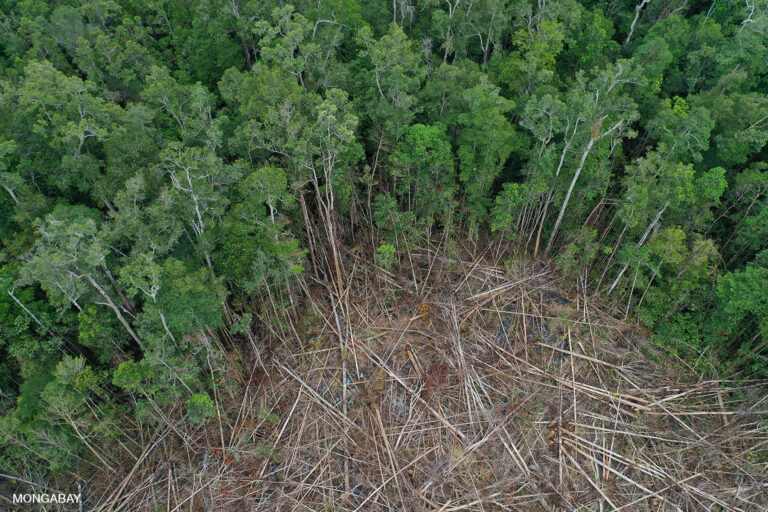
The EUDR was designed to protect tropical forests in places like the Amazon and Indonesia, which continue to shrink at alarming rates, driven in large part to meet consumption demand in wealthy markets. The EU is the world’s second-largest driver of imported deforestation, after China.
But political momentum has shifted sharply inside the bloc. The EUDR was meant to go into force at the end of 2024. This was then delayed by a year, pushing the enforcement date to Dec. 30 this year. But since late 2024, member states and business groups have pressed for more delays and exemptions, citing readiness concerns and pressure from sectors such as timber and cattle.
On Nov. 19, EU governments went further. Meeting in Brussels, the Council of the EU, which represents the governments of member states, adopted a negotiating mandate that supports a uniform one-year delay, pushing the main obligations to December 2026, and backs sweeping reductions to due-diligence requirements. The same mandate also calls for a review in 2026 that would allow the European Commission, the executive branch of the EU, to reopen the regulation and propose new simplification measures.
This will be the position that the Council of the EU will take into talks with the European Parliament, which represents and is elected by EU citizens. It also points to a high likelihood that the EUDR will be diluted before it ever takes effect.
This aligns closely with Germany’s position, which was pivotal ahead of the Council of the EU vote. Berlin pushed for both a one-year delay and lighter requirements for European businesses to comply. Only the Netherlands, Belgium and Spain abstained or objected, according to Giulia Bondi, a senior campaigner at advocacy group Global Witness.
“The hope was to have a blocking minority with France, but [France] decided to back up Germany’s proposal,” she told Mongabay.
The move comes on top of an earlier proposal from the European Commission, released on Oct. 21, which already included significant rollbacks. The Commission did not propose a fresh delay, but its revisions expanded exemptions and simplified procedures for operators and traders. Civil society groups warned at the time that these changes alone threatened to undermine the core of the law.
Amid these developments, 95 civil society organizations, including Greenpeace EU and WWF EU, issued a joint call urging EU leaders to implement the EUDR as written and avoid weakening its essential protections. They argued that further postponement would unfairly penalize, through sunk costs, those companies and member states that have already invested heavily in compliance, eroding confidence in the EU as a stable regulatory environment. One year has already been lost to political wrangling, they said, leaving supply chains in limbo.
Despite the mounting pressure, observers say EU delegates have been largely silent about forests and the EUDR throughout COP30.
“There’s a lot of talk about the COP being at the doors of the Amazon, but deforestation is not prominent in the negotiations [which] very much is focused on phasing out fossil fuels,” Bondi said.
For Patentreger, the missed opportunity at the EU press conference underscores the contradiction.
“If we’re not saying here in COP30 in the Amazon that we want to save the forest, what’s the sense of having a COP in the Amazon?” he said.
Asked about the push to delay and weaken the regulation, Lidia Pereira, who heads the European Parliament’s delegation to COP30, said discussions were still at an early stage.
“I believe the outcome will be the enforcement of the EUDR as soon as possible,” she told Mongabay. “And we have to make sure that the mechanisms are in place to monitor and verify the implementation and the use of the law.”
Patentreger rejected that characterization. He pointed out that more than two years have passed since the EUDR was adopted, its original start date of December 2024 has already slipped to 2025, and now member states are positioning themselves to delay it again to 2026.
“We’re at the last stage, and at this moment, [at] COP, they’re killing the EUDR,” he said.
Patentreger’s colleague, Mighty Earth senior adviser Isabel Fernandez, said EU governments were breaking their promises.
“While EU climate negotiators mouth platitudes at COP30 in the Amazon in Brazil, member states in Brussels are condemning another 70,000 hectares [173,000 acres] of forests like the Amazon to be razed to the ground via this outrageous proposal to further postpone the EUDR,” she said.
Bondi said another delay would embolden sectors such as meat, soy, palm oil and cocoa, which have spent the past year lobbying to weaken the rules.
“What’s happening in Brussels is terrible and the EU is playing a double game: here in Belém they keep saying that they want to walk the talk, they want to show leadership, but what’s happening in reality is continuing to give companies extra time to be off the hook from any obligations,” she said.
Fernandez reminded the EU of what’s at stake: “If this crucial law is not implemented in full and on time, there will be devastating consequences not just for tropical forests and the people and wildlife that live there, but for the whole planet.”
The consequences would be even more serious for rainforest countries like Indonesia, said Andi Muttaqien, the executive director of Indonesian NGO Satya Bumi.
“For Indonesia, the delay carries major implications for the potential clearing of 3.6 million hectares [8.9 million acres] of natural forest inside oil palm concessions, and roughly 17 million hectares [42 million acres] of natural forest inside industrial timber concessions,” he told Mongabay. “Another consequence is that it pushes Indonesia further away from the ambition of achieving deforestation-free and sustainable plantation governance.”
Update: This story has been updated to include additional comments from Andi Muttaqien, executive director of Satya Bumi, on the implications of a potential EUDR delay for Indonesia.
Banner image: Patchwork of legal forest reserves, pasture and soy farms in the Brazilian Amazon. Image by Rhett A. Butler/Mongabay.
FEEDBACK: Use this form to send a message to the author of this post. If you want to post a public comment, you can do that at the bottom of the page.
Cite this article
Hans Nicholas Jong (2025). EU touts climate leadership while undermining antideforestation rules, critics say. Mongabay Conservation news. DOI: https://doi.org/10.66709/news-309907Credits


