- Hundreds of live hornbills and their parts, including casques, heads and feathers, are illegally traded in Indonesia, some online, according to a new study.
- Researchers reported that nearly 500 hornbills, most of them alive, were confiscated by Indonesian authorities from 2015 to 2024. The illegal commerce spanned seven countries. China was a prominent destination.
- More than 500 of the birds, including chicks, were sold online for the pet trade. Facebook was the main marketplace.
- As long-living, slow-reproducing birds, hornbills don’t bounce back easily from declines. Conservationists called on Indonesian authorities to enforce laws and prosecute those involved in the illegal trade. They also urged accountability for online platforms permitting this illicit activity.
Among the many inhabitants of Southeast Asia’s dense rainforests are hornbills — a group of birds that stand out with their raucous call, large, ostentatious beak and colorful feathers. Indonesia harbors 13 species, the most of any country in Asia, three of which are found nowhere else.
Hornbills are rapidly losing their homes as large swaths of Indonesian forests are cut down to make way for plantations, mining, dams, cities and other development, or are scorched by wildfires.
Trade in these birds also poses another serious threat. Hundreds of hornbills are entering the illegal trade in Indonesia, according to a new study published in the journal Wild, some of which are offered for sale online. They’re sold alive as pets or killed for their casques, the ivory-like appendages above their beaks, and their taxidermied heads, which are displayed as home décor.
To understand the scope of this trade, researchers analyzed police and customs confiscation data and surveyed online ads from 2015 to 2025. They learned that this illegal commerce is widespread and involves every Indonesian hornbill species and some from Africa and the Philippines as well. Most birds were sold alive, suggesting they’re bought as pets. Facebook was the preferred online marketplace.
“The scale of the hornbill trade in Indonesia is probably greater now than I’ve seen it in the past,” said study author and wildlife trade researcher Chris Shepherd from the U.S.-based Center for Biological Diversity. “It’s becoming, perhaps, trendier to keep hornbills.”
Indonesia is infamous for its songbird trade, which has caused what scientists dubbed the “Asian songbird crisis.” Each year, millions of songbirds, worth billions of dollars, are caught in the wild and sold in bird markets. They’re kept as pets or forced to compete in singing competitions. The trade has emptied the forests and pushed many bird species to near-extinction.

Like many songbirds, all hornbill species are protected under Indonesia’s laws, making it illegal to hunt, keep, buy, sell or transport the birds. While the songbird trade is extensively studied, there’s little data on hornbills. The new study sheds some light on this illicit activity.
Bird trade researcher Simon Bruslund from the Copenhagen Zoo said this study “is very relevant” to understanding the targeted trade in hornbills. “There seems to be a growing regional market for keeping nonnative hornbills in Asia, particularly with Philippine species in Indonesia and Indonesian species in India,” said Bruslund, who wasn’t an author on the study but helped identify the species sold online.
A worrying growth in trade, online and offline
Seizure records revealed 126 incidents involving about 556 hornbills from 14 species, including the rufous hornbill (Buceros hydrocorax), also known as the Philippine hornbill, which is endemic to that country. Nearly half of the seizures, involving some 222 birds, were traded alive, likely intended for the pet trade. Parts of dead birds are also popular, including beaks and heads.
“The growing demand for hornbill heads as a decoration is a little bit shocking and confusing,” Shepherd said. “We’ve seen this in Africa suddenly skyrocket, and although it is not to the same scale in Southeast Asia, we are seeing more heads here.”
In 2025, researchers called for trade protections for African forest hornbills after they found more than 2,000 dried heads imported into the U.S. between 1999 and 2024. These protections were granted later that year under CITES, the global convention to regulate the trade in threatened wild plants and animals. Legal global commerce requires permits; birds that were seized by officials and recorded in the study were illegally traded.
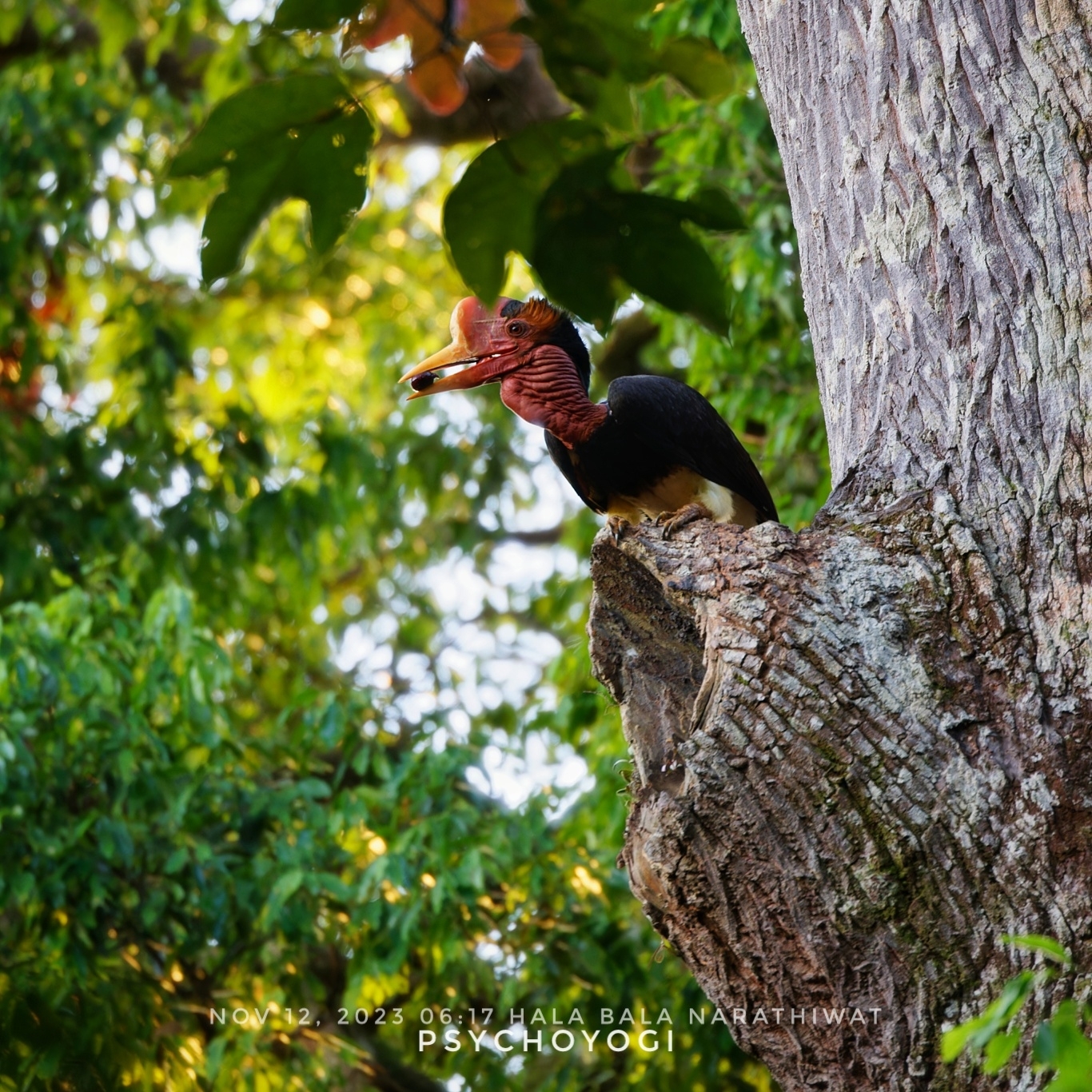
The critically endangered helmeted hornbill (Rhinoplax vigil) topped the list of traded species, with 80 birds found in 13 incidents. Their casques are carved into decorative items, just like ivory. The unrelenting demand for casques, primarily from China, drove this unique bird from near-threatened status in 2015 to critically endangered just three years later.

The wreathed hornbill (Rhyticeros undulatus), a vulnerable species found across Southeast and South Asia, was also in high demand: Officials found 72 of the birds in 26 incidents. Other widely traded species include the knobbed hornbill (Rhyticeros cassidix) and rhinoceros hornbill (Buceros rhinoceros).
About two-thirds of the seizures involved other wildlife: live birds of prey, cockatoos, gibbons, and body parts from pangolins, bears, tigers and snakes.
More than 100 people were prosecuted for hornbill trafficking, according to the study. They faced prison sentences from a month to four years, and fines ranging from 500,000 to 100 million rupiah ($27.50 to $5,500 at current exchange rates).
The study also shed light on trafficking routes. East Java and Jakarta, two of the country’s main population centers, were the most prominent destinations for smuggled hornbills, while the largely forested island of Sulawesi was a major source. The international trade involved at least seven countries, with China being the most prominent destination.
This analysis is likely an underestimate, the researchers say, because seizures represent just a sliver of illegal commerce and the data excluded all cases that didn’t go to court.
Chicks and young birds dominate online trade
While investigating the online trade, the researchers recorded 231 posts advertising hornbills from Indonesia. They documented 560 birds belonging to 16 species for sale, including one from Africa; the wreathed hornbill was the most popular. One advertiser on Tokopedia, Indonesia’s largest online marketplace, claimed to have a stock of 1,000 hornbills. Another said they had 100.
Ninety percent of sellers posted on Facebook, a platform preferred by wildlife traffickers, according to numerous reports and investigations. The highest online price was 42.5 million rupiah ($2,340) for the western long-tailed hornbill (Horizocerus albocristatus), endemic to West Africa.
“A lot of the hornbill trade has gone online, especially on Facebook,” Shepherd said. “There are Facebook groups dedicated to hornbill collectors and hornbill traders, and they have a lot of members.”
These groups, he said, connect buyers and sellers — and encourage more buyers. “You might be interested in hornbills, but never in a million years think you’re going to own one. And then you get into one of these groups and, well, they’ll deliver to your house.”
At least half of these ads, the study found, featured hornbill chicks or juveniles. The researchers say they’re likely caught in the wild because breeding hornbills in captivity is extremely challenging.
In the wild, the female and her chick nest in a hollow tree cavity that’s sheltered from the outside. The male bird regularly delivers food through a small slit. To snatch these birds, poachers “have located the nest and climbed up and smashed through the barrier and taken the chicks out,” Shepherd said.
Even when poachers get the chicks, raising them is a challenge. “The young birds often need intensive care,” Bruslund from Copenhagen Zoo said, adding that actors from abroad likely commission poachers to capture rare hornbill species.

Conservationists call for actions
These birds play a vital ecological role as seed dispersers in the landscapes they inhabit. “Hornbills are incredibly important for reforestation — they eat big fruits and poop out big seeds,” Shepherd said. “They regenerate the forest … in ways that other species can’t.”
As their habitats vanish, trade is threatening the future of these heavy-beaked birds. “Hornbills occur in low densities and reproduce very slowly, and often only occur in lowland rainforests, which are under particular pressure,” Bruslund said. Since most species raise just one chick a year, they can’t easily bounce back from sharp population declines.
“With additional threats of trapping and hunting, populations are very vulnerable,” Bruslund said.
Most Southeast Asian hornbills are protected under CITES, which requires permits for cross-border trade. But the African and Philippine species offered for sale online didn’t appear to have any paperwork, the researchers said, which violates international laws. Commerce in all Indonesian species is outlawed by the country’s regulations.
While some birds are stumbled upon by hunters, others are actively sought. “Hornbills are in the mix between opportunistic and targeted trade,” Bruslund said. “It’s the targeted trade which is being enabled by social media markets I am most worried about.”
The researchers urged Indonesian authorities to investigate the numerous bird markets spread across the country, enforce national laws and strengthen regulations to address the illegal trade.

“Indonesia really needs to close the bird markets, which are largely full of illegally sourced birds,” Shepherd said. “Dealers in these markets are very often involved in trading hornbills, and these people need to be investigated. If they’re found with hornbills, legal action has to be taken against them.”
He also said corruption at airports may facilitate the trafficking of these noisy birds. “Moving large animals like that generally relies on a healthy dose of corruption,” Shepherd said. “Airports have the best security systems you can imagine. How come you can take a live hornbill through them? [They] need to be investigated and monitored, and there needs to be a great increase in vigilance in airports.”
Online platforms, including Facebook, have policies meant to prohibit buying or selling animals and their parts, but these are rarely enforced, as evidenced by numerous reports. While the platform has been aware of ongoing commerce in wildlife and threatened species, it has done little to address it, Shepherd said. Meanwhile, shutting down groups and accounts is only a minor “hassle” for traffickers, he said, as they simply launch a new group or create a new account.
“The birds still are in somebody’s hands, and if you shut down the Facebook groups, [traffickers] are going to move to WhatsApp or something else,” Shepherd said.
However, he added, “If you arrest and put [them] in prison for selling hornbills illegally, that becomes more than a hassle and a real deterrent.”
Banner image: The wreathed hornbill, found across South and Southeast Asia, was prominently represented in the seizures. Image by Nick Volpe via iNaturalist (CC BY-NC 4.0).
Spoorthy Raman is a staff writer at Mongabay, covering all things wild with a special focus on lesser-known wildlife, the wildlife trade, and environmental crime.
African forest hornbills gain new protections from unsustainable trade
With ‘terrifying’ trade in African hornbills, scientists call for increased protection
New database unveils the role of Asian hornbills as forest seed dispersers
Citations:
Gomez, L., Leupen, B. T. C., Rachmayuningtyas, B., Sari, D. R., & Shepherd, C. R. (2026). The illegal exploitation of hornbills in Indonesia with international trafficking links to Africa and Asia. Wild, 3(2), 19. doi:10.3390/wild3020019
Lees, A. C., & Yuda, P. (2022). The Asian songbird crisis. Current Biology, 32(20), R1063-R1064. doi:10.1016/j.cub.2022.08.066
FEEDBACK: Use this form to send a message to the author of this post. If you want to post a public comment, you can do that at the bottom of the page.
Credits