Researchers in Nepal have confirmed a rare Chinese pangolin living in a small community forest considered sacred by locals, according to a recent study. It may also be the first video evidence of the pangolin in Nepal’s Sunsari district, researchers said.
The Chinese pangolin (Manis pentadactyla), listed as critically endangered on the IUCN Red List and protected under Nepalese laws, is threatened by both habitat loss and poaching. This makes every verified population, especially those outside protected areas, important for conservation, study lead author Tujin Rai with Tribhuvan University in Nepal told Mongabay by email.
Chinese pangolins are found across Nepal. However, verified records of the species in eastern Nepal remain poor, the authors wrote.
Previous research has found indirect signs such as pangolin burrows and footprints in Panchakanya community forest in Sunsari district. The community forest, spanning just 0.56 square kilometers (0.22 square miles), is located “within a mosaic of villages, agricultural lands, transportation infrastructure, and the Sewti River,” Rai said.
To verify the presence of the pangolin in the forest, Rai and his colleagues installed camera traps on trails and around recently dug burrows in January 2025.
On Jan. 21, 2025, the cameras recorded a male Chinese pangolin.
Rai told Mongabay that during field surveys they also recorded nearly 30 pangolin burrows and other signs, especially in areas with abundant ant and termite colonies, which pangolins like to eat. These observations suggest the forest possibly supports more than a single individual; however, right now the team can only confirm one individual, he said. Long-term monitoring will be needed to assess population size and habitat use patterns, he added.
Still, confirmation of a Chinese pangolin in Panchakanya “demonstrates that even small, fragmented forests outside protected areas can provide important refuges for threatened wildlife,” Rai said.
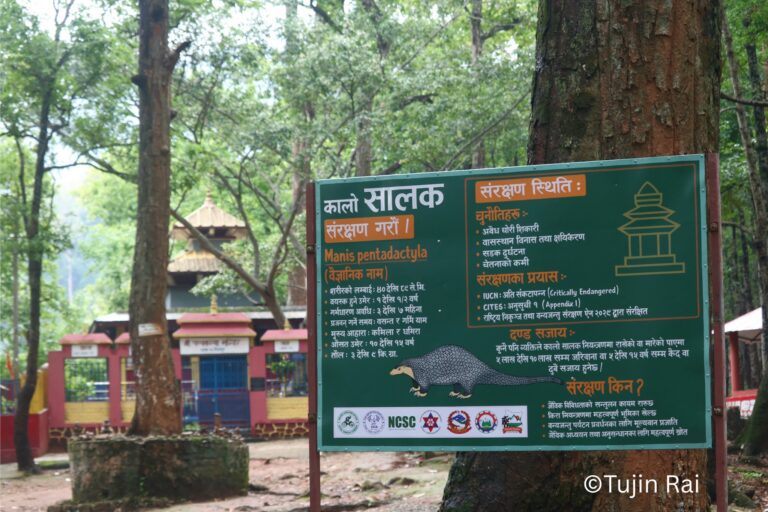
A temple within Panchakanya that’s revered by local communities, likely offers the forest some protection. A community forest user group has also established “guidelines on harvesting forest products, livestock grazing, and other activities that could affect the forest ecosystem,” he said.
Panchakanya still has patches of relatively intact forests thanks to protection afforded by local traditions, religious beliefs and community forest management; however, human activities such as fuelwood and mushroom collection and religious and cultural gatherings do have an impact, Rai said. There is a need for proactive community stewardship to conserve the species, he added.
Kumar Paudel, a pangolin specialist from the nonprofit Greenhood Nepal who wasn’t involved in the study, told Mongabay that apart from poaching, habitat loss is a major threat in community forests outside protected areas. “Communities can help reduce poaching and prioritise not disturbing pangolin habitats while doing other forest management or development activities.”
Banner image: Camera-trap photograph of a Chinese pangolin recorded in the Panchakanya forest in Nepal on Jan. 21, 2025. Image courtesy of Tujin Rai/Nature Conservation and Study Centre.
Credits