- Part of the difficulty in mainstreaming religious faith into conservation thinking and practice comes down to outdated narratives.
- The negative impact of Christianity on the environment has in particular been well-circulated for over a half-century, but this doesn’t fully reflect current realities in nations like Kenya.
- “As the diversity of Christian expression in Kenya demonstrates, the faith, its theologies and its outworkings are plural, contested, and capable of generating both productive and destructive relationships with the environment and its non-human inhabitants,” a new op-ed argues.
- This article is a commentary. The views expressed are those of the author, not necessarily of Mongabay.
The influence of Christianity in public life in Kenya is undisputed. Indeed, for more than a century, everyday life in the country — from education to health care and politics — has, in many ways, been shaped by the faith. From missionary origins to indigenous expressions, Christianity has been, and remains, “one of the most powerful sociocultural forces” in Kenya. Interestingly, however, despite the prominent place of Christianity, the entanglements between Christianity and conservation — itself a major sociopolitical contour in Kenya — have been sorely understudied.
In this sense, Stuart Butler’s 2024 article for Mongabay exploring the dynamic intersection of Maasai traditional religion, Christianity, land privatization, and conservation in the Naimina Enkiyioo (Loita) Forest is, in part, a breath of fresh air. For too long, religious faith (of any kind) has been on the margins of mainstream conservation thinking and practice. While some major players in conservation have begun to increasingly partner with faith communities and faith-based organizations (see for example WWF and UNEP), the task of getting (mainly Western) conservation practitioners and organizations to take faith seriously remains an uphill battle.
Perhaps part of the difficulty in mainstreaming religious faith into conservation thinking and practice are the popular, but often partial, narratives concerning how faith — and for the purposes of this piece, Christianity — relate to conservation. In particular, the narrative concerning the negative impact of Christianity on the environment has been well-circulated for over a half-century, popularized and propelled most notably by the publication of Lynn White Jr.’s 1967 article in Science, “The Historical Roots of our Ecological Crisis,” an article that, to date, has been cited nearly 12,000 times in the academic literature.

In this unquestionably seminal article, White Jr. argued persuasively that Christianity as practiced in the West is a major cause of worldwide ecological crisis. Importantly, White Jr. was not alone in this view, as demonstrated by a host of academic and nonacademic publications that build on his pathbreaking work by linking Christianity to environmental degradation in both historical and contemporary contexts.
Against this backdrop, Butler’s piece builds on a well-established narrative in conservation thinking. This, however, does not mean there is no truth in Butler’s writing. During my Ph.D. studies on the intersection of Christianity and conservation in Kenya, I too encountered stories of communities whose conversion to Christianity led them to believe they had “dominion” over (read: right to exploit) landscapes once considered sacred. Indeed, Butler is right to draw attention to the potential negative impacts of increasing Christianization on both deforestation and land privatization in the context of the Naimina Enkiyioo Forest. For while Christianity as practiced has long been blamed for environmental degradation, as his piece demonstrates, much of this is well-deserved.
However, in Kenya, perhaps more than in many other countries, the entanglements between Christianity and conservation are particularly unique. Butler’s piece productively draws attention to these entanglements, but does so through a necessarily focused lens. In foregrounding the potentially negative environmental implications of Christianization of the Maasai in the Naimina Enkiyioo Forest, the article highlights just one important color of a polychromatic and dynamic relationship between Christianity and conservation in Kenya.
In this sense, while on one hand Butler provides an important service to this understudied intersection by taking the role of faith seriously, on the other hand, the account also reflects a wider tendency to emphasize the popular yet partial narrative of Christianization leading to environmental degradation, while at the same time neglecting Christian movements that have fruitfully engaged with conservation thinking and practice.
To be clear, Butler is right to call out the potentially negative environmental impacts of Christianization among the Maasai, but to take faith seriously also means keeping track of both the worst and the best of the entanglements between conservation and Kenya’s largest religious demographic. Once this broader perspective is taken, a different set of stories enter the frame — stories that serve to complicate the narrative that, as Butler’s title suggests, Christianity and conservation are in conflict.
Since at least the early 1990s, there have been sustained, fruitful entanglements between Christianity and conservation in Kenya. In November 1991, the Anglican archbishop-to-be of Kenya, David Gitari, led a series of influential meetings and Bible studies at a nationwide conference of church leaders on the environment and the role of the church in environmental stewardship.

Building on this, in February 1992, the National Council of Churches of Kenya (NCCK), together with the Green Belt Movement founded by Wangari Maathai, convened the Churches Forum on Environment and Development in Nairobi to further discuss the ways in which churches and faith communities across Kenya could work to promote and practice environmental stewardship. Their efforts would bear fruit toward the turn of the century, when Kenya’s first explicitly Christian conservation organization, A Rocha Kenya (ARK), was established.
ARK was born in 1998, in part out of the wider Christian conservation movement that is a rocha (Portuguese for “the rock”), years after the first A Rocha organization founded in Portugal in 1983. Since its establishment, ARK, motivated by its mission to “make God’s love for His world known by demonstrating how to practically care for it,” has been actively involved in practical conservation efforts along Kenya’s central coast and coastal hinterlands.
From its founding to present day, ARK has carried out community conservation work in the Arabuko-Sokoke Forest in Kilifi county, the largest and most intact coastal dryland forest in East Africa. More recently, ARK has worked to establish a nature reserve of more than 7,000 acres (2,800 hectares) in the Dakatcha Woodland — a Key Biodiversity Area (KBA) home to 13 IUCN Red Listed species, including four classified as endangered — that has been under increasing threat of deforestation due to increased charcoal production and the rapid expansion of pineapple farms.
Further inland, Creation Stewards International (CSI; formerly Care of Creation Kenya) has been working to promote environmental stewardship in and around the Rift Valley since 2005. Focusing on creation stewardship training and educating church leaders, CSI works to integrate creation stewardship into mainstream church teaching while promoting indigenous forestry, biodiversity conservation, and sustainable livelihood practices through practical workshops and training events.
Perhaps the best-known merging of Christianity and environmentalism more broadly in the Kenyan context can be seen in the life, work and writings of the late Maathai, the founder of the Green Belt Movement and the first African woman to receive a Nobel Peace Prize. While her political and environmental activism are typically the main subject of writings and commentaries on her life, a less appreciated but fascinating part of her work were the ways in which she drew on biblical themes of environmental stewardship to motivate and justify her work. Though Maathai was rightly critical of Christianity’s connection to empire, cultural condemnation and land dispossession, her final publication, Replenishing the Earth: Spiritual Values for Healing Ourselves and the World, published just a year before her death, is replete with biblical references used to establish a spiritual basis for environmental stewardship.

Importantly, this spirit of Christian environmental activism lives on in Kenya. Newly established groups such as the Young Theologians Initiative for Climate Action and Kenya’s Green Anglicans Movement are working to safeguard the integrity of creation across Kenya. What’s more, the Anglican Church of Kenya has declared 2026 the “year dedicated to care for the environment” under the banner of the theme “Wholesome Ecology.” Critically, many of these efforts in church-led environmental stewardship are being spearheaded and sustained by young Kenyans who are increasingly recognizing that their faith and caring for creation are not in conflict, but rather are co-productive.
This article is not suggesting that Christians or the church have a monopoly on how to rightly practice conservation or environmental stewardship more broadly. History clearly shows that Christians have a less than laudable track record on this front. Nor is this an attempt to rehabilitate the environmental record of Christians through selective amnesia. Rather, this is about trying to take faith seriously and tell the truth about the dynamic, fascinating, and often contradictory entanglements between Christianity and conservation in Kenya.
As Butler alludes to, Christianity in Kenya is an extremely powerful social force, with more than 85% of Kenyans identifying as Christian. With such a large contingent of Kenyans practicing the faith, this shows that in the context of conservation, Christianity in Kenya cannot be treated as monolithic. As the diversity of Christian expression in Kenya demonstrates, the faith, its theologies and its outworkings are plural, contested, and capable of generating both productive and destructive relationships with the environment and its nonhuman inhabitants.
Rather than casting it in the singular mold of conservation anathema, conservation thinkers and practitioners could embrace the kaleidoscopic complexities of Christianity — and all religious faiths — in shaping decisions and outcomes. Indeed, if conservation is to be marked by a deep spirit of social relevance in Kenya and elsewhere, religious faith must be taken more seriously.
Peter Rowe completed his Ph.D. in geography at the University of Edinburgh, U.K., in 2025, where he investigated historical and contemporary links between Christianity, conservation and agriculture in Kenya.
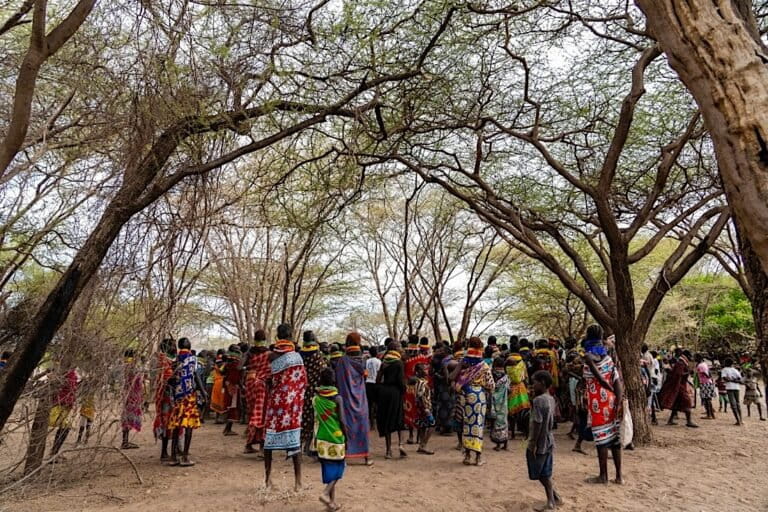
Banner image: Kenyan Christian congregations which lack churches often gather for worship in the shade of forests. Image courtesy of AGWM Africa.
See related coverage of conservation and religion:
Photos: For Kenya’s Maasai, will a new faith undo age-old conservation traditions?
Taboo against harming strangler fig spirits protects forests in Indonesian Borneo
Bangladesh protects sacred forests to strengthen biodiversity conservation
Citations:
White, L. (1967). The historical roots of our ecologic crisis. Science, 155(3767), 1203-1207. doi:10.1126/science.155.3767.1203
Orr, D. W. (2005). Armageddon versus extinction. Conservation Biology, 19(2), 290-292. doi:10.1111/j.1523-1739.2005.s04_1.x
Sommerschuh, J. (2025). Defending life: Environmental crisis and Catholicism in western Kenya. Religion, 56(1), 117-132. doi:10.1080/0048721x.2025.2504870
Credits