- Brazilian researcher Silvia Pavan organized an expedition to a remote protected area in the Peruvian Amazon to search for a species of squirrel last observed 30 years ago.
- During the expedition, the team discovered a new species of mouse opossum, a type of marsupial, which they named Marmosa chachapoya.
- This new species is distinguished by its reddish-brown fur, yellow-grayish belly, and long, narrow face.
- The eastern Andes of Peru is notable for its high endemism, but remains largely understudied, researchers say.
In 2018, Brazilian biologist Silvia Pavan traveled to Río Abiseo National Park, in Peru’s San Martín region, following the trail of a squirrel species first described from there in the 1990s. At the time, Pavan was collecting genetic samples to study the evolution of South American squirrels. She decided to organize an expedition to Río Abiseo to search for additional specimens of an individual squirrel kept in the National Museum of Natural History, which had never been formally named or described.
“It was a species known from a single specimen collected a long time ago, for which we had no genetic samples,” Pavan tells Mongabay Latam. “So, I proposed to National Geographic that we organize an expedition to where it had originally been found.”
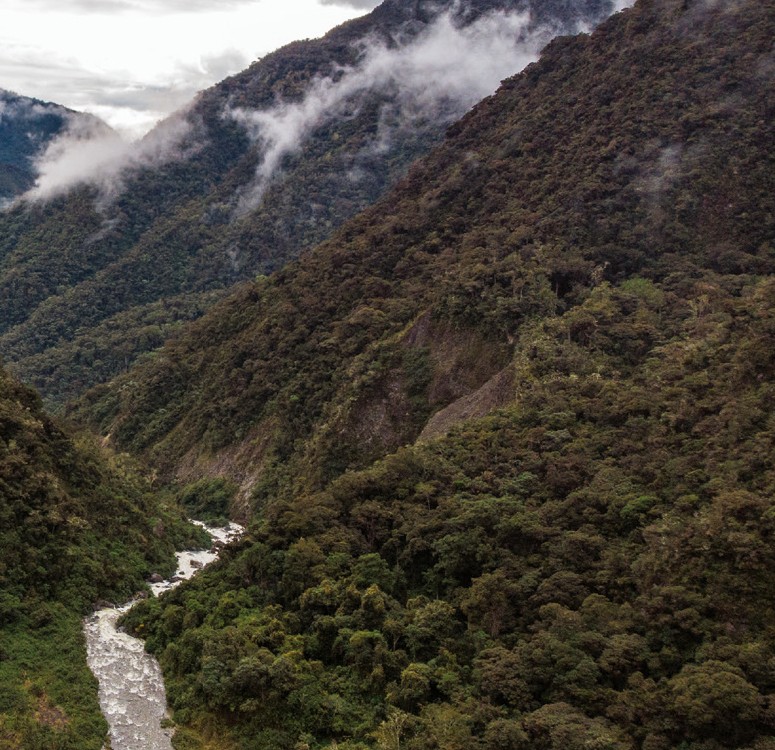
During the expedition, the team managed to see the mysterious squirrel only once, Pavan recalls. However, the journey resulted in the discovery of a new marsupial: Marmosa chachapoya.
Inhabiting cloud forests, this new-to-science mouse possum was observed at an elevation of 2,664 meters (8,740 feet) in an ecosystem renowned for its high level of endemism. M. chachapoya is likely not the only new-to-science species found here. Researchers have encountered at least two other species of mammal unknown to science, and are now analyzing and processing the data. “Marmosa chachapoya, sp. nov., is one of several recently discovered new species from the Parque Nacional del Río Abiseo, a protected area with remarkably high mammalian diversity,” Pavan and colleagues write in a paper published in the journal American Museum Novitates describing the new marsupial.
Meet Marmosa chachapoya
The paper describes the species as having a “long and narrow rostrum [snout], reddish brown dorsal fur, tail much longer than combined length of head and body, midrostral fur lighter colored than fur of crown, and dark facial mask.”
During the expedition, only a single specimen was collected, according to Pavan. “Marmosa chachapoya is the first species that we discovered and were able to catalog on this expedition,” Pavan says.

Pavan says the permit granted by Peru’s National Service of State-Protected Natural Areas (SERNANP) for research in the parks allows for the collection of only a small number of specimens. In addition, the expedition lasted only 15 days, a short period of time for observing more individuals of the species.
“It’s an area with exceptionally high endemism among small mammals, which has been little studied scientifically,” Pavan says. “There are undoubtedly other species that still need to be described.”
In a 2024 study, Pavan and colleagues broached the likelihood of discovering new-to-science species in this region: “The eastern Andean slopes harbours [sic] a diverse fauna with multiple endemic and endangered species. The region is identified as a biodiversity hotspot with high conservation priority. However, it remains one of the least studied in South America regarding the diversity of mammals.”

That earlier study provided new insights into the diversity of small mammals, including marsupials and rodents, in Río Abiseo National Park. During 15 days of sampling, researchers recorded 16 species — 12 rodents and four marsupials — within the montane forests, at elevations of 2,500-2,800 m (8,200-9,190 ft). The study also noted that 11 of the 16 recorded species have never been observed anywhere else.
Genetic identification of the new species
“Dr. Pavan and I worked on samples in Brazil to obtain their genetic data, which we then compared with other samples from both the San Marcos Natural History Museum and the American Museum of Natural History,” says Pamela Sanchez-Vendizú, a Peruvian researcher at the Mammalogy Department of the Natural History Museum of the National University of San Marcos and a co-author of the new paper. “That’s how we confirmed that we truly had a new species.”
Historically, she says, confirming whether a specimen constitutes a new species relied primarily on comparisons of its morphology, or physical characteristics, with those of known species. This has changed with the rise of genetic research. “The DNA of our new species is highly divergent from that of other known species,” Sanchez-Vendizú says, referring to the genetic comparisons with specimens held in museum collections.

She says that when they first observed this new species, they were struck by the fact that the animal was found higher upslope than other known species of the same genus, which typically inhabit lower elevations. “That was our first intuition that what we had captured was probably another species,” she says, adding that its morphological traits were also different from those of known mouse opossums in the genus Marmosa.
Because they were only able to obtain one specimen of M. chachapoya, it’s been difficult to carry out analyses using advanced molecular technologies, Sanchez-Vendizú says. As a result, much still remains to be discovered about the new species.
César Medina, a researcher in the Mammalogy Department of the Natural History Museum in Arequipa, says molecular DNA analysis makes identifying a new species “a bit easier,” since it allows scientists to “distinguish more quickly between one species and another.” In the past “many specimens were needed to make comparisons,” he says, and researchers had to capture animals from different locations to carry out those analyses.
Medina, who wasn’t involved in Pavan’s expeditions, says expeditions to assess a protected area or a remote location in the Peruvian Andes — such as the valley formed by the Apurímac, Ene and Mantaro rivers — almost always yield a new-to-science species. In most cases these are insect, but can also be a new plant or, in this case, a new mammal.

Medina points out another distinctive feature of the Andes: “As you ascend the mountain range, the composition of species changes. The same species are not found at all elevations — some are observable at around 2,000 meters [6,600 ft] above sea level, while others are at about 800 meters [2,600 ft] above sea level.”
Medina says many species remain undescribed in the eastern Andes. “There are mouse species known from only one or two collected specimens, and to this day, no one else has encountered them,” he says, emphasizing that these are challenging areas to explore.
“Climbing the Ceja de Selva — the section of the Andes that slopes down toward the Amazon — is like climbing Misti [a volcano] but covered with dense trees and moss. There’s no clear path; you have to forge your way with a machete, and you can only walk along the ridges of the hills because entering the valleys means facing sheer cliffs.”
In the north, for example, Medina says parts of the Andes in the Ceja de Selva form deep canyons. “You’re walking along a ridge, and when you look to the right, there’s a canyon about 100 meters [330 ft] deep. It’s very challenging terrain, which is why there aren’t many expeditions.”
Banner image: Marmosa chachapoya is a newly described species of mouse opossum. Image courtesy of Silvia Pavan.
This story was first published here in Spanish on July 30, 2025.
Citations:
Pavan, S. E., Abreu, E. F., Sánchez-Vendizú, P. Y., & Voss, R. S. (2025). A new species of Marmosa (Mammalia: Didelphimorphia: Didelphidae) from Parque Nacional del Río Abiseo, Peru. American Museum Novitates, 2025(4037). doi:10.1206/4037.1
Pavan, S. E., Abreu, E. F., Sánchez-Vendizú, P. Y., Batista, R., Murta-Fonseca, R. A., Pradel, R., … Peloso, P. (2024). A hint on the unknown diversity of eastern Andes: High endemicity and new species of mammals revealed through DNA barcoding. Systematics and Biodiversity, 22(1). doi:10.1080/14772000.2024.2302196
Credits