

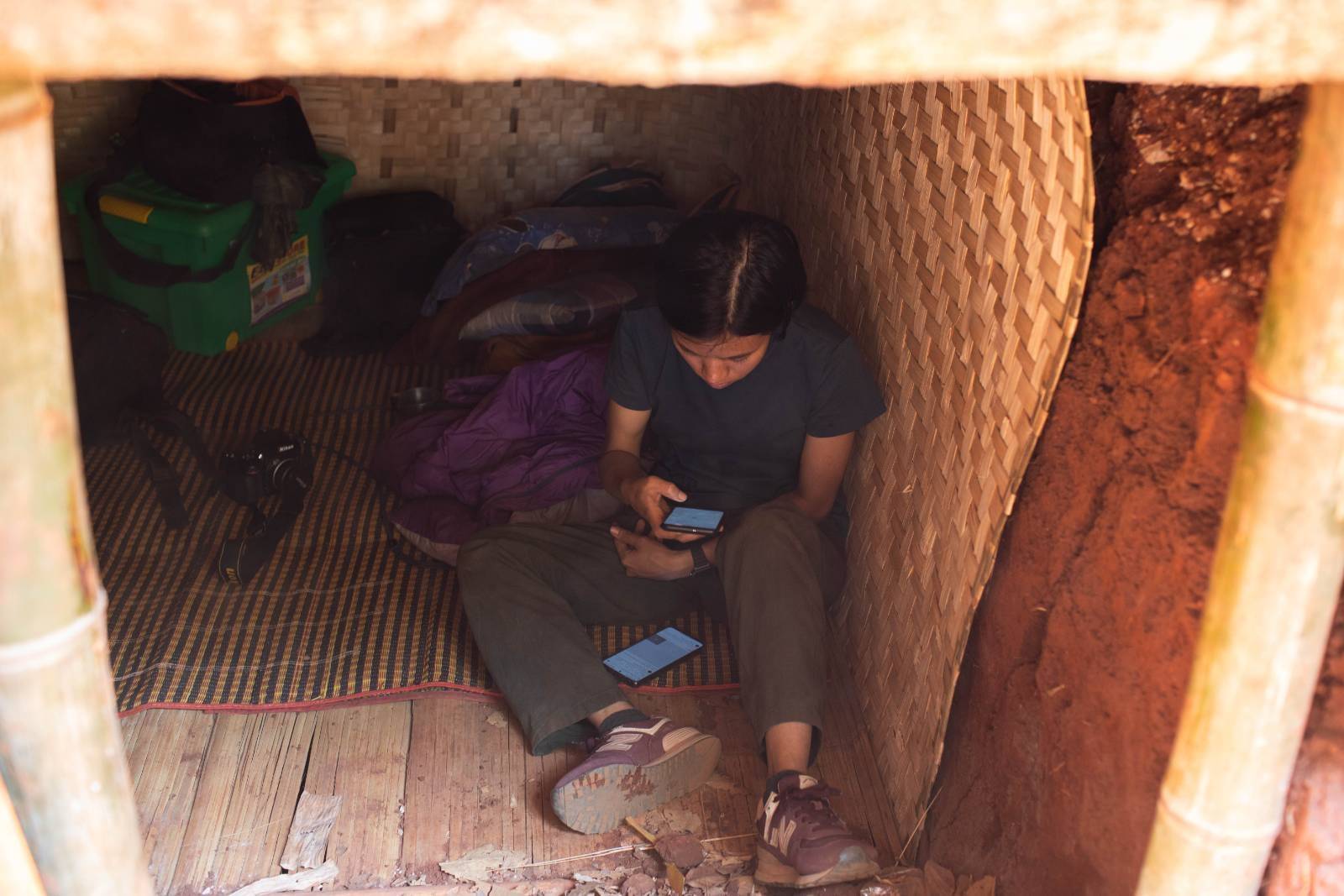
- Since the 2021 coup in Myanmar, environmental degradation has worsened, but one small women-led team works on grassroots conservation in conflict areas.
- Clean Mountains helps local communities in Karenni and Karen states with waste management, water conservation, sustainable agriculture and forest conservation.
- Founder Ou Ou discusses how the ongoing conflict has fueled natural resource destruction and also silenced the voices of conservationists.
- She also speaks about the role of gender in conservation work, why women participate more often in waste management efforts and how long-standing traditional beliefs continue to leave women out of decision-making roles.
Myanmar experienced a military coup in February 2021. In the aftermath, widespread repression by the military regime fueled the emergence of armed resistance movements across the country, pushing an ongoing conflict to its most intense level in decades.
Starting from 2024, the military’s conscription law has further threatened the lives and futures of young people, forcing thousands to leave the country. Meanwhile, environmental degradation continues to worsen. People are facing multiple crises, including environmental destruction caused by the overexploitation of natural resources, natural disasters, armed conflict, and human rights violations by the military regime.
The democratic freedoms that used to exist during the five years of semi-civilian government before the coup have disappeared. Within this context, environmental activism and conservation efforts have widely faded.
Yet, against this backdrop, the environmental group Clean Mountains was established in 2024 and is based in the conflict-affected states of Karenni (Kayah) and Karen (Kayin), areas controlled by resistance forces. The organization — funded through grants and donations — is a small, women-led team of four members between the ages of 22 and 28. The group’s founder, Ou Ou, 27, leads Clean Mountains in implementing community-based conservation in conflict-affected mountainous regions, focusing on waste management, water conservation, sustainable agriculture and forest conservation.

Through both her previous organization and Clean Mountains, waste management systems have been established in more than 130 villages, including 15 in Karenni state alone. Each waste collection cycle gathers approximately 600 kilograms (1,322 pounds) to 1 ton of waste per village.
Mongabay spoke with Ou Ou in June. The following interview has been translated from Burmese and edited for length and clarity.
Mongabay: How does environmental work connect to your personal identity and personality?
Ou Ou: This is connected to my childhood. I grew up in a broken family, and I felt my existence did not matter to anyone. I felt like a useless person. But when I started working in the environmental field, I began to see the impact of my actions. My contributions could benefit many people and ecosystems.
I previously worked in hotels in customer service. At that time, I often asked myself why I was using my knowledge and energy to make the wealth of the owner. That feeling pushed me to shift toward work that benefits the people.
Gradually, I realized that the consequences of environmental destruction are very scary. If we do not act now, future generations may not have clean air or safe water. Environmental degradation is also a violation of children’s rights.
Although I did not receive much love or protection in my childhood, I want to leave something good for the next generation. I continue my environmental work with this mindset.

Mongabay: What were you doing before the coup, and what have you been doing since the coup?
Ou Ou: I have been working in environmental conservation since 2018. I am primarily an activist focused on reducing plastic waste and plastic pollution. Across Myanmar, from Kachin state in the north to Kawthaung in the south, I worked to establish waste collection systems in villages. My work was mainly grassroots-oriented, focusing on community-based projects. In late 2024, travel became increasingly difficult due to the military conscription law, and I fall within the age range under this law. I did not want to give up my work and leave the country. So, I relocated to resistance-controlled areas in Karenni and Karen states.
Mongabay: How does your waste management program work? Do community members participate directly, or does your team collect the waste yourselves?
Ou Ou: Our philosophy is that we do not give fish. We teach how to catch fish. When we enter a village, we first meet with village leaders, elders, administrators and internally displaced persons committees to discuss how a waste management system can be established and operated. After that, we organize a meeting, introduce ourselves [to the community], introduce the project and explain our objectives transparently.
We then provide awareness sessions depending on the size of the community. We teach people how to separate waste and how to dispose of it properly.
Then, we help establish a waste management committee to ensure the system continues functioning, whether we are here or not. The committee then determines its own garbage collection schedule, whether once a week, every two weeks or once a month.
Unlike municipal waste services in urban areas, our model emphasizes community participation. Villagers use any transportation available — oxcarts, farm tractor, three-wheel auto rickshaw, motorcycles and trucks — to collect waste. Recyclable materials are sold to junk shops. However, due to transportation difficulties and the many military checkpoints, much of the recyclable waste never reaches recycling facilities and instead ends up in dumpsites.
Plastic waste, which poses the greatest environmental risk, is collected and sorted by hand and disposed of in designated locations away from residential areas. Through this system, waste generated by approximately 200 households can be processed within an hour.
Households manage food scraps by feeding them to their livestock. For other biodegradable waste, we teach them how to make compost.

Mongabay: Is it easy to persuade people to participate? How do communities respond to the waste management committees?
Ou Ou: A lot depends on how we communicate and the language we use. We cannot simply talk about global or national environmental issues. We explain the environmental problems we observe in a particular village and how they could affect people’s farms and health, if left unaddressed.
We then ask community members whether they want the system or not. We ask their consent first. People in these communities are already living with many fears and uncertainties. Rather than adding to those fears, we emphasize empathy and collective problem-solving. We focus on the idea that we can work together. The choice of words and communication strategy are important.
Mongabay: What led you to work on waste management issues? What motivated you?
Ou Ou: I studied tourism management in university. Many of my friends are working in the tourism and hospitality industries. For me, I felt that Myanmar is a beautiful country, but that beauty is being damaged by plastic waste. When you enter a city or a village, you see plastic litter everywhere. Very few people seem to address this problem and so I wanted to take on an issue that was being overlooked. As I became more involved in this work, I came to realize how important it is — not only for people, but also for the ecosystem and the environment which strengthened my passion and commitment.
Mongabay: In addition to waste management, could you tell us about the other activities that Clean Mountains is currently carrying out?
Ou Ou: These are our three main program areas: waste management, water conservation and sustainable agriculture.
Rather than focusing on short-term solutions such as water donations, we dig water retention pits in the hills, support the natural regeneration of forests and plant trees to restore natural barriers and improve water retention.
We [also] help farmers make use of locally available resources by teaching them how to produce organic fertilizers, natural pesticides, herbicides and pest-control solutions. We help establish farmer groups so these practices can be applied and shared within communities. In addition, we provide training programs for young people, schools and local organizations.

Mongabay: How interested are local communities in water conservation in Karenni?
Ou Ou: Water conservation is quite different from waste management. After collecting the waste, people can see the results within a week. The area becomes visibly cleaner. So, community participation is very strong.
In water conservation, one challenge is access to land. In Karenni, every piece of land has an owner — a family, a clan or passed down through generations. We need to negotiate with landowners before implementing water conservation activities, such as digging water retention pits.
We explain the benefits and demonstrate successful examples. Once people see the examples, many become interested and start saying ‘I want this on my land’ or ‘I want to do this on my farm.’ Challenges that we faced last year are no longer obstacles this year.
Another aspect of water conservation is forest restoration. Trees take time to grow, so the results are not as immediate as those from waste management.
One approach we use is a cash-for-work model. For example, if we plan to dig water retention pits, we organize community participation while providing income opportunities. So, community participation has become stronger.
Mongabay: Could you share an experience that changed the way you felt about your work?
Ou Ou: The reason why I remain deeply committed to this work is the direct interaction I have had with farmers and fishing communities. In urban areas, people often talk about climate change and organize conferences, workshops and discussions about environmental issues. Much of that conversation takes place in air-conditioned rooms and is disconnected from the realities on the ground.
When I spend time with grassroots people who are experiencing these challenges firsthand, I can clearly see and hear how climate change and environmental degradation are affecting their livelihoods.
One particular experience [with my previous work] was during a research project in the Mergui Archipelago, where we conducted surveys to assess the extent of marine waste pollution. We learned about the growing challenges faced by fishing communities. As temperatures rise and climate conditions change, fishermen are forced to travel farther offshore to catch fish. This increases their operating costs, including fuel and ice for preserving their catch.
Finally, they had to abandon fishing by selling their boats and seeking work as migrant workers in Thailand. From the perspective of both human resources and food security, the impacts are severe.

Mongabay: Why did you choose the name Clean Mountains?
Ou Ou: The name Clean Mountains was chosen for a specific reason. The word ‘Mountains’ is plural. Due to the ongoing conflict, it is impossible for us to travel freely to other areas. Under such situations, the places where I have strong connections and can work are predominantly mountainous regions. We chose the name Clean Mountains to reflect these regions.
Mongabay: In resistance-controlled areas, people face armed conflict, the junta’s airstrikes and artillery attacks. In such a risky environment, are people interested in environmental conservation?
Ou Ou: Compared to other emergency concerns, environmental issues are always left behind. In Myanmar, people are experiencing both armed conflict and environmental crises, not only in rebel-controlled areas but also in junta-controlled areas. When we work with communities, we do not simply tell them the environment is being degraded. Instead, we explain how environmental damage directly affects the things they rely on every day — their soil, water, air quality, health, income and future. When people can clearly see those examples, many communities become highly cooperative.
However, environmental issues still receive less attention than many other sectors. In places like Karenni, discussions about environmental conservation tend to focus mainly on agriculture and forestry. When it comes to natural resources, the issue remains highly sensitive.
Mongabay: Why is it sensitive to talk about natural resources? How?
Ou Ou: Agriculture and forestry are topics that are easy for people to understand and engage with. However, the most serious environmental destruction is being driven by the ongoing armed conflict.
Both the military junta and resistance groups are reportedly relying on natural resources to fund military budgets. I am not saying natural resources extraction should never be done — but it must be done with careful consideration of the consequences. If a certain area is destroyed, there should be an emergency relocation plan for affected communities or some form of restoration. The key is to minimize the harm.
No laws protect environmental defenders like us. Even when we see what is happening, we have very little ability to speak out. We could even get killed if we speak out. What we are fighting for is our future and human rights. It is important that in fighting against the dictatorship, people should not act like the dictators they are fighting against. If they need to extract natural resources, they should do it very carefully.

Mongabay: Can you elaborate on how the military coup and ongoing conflict affected environmental activism?
Ou Ou: The conflict and security situation have significantly shut down our voices. We can no longer speak freely. I can no longer conduct public awareness campaigns on social media. When environmental advocates lose the ability to communicate freely, they [corporates] can take advantage of that silence.
Mongabay: As a woman, do you feel that your gender has influenced your experience working in environmental conservation?
Ou Ou: When I was working in the city, I did not feel the impact of gender very strongly. However, in rural communities, I have experienced it more often.
If I travel with a male colleague, people often assume he is the leader. In our work, we do not usually introduce ourselves by our job titles or positions. In this case, people make assumptions based on gender from their first impression. They assume the male is the person in charge. These are situations I face regularly.
Apart from that, I do not feel that being a woman prevents me from doing my work. I consider myself an independent woman, and I am able to go [through a] rough journey. There may be some physically demanding tasks where men have advantages, but overall I have not faced major barriers.

Mongabay: In your experience, who is more interested in environmental issues — men or women?
Ou Ou: Women are more interested. I’ve clearly observed during more than eight years I’ve been working in this field. Whenever we announce job opportunities or people approach us about work, women show more interest.
Men, on the other hand, tend to be more drawn to jobs that are seen as higher-paying or more physically demanding. In environmental conservation work, women have become more outstanding and more actively involved.
Most of the environmental activists I know are also women. There are experts among men as well, but the most visible and highlighted figures tend to be women.
Women are more active in waste management committees. When we explain environmental impacts, such as how waste affects health, income and children’s future, women tend to respond more emotionally and protectively, especially as mothers. This often leads to higher participation and stronger leadership from women.
In many villages, about 70% of waste management committees are led by women.
Mongabay: How do experiences differ between men and women in armed conflict contexts? How do they take their roles?
Ou Ou: Recently, I conducted field sessions on environmental and gender issues in villages. In many meetings, we still see that women are not included in decision-making processes. Even some men really support women’s participation and see it as positive. But, women themselves do not see this as their responsibility because they think it is ‘men’s work’.
This is due to long-standing traditional beliefs: When women get married, they are seen as belonging to another household, which leads families to invest less in their education. In some cases, girls drop out of school early to earn income for [their] family. This results in women being less confident in attending meetings or training, and they become afraid to appear in public. This situation still exists in large percentages.
Another issue is that household chores such as water fetching and firewood gathering are considered women’s responsibilities. These tasks involve traveling long distances and taking risks, and we even heard some reports of women being robbed.
Also, economic hardship forces both men and women to work. But even when women contribute equally in earning money, they still have to handle all household duties after finishing work, while men are taking a rest. Women are working more than men.
In most decision-making spaces, men still dominate leadership roles. This is also seen in many NGOs. Women’s participation is often mentioned only in their reports. People say, ‘Women are included in panels or meetings,’ but just being a panelist does not mean inclusion. Where are women’s voices in actual decision-making? Are we truly being listened to or given space?
Even when policies mention women’s representation, such as 30% participation in certain structures, in practice, male voices still dominate in decision-making.

Mongabay: What are the future plans of Clean Mountains?
Ou Ou: We are planning to contribute to food security in Karenni state by linking environmental conservation with livelihoods. This includes food forest design and product-level outputs.
We also plan to continue strengthening our water conservation work. We don’t know how long this situation will last or how long we will be able to continue working, so what we can do now is ‘plant seeds.’ That means focusing on environmental education at community schools. We are also trying to support this work with the capacity we have by offering internships to youth.
Banner image: A local community in Karenni collects garbage in 2025. Image courtesy of Clean Mountains.
Cite this article
Esther J (2026). Community conservation under fire: Interview with Myanmar’s Clean Mountains founder. Mongabay Conservation news. DOI: https://doi.org/10.66709/news-323228Credits


