- COP30, held in Brazil, was promoted as both the “Amazonian COP” and the “Indigenous COP,” where more than 900 Indigenous representatives from around the world formally took part in the negotiations.
- While Brazil announced the demarcation of new Indigenous territories and 11 signatories issued a joint commitment to strengthen land tenure for Indigenous peoples, wider frustrations overshadowed these measures.
- Indigenous delegates described a familiar pattern: They were invited into the venue but not into the center of decision-making; that divide was visible in the Global Mutirão, the main COP30 outcome, in which Indigenous peoples appear in the preamble but are absent from the operative paragraphs — the part of the text that directs how countries must act and report.
BELÉM, Brazil — Brazil promoted COP30 as both the “Indigenous COP” and the “Amazonian COP,” a summit that would finally center the peoples who have protected the rainforest for millennia. Belém, the host city on the mouth of the Amazon River, sits at the gateway of a biome home to more than a million Indigenous people, including groups living in voluntary isolation.
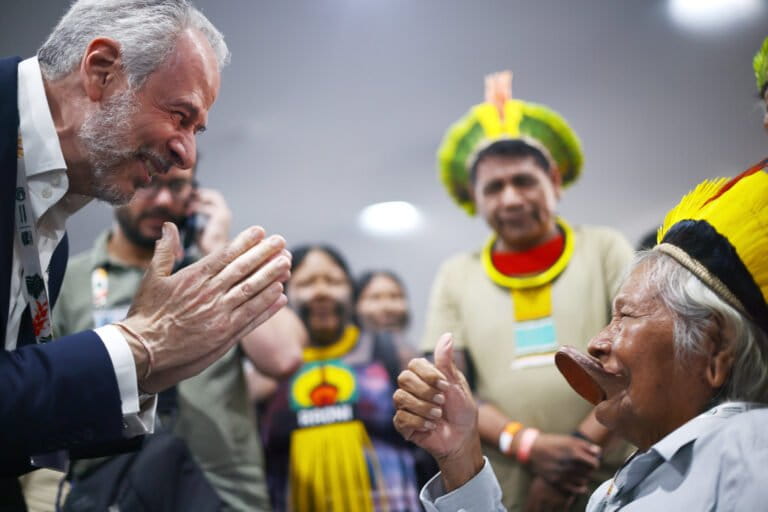
Expectations rose as thousands of Indigenous representatives traveled to Belém, including more than 900 who entered the negotiating rooms — an unprecedented level of formal participation in U.N. climate talks long dominated by governments.
For many, the gathering created a sense of shared purpose with communities facing similar threats elsewhere in the world. And despite the tensions that would follow, there were moments of progress that Indigenous groups acknowledged.
Brazil announced advances in the demarcation of 10 Indigenous territories. Eleven signatories — Brazil, Costa Rica, Colombia, the Democratic Republic of Congo, Ecuador, Fiji, Ghana, Indonesia, Pakistan, Tanzania and Nigeria’s Cross River State — issued a joint commitment to expand and strengthen land tenure for Indigenous peoples, local communities and people of African descent by roughly 80 million hectares (198 million acres) by 2030.
Indonesia’s main Indigenous alliance, AMAN, welcomed the pledge. In a statement, it urged Jakarta to deliver on its own promise made during COP30 to recognize 1.4 million hectares (3.5 million acres) of customary forests through ministerial decrees.
“The 1.4 million-hectare commitment is an initial figure that must be expanded and strengthened to protect Indigenous Peoples by passing the Indigenous Peoples Bill,” AMAN said.
With such a law, it added, Indonesia could ensure formal recognition of at least 60% of the 33.7 million hectares (83.3 million acres) of Indigenous territories already mapped and submitted to the government.
There were also important gains in the Just Transition Work Programme, which, for the first time, explicitly affirmed Indigenous peoples’ collective rights, including self-determination, free, prior and informed consent and protections for peoples living in voluntary isolation.
Taily Terena, an Indigenous woman from the Terena nation in Brazil, said she was happy because the text for the first time mentioned those rights explicitly as being relevant to climate mitigation and adaptation policy.
But wider frustrations overshadowed these bright spots. Across regions, Indigenous delegates said the summit’s branding bore little resemblance to their experience inside the negotiating halls.

‘Invited but not included’
Across the negotiations, Indigenous delegates described a familiar pattern: They were invited into the venue but not into the center of decision-making.
That divide is visible in the Global Mutirão, the main COP30 outcome. While Indigenous peoples appear in the preamble, they are absent from the operative paragraphs — the part of the text that directs how countries must act and report, said Sara Olsvig, who chairs the Inuit Circumpolar Council, representing Inuit across Alaska, Canada, Greenland and Chukotka.
“So we are seeing much too much tokenism in terms of having Indigenous peoples from all over the world looking good on pictures but not being reflected in actual action when these negotiations come to an end,” she said during a press conference at the last few days of COP30. “And this is happening COP after COP.”
Leaders from other regions said the same.
Gustavo Ulcue Campo, a Nasa leader from Colombia, noted that participation is only meaningful when Indigenous proposals are actually incorporated.
“An Indigenous COP without the integration of our rights in a full and operative way in all decisions to be made is not an Indigenous COP,” he said.
Those sentiments deepened when the COP presidency met with the Indigenous Peoples’ Caucus only in the final days, said Bina Nepram, a representative from Manipur.
“They did not meet us at the beginning of this conference, so we feel completely left out of the process,” she said.
The imbalance of power was striking in another way: the presence of fossil fuel lobbyists.
An estimated 1,602 lobbyists affiliated with oil, gas and emissions-trading interests were accredited to COP30, the largest concentration of fossil fuel lobbyists in the history of the U.N. climate talks.
Their numbers far exceeded those of Indigenous delegates.
“When oil and gas lobbyists outnumber Indigenous delegates by nearly 50%, this is not the COP of truth,” said Willo Prince of Indigenous Climate Action in Canada.
A ‘Forest COP’ without a forest mandate
The disconnect ran deeper than representation — it extended to forests, the supposed core of the “Amazonian COP.”
COP30 was expected to deliver a binding road map to end deforestation by 2030 — a centerpiece of Brazil’s presidency and a rallying point for more than 90 countries.
Instead, the idea collapsed during negotiations after Brazil linked it to a road map to phase out fossil fuels. That second road map faced stiff resistance from Saudi Arabia and other oil-producing nations, and once it fell, the forest road map was dropped as well.
The Global Mutirão contains only a single, broad reference to the Amazon, again in the preamble, despite the summit being held in a rainforest city amid warnings from scientists and Indigenous communities that climate stability depends on safeguarding forests.
The absence of a concrete plan drew sharp criticism.
“The proposed final text is far from being an adequate response to the crisis we are facing,” said Carolina Pasquali, executive director of Greenpeace Brazil. “It provides neither a map nor a path for the transition away from fossil fuels and for the end of deforestation by 2030.”
Robert Nasi, director-general of the Center for International Forestry Research, or CIFOR, said the failure was symptomatic of deeper limitations within the UNFCCC system.
The forest-climate connection, he argued, has grown too politically charged and too complex for consensus-based negotiations to handle.
The UNFCCC process “proved unable to digest the complexity of the forest-climate nexus,” Nasi wrote. “We have effectively moved from a consensus-based approach to a plurilateral one, where progress rests on voluntary clubs of nations rather than global law.”
Outside the negotiating rooms, the urgency is unmistakable.
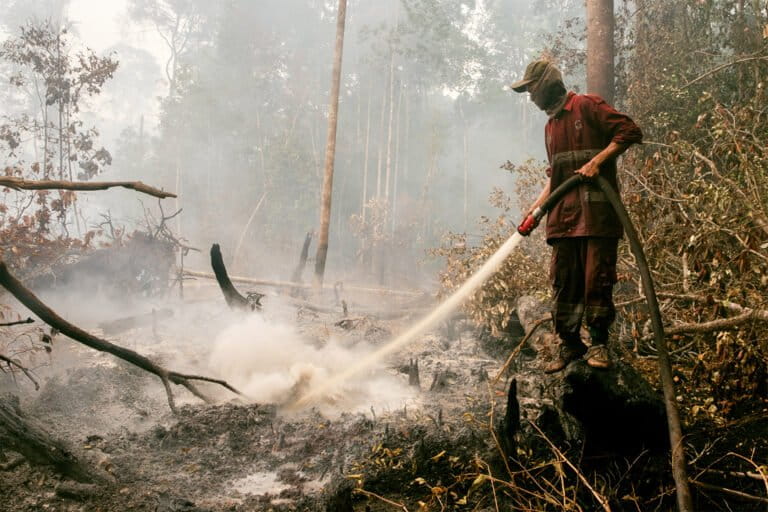
Many regions saw fires surpass agricultural clearing as the main driver of forest loss for the first time in 2024.
Climate-induced drought is drying out rainforest canopies, creating tinderbox conditions that feed back into rising temperatures. The world is currently 63% off track from achieving zero deforestation by 2030, and reversing that trajectory would require steep annual declines.
Given the stalemate, Nasi argued that efforts to protect forests will increasingly depend on mechanisms outside the UNFCCC — from carbon markets to funding facilities like the Tropical Forest Forever Facility (TFFF) and regulatory regimes such as the EU Deforestation Regulation.
“The effort to save the world’s forests now moves from negotiation halls to markets, courts and the territories where people defend them every day,” he said.

A summit of contradictions
COP30 offered moments of recognition and modest gains for Indigenous communities — meaningful enough to matter but not enough to match the summit’s name or the scale of the crisis they face.
Delegates left Belém with a familiar mix of hope, solidarity and deep disappointment.
As Bina told reporters, the anger seen from Indigenous protesters should not be mistaken for hostility.
“A lot of media has been covering the Indigenous protest [at COP30], painting us as angry people. But let me tell you, this anger comes from a place of very deep love and care,” she said. “Eighty percent of the world’s biodiversity is managed by Indigenous peoples, and it is up to us to be able to protect the lungs of this Earth. And [yet] this has not been recognized here at COP30, and we urge that this is changed right now.”
Banner image: Sonia Guajajara, Minister for Indigenous Peoples of Brazil cries with a indigenous woman Angela Kaxuyana as they participate a signing ceremony for the delimitation of lands with National Foundation of Indigenous Peoples and the celebration of the declaration and homologation decrees for indigenous lands, at the 30th Conference of the Parties (COP30). Photo by Ueslei Marcelino/COP30.
FEEDBACK: Use this form to send a message to the author of this post. If you want to post a public comment, you can do that at the bottom of the page.
Credits