- Researchers are developing solutions to help Brazil nut collectors in the Amazon Rainforest reduce the physical toll of the trade.
- These include zip lines to haul heavy sacks across difficult terrain, and ergonomic baskets to reduce back strain while picking up the nut pods.
- These new technologies could encourage Indigenous youths to continue the practice, a crucial step for sustaining local communities who keep the Amazon standing.
- These advances are part of Brazil’s national push for a bioeconomy, a model designed to generate economic growth and social inclusion while protecting the rainforest.
Every year, the arrival of the rainy season and the swelling of the Anauá River indicate it’s time for the Wai Wai Indigenous people to go upriver to collect Brazil nuts. They spend the next few weeks in campsites in the middle of the Amazon Rainforest, wandering through the nut groves and filling thousands of bags with the so-called hedgehogs, the woody fruit pods that hold the nuts.
Brazil nuts, known locally as castanha, are popular worldwide, where they’re often marketed as Amazon nuts or Pará nuts. They’re the main source of income for around 60,000 Amazonian people living in Indigenous and riverine communities. In the Wai Wai territory, in Brazil’s Roraima state, the nuts are also a crucial part of the diet, blended with cassava flour to eat, or made into broth, juice or oil.
However, bringing the nuts back to the villages from the depths of the rainforest, and from there selling them on to traders, is an adventure. Once the collection is over, the Indigenous people fill their boats with heavy bags of nuts and go down the winding river, where they run a gauntlet of rocky rapids and waterfalls. This often forces the Wai Wai to step out of their boats and tow them.
One of the waterfalls, known as Conceição, is often impossible to cross, forcing the group to finish the route on foot. “We have to pull the canoe up to the waterfall,” Levi José da Silva, the leader of the Anauá community, told1 Mongabay by phone. “There’s a place where we unload the nuts and carry them on our backs to the shed.” He has a 10-meter (33-foot) canoe, which can hold around 50 bags of nuts, each weighing 50 kilograms (110 pounds). “I have to carry the 50 bags on my back. It is very hard work.”

That’s why the Wai Wai people were among the first nut collectors to join a project aimed at streamlining the logistics for Amazonian communities. The project is led by Embrapa, a federal government outfit that researches and promotes agricultural innovation in Brazil.
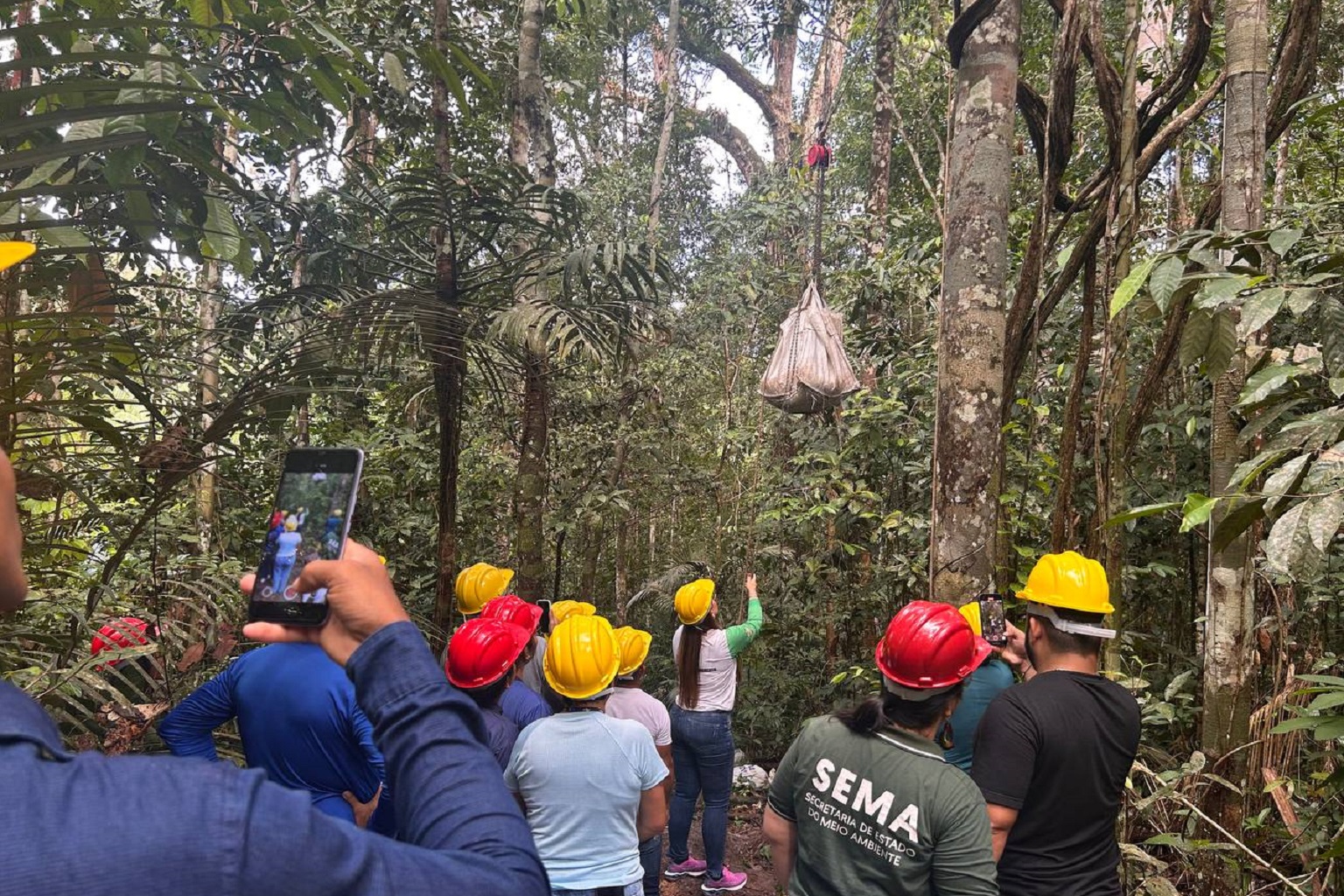
The idea is to use a kind of zip line made with steel cables to transport the nuts in areas that are hard to access. “This technology has a wide range of applications in areas with rapids and waterfalls,” Kátia Silva, who is developing the project in Embrapa, told2 Mongabay by phone from Manaus, in Amazonas state. “We select trees with a diameter of more than 25 centimeters [10 inches] so that they can support the weight, and we anchor the cable to those trees at a certain angle, using large bags that can carry approximately 200 kilos [440 lbs] over a distance of at least 50 meters [164 ft].”
In June, Embrapa gathered representatives from three Amazonas communities in Manaus to test the new system. It received the approval of the nut collectors.
According to Silva, zip lines are already used to transport agricultural commodities such as bananas and apples, but this is the first time they’re being applied to resources harvested from the forest. “We see this aerial cable technology as an opportunity to bring young people [into the nut business],” she said3. “They no longer want to take on this activity due to its arduous nature.”
The initiative comes as Brazil works to boost its so-called bioeconomy — economic ventures that bring profits while keeping the forest standing. With the right tools and support, the traditional Amazonian communities practicing these ventures could generate up to $8 billion a year while keeping the rainforest preserved, a study shows.
State governments in the Brazilian Amazon have gradually embraced the bioeconomy model, with initiatives like the Bioeconomy Priority Program, which will finance sustainable businesses in Acre and Rondônia states. Pará state has launched its own Bioeconomy Plan (PlanBio), which promises to support ecotourism and provide technical assistance to those working with forest products.
In many parts of the Amazon, however, communities still lack access to financial support and basic infrastructure to process and move their products.

An app to find routes
The plan is to combine zip lines with another tool being developed by Embrapa: a smartphone app that would work like the popular urban traffic app Waze, but in the rainforest. The user would insert the locations of rivers and nut trees, as well as information about the terrain. Then, the system would show the best route to move the nuts from one point to another.
“Based on this map, together with these extractivists, we will identify the most difficult locations to access and try to install these cables there,” Silva said. Embrapa has already developed the app using paid software and is now working on transferring it to a free, open-source platform.
In the Rio Cajari Extractive Reserve (Resex Cajari), in Amapá state, each family has its designated nut grove and may spend up to three weeks in the middle of the forest collecting the nuts. “The nut groves are quite large, so you have to walk around all day picking up the hedgehogs one by one,” Elziane Ribeiro de Souza, from the community of Água Branca do Cajari, told4 Mongabay by phone. “The first step is to gather everything, put it in a place inside the nut grove that we call the breaker, where we break them,” she said, referring to the task of hacking open the fruit pods with a machete.
The collectors pick up the fallen pods from the ground with a wooden stick known as cambito or mão-de-onça, which means “jaguar hand” in Portuguese. They toss them into handwoven baskets they carry on their backs, known as paneiros.
The repetitive physical effort means it’s common for the extractivists to suffer from back pain. “Imagine working all day with 50, 60 kilos on your back, and then making a movement to turn [the pods] into a pile, putting all that weight on your spine,” Marcelino Guedes, an Embrapa researcher who works with the Resex Cajari communities, told5 Mongabay.
To alleviate the physical pressure, Guedes and researcher Aldine Pereira Baia from the Federal University of Amapá are working on a new paneiro model specially designed for the collectors. They call it paneiro maneiro, or cool paneiro. “We are working to develop a lighter and more ergonomically suitable paneiro,” Guedes said6. “We will also make a cambito that is adjustable in size, which is important for reaching fruits that are under a vine, for example.”
The Brazilian nut supply chain relies exclusively on the rainforest communities, who usually sell their products to middlemen or directly to the industries. According to the Amazon Castanha Observatory7 (OCA), a civil society network supporting rainforest nut producers, this value chain generates more than 2 billion reais ($361 million) per year. However, less than 5% of the profit goes to the forest communities.
Besides the commercial and logistical challenges, the forest communities also have to deal with poor access to basic utilities such as electricity and treated water. This prevents them from processing the nuts locally, which would allow them to sell at a higher price. The communities have also recently been facing the impacts of climate change, which has led to two crop failures since 2017. In the 2024/2025 collecting season, some Amazonian communities gathered 80% less than they had the previous season.
Banner image: The Wai Wai Indigenous people carry Brazil nuts through the rainforest in 50-kilo bags. Image courtesy of Rogério Assis/ISA.
Iconic Brazil nut crop plunges after extreme drought, skyrocketing prices
FEEDBACK: Use this form to send a message to the author of this post. If you want to post a public comment, you can do that at the bottom of the page.
Credits