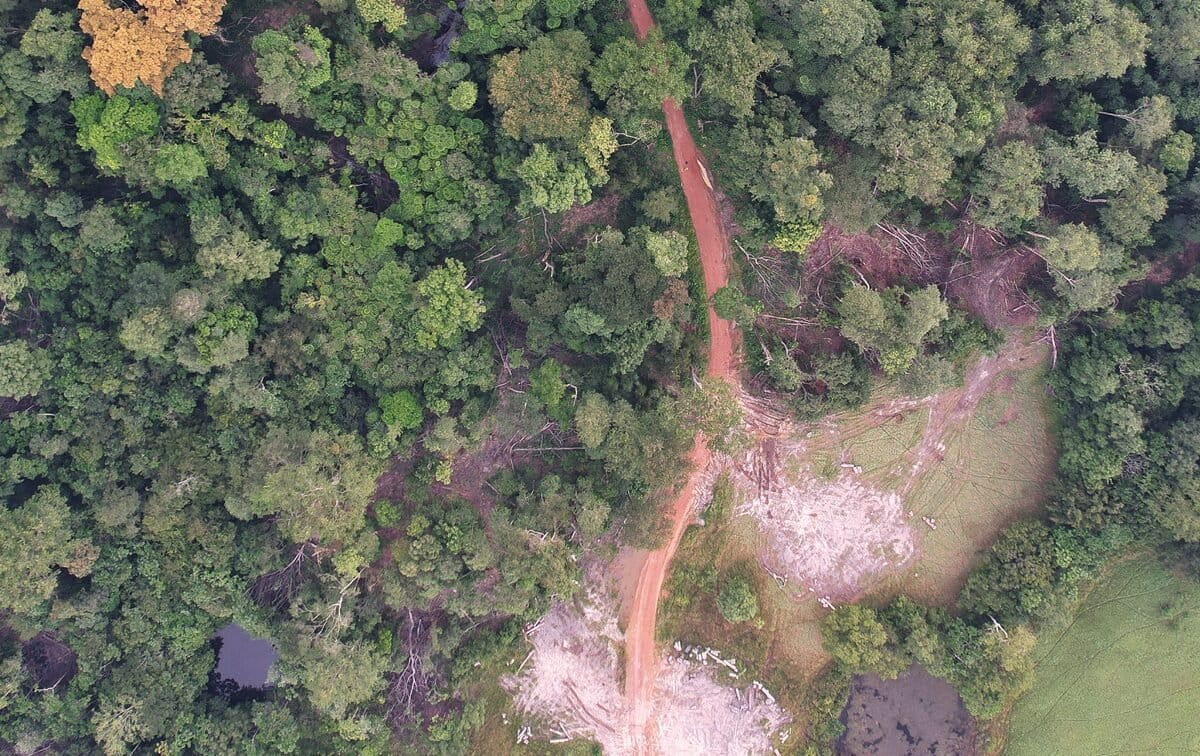
- Suffering repeated changes, Brazil’s Forest Code regulates protected areas and forest management on private property, as well as commercialization of forest products.
- If a landholder exceeds the legally permitted area eligible for conversion, they are legally required to restore the forest to meet the Code’s requirements.
- In 2012, the Forest Code was modified to lessen restoration requirements under certain circumstances and freed landholders of liability for any fines or damages linked to forest clearing prior to 2008.
The most consequential of strategies regarding forests has been Brazil’s longstanding policy to obligate landholders to conserve forest and other natural habitats on their properties. There have been three major iterations of the Brazilian Forest Code: 1936, 1965 and 2012.
The first version declared the ‘forest’ to be a public good and recognized its essential functions, which justify the role of the state in forest management. It provided guidelines for establishing protected area categories (parks and reserves) and clarified that forests on private property must be managed according to the principles outlined by the law.
The Forest Code of 1965 increased the state’s power to regulate forest landscapes and the commercialization of forest products. It was subsequently modified four times (1978, 1984, 1989 and 2001), reflecting the evolving consensus about the need to conserve forests. The 1965 version introduced the concept of forest reserves on private property and defined two categories: (1) Area of Permanent Preservation (Área de Preservação Permanente or APP), which are deemed essential for maintaining ecosystem function, such as riparian corridors, lakesides, steep slopes and hilltops; and (2) Legal Reserve (Reserva Legal or RL), an additional area of native forest that must be protected in each landholding to ensure the conservation of natural habitats at the landscape scale. The area allocated as APP depends on topography and hydrology, but the dimensions of the RL were stipulated by the law.
This value was originally set at 20% in the 1934 law, but was increased to 50% for Amazonian properties in 1965, and to 80% via presidential decree in 2001, plus whatever area was required by the APP. If a landholding exceeds the legally permitted area eligible for conversion, that landholding is said to have a ‘forest debt’, which is the difference between the actual forest cover and the amount required by law. Regulations require landholders to restore forest if they have exceeded the permitted level; there are no exceptions for the APP, but there are a variety of allowances regarding the RL that reflect both the historical legacy of deforestation, as well as the political compromises that have accompanied the periodic attempts to reform (or overturn) the law.
The Forest Code of 2012 retains the basic tenets of the previous version, but it introduced several significant changes. The calculation of the total area to be included within the RL was modified to include areas within the APP, which previously was accounted for separately. That change effectively reduced the forest area conserved. Provisions also were included to lessen restoration requirements under certain circumstances, which reduced the total area requiring restoration by 41% in Mato Grosso and 68% in Pará.
An important concession to landholders freed them of liability for any fines or damages linked to forest clearing prior to 2008.
The federal environmental agency (IBAMA) is primarily responsible for enforcing the Forest Code, but it coordinates its actions with state environmental agencies which help landholders comply with the laws, while issuing fines and publishing lists of non-compliant landholdings. Landowners, meanwhile, must register their properties in a specialized land registry, develop forest management plans and agree to pay penalties imposed by IBAMA. Wilful violation of the Forest Code is a crime, and both state and federal public prosecutors proactively pursue perpetrators in close coordination with IBAMA and other agencies.
Featured image: Soybean field adjacent to Amazonian transition forest. Image by Rhett A. Butler.
Credits