
Sarah Goodyear, Doug Gordon and Aaron Naparstek realized that no one was discussing the many cultural factors that have played a role in humanity’s car dependency, or the negative impacts this reliance on motor vehicles has on human health and the planet. So they started their own show to do exactly that, The War on Cars.
Gordon joins Mongabay’s podcast to discuss just how human society got here — and how we might get ourselves out of it — which is also the subject of a new book he co-authored with Goodyear and Naparstek, Life After Cars: Freeing Ourselves from the Tyranny of the Automobile.
“We felt that nobody was really covering the car as this overwhelming determinative force in the life of you as an individual, the life of society and nature, politics, culture, everything,” he says.
The lobbying efforts of the auto industry greatly contributed car dependency today, which has human health effects ranging from loneliness to respiratory illnesses and even Alzheimer’s disease. These are health impacts that Gordon says will not be solved by a switch to electric vehicles, as toxic particulate matter from tires is produced faster by EVs due to their greater weight.
Beyond the physical and medical problems they pose for humans, cars are deadlier for wildlife: nearly a million animals are killed on roads every day, just in the U.S., which is a reality we previously discussed on the podcast with journalist Ben Goldfarb. But noise pollution from roadways also impacts anyone within earshot of a road, which negatively affects animal behavior, too. Half the animals in the U.K. are estimated to be exposed to noise pollution, according to Paul Donald, senior scientist at BirdLife International and author of the book Traffication.
“There have been various studies on the effects of cortisol on the human body and on animals, and that’s a hormone that’s activated by stress that [is] very deeply rooted in us as creatures of evolution. But when you live near a road or are constantly exposed to car horns, those things elevate your cortisol levels, and your stress goes up, your blood pressure goes up,” Gordon says.
However, there are a number of solutions and actions suggested by the trio’s new book, ranging from simple to societal, that can change how humanity uses and relates to cars, as Gordon explains during the discussion.
Take a minute to let us know what you think of our audio reporting, which you can do here.
The Mongabay Newscast is available on major podcast platforms, including Apple and Spotify, and all previous episodes are accessible at our website’s podcast page.
Mike DiGirolamo is a host & associate producer for Mongabay based in Sydney. He co-hosts and edits the Mongabay Newscast. Find him on LinkedIn and Bluesky.
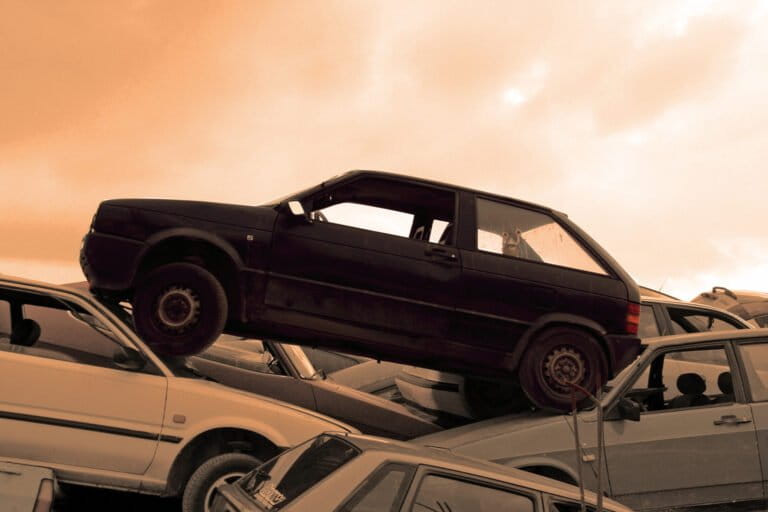
Banner Image: Where cars go to die: an auto graveyard. The production, use and disposal of combustion and electric vehicles each come with their own environmental concerns. Applying circular principles across the supply chain of electric vehicles in particular — such as producing vehicles using clean energy, reusing materials to reduce virgin resource use, and increasing vehicle longevity — is a central part of decarbonizing the industry and lowering material footprints, according to experts. Image by George Laoutaris via Flickr (CC BY-ND 2.0).
Citations:
Limke, A., Scharpf, I., Blesing, F., & von Mikecz, A. (2023). Tire components, age and temperature accelerate neurodegeneration in C. elegans models of Alzheimer’s and Parkinson’s disease. Environmental Pollution, 328, 121660. doi:10.1016/j.envpol.2023.121660
Mattioli, G., Roberts, C., Steinberger, J. K., & Brown, A. (2020). The political economy of car dependence: A systems of provision approach. Energy Research & Social Science, 66, 101486. doi:10.1016/j.erss.2020.101486
Miller, A., Osborne, E., Edwards, R., Macmillan, A., & Shaw, C. (2025). The road lobby and unhealthy transport policy discourse in Aotearoa New Zealand: A framing analysis. Journal of Transport & Health, 41, 101999. doi:10.1016/j.jth.2025.101999
Sugiyama, T., Wijndaele, K., Koohsari, M. J., Tanamas, S. K., Dunstan, D. W., & Owen, N. (2016). Adverse associations of car time with markers of cardio-metabolic risk. Preventive Medicine, 83, 26-30. doi:10.1016/j.ypmed.2015.11.029
Transcript
Notice: Transcripts are machine and human generated and lightly edited for accuracy. They may contain errors.Doug Gordon: Cities are not inherently loud places. Cars generally are what make them loud, and there are also different qualities of noise. The sound of children playing, the sound of people talking. When you walk out of that train station in Tokyo and you hear the sound of footsteps and people having conversations, that’s different than a horn that could go off at any moment, the revving of an engine that activates those startle reflexes and the cortisol levels, and elevates those things and causes your heart to race a little bit.
Those have very negative effects. We also go to the city of Ghent in Belgium and we found something very similar, very lively, very wonderful city to walk and bike around, but very few cars, and it functions beautifully. And what is most beautiful in many ways about it is that it is, like I was saying, calm but lively and very active, but not stressful.
And that’s what we want more of in our lives. It’s not going to be life with no cars. There are going to be people with mobility issues. There are going to be times when even I, as a kind of diehard soldier in the war on cars, need a car for the long-distance trip or the thing that I can’t carry on my bicycle or whatever.
But I don’t have to get into a car for every thing I do. I think there’s some stat that we don’t include in the book, that’s something like 96% of Americans use a car every single day. And it would be hard to imagine that they’re doing that because they want to for every single trip. And that’s what we’re trying to fix.
Mike DiGirolamo: Welcome to the Mongabay Newscast. I’m your co-host, Mike DiGirolamo, bringing you weekly conversations with experts, authors, scientists and activists working on the front lines of conservation, shining a light on some of the most pressing issues facing our planet and holding people in power to account.
This podcast is edited on Gadigal Land. Today, on the Newscast, we speak with Doug Gordon, co-host of the popular podcast The War on Cars, which highlights the negative impacts of cars on our lives and the planet, and what we can do about it.
Along with his co-host of the podcast, Sarah Goodyear, and co-author Aaron Naparstek, Gordon has helped pen the new book Life After Cars: Freeing Ourselves from the Tyranny of the Automobile. Gordon joins me to talk about this book, which chronicles a detailed history of the automobile, its impact on human life, how cities, particularly in the U.S. and also Europe, which were originally designed around foot traffic, were bulldozed and rezoned to make way for vehicles, but not through any sort of democratic process, but through lobbying by automobile manufacturers.
We discuss the impacts that cars have upon wildlife and nature, which you may remember from our previous conversation with journalist Ben Goldfarb from his book Crossings. But Gordon sheds light on some of the unseen and unheard impacts of vehicles, especially on human health, wildlife, and social cohesion.
He describes these things as car blindness. But much like the book he’s co-written, this conversation leans on what’s possible if we reduce car dependency and how you as the listener can affect some of that change.
Doug Gordon, welcome to the Mongabay Newscast. It is a pleasure to have you with us.
Doug: Glad to be here. Thanks for having me.
Mike: And I’m really excited to speak with you. I’m a fan, I’m a fan of The War on Cars. I loved your book. This is a very well-told narrative on the history of vehicles and infrastructure and all the impacts they’re having on society. It’s a fabulous read. Can’t recommend it enough. Before we talk about that though, can you explain to our listeners: what is The War on Cars and how did you and Sarah both come to be working on this podcast?
Doug: We started the podcast in 2018 and we came together because we felt that nobody was really covering the car as this overwhelming, determinative force in the life of you as an individual, the life of society and nature, politics, culture, everything.
And so we wanted to do something that was a little less focused on the policy of transportation, although we do cover that, and more on the culture. That allowed us to get to a place where cars dominate everything. So when we were coming up with a title, because that’s always a question that people have about the show, we had come up with some sort of wonky names, StreetsPod and some other things like that.
And my co-host, Sarah Goodyear, said, it’s the podcast about the war on cars. And we said, oh, okay, that’s probably a good title for the show. The “war on cars” is a thing people say, and your listeners are probably familiar with this. If you attempt to do even the slightest change to the street in front of your home, or many streets in your city, and install bike parking, a bike lane, a new bus route, people will accuse you of waging a war on cars. So that’s why we decided to just lean into that and name the show that.
Mike: Yeah, it is a clever use of that phrase. And I think that the thing that I really appreciate about what you both do is you highlight just how manufactured this entire car infrastructure is. It wasn’t always this way, obviously, because cars are an invention, but things were designed in many cities specifically around foot traffic for a really long time.
And we’ll cover that in a little bit, but I want to talk about first how you talk about car blindness on the podcast and how they’re so ubiquitous that you don’t even see them. And Ben Goldfarb, who we also interviewed, talked about this in relation to roadkill, that roadkill is so common that we don’t even really notice it anymore.
But I would love for you to talk about: what are some of the ways in which cars impact us and nature that we are really blind to?
Doug: Yeah, I think it’s probably best to start with the things we do know. We do tend to understand that air pollution is bad and that air pollution from cars is bad, and switching to electric vehicles is one way to solve that problem. We think a little less maybe about other effects.
Maybe we think about sedentary lifestyles, right, and what they do to ourselves when we’re not able to walk or cycle places. But in terms of our health, there are cognitive issues that come with the particulate matter that is shed by car tires that is not going to be solved with electric cars, and in fact may be worsened by electric vehicles because they’re heavier and they wear down a bit faster.
So those particulates get lodged into your bloodstream, into your brain, and they can lead to things like early-onset Alzheimer’s disease. They can lead to erectile dysfunction, they can lead to cardiovascular problems. We tend not to really think about that stuff. We think more about asthma and lung cancer or things like that.
There’s the noise pollution. I think one of the things that we found during COVID was how quiet a lot of cities became when people were not commuting to work via car. I like to say that cities aren’t loud, cars are loud. We know that birds have different songs when they’re near highways versus when they are not, because they have to be heard and it affects mating patterns. It affects just their general sense of health and safety.
There have been various studies on the effects of cortisol on the human body and on animals, and that’s a hormone that’s activated by stress that is very deeply rooted in us as creatures of evolution. But when you live near a road or are constantly exposed to car horns, those things elevate your cortisol levels and your stress goes up, your blood pressure goes up, hypertension. So I think we sometimes make direct comparisons, or we have a direct understanding of the health effects of sitting in the car or being near the car and relying on the car all the time.
We don’t tend to think about these sort of second- or third-level effects of even living two or three blocks away from a busy road, if you can hear it and the honking, what that does to you.
Mike: Yeah, a lot of that stuff, as you mentioned, is ambient and it seems like it could be cumulative, rather than occurring the very next day, like getting in a car crash for instance. This is stuff that impacts you over the course of your life and may not fully show up until you receive some sort of diagnosis or an illness.
So that’s a really sneaky problem. What was it, when you were researching this book, what were some of the ways that you saw this impact wildlife in particular?
Doug: Yeah. There are very few places in the world left that aren’t intersected or bisected by roads, and what that does is it almost creates a Darwinian, Galapagos Island–style archipelago of wildlife habitats where animals are cut off from mating partners, from ecosystems that they rely on.
We tend to really think a lot, obviously, about roadkill. As we’re driving and we see the dead animal on the side of the road, we think, oh, how horrible. We tend not to think about the animals that are cut off from important ecosystems. And so that is having a drastic effect on, I think, a lot of your listeners.
If they’re of a certain age, they might remember driving through the country and having windshields splattered with insects. That’s not as common anymore. There are a lot fewer insects out there, and part of that is climate change. Part of that is unrelated to automobile traffic and the rise of cars, but a lot of it is. In terms of places where they can just reproduce, those are cut off from where they used to live.
Mike: Now, correct me if I’m wrong. It’s a phrase that Paul Donald describes in your book. It’s called Cation. Is that what you’re referring to here, or is…
Doug: Yeah. Yeah, so you had mentioned Ben Goldfarb, and his book Crossings is incredible and he’s great. Paul Donald is a UK researcher. He’s also studied this, and his book Fication, that word… We don’t really have a word to describe the increase in cars over the course of our lifetimes, and certainly over the course of, let’s say, the last 30 to 40 years.
And he describes this term ification to be what we’ve experienced, that when we were younger, there were fewer cars. Now there are a lot more, and they’ve had really negative effects on nature, on the human body, on our planet. But we tend not to notice it because, like the proverbial frog in the pot of water, it has happened so slowly that we don’t even need to give it a word because we just think it’s, oh, it’s like the river and the tides or something. It’s just a piece of nature that happens.
Mike: And Goldfarb, obviously he talks about this in his book Crossings, about the effect of cars on wildlife and also on wildlife crossing points. But you mention in the book that wildlife crossing points won’t solve this problem. And I’ve looked into it and I’m familiar with it, but can you explain to our listeners why this is not really a solution to this problem?
Doug: Some of it’s intuitive, right? You and I, as human animals and our ability to think, we know where the crosswalk is. We know where the bridge is. Animal crossings and wildlife bridges and things like that can help to a certain degree, but animals are going to cross where they cross and migration patterns are what they are.
And so we can’t teach all of the mountain lions and birds and frogs and turtles and insects where to cross. They’re just going to cross from one place to another. Now, some animals have developed a sort of startle reflex, right? If you think of deer or other large fauna like that, where if they get close to a road, they know to be careful and they are startled by things like noise and headlights. But other animals, like turtles, insects, just do what they do and they get smooshed, and that has really negative effects.
Mike: And you’ve already started to talk about this, but you were talking about the chemicals and the particulate matter that’s released from tires. I wish Sarah was here to describe the answer to this question, but there’s a connection between her last name and that of the corporation Goodyear itself, which was founded in 1898 by Frank Seiberling, under whom vulcanized rubber was popularized.
But this is the cutest way of me asking: can you explain why animals don’t have to die under tires to die from them?
Doug: Yeah. Do you want me to explain the connection to Sarah’s name? I feel like people always have that question. Sarah’s last name is Goodyear and odds are, as she says, that if someone in the United States has the last name Goodyear, they’re related somehow to Charles Goodyear, for whom the tire company is named.
Now, Charles Goodyear spent many years trying to create a process that we now know as vulcanized rubber to allow rubber to hold up under extreme conditions like extreme heat or extreme cold. And that’s what allows your tire to work at high speeds and under all kinds of conditions on the road, so it doesn’t shred, it doesn’t break, it doesn’t get brittle.
And he experimented with all kinds of different chemicals and eventually died penniless after having developed this process, likely the victim of all sorts of chemical poisoning. He had gone slightly insane. He never patented this process. He never made any money off of it. And the company, as you noted, was not founded by him. It was just named in honor of him. Sarah is a very distant relation to Charles Goodyear, but not an heir to any sort of tire fortune as a result.
Yeah, so we do write in the book that the effects of car tires, as you said, they don’t have to be run over for these effects to be very negative. There were scientists in Washington, the Pacific Northwest of the United States, and they were noticing that there was a kind of salmon die-off. They weren’t spawning and they weren’t really responding to the normal natural cues that trigger spawning in salmon.
And scientists were able to look at these different chemicals in the water of the rivers that were often located, as many roads are, along different rivers and streams. And they would find that after rainstorms, a lot of stuff would wash into the river from the roads. Obviously things like the chemicals that go into asphalt, oil and gas and things like that that would leak or just be the byproduct of driving.
But they isolated a very particular chemical that unfortunately is actually a proprietary chemical of many of the tire companies, and there’s no law requiring them to disclose exactly what’s in it, that they found was suppressing this instinct in coho salmon to spawn. And so that’s why we talk about how tire wear is still going to be a real big problem.
One of the solutions that people came up with to stop this from running off into streams were things like filters along the side of the road, or like you might have seen these things of little hay bales or things like that that capture water and filter it before it gets into the more natural part of the environment.
But what we argue in the book is: how about just less driving? How about less tire wear? How about different chemicals in the tires that might not be as harmful? But because they’re proprietary and owned by these companies, it’s very difficult to really isolate exactly what could make them better.
Mike: Yeah, I found that section in the book really interesting, particularly where you mention that the Yurok Tribe actually asked the Environmental Protection Agency, the EPA, to ban, I believe, one of these chemicals, which is named 6PPD. Yeah. So what happened there?
Doug: Nothing, because they are proprietary chemicals. So even if they banned this particular 6PPD, the companies would probably just do something else. Yeah, and that’s what’s tragic about this: the coho salmon is really important to the First Nations and the First Peoples of the United States, especially in the Pacific Northwest. It’s written into their iconography, their lore. It’s an important food source and things like that. So yeah, it’s one of the more tragic parts of the book.
Mike: Yeah, that was quite shocking to me. You already touched upon this earlier, but something you… It’s a stat that you use in the book, that half of the animals in the United Kingdom are impacted by noise pollution, which is a very large amount of animals. So can you talk about the impact of noise pollution on animals in the United Kingdom and on humans, which you already started to get into earlier?
Doug: Yeah. Paul Donald talks a lot about this in his book. Ben Goldfarb talks a little bit about this. But just think from your own experience, your listeners’ own experience: how far are you ever from a road? Chances are you’re never all that far from a road.
And in the UK, he basically found that animals, these environments, were all bisected, cut off, like I said, little archipelagos, little islands surrounded by asphalt, of large highways, of smaller roads. And as I mentioned earlier, just the noise alone can change birdsong, it can change mating calls, it can cause animals to have higher stress levels, which can affect the rate at which they reproduce and things like that.
So there is hardly a creature on Earth in any developed nation, for sure, that isn’t within earshot in some way of road noise. And the thing about road noise is that we tend to think of engine noise as one of the major sources of the noise that comes from roadways, but actually the majority of the noise that you get from motorways is rolling noise.
And that is not something that, again, is going to be solved by quieter electric vehicles, because over 25, 30 miles an hour, something like 80 to 90% of the noise that comes from a car is the rolling noise. So you could have a car that runs on water vapor and is completely clean in terms of tailpipe emissions, but as long as it’s going a certain speed and it has tires as we understand them today, there’s going to be noise from that car and it’s going to have an effect on the surrounding environment.
Mike: Hello listeners, and thanks for tuning in. This is just a friendly reminder that if you previously listened to us on our Newscast app, service is unfortunately no longer available for that app. So please do subscribe to us on the podcast platform of your choosing if you haven’t already.
Our podcast survey for 2025 is live, so if you have feedback about the show, we welcome it. You can find it in the links of the show notes. Don’t forget to also check out our previous conversation with Ben Goldfarb, which is linked in the episode summary to this show on mongabay.com.
Back to the conversation with Doug Gordon. Something that I think really bears repeating, which you outline in such a clear-eyed manner in the book, is the death toll that cars have each year just in the United States alone and the social-cultural mentality that accepts it. And I would like to give you some space to describe, I guess there’s no other way I can describe this, the horror of that.
Doug: Yeah, I think we’re all familiar with some of the stats. You have about 40,000 people in the United States alone who are killed in automobile crashes, either as occupants of those vehicles or pedestrians, people outside of those vehicles. You have millions more who are injured or who face serious injuries, life-altering injuries: paralysis, loss of a limb or something like that.
But then of course there are the much more, or let’s say less tangible effects, but that have real negative consequences. Right now, politically, we’re in a strange era, where there’s a lot of anger, there’s rising fascism, and I don’t think you can really separate what cars do to us socially.
We talk about a researcher in the book named Donald Appleyard, who, in the 1960s, the city of San Francisco was undergoing a new traffic and transportation plan, and they hired Donald Appleyard to take a look at just what traffic was doing to the city.
And he looked at a community and he chose three different streets: one with heavy traffic on one end, one with very light traffic on the other end, and one in the middle with moderate traffic. And he found that on the street with light traffic, people had three times as many close friends and two times as many acquaintances as the people on the street with heavy traffic.
And obviously we understand the social loneliness and all the effects that has on us as human beings and how important connections to other human beings are. On the street with the very heavy traffic, people obviously had fewer connections, fewer friends. They retreated to the indoors. They couldn’t rely on neighbors as much. They didn’t know their neighbors as much.
And at the time that this was happening in the United States in the 1960s, very similar to today, there was a lot of fearmongering about crime in the quote-unquote inner city. But if you actually asked the people — and Donald Appleyard did — what they were most concerned with in their neighborhood, it wasn’t crime, it was traffic and the dangers of traffic.
And on the moderate street, where you’d think, okay, they’d be somewhere in the middle of those two, actually what they were finding was they felt that the traffic was getting worse and they were slowly starting to take on the behaviors and characteristics of the heavy-traffic street. They were thinking of moving out. They knew fewer people.
And we see these really negative results. To me, that was one of the more surprising parts of this story, because again, we know the health effects of loneliness. We know what social isolation does to elderly people, for example. And that study really stuck with me as one of the more surprising parts of the book.
Mike: Yeah, I mean, it’s incredible the amount of impact that cars have on us, on the fabric of our societies, which in turn affects us health-wise, mental-health-wise, and it can even alter the trajectory of what we do, the friends we make. So I was really glad that you highlighted that.
But now, if we could shift the conversation a bit, let’s talk about — your book is titled Life After Cars. So let’s talk about what we could actually have if we weren’t dependent on car infrastructure. And a place I’d like to start with, which Sarah has visited, and I’m not sure if you have visited as well, but it’s Tokyo, which is the largest city in the world by population.
And I’ve been there as well, and I was quite shocked at how quiet Tokyo is.
Doug: Yes. Yeah.
Mike: It’s not like it’s completely silent. Obviously it is a bustling metropolis, but if you step off a train and you walk into any neighborhood, it is silent. People are walking around. They’re commuting with each other. They’re going to restaurants and shops, but there is very little noise.
Can you talk about what it’s like to live in a place like Tokyo where car dependency is not really a thing?
Doug: Yeah, I can talk about my own experience here in Brooklyn, in New York, but Tokyo’s a great example because it is bustling. You can get any train you want to any part of the country at almost any time. And there’s plenty of bicycles. There’s plenty of service vehicles. There’s plenty of trucks.
But you’re not forced into car dependency, that phrase that you use: dependency. You have options to get around. Here in Brooklyn, I live in the middle of a very busy neighborhood. My neighborhood has more people in it than some small towns in the United States. And right outside my door, it’s pretty quiet, because we just don’t have a lot of traffic on our street.
What we do have are a lot of people walking by. I have a bike-share station on one end of my block, another on the other end. I’ve got bus lines in every direction. I have multiple subway lines. We have cars. Things are delivered by trucks. We have service vehicles, fire trucks, ambulances, things like that.
What we’re arguing in Life After Cars is not life with no cars. It’s really life without car dependency, where you, the individual, have that freedom to say, you know what, I’m just going to the store to get a gallon of milk or some eggs. I don’t need to get in a Ford F-150 or even a small Toyota Camry to do that.
I can just walk there or ride a bicycle there or take the bus there because it’s frequent, it’s safe, it’s reliable. That’s what life after cars, to me, looks like. And yeah, it gets to the point I was saying earlier: cities are not inherently loud places. Cars generally are what make them loud, and there are also different qualities of noise.
The sound of children playing, the sound of people talking. When you walk out of that train station in Tokyo and you hear the sound of footsteps and people having conversations, that’s different than a horn that could go off at any moment, the revving of an engine that activates those startle reflexes and the cortisol levels, and elevates those things and causes your heart to race a little bit.
Those have very negative effects. We also go to the city of Ghent in Belgium and we had found something very similar, very lively, very wonderful city to walk and bike around, but very few cars, and it functions beautifully. And what is most beautiful in many ways about it is that it is, like I was saying, calm but lively and very active, but not stressful.
And that’s what we want more of in our lives. It’s not going to be life with no cars. There are going to be people with mobility issues. There are going to be times when even I, as a kind of diehard soldier in the war on cars, need a car for the long-distance trip or the thing that I can’t carry on my bicycle or whatever.
But I don’t have to get into a car for every thing I do. I think there’s some stat that we don’t include in the book, that’s something like 96% of Americans use a car every single day, and it would be hard to imagine that they’re doing that because they want to for every single trip. And that’s what we’re trying to fix.
Use the car when you want to or when you absolutely need to, but we are hoping you don’t absolutely need to just for the most basic of social activities or work or anything like that.
Mike: I think it should be pointed out here that many cities in the United States used to function much like how Brooklyn is right now. It used to be a place with streetcars, trolleys, people could walk. What were some of the biggest reasons you and Sarah identified that’s preventing us from having that again?
Doug: Yeah. Jason Slaughter of the YouTube channel Not Just Bikes, he often says American cities, especially North American cities — but it’s true in Australia, it’s true in the UK — were not built for cars. They were bulldozed for cars. And as you mentioned, there are a lot of places that have, in the past, incredible streetcar networks.
We were just in San Diego, one of the most car-dependent cities in the nation currently, but you can walk around some neighborhoods and see those former streetcar suburbs with the old buildings that only exist there because they used to have streetcars stopping right by them.
In the book, in the early chapters, we talk about a historian, Peter Norton, at the University of Virginia. He wrote a really excellent book called Fighting Traffic, and it’s all about the rise of the automobile in the 1910s and the 1920s in the United States.
And there’s this myth that the Model T was invented and it was affordable to the masses, and that over time, it’s just sort of market forces that won out. People preferred cars. They got off of trolleys and out of streetcars and just said, you know what, that’s it, I’d like a car. But that’s not really what happened.
There was a real campaign on the part of what Peter Norton calls “motordom,” which is all of the auto clubs and car companies and road builders, anything car-related, that forced auto dependency upon people. Part of that was creating new social norms around driving.
When drivers and cars first arrived on the scene, they were killing thousands of people, and people reacted very negatively to that. They held protests in the streets. They built monuments and memorials to the dead children who were killed, some hundreds every year in New York City alone.
Over time, the car industry and its allies in government and elsewhere created concepts like jaywalking. We tend to think, cross at the green, not in between, stay in the crosswalk, things like that. That’s a very new phenomenon in the course of human history. The idea that pedestrians, that humans, have to walk in these straight lines and turn at right angles. That’s not a thing that really happened until cars came around.
You used to hop on the streetcar in the middle of the street. You used to walk diagonally across the street. Kids used to play in the street. Streets were places where people could set up commerce and, yes, transportation too. But these were all concepts that were invented by people in cities like Los Angeles.
And we tell the story in Cincinnati, Ohio, of a ground-up movement by people to require all automobiles in that city, in 1922 or so, to come equipped with a speed governor that would have limited them to 25 miles an hour to prevent them, or at least reduce the chances, of drivers killing someone.
That was defeated by a campaign of auto dealers and car enthusiasts who mailed letters to every car owner in the city, who took out ads in newspapers to fight back, as expensive and detailed as any political campaign you might see today. These were not natural forces where people just said, huh, this is more convenient. These were active political and cultural choices that were forced upon people.
Mike: And so Doug, what are some of the things that you and Sarah highlight in your book that you want listeners and readers to think about and perhaps consider doing to improve their community and make it less car-dependent?
Doug: Yeah, a big thing we’re trying to do with the book right out of the gate is to just get people to see that this is a problem. The solutions, many of them seem so big. We’re not going to tear down highways tomorrow. You can’t build a transit system overnight. Bike lanes even take a long time to build.
But step number one is we just want people to see that this is a problem, that, like, why do I have to spend — in the U.S. now — $50,000 or more, or take out a seven-year auto loan, or spend thousands of dollars on insurance just to get to jobs, just to see friends?
We want people to contact their elected officials. We want people to say, hey, I’d like more options in my life and that bike lane that’s going in across town, I support that. That new bus lane you want to put in my neighborhood, I support that. That’s a big thing.
Get organized. Every city has cycling and pedestrian and transit advocacy groups, or climate groups, or even just parks conservancy groups. Get involved with groups like that because there are a lot of like-minded people. I think one of the most encouraging things we’ve seen since the book came out — we’ve been on book tour in some very car-dependent places such as San Diego and Los Angeles — is just the number of people who want change.
I think the most important thing is just to remember, you’re not alone. Reading the book might inspire you, might help you meet other people. So I think that’s a big one.
And the other thing I would say is, look, we’re not an absolutist movement. As I said earlier, there’s always going to be a space for cars and automobiles of different kinds in our lives, including in cities. And what we want people to maybe think about is, think of it like a Meatless Monday movement in vegetarianism, right?
Maybe you go one day not getting in the car and walking to the grocery store, and you start to see, oh, that crossing, that crosswalk is really dangerous. I’m going to call my local elected official and ask them what they can do to make it safer. And if everybody starts to do that, we probably could make great strides towards this sort of life after cars.
Mike: You have done a lot of interviews with a lot of very smart, influential people that work in transportation and environment. I am curious: what have been some of the most inspirational or promising conversations that you’ve had that really gave you hope that, hey, we can turn this around?
Doug: Yeah. I interviewed the late Donald Shoup, who was a professor at UCLA, and he’s considered the guru of parking. He wrote a fantastic, very detailed book called The High Cost of Free Parking, and he was really one of the first people working in economics to connect the cost of building and providing parking to the cost of everything else.
You know, when you go shopping at a grocery store and it’s free to park your car, it’s not really free to park your car because the store has to maintain all of that real estate, and that’s reflected then, of course, in the price of the goods that you pay at the store, whether you drive or not.
So that was, to me, one of the most inspiring interviews I’ve done because he really talked about this little magical key to understanding how cities are built and how they function. And now parking reform — making sure that when a building is built, it is not required to have excessive amounts of parking — has been one of the most interesting and encouraging movements in North America.
There’s the Parking Reform Network run by a guy named Tony Jordan here in the U.S., and they’ve successfully gotten a bunch of cities to eliminate parking minimum requirements in new development. So that’s been really great. Yeah, that’s been a big, promising development, but one of those little “secret sauce” things that you can’t necessarily go out and just do yourself.
Mike: But there is… that is something people can listen to and take away for what they can affect in their community. Because those minimum parking requirements, they take up so much space, and Not Just Bikes, who you have mentioned on this podcast, has a really great video about this as well, about how minimum parking requirements really mess up cities.
Doug: That is a thing you can call your elected official about and say, there’s a new building being built down the block from me. It’s probably going to affect the neighborhood. If there’s a lot of parking in there, the cost of the housing in that building will be higher as a result. Wouldn’t it be better if we had ground-floor retail so that people could walk to the store, or a doctor’s office, or a drug store, or something like that? So yeah, that is a thing you could affect with just a phone call.
Mike: I hope touring has been going well. You visited a lot of cities across the United States. Do you have any plans to go internationally, or perhaps come here to Australia or New Zealand? What are your plans for the future?
Doug: Yeah, we would love to come to New Zealand. We’d love to come to Australia. Melbourne has been on my radar for a while because it does have some pretty good public transportation. I know they have a pretty good streetcar network and great streets.
I know that other cities in Australia — I know Sydney has its walkable areas but is very car-dependent. And the New Zealand cities like Auckland, I’ve been there and it’s beautiful, but what was most disappointing about it is how developed it is around the car. It has a sort of L.A. feel to it, lots of freeways and car-dependent neighborhoods.
So I think it would be great to come down there because I think there is a hunger for this in all parts of the world. And certainly where you are, the weather is conducive, for much of the year, to year-round cycling and walking.
Mike: Where would you like listeners to go to learn more about — other than obviously checking out your podcast The War on Cars and your book — where would you like to direct listeners to learn more about you and Sarah and the work you do?
Doug: Yeah, you can go to lifeaftercars.com. That’s everything about the book, tour, and it links back to our Patreon, to the podcast. And the podcast you can find really wherever you listen to podcasts.
Mike: Doug Gordon, it has been a pleasure speaking with you. Thank you so much for joining me today, and safe travels.
Doug: Yeah. Thanks. Hopefully we’ll make it to your part of the world.
Mike: If you want to purchase a copy of Life After Cars or listen to The War on Cars podcast, you can find links in the show notes.
As always, if you’re enjoying the Mongabay Newscast or any of our podcast content and you want to help us out, we encourage you to spread the word about the work we’re doing, tell a friend and leave a review. Word of mouth is the best way to help expand our reach.
You can also support us by becoming a monthly sponsor via our Patreon page at patreon.com/mongabay. We here at Mongabay are a nonprofit news outlet, so when you pledge a dollar per month, it makes a big difference. It helps us offset production costs. So if you’re a fan of our audio reports from nature’s frontline, go to patreon.com/mongabay to learn more and support the Mongabay Newscast.
And you can also read our news and inspiration from nature’s frontline at mongabay.com, or you can follow us on social media. Find Mongabay on LinkedIn at Mongabay News, and on Instagram, Threads, BlueSky, Mastodon, Facebook, and TikTok, where our handle is @mongabay, and on YouTube at Mongabay TV.
Thank you, as always, for listening.
Credits