- A once-common reef fish in the Galápagos has not been seen since 1983, raising the question of whether it has already disappeared.
- A recent study by Jack Stein Grove and colleagues concludes the species is likely extinct, based on decades of failed searches and historical records.
- Its disappearance is linked to the severe 1982–83 El Niño, which disrupted the islands’ nutrient cycles and food webs.
- The case highlights how even well-known marine ecosystems can lose species quietly, with declines only becoming clear in hindsight.

A small, blue-gray fish that once gathered in loose schools along the rocky shores of the Galápagos Islands has become the subject of a more precise question: whether it is already gone.
The Galápagos damselfish (Azurina eupalama) has not been recorded since 1983. Before that, it was regularly encountered. Specimens were collected by nearly every major scientific expedition to the islands across the 20th century, and divers could expect to find it at multiple sites. Its disappearance has therefore drawn attention not only for its outcome, but for its abruptness.
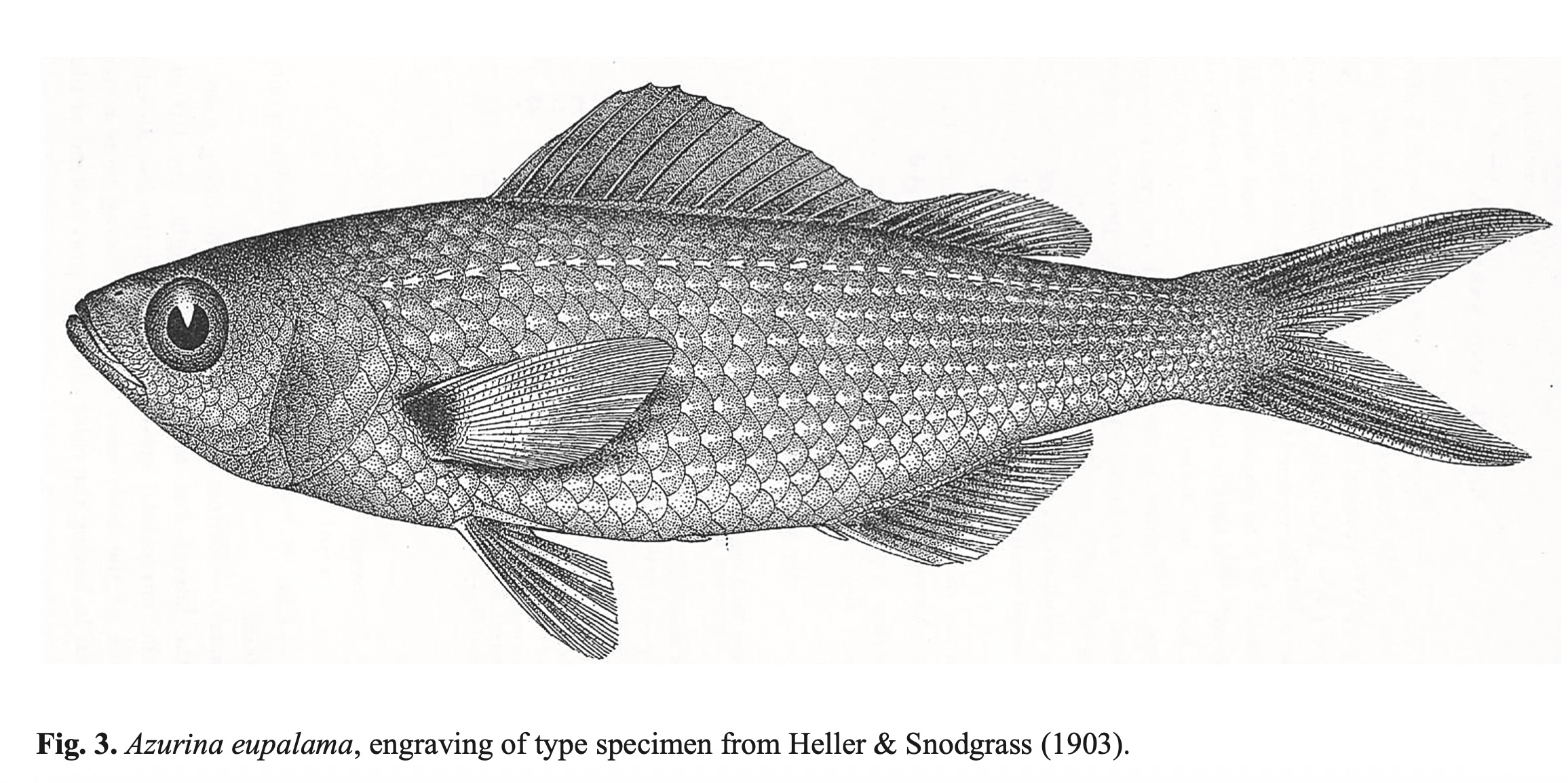
A recent paper by Jack Stein Grove and Benjamin Victor revisits the evidence and concludes that the species is now likely extinct. The paper, published in the Journal of the Ocean Science Foundation, assembles historical records, ecological context, and decades of unsuccessful searches to argue that the absence is no longer plausibly explained by oversight.
The timing points to a specific event. The last confirmed sighting came in the aftermath of the 1982–83 El Niño Southern Oscillation (ENSO), one of the most intense on record. During such episodes, the cold, nutrient-rich upwelling that sustains the Galápagos marine ecosystem weakens or stops. Warmer, less productive water spreads across the archipelago, reducing plankton availability and disrupting food webs.
For a species like the Galápagos damselfish, this would have been consequential. It was an obligate planktivore, dependent on the steady supply of microscopic organisms that thrive under normal upwelling conditions. It also occupied a narrow ecological range, confined to shallow, exposed shorelines and absent from continental habitats. These traits, the authors argue, left it poorly equipped to withstand prolonged environmental change.

The 1982–83 event did not affect all species equally. Some tropical fish expanded into the islands during warmer conditions. Others declined and later recovered. Reef structures, however, were severely damaged, with coral mortality and long-term habitat loss documented across the archipelago. The damselfish appears to have fallen into a narrower category: a species both geographically restricted and adapted to cooler waters, unable to shift or recolonize once conditions deteriorated.
What followed was not neglect, but sustained attention. The Galápagos is among the most intensively studied marine environments in the world. It attracts professional scientists, underwater photographers, and trained naturalist guides, many of whom routinely document rare or transient species. In addition, targeted expeditions have sought out poorly known or missing fishes, including recent surveys that produced thousands of underwater images. None have confirmed the damselfish’s presence.
That absence carries weight. The species was neither cryptic nor confined to inaccessible depths. It occurred in clear, shallow water and often in groups. Its prior visibility makes its current invisibility harder to attribute to chance.
Even so, the designation of extinction remains cautious. Marine fishes are rarely declared extinct with certainty, in part because of their dispersal strategies. Most species have a pelagic larval phase that allows for recolonization over large distances, reducing the likelihood of permanent loss. The Galápagos damselfish was more constrained. Its distribution was limited to the archipelago, with a possible but unconfirmed record from Cocos Island, and its ecological niche appears to have been narrow.

The case is therefore unusual, though not entirely without precedent. The paper situates it alongside a small number of other suspected marine fish extinctions, many of which remain unresolved or contested. What distinguishes this one is the combination of historical abundance, extensive documentation, and prolonged absence in a well-surveyed environment.
There is still a residual possibility that the species persists undetected. The authors point to emerging techniques, particularly environmental DNA sampling, which can identify species from trace genetic material in seawater. Planned surveys targeting historical sites may yet yield evidence one way or the other.
Until then, the Galápagos damselfish occupies an ambiguous position: present in records, absent in reality. Its likely disappearance does not alter the broader structure of the islands’ marine ecosystem, which remains diverse and comparatively intact. But it does narrow it, in a way that is difficult to perceive without close attention.
Extinction in the ocean is often discussed in aggregate, as a matter of declining biomass or shifting ranges. The loss of a single, localized species sits at a different scale. It is specific, contained, and easily overlooked.
In this case, it is also well documented. And that, perhaps, is what makes it harder to ignore.
Further reading:
- The Fish We Never Knew by Eric Simons in Bay Nature
- Vanished Without a Trace? The Galápagos Damselfish and the Legacy of the 1982–1983 El Niño by the Galapagos Conservatory
Citation:
- Grove, J., & Victor, B. (2025). Has climate change driven the Galapagos Damselfish, Azurina eupalama, to extinction?. Journal of the Ocean Science Foundation, 42, 7–14. https://doi.org/10.5281/zenodo.14846312
Credits