- Cases from Nepal suggest that degraded land can regenerate naturally when locals enforce rules such as banning open livestock grazing, restricting access, fining illegal logging and organizing patrols, without the need for costly tree-planting drives.
- Native species return within a few years after the land is protected, showing that fertile soil, existing seed banks and wildlife presence can restore forests naturally.
- Researchers and community leaders say Nepal should prioritize long-term, community-led forest protection and natural regeneration, which are more effective, sustainable and lower-cost than coordinated tree planting.
NAWALPUR, Nepal — At 75, Hasta Bahadur Sathighare Magar says he still remembers the time when the slopes above his village in the rural municipality of Rupsekot, in central Nepal, looked dead. Dust blew freely as cattle marauded the barren land.
That view has since changed. The barren slopes have given way to native trees like sal(Shorea robusta), sisau (Dalbergia sissoo), jamun (Syzygium cumini) and bakaino(Melia azedarach), which cast a shade with their canopy.
“When I’m in the jungle, I feel as if I gain energy from the plants. Many people like me come here to walk and enjoy nature,” Magar says.
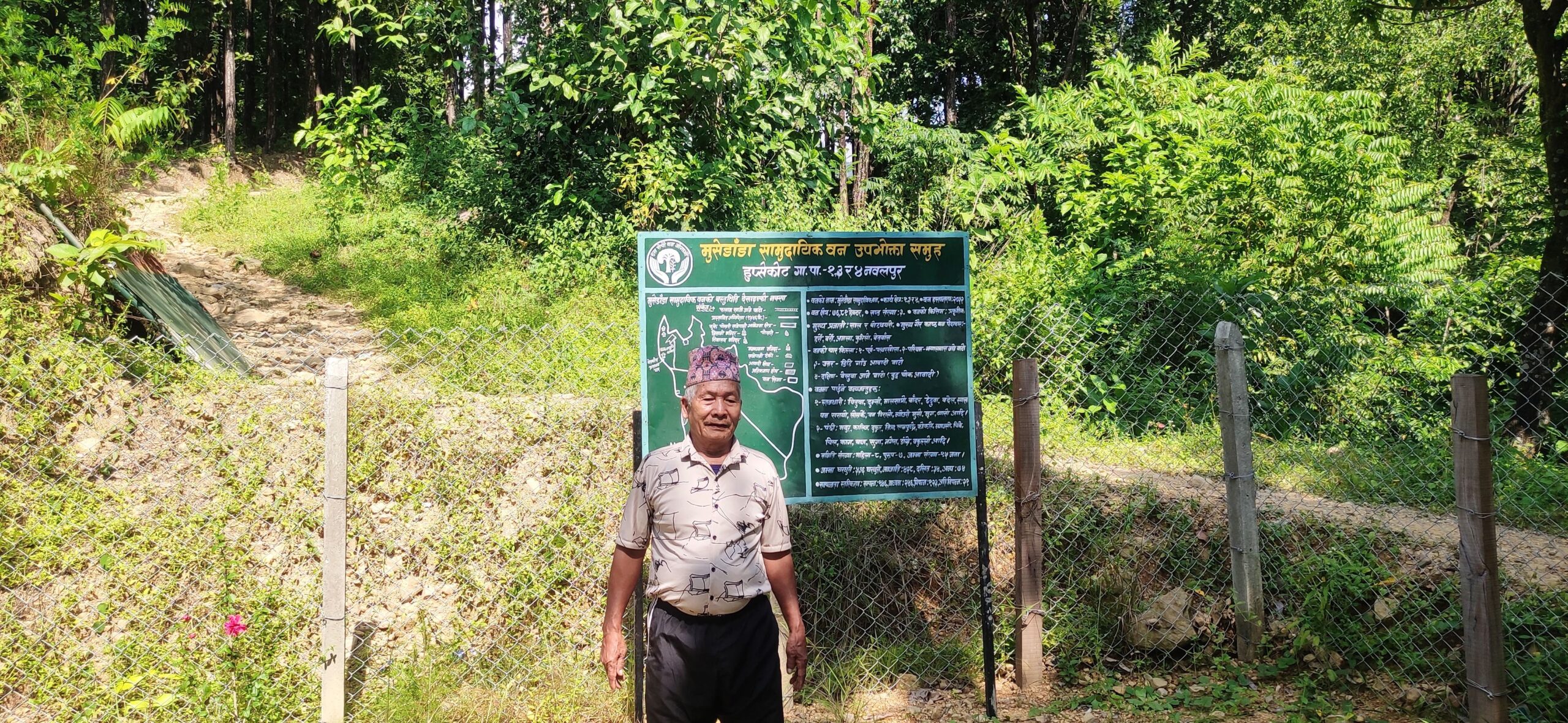

The recovery of the Muse Danda Community Forest wasn’t funded by large-scale tree-planting campaigns. Instead, it was driven by small local changes. Community members simply protected the land, and the forest grew back.
As the government struggles to restore degraded land across Nepal’s Chure foothills through large-scale tree-planting programs, the success of low-cast, community-led efforts signals that natural regeneration could happen if communities protect the land.
The Chure range is Nepal’s green spine: fragile, vital, and now fighting to survive. It covers about 13% of the country’s total area and stretches east to west along the southern foothills of the Himalayas. This biologically rich landscape supports a wide range of species — from tigers (Panthera tigris) and sloth bears (Melursus ursinus) to birds such as ducks, storks, herons, woodpeckers, sunbirds and wagtails — and provides vital ecosystem services to millions of people.

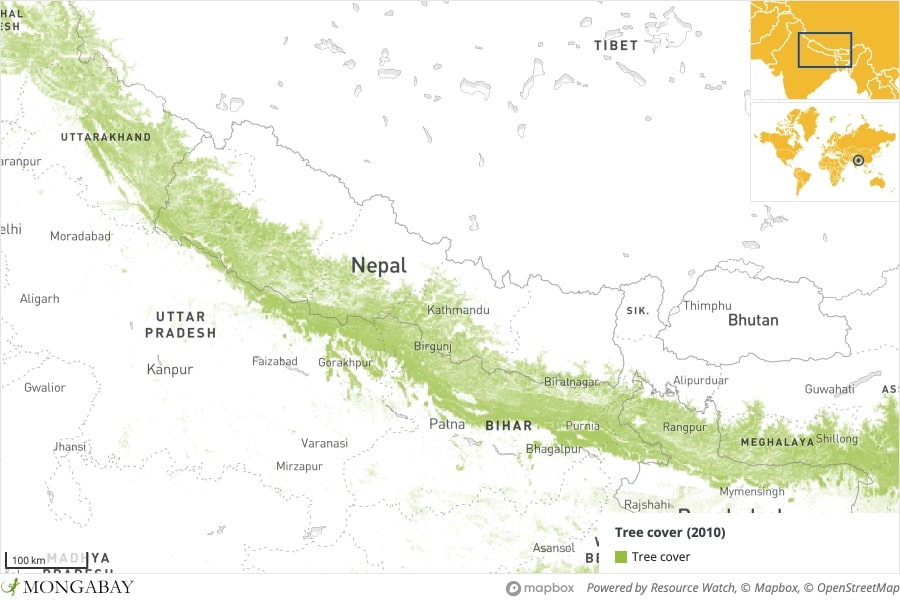
The Chure acts like a giant sponge for Nepal, soaking up rainwater and feeding the rivers below. Often referred to as the “water tower” of the Terai, the southern plains of Nepal that form part of the Indo-Gangetic plains, the Chure plays a crucial role in recharging groundwater and maintaining the ecological balance of Nepal’s lowlands.
However, decades of unsustainable extraction of rocks and riverbed quarrying, unsustainable harvesting and ecosystem encroachment have undermined the Chure’s capacity to soak up rainwater. Each year, the forest area across the Chure continues to shrink; research shows they’re disappearing at a rate of 0.18% per year.
When local communities in Muse Danda took charge of the area’s degraded forests, they introduced simple but strict rules: they banned open grazing of livestock; restricted access; imposed fines for illegal cutting of trees; and organized 24-hour patrols.
These measures, combined with fencing and local monitoring, stopped further damage and allowed nature to reclaim the land.
“We conducted a rule to enter into the forest; those who used to ignore the rule, we fined them,” says Man Bahadur Malla, chair of the Muse Danda Community Forest.
This success is mirrored in the Bageswori Community Forest in Kapilvastu district. Once degraded to the state of a “football field,” the land was handed over to the community in 2006.
Lem Bahadur Gurung, the Bageswori Community Forest chair, says it didn’t require a coordinated tree-planting campaign: “If we stop open grazing, the oldest plants start regenerating automatically. Sal, sisau and simal grew back within three to four years.”
While communities such as Muse Danda and Bageswori celebrate their forest regeneration successes, it’s a different tale for government-led tree-planting projects in the Chure.

In the spotlight is the President Chure–Terai Madhesh Conservation Development Board (PCTM–CDB). Despite its mandate to restore the forests in the region, the board faces allegations of inefficiency and powerlessness.
Sharad Babu Pangeni, the board’s deputy secretary, says they plant roughly 160,000 tree saplings annually at a cost of roughly $2,000 per hectare (about $800 per acre). However, the board lacks the legal power to enforce protection.
“The board exists only in name,” Pangeni says. “We don’t have the authority to regulate. If a problem arises, we must beg for action from the division forest office or district administration.”
At the Ban Devi Community Forest in western Nawalparasi, the board commissioned the Nepal Army to plant 72,000 saplings of different species of natives between 2016 and 2024. Raja Ram Basnet, a spokesman for the army, claimed a survival rate of 80% across their project sites. On the ground in Nawalparasi, however, the reality was starkly different. When Mongabay visited the tree-planting site on Oct. 26 this year, only about 10% of the saplings appeared to be surviving.
“In the initial phase, the army regularly patrolled the area,” says Bharat Neupane, chair of the community forest. “But once they stopped monitoring, the plantation area was completely destroyed by locals. We requested the army to continue patrolling, but they didn’t. If the army had continued, the saplings would have survived. We don’t have the resources to hire guards for regular patrolling in the forest.”

Pangeni says that in areas with difficult geography, community groups can’t continue the conservation work, meaning the responsibility for tree planting is given over to the army. After five years, the army is required to hand over the planted forest area to the community.
The contrast between natural regeneration and coordinated planting has also been picked up by researchers. Bharat Pokhrel, a senior researcher with the Nepal-Swiss Community Forest project, says Nepal’s soil is naturally fertile and rarely requires artificial planting.
“Our soil, the seeds, and the birds that spread those seeds all help. If we just protect the land, the forest comes back by itself,” Pokhrel says.
He criticizes the government’s focus on planting a certain number of trees and not giving enough attention to tree survival. “Tree planting is a scheme designed to make money. Fencing and planting bring commissions,” he says.
Pokhrel says the government should prepare a long-term plan to incorporate community-based regeneration of forests, given that it appears to be more efficient and effective compared to large-scale tree-planting programs.
Cover image: President Ramchandra Paudel along with First Lady Sabita Paudel attends tree plantation program on the occasion of Chure Conservation Day at Kawasoti 3, Nawalparasi on June 16, 2025. Image courtesy of Office of the President, Nepal.
Citation:
Poudel, T. R., Aryal, P. C., Khan, M. T., Roberts, N. J., Poudel, M., & Shrestha, D. P. (2025). Forest structure, diversity, and regeneration in a community‐managed forest of Nepal: A model for carbon sequestration and sustainable management. Plant-Environment Interactions, 6(2). doi:10.1002/pei3.70044
In Nepal, a eucalyptus boom became an ecological cautionary tale
Credits