- A report from the Independent Consultation and Investigation Mechanism of the Inter-American Development Bank (IDB) Group says that agribusiness Pronaca contaminated for decades the Tsáchila Indigenous Territory in Ecuador.
- IDB Invest financed Pronaca, a major player in meat and poultry products, without adequately evaluating the company’s environmental and social impacts, according to its own conclusions.
- According to the report, for years, the company discharged residual waters from pig farms into the rivers that the Tsáchila depend on, affecting their health, culture, farming and tourism.
- Inés Manzano, Ecuador’s Minister for Environment and Energy, is married to Christian Bakker, who is part of the family who founded Pronaca.
In Peripa, an Indigenous Tsáchila village in Ecuador, there are still traditional healers, but medicinal plants are disappearing. Rivers no longer heal — instead, they make people sick. In the late 1990s, the company Pronaca set up pig farms nearby, in the province of Santo Domingo de los Tsáchilas, southwest of Quito. Soon after, residents noticed that surface and groundwater sources were no longer safe.
After almost 30 years in which locals’ complaints to Ecuador’s state institutions remained unanswered, a new report on Pronaca confirms decades of pollution and violations in the Tsáchila Indigenous Territory. The report, released in September, was prepared by the Independent Consultation and Investigation Mechanism (MICI) of the Inter-American Development Bank (IDB) Group.
“Water was one of the main sources of power for the poné [healers], and purification baths were performed in the rivers. Now, if someone visits us and goes into the river, they will come out with a skin disease,” Ricardo Calazacón, a Tsáchila resident of Peripa, told Mongabay Latam.
“If there are no reparations, what will happen to us, since most of us are healers and farmers?” he asked. Calazacón and his family have been leading the defense of their ancestral territory for 25 years. For them, the MICI report represents a victory, but they recognize that the claims will not be resolved until they obtain reparations.

The IDB entered the picture when it provided $50 million in financing to Pronaca in 2021. In 2023, Tsáchila communities filed a complaint with MICI, alleging that the project was causing contamination. After accepting the request, the agency conducted an investigation that included a visit to the area.
MICI found that IDB Invest had failed to adhere to its own policies designed to prevent financing projects that cause social or environmental harm. The report cited poor management of environmental impacts, lack of meaningful consultation with Indigenous communities, concealment of relevant information and failure to take responsibility for polluting rivers.
“We demand transparency from development banks, especially when they grant million-dollar loans to companies with a history of pollution and harm to Indigenous peoples,” Natalia Greene, an activist and political scientist, said in a statement by the Ecuadorian Coordinator of Organizations for the Defense of Nature and the Environment (CEDENMA by its Spanish acronym). The Tsáchila complainants appointed this organization as their representative in the process, which also had the support of Friends of the Earth and the Bank Information Center (BIC), an organization that monitors the activity of multilateral development banks.
Close to power
“The company has always gotten away with things because it has economic and now political power,” said Shady Heredia, an expert who has closely followed the case as a collaborator with CEDENMA. She was referring to the fact that Ecuadorian Minister of Environment and Energy Inés Manzano is married to Christian Bakker, a member of the family that founded Pronaca.

Mongabay Latam sought a statement from the Ministry of Environment and Energy regarding MICI’s findings, but it did not respond to requests by the time of publication. Mongabay Latam also asked whether Minister Manzano had formally declared a possible conflict of interest due to her relationship with a partner in the company, but got no response.
Pronaca told Mongabay Latam that “given the confidential nature of the process and its ongoing evaluation status, the company cannot anticipate information or decisions that are still being deliberated and agreed upon by all parties.”
The meat company confirmed that it is working with IDB Invest on the joint action plan ordered by the MICI report. Meanwhile, IDB Invest told Mongabay Latam that it will comply with the established deadlines to create the action plan, which will be discussed by the institution’s executive board.
No consultation or information
“What is happening is very shocking,” Calazacón said.
“I grew up swimming and enjoying the river, but my younger siblings can’t do the same,” he said. The Tsáchila not only lost a space that was essential to their spirituality and recreation, but they also lost the source of clean water they used daily for cooking, washing, bathing, watering crops and providing for farm animals.
In 1994, Pronaca set up its farms 290 meters (950 feet) from the community of Peripa, according to information from MICI. This occurred despite national agricultural regulations stipulating that pig farms must be located at least 3 kilometers (about 2 miles) away from populated areas.
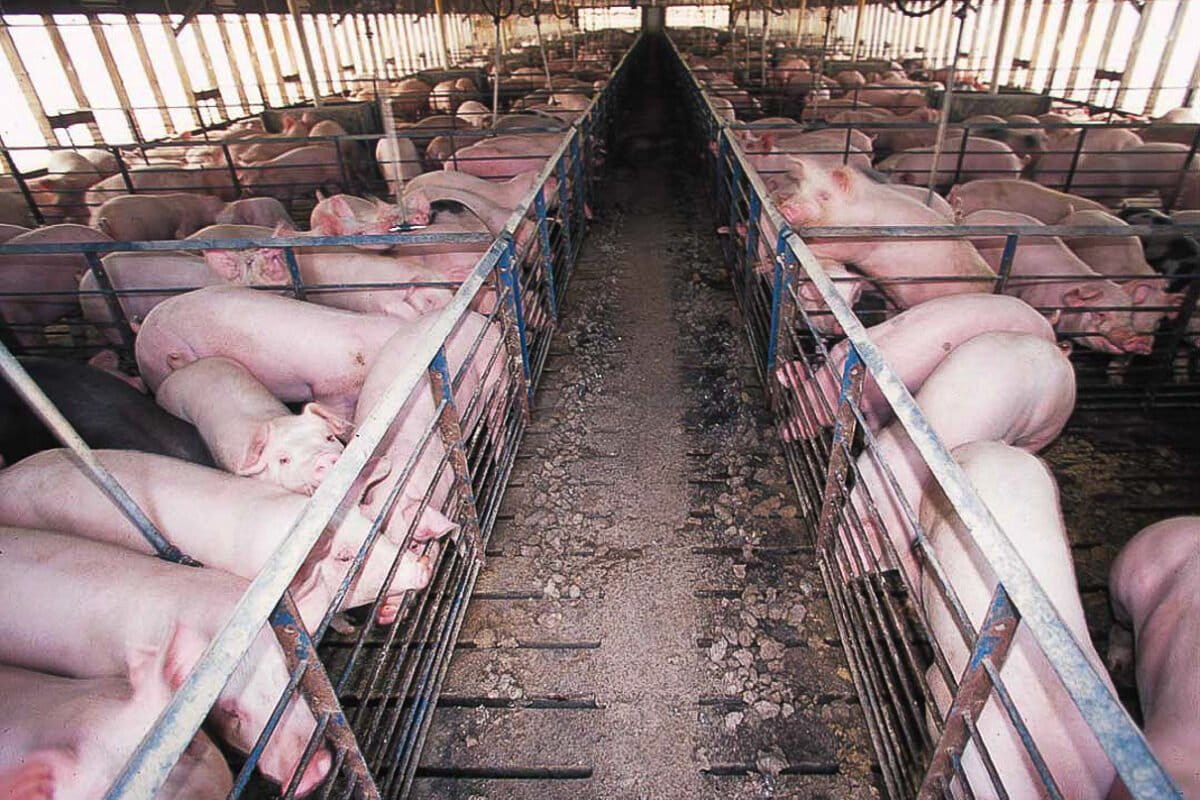
“The problem is that they always told [the community] there’s no definition of what constitutes a populated area, and therefore they didn’t qualify as a populated area, and since the district capital is Santo Domingo, they couldn’t complain,” Heredia said.
Indeed, MICI found that the company did not identify the Tsáchila Peripa community as part of the project’s area of influence — therefore, no special measures were implemented to address their vulnerability.
According to the report, the community was also not consulted about the company’s activities, a right that Indigenous people have when an activity affects their territories. The report reads: “MICI concludes that this omission constitutes a violation of the IDB Invest standard that protects the rights of Indigenous peoples and undermines the legitimacy of the project.”

MICI also criticized the fact that IDB Invest did not ensure that Pronaca provided complete and regular information about the project, its impacts and mitigation measures. Another breach involved Pronaca classifying documents on environmental impact as confidential, thus depriving communities of access to transparent information.
“I find the report interesting in terms of access to information,” said Carolina Juaneda, BIC’s Latin America coordinator and director for environment.
“There are around 3,000 people who belong to the Tsáchila nationality, and they are divided by the company,” Heredia said. She explained that Pronaca gives gifts and jobs to those who drop their complaints against the company and support it. Calazacón pointed out that very few people remain to defend the land they inherited from their grandparents.
His father, who has the same name and has championed the process, received insults and threats from other Tsáchilas.
“Historical” pollution ignored
Those affected say Pronaca dumped polluting and untreated waste into the rivers of the province of Santo Domingo de los Tsáchilas for years, a practice confirmed by MICI’s report.
To clean up the waste from the animals at the Chanchos Plata 1 farm, Pronaca used water from the Peripa River and then discharged the wastewater directly into the same river.

After years of complaints, including a public statement by the town government of Puerto Limón, in 2000, the company began a new cleanup system using a bed of rice husks to compact the pig waste so that it can be removed without generating wastewater.
However, this change was only made at the Chanchos Plata 1 farm. MICI noted that there are nine other farms in the province that operate under the traditional system, although currently, wastewater is treated and used as fertigation. However, the investigation found that the groundwater at Pronaca’s farms is not monitored. This creates a potential risk of contamination of groundwater and surface water sources.
According to MICI, IDB Invest failed in its supervisory duties due to the inadequate development and implementation of the Environmental and Social Management System (ESMS) for the pig breeding farms. This omission is significant, considering the company has more than 100 operating centers across Ecuador.
Heredia pointed out that a study (accessed by Mongabay Latam) found that the Peripa River is contaminated with coliforms — bacteria associated with feces — at a rate that exceeds the standards considered safe for human consumption or recreational use. She recognized that further research is needed to determine the company’s responsibility, as unfiltered sewage from nearby towns is also discharged into the river.
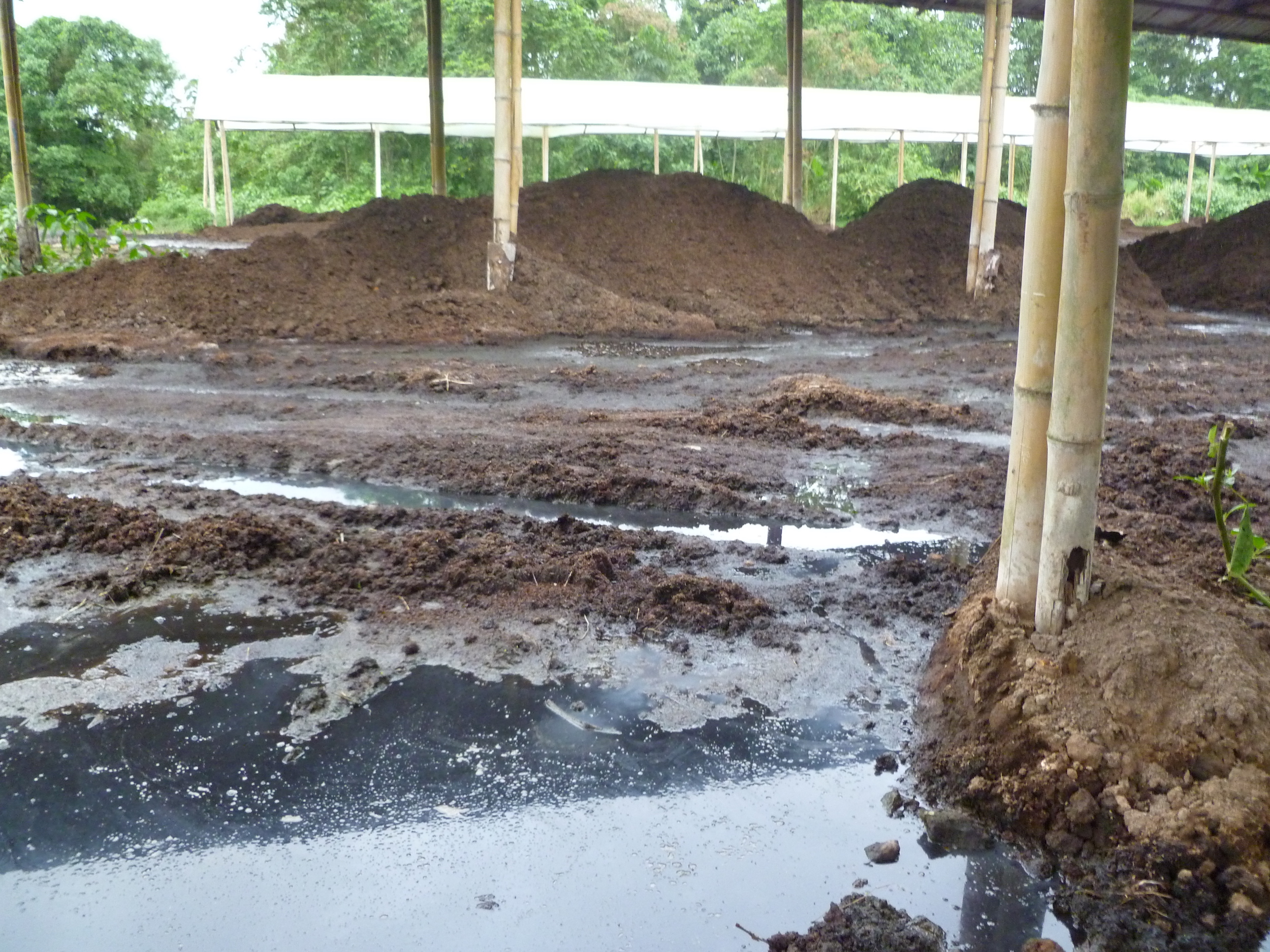
“However, the company has been operating in the area for 30 years, so the community still considers Pronaca to be polluting,” Heredia said.
The MICI investigation concluded that IDB Invest did not determine whether the company contributed to the historical pollution, and that this omission prevented the adoption of adequate environmental management measures.
For Calazacón, the damage is felt every day because there are no drinking water services in this area. The inhabitants of the Tsáchila communities and the mestizo (mixed or non-native) populations in the area obtain water from wells and continue to depend on rivers.
Nauseating odors
A few years ago, the community created a tourism project called Aldea Colorada (Red Village) — the Tsáchilas are known as colorados (redheads) because of the bright red achiote seeds they apply to their hair. Calazacón explained that domestic and foreign tourists were interested in the unique characteristics of the local Indigenous culture, as well as the warm climate, rivers and forests of the territory situated at the foothills of the western Andes.
“Overnight, the project collapsed,” Calazacón said. To reach the community, visitors must pass through a road that runs alongside the Pronaca farms. “Tourists want to see nature, and passing through the farm is unpleasant; the smell is very strong,” he said. Thus, Pronaca caused another loss for the Tsáchilas, this time an economic one.
As Pronaca’s operations grew, the odors worsened. Heredia said that on the hottest days, the stench travels up to 2 km (1.2 mi) away. Residents complain of constant headaches, which they attribute to the nauseating odors coming from the pig farms.
The MICI report notes that IDB Invest failed to consider previous studies on the impact of odors on communities near the company’s operating plants. Nor did it check that Pronaca had taken measures to manage these impacts or that the company had developed an adequate odor management plan.
Awaiting compliance
For each breach of compliance, MICI provided recommendations to help promote responsible social and environmental management by recognizing the rights of the Tsáchila communities and restoring historically polluted rivers. Another objective is for the IDB to improve its processes so that other actors can benefit in the future from updated policies on transparency and environmental responsibility.
“The idea is that the reports will lead to reparations and systemic changes within development banks so that the mistakes identified in the investigations are not repeated,” Juaneda of BIC explained.

Juaneda said the investigation is robust, but the “most interesting” thing is that, based on the recommendations, the IDB administration will have to develop an action plan. MICI will monitor the case to ensure that the recommendations are implemented. The Tsáchilas, Calazacón said, will remain vigilant, but they are also asking for support from civil society in monitoring compliance.
Meanwhile, in Peripa, the medicinal plants on the riverbanks are gradually disappearing. Now, the Tsáchilas plant some in their gardens, but they have not been able to recover or replicate the nearly 600 species they once obtained from nature. “If the company does not recognize its impact, in 10 or 20 years, there will be no more medicinal plants. Our wise ones will have no plants with which to heal people,” Calazacón predicted.
Banner image: A promotional image of Pronaca published on the company’s website. Image courtesy of Pronaca.
This story was first published here in Spanish on 29 Oct., 2025.
The uncertain future of DRC’s traditional medicine, a heritage to save (commentary)
Credits