- Indigenous Peoples in Voluntary Isolation and Initial Contact (PIACI) in Peru and Brazil’s Yavarí-Tapiche Territorial Corridor are under threat by oil and gas expansion, proposed highways and illegal mining, a recent report says.
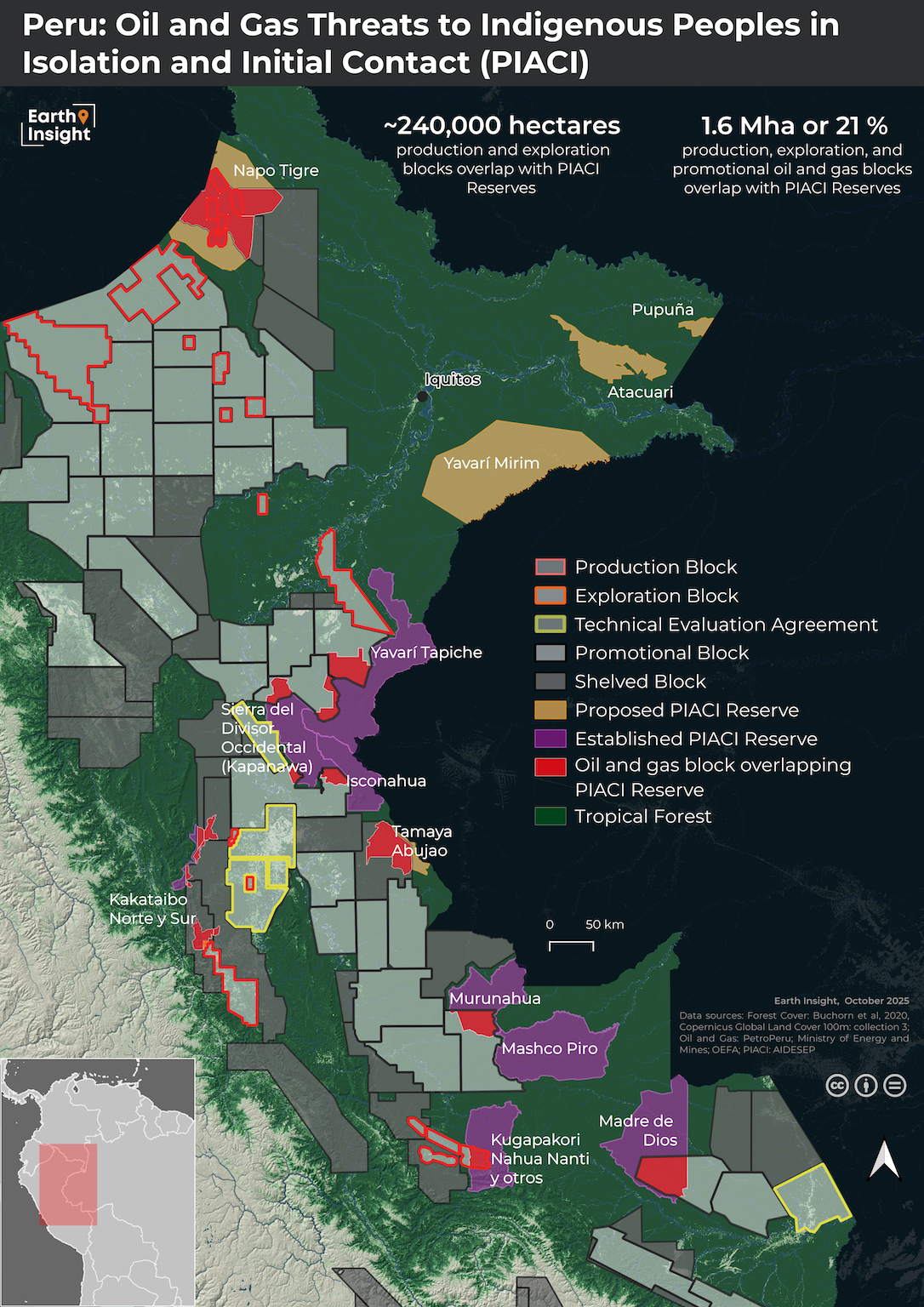
- Oil and gas blocks overlap with 10% of the 16-million-hectare corridor, including nearly 1.7 million hectares of intact tropical forest, and 12% of PIACI reserves pending approval are at risk from oil and gas.
- The report identifies 13 mining concessions and 500,000 hectares of logging concessions on the Peruvian side alone.
- Indigenous leaders and civil society organizations in Peru say the government must stop handing out concessions and revoke or relocate existing ones, otherwise PIACI face exposure to disease due to forced contact, conflict and the destruction of the ecosystems they depend on to survive.
Indigenous Peoples in Voluntary Isolation and Initial Contact (PIACI) in the Yavarí-Tapiche Territorial Corridor, one of the largest contiguous, intact forests in the Amazon and home to the world’s highest concentrations of PIACI, are under threat by extractive and large-scale industrial activities, which pose an existential threat to its inhabitants and the ecosystems they depend on.
This is according to a new report co-authored by Earth Insight, the Regional Organization of Indigenous Peoples of the East (ORPIO), the Coordination of the Indigenous Organizations of the Brazilian Amazon (COIAB) and the Interethnic Association for the Development of the Peruvian Rainforest (AIDESEP).
The report finds that oil and gas blocks overlap with 10% of the 16-million-hectare (39.5-million-acre) corridor, including almost 1.7 million hectares (4.2 million acres) of intact tropical moist forest, 907,000 hectares (2.2 million acres) of Key Biodiversity Areas and 713,000 hectares (1.8 million acres) of protected areas.
“Pressure from hydrocarbons is increasing on the Peruvian side of the Yavarí Tapiche corridor,” Edith Espejo, senior program manager at Earth Insight and author of the report, told Mongabay over WhatsApp messages. “Our report serves as a warning for the irreversible harm that could take place if these oil blocks move into this corridor. Mining concessions within and on the peripheries of the corridor also pose a threat of encroachment and contamination of waterways.”
A critical corridor for ecosystems and Indigenous communities
The Yavarí-Tapiche Corridor covers Brazil’s western border states of Amazonas and Acre and Peru’s Loreto and Ucayali departments in the Amazon River’s southern basin. It is home to the greatest diversity of primates in the world, including spider monkeys (Ateles belzebuth) and pygmy marmosets (Callithrix pygmaea).
Most of the corridor is on the Brazilian side, accounting for 66% of the total area, and 90% is under some form of protected status, according to the report. At least 17 isolated groups that live inside the corridor in Brazil, such as in the Vale do Javari Indigenous Territory, have been recognized. In Peru, the corridor consists of national parks and protected areas that overlap with Indigenous reserves. Some isolated peoples have been recognized, such as the Matsés, Isconahua and Remo, but the approval process to recognize all lands inside the corridor has been slow.
“Perhaps one of the biggest risks to communities, and in turn the forests that they steward, is that proposed PIACI reserves in Peru remain in bureaucratic limbo,” Espejo said. “The government commission in charge of approving reserves refused to approve Yavarí-Mirim in 2025, and the anti-PIACI bills regularly introduced to the Peruvian Congress risk opening even established reserves to extraction. Communities would be less at risk if all proposed PIACI reserves in Peru were approved.”
“There is a systemic problem with the decisions that have been made recently by the members of the PIACI Multisectoral Commission, led by the Ministry of Culture, because political considerations are being prioritized over the technical studies conducted by consultants and research centers hired to gather evidence on the existence of Indigenous peoples in isolation,” Hector Rodríguez, a lawyer involved in drafting a bill to recognize and establish territorial corridors in the Amazon, told Mongabay over a video call. “This is happening because there are many economic interests and political alliances seeking to expand the extractive frontier (oil and gas block contracts, forestry concessions).”
Leo Chuma Teca Beso, the president of the Matsés Native community in Peru’s Loreto region, which is located within the corridor, told Mongabay over a video call that an intact forest is critical for his community. “This includes the flora and fauna, the animals, the plants,” he said. “Since we are gatherers, it’s very important for us to have a healthy life with biodiversity. Furthermore, there are Indigenous peoples living in isolation who need protection, and we, as organizations, directly care for those territories. If we don’t take care of them, who will?”
Without protection, the PIACI are at risk of exposure to disease due to forced contact, conflict and the destruction of the ecosystems they depend on to survive, the report states.
Pressures on ecosystems and communities
According to the report, oil and gas blocks cover 537,000 hectares (1.3 million acres) of PIACI reserves within the corridor. There is currently one block under production, four under promotion and five shelved.

The Yavarí-Tapiche Indigenous Reserve, the Isconahua Territorial Reserve, the Sierra del Divisor Occidental Indigenous Reserve and the Tamaya Abujao Indigenous Reserve, which are surrounded by or in some cases overlap with oil and gas blocks under production or promotion, are at greatest risk of impacts from these industries. These projects are known to cause severe environmental degradation, significant health impacts, disease, violence and cultural loss.
“It’s not just the pollution of the river, but also the pollution of the mountains and the forest,” Beso said. “It also creates social problems that generate significant divisions and conflicts between families and communities. It’s a very big problem. There are also sexual exploitation and many other issues that arise when this type of company comes in.”
Roberto Tafur Shupingahua, the president of the Federation of Native Communities of the Tapiche Blanco Basin, from the Huicungo community in the Yavarí Tapiche Indigenous Reserve in Peru, told Mongabay over WhatsApp voice messages that Perúpetro S.A., a state-owned company responsible for the promotion and supervision of hydrocarbon exploration and exploitation activities, has been conducting studies to develop an oil field in the Tapiche and Curín basins and the Blanco River.
“I’m praying that this oil company, God willing, won’t do it,” he said. “We’re fighting to prevent them from doing too much damage to nature, knowing that our PIACI brothers and sisters are there.”
Perúpetro and Peru’s Ministry of Culture did not respond to Mongabay’s request for comment by the time of publication.

A significant concern is the risk of oil spills, which can carry pollution downstream to Indigenous and PIACI communities. In 2024, a collision between two oil barges near block 95 spilled crude into the Puinahua River near the Pacaya-Samiria National Reserve. As a result of the contamination, Indigenous communities that almost exclusively depend on the river for their livelihoods, such as the Manco Cápac community, could no longer collect water or fish.
The report also highlights the threat mining and logging pose to communities. At present, 13 mining concessions overlap with the corridor, and logging concessions cover 500,000 hectares (1.2 million acres) on the Peruvian side alone.
Solutions
The report recommends that governments provide logistical and security support to dismantle criminal networks, such as illegal mining and drug trafficking, which also pose a threat to communities, and expand Indigenous monitoring stations. It also highlights the importance of strengthening Indigenous governance systems, in addition to the need for investments in Indigenous-led economies and enabling infrastructure, such as electricity and digital connectivity, among other actions.
Julio Cusurichi Palacios, a Shipibo-Conibo leader and treasurer for AIDESEP, told Mongabay that “in order to protect Indigenous Peoples in Isolation and in Initial Contact from the expansion of the oil and gas industry, the government should stop granting extractive concessions in the territories where our PIACI brothers and sisters live and should revoke or relocate existing concessions.”
But the current political situation in Peru adds another layer of complexity to the challenge. As Mauricio Pinzás Luna, a geographer at the Peruvian NGO CooperAcción, told Mongabay over WhatsApp voice messages, Peru has faced strong political instability for the last decade. “This has affected and weakened the existing institutional framework in various sectors, including culture and the environment,” he explained. “So, there’s a lack of seriousness, a lack of technical focus, a lot of political maneuvering, corruption and setbacks in several areas.”

He added that this is also linked to the influence of political interest groups and lobbyists in Peru’s Congress, which are responsible for authorizing and promoting the expansion of promotional oil and gas blocks across the country.
Peru has seen eight presidents in the last decade due to legislative impeachments and resignations. The next presidential elections will be held June 7.
“This weakening of the democratic, technical role of public servants and politicians in power, in favor of specific economic interests, many of them extractive, is what fosters industries typical of the extractive sector, such as hydrocarbons, gas and mining,” he said. “Regarding mining, informal and illegal mining has likely infiltrated Peruvian politics to a considerable extent. It moves a lot of money now, and with high metal prices, especially gold, it’s gaining even more influence.”
Banner image: The Yavarí-Tapiche Territorial Corridor from above on the Peruvian side, near the Peru-Brazil border. Image courtesy of ORPIO.
FEEDBACK: Use this form to send a message to the author of this post. If you want to post a public comment, you can do that at the bottom of the page.
Credits