- Nepal’s Indigenous Newa communities in Khokana and Bungamati are resisting the Kathmandu–Terai Fast Track expressway, which would cut through their ancestral lands, threatening livelihoods, settlements and cultural identity rooted in centuries-old traditions.
- The government promotes the highway as a “national pride” project to boost connectivity and economic growth, but locals say it was pushed forward without meaningful consultation and dismisses Indigenous rights and heritage.
- Resistance is fueled not only by the highway but by fears that it will trigger a cascade of additional infrastructure projects, including an outer ring road, Bagmati Corridor road expansion, transmission lines, a railway line, and a planned satellite city.
- Community members stress their fight is not about compensation but survival, arguing that money cannot replace their land, culture and civilization, and warning that the expressway would permanently erase their Indigenous way of life.
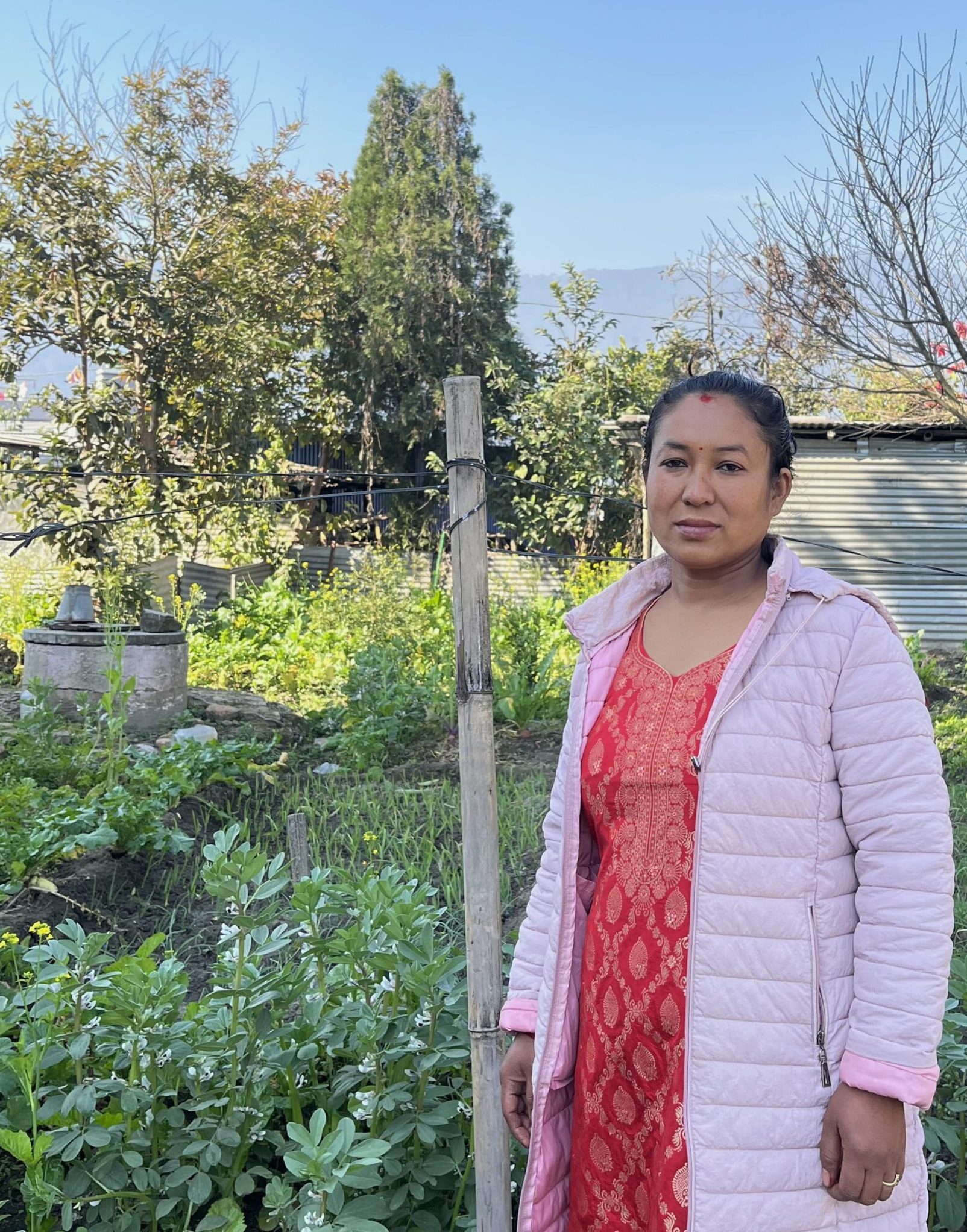
KHOKANA — For generations, Manhera Shrestha’s family has cultivated the same ancestral land in Khokana, an ancient settlement perched on the southern edge of Nepal’s capital, Kathmandu. Life here has long been rooted in the land and its harvest. But in 2016, a land acquisition notice issued by the government carried an ominous warning: a highway would cut through their fields.
Under the plan, Shrestha’s family would lose about 0.3 hectares (0.75 acres) of their land to the road. The fertile land that sustains the household of 12 and anchors their livelihood would be lost, threatening their livelihood, home and a way of life rooted in the soil.
“We will lose everything,” Shrestha says, standing outside her house under a balmy winter sun. “It’s not only about our land and house. Once the highway comes, it will not just change the settlement but also our culture and traditions. Khokana will not remain Khokana anymore. We will lose our identity.”
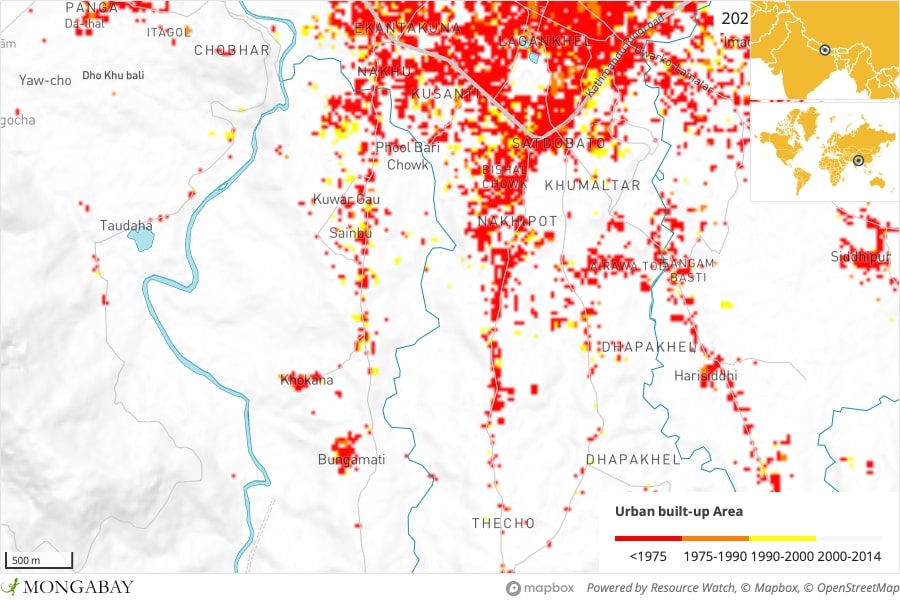

The quiet, agrarian settlements of Khokana and neighboring Bungamati — homes to the Indigenous Newa people and centuries-old traditions and vibrant festivals — have become flashpoints in the controversy surrounding the Kathmandu–Terai Fast Track highway. The Nepali government has promoted the project as a “national pride” initiative, promising it will shorten travel times between Kathmandu and Nijgadh in the southern plains, near the border with India, from about five hours to just an hour, and spur new economic growth.
However, the project has met with fierce resistance from the Newa people, who say they fear the loss of ancestral land and the displacement of settlements. Villages such as Bungamati, Khokana, Shikali and Ku Dya — an early settlement area of Khokana locals — lie in the project’s path.
Since 2018, residents of Khokana and Bungamati, along with Indigenous rights advocates, have staged several protests against the government’s decision, in some instances clashing with police. They accuse the government and the army, which is overseeing the highway’s construction, of being insensitive to Indigenous culture and heritage, pushing ahead without meaningful consultations.
Controversial project
First envisioned in 1966, the project languished for decades before the government handed the 71-kilometer (44-mile) expressway to the army after repeated setbacks from other contractors. The army soon built an oversight camp north of Khokana in a decisive push to move the project forward, although the construction now remains stalled due to unresolved disputes and local resistance.
So far, only about 44% of the project has been completed, leaving the government’s goal of finishing it in 2027 highly uncertain. Local activists have also raised concerns over possible corruption, noting that the project cost has ballooned from the original estimate of 175 billion rupees to 213 billion rupees (from $1.22 billion to $1.48 billion).
But a major concern for the locals centers on the expressway’s proposed entry point in Khokana. Under the current plan, the highway would begin at the sacred Shikali Temple grounds, cutting through the route of an annual chariot procession and dismantling the community’s funeral spaces that have long held spiritual significance. The expressway would end in Nijgadh, the site of a contentious international airport project that has sparked environmental and Indigenous rights concerns.
Addressing the issue on the project website, the army says it’s continuing the “necessary coordination” to resolve the local land issues in Khokana and Bungamati. But locals say the discussions have been fruitless.
“Even if our temple is spared, how will our traditions survive when a major expressway is just a few meters away?” says Nepal Dangol, a member of the Janasarokar Samiti, a citizens’ committee formed to challenge the expressway’s path through Khokana and Bungamati. “It’s unacceptable that a major highway runs through our old settlement. We associate with our land from birth to death, and this will be a death knell for the community and our Indigenous culture.”
Locals also allege the government has sidestepped the project’s environmental impact assessment, which documents many of the concerns they raise. The assessment, seen by Mongabay, lists more than a dozen places with historical or religious significance that lie near the planned route, and records public objections over the lack of consultation during the project’s feasibility stage.

The expressway’s proposed entryway has also drawn concerns among government departments. In 2021, the Department of Archaeology highlighted the project’s impact on the tangible and intangible heritage of Khokana and Bungamati, and recommended an alternative route. Six such routes were reviewed in the environmental impact assessment, designed to avoid traditional settlements.
In June 2025, the Indigenous Nationalities Commission recommended that the government move the entry point from Khokana to Dukuchhap, about 5 km (3 mi) farther south, for better connectivity. That recommendation has also garnered local support in Dukuchhap. The commission warned that the current plan risks displacing the Newa community and eroding their cultural heritage. The government has yet to decide on whether to adopt the alternative route.
“We have given them alternatives so that the country gets this fast track while not destroying our ancient settlements,” says Pashupati Tuladhar, an activist from Bungamati who was among the 60 people consulted by the local government in 2023. “We are not anti-development, and we will support this expressway project, but it needs to align with our culture. It should not obliterate our settlements, temples, communal lands and traditions.”
‘Not just an expressway’
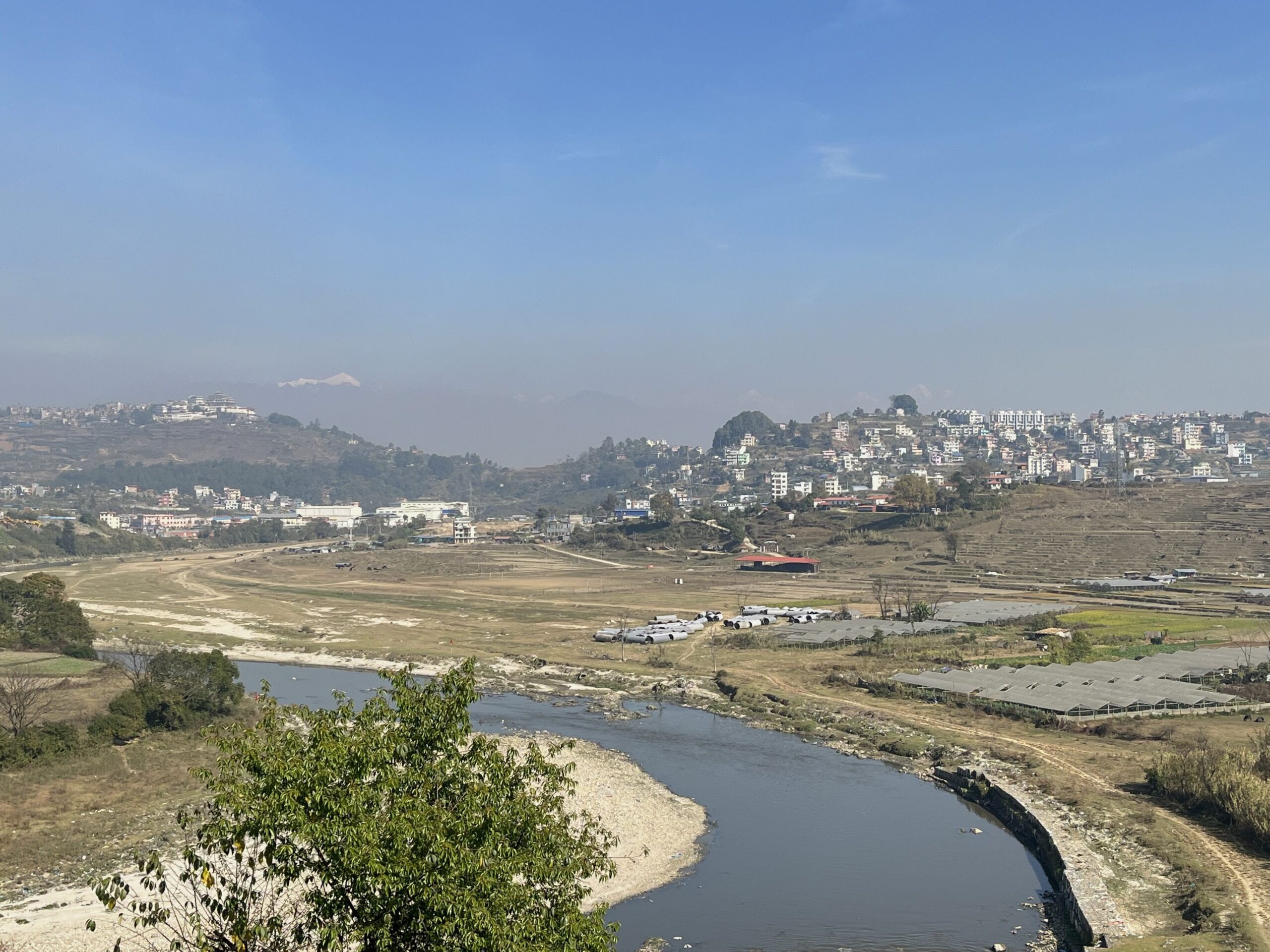
Standing on the Shikali Temple grounds, Naresh Maharjan surveys the once lush pasture across the Bagmati River, now bulldozed for the highway. He shows a concrete marker just meters away from the temple, marking the land that will be taken, then scrolls through photos on his phone, showing a similar marker for a proposed railway project cutting through the same sacred areas.
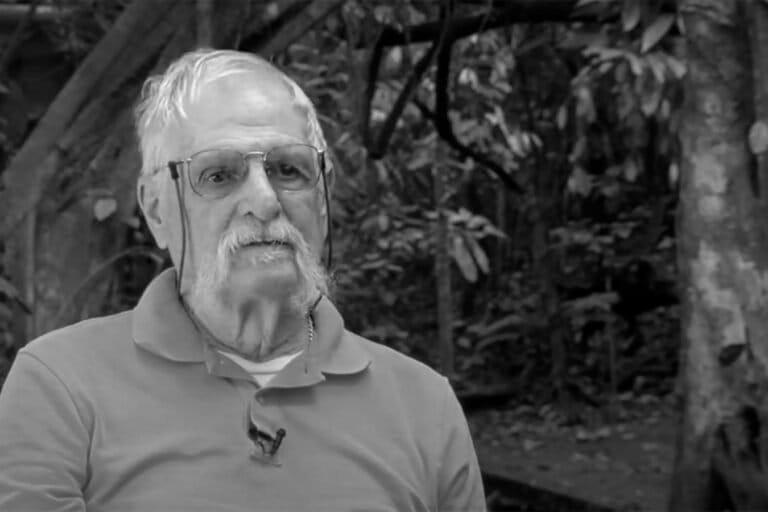
“It’s not just an expressway,” says Maharjan, an activist from Khokana whose land has been acquired for the fast-track project. “Once the expressway is here, several other projects would be required to make this project successful. Once we give in to the expressway, we will have to agree to the development of other projects, too.”
In addition to the Kathmandu–Terai Fast Track, several other infrastructure projects around the highway’s route would impact Khokana and Bungamati, including an outer ring road and the Bagmati Corridor project for better traffic management; a 132-kilovolt power transmission line; and a satellite city.
Across Nepal, infrastructure projects have repeatedly encroached on Indigenous lands. In August, Indigenous Tamangs and other residents of Bojheni, northeast of Kathmandu, raised objections about the Tamakoshi–Kathmandu power transmission line, which they say is being constructed against their will.
In 2024, residents of Lungbasamba in eastern Nepal’s Sankhuwasabha district accusedhydropower companies of fabricating information in the environmental impact assessment and encroaching on the sacred lands of the Bhote Singsa people for a hydropower project there. That same year, protests erupted in Mukkumlung in eastern Nepal over a proposed cable car that would require felling thousands of trees revered by the Indigenous Yakthung (or Limbu) community.
Some have turned to the courts, with residents of Khokana and Bungamati filing two writ petitions at the Supreme Court in 2020. They argued that the fast-track project would destroy the ancient civilization of both towns. The court has yet to hear the cases.
“Encroachment of our Indigenous lands for infrastructure projects shows that the authorities are not just insensitive but unaware about history, cultures and traditions,” says Prabindra Shakya, coordinator of the Community Empowerment and Social Justice Network, which advocates for Indigenous rights.
“Khokana and Bungamati are the last remaining open spaces in the Kathmandu Valley, and a sacred site for the Indigenous people that cannot be compromised at any cost.”
A fight for survival
Sangeeta Singh, a professor of urban planning at Kathmandu’s Institute of Engineering, says the fast-track planners could have chosen several alternative routes that don’t cut through historical settlements, underscoring that such planning in Nepal is usually carried out by engineers instead of urban planners. She adds that community consensus is often missing in such project implementations, pointing out that the government has largely ignored the voices and concerns of the Indigenous people of Khokana and Bungamati.
“We only see building roads as economic indicators, but often miss out on the social welfare of the community and economic development using their existing strengths while preserving traditional settlements and their unique identity,” says Singh, who also co-authored a 2020 study on the fast track’s impact on the community.
Beyond its heritage sites and fertile farmlands, Khokana is known for its famed mustard presses that once supplied much of Kathmandu’s oil. The town is also listed on UNESCO’s tentative list of World Heritage Sites, highlighting its cultural significance.
Since 2020, local campaigners have appealed to United Nations institutions and special rapporteurs on Indigenous rights, urging prompt action to protect the communities in Khokana and Bungamati. In 2024, four U.N. Special Procedures sought clarification from 20 entities involved in the Kathmandu–Terai Fast Track project, including the Nepali government, though most have yet to respond.

Meanwhile, the army’s latest update, published in April 2025, shows that some 18 hectares (45 acres) — equivalent to 25 soccer fields — in the Khokana–Bungamati section still need to be acquired for the project, while compensation is pending for 9.5 hectares (24 acres) of land already acquired. The price for an additional 7.9 hectares (19.5 acres) of land remains to be determined.
So far, campaigners say only a minority of landowners have accepted the government’s compensation. They accuse authorities of exploiting those “under duress and desperate for money” by offering payments far below market value, while also sowing division among community members.
“Our struggle is not about compensation,” says Tuladhar, the activist from Bungamati. “It’s about our civilization, and we shouldn’t have to make compromises. Even if we take the money that the government offers, we cannot build another civilization like this once our communities are uprooted.”
In Khokana, campaigners like Dangol say they’re “ready to die,” refusing to compromise. Landowners like Shrestha blast the government’s compensation offer as insulting, insisting they will not trade their ancestral land for money.
“What are we going to do with that money?” she says. “We are not business-minded, and that money will eventually run out. But our land will feed us for a lifetime. I don’t think the government is listening, but we will continue to put pressure. This is about our identity and survival, and the government must listen and reconsider its plan.”
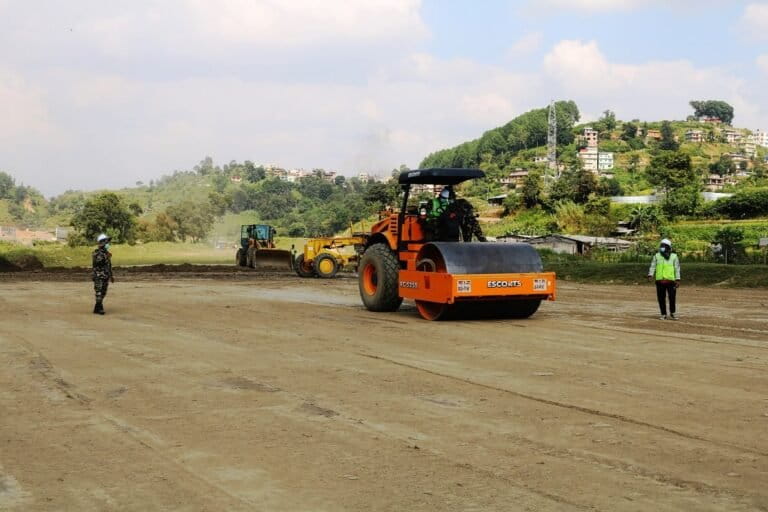
Banner image: Construction personnel at work on the Kathmandu-Nijhgadh expressway. Image courtesy of Nepal Army.
Citation:
Shrestha, A., & Singh, S. (2020). Impact of fast track project envisaged from Kathmandu to Nijgadh on socio-cultural and economic aspects of Khokana settlement. Proceedings of 8th IOE Graduate Conference, 8, 287-293. Retrieved from https://conference.ioe.edu.np/ioegc8/papers/ioegc-8-035-80047.pdf
In Nepal’s hills, a fight brews over the country’s biggest iron deposit
Credits