- A new certification for deforestation-free beef in Brazil, the first of its kind, aims to bring more transparency to existing protocols for monitoring deforestation in meat supply chains.
- The Beef-on-Track (BoT) label has four tiers of certification to guarantee that certified beef meets certain socioenvironmental requirements.
- The label was created to meet demands from China, but it could also help with EUDR compliance, as its highest tier meets EUDR requirements for a deforestation-free supply chain.
- Brazil’s meat industry has not yet embraced the BoT certification, but companies are expected to get on board, as demand for BoT-certified beef grows among exporters, retailers and other actors.
Amid growing pressure for beef supply chains to be deforestation-free, a new certification system in Brazil will allow meatpackers, importers and retailers to guarantee that the meat cuts they sell are not associated with deforestation. Down the line, this could also help companies become compliant with the European Union’s regulation on deforestation-free products (EUDR).
The voluntary Beef on Track (BoT) label, launched by the Institute of Forest and Agricultural Management and Certification (Imaflora) in October and due to come into effect in 2026, is the first certification of its kind to guarantee deforestation-free beef. It will do so by building on existing monitoring, reporting and verification protocols adopted by the meat industry, rather than by designing new systems.
“We’re not reinventing the wheel; we’re giving visibility to processes that already exist,” said Marina Guyot, Imaflora’s executive manager for climate, land use and public policy.
Imaflora was involved in creating two initiatives that encourage best practices in the beef industry through monitoring, reporting and verification in recent years: the Beef on Track program (Boi na Linha in Portuguese) for beef produced in the Amazon, set up in 2019, and the Cerrado Protocol, launched in 2024. Companies that are already 95% compliant with these protocols are automatically eligible for BoT’s lowest certification level. Imaflora plans to develop similar frameworks for other Brazilian biomes in the future.
The BoT certification will also rely on criteria from the Working Group of Indirect Suppliers (GTFI in Portuguese), a cross-sector body working to uproot deforestation from indirect supply chains, and the deforestation and conversion-free (DCF) commitment, which requires zero-deforestation.

Beef is a major driver of deforestation across Brazil. In the Amazon, 90% of the areas deforested between 1985 and 2023 became pasture, according to mapping initiative MapBiomas. Cattle ranching remains the leading source of land conversion, but research shows that zero-deforestation commitments in the cattle industry help lead to a decrease in deforestation, highlighting the importance of systems to ensure these pledges are being met.
The BoT label is awarded to individual meatpacking plants or slaughterhouses, rather than to ranchers or an entire meatpacking company. Actors that deal with the plants — clients like exporters and retailers as well as financial institutions — can also be certified, and the label will be visible for end consumers, thus increasing transparency.
The certification comes in four tiers: bronze, silver, gold and platinum.
A bronze-level plant must ensure its direct cattle suppliers are free of illegal deforestation, do not operate in embargoed areas or on protected public land (which includes conservation areas and Indigenous territories) and are not associated with slave-like labor. Many companies are already doing this, Guyot said.
At the silver level, requirements expand to prohibit any deforestation among direct suppliers, whether legal or illegal. The two higher tiers, gold and platinum, also apply to indirect suppliers: The gold level bans illegal deforestation across all suppliers, while platinum also targets legal deforestation, requiring an entirely deforestation-free supply chain.
“The principal challenge nowadays is monitoring indirect suppliers,” said Graciela Froelich, a researcher at the Amazon Environmental Research Institute (IPAM). It is possible to trace the indirect supply chain, she told Mongabay over video call, “but this requires time, training and high-quality information.”
Imaflora hopes the BoT label will encourage meatpackers to aspire to this level of monitoring.
“From a socioenvironmental perspective, we need the entire supply chain to be monitored, not just for direct suppliers, but indirect, too; not just in the Amazon, but for all biomes. And this label creates an opportunity to incentivize this,” Guyot said.
To be certified, a plant’s entire production must meet the criteria for the bronze level. A plant can have part of its output certified at a higher level. To keep the certification, it must show that the certified volume is increasing over time, with the aim of gradually progressing to higher levels of certification.
A tool for EUDR
The idea for the BoT label emerged from conversations between Imaflora and importers in China, who wanted a certification that could reflect different protocols, Guyot told Mongabay. China is Brazil’s biggest export market for beef, absorbing 46% of exports in 2024, and has deforestation commitments written into a trade deal.
But BoT could also help companies exporting to the EU after the EUDR comes into effect. Initially due to be enforced Dec. 30 this year, the regulation is now being pushed back by 12 months after the European Parliament voted in favor of an amendment delaying the start date and introducing changes.
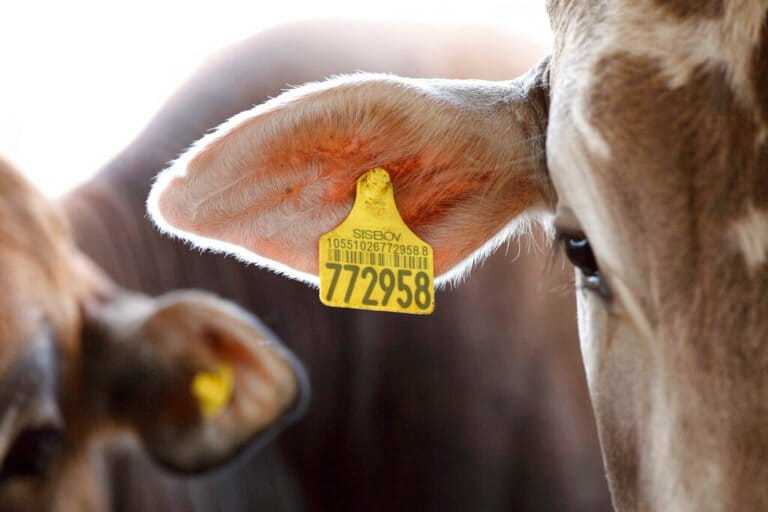
Currently, the EUDR bans the sale of products cultivated on land deforested after 2020 and requires compliance with producer-country laws on a number of issues, including labor rights. BoT platinum-certified beef would therefore be EUDR-compliant.
“Beef volumes classified [as platinum] could be accepted under the EUDR; it could even be a pathway to give more visibility to the implementation of the EUDR in a complex supply chain like livestock,” Guyot said. The EU accounted for about 2.9% of Brazil’s beef exports in 2024, so only a small fraction of slaughterhouses is concerned by the regulation.
However, the EUDR does not allow the mixing of certified and noncertified goods in the chain of custody, so plants would have to physically segregate their platinum-certified goods from lower-tier ones to be compliant, even though this is not a BoT requirement.
Imaflora aims to drum up interest in the BoT label in Europe in 2026, with a roadshow and bilateral meetings with companies and industry groups, Guyot said.
Challenges ahead
Several steps remain before the BoT certification is up and running. “The sector is expectant, waiting to see how this certification will be implemented, especially for indirect [suppliers],” said Dari Santos, impact lead at Do Pasto ao Prato (From Pasture to Plate), a project that aims to increase transparency in the beef supply chain on Brazil’s domestic market.
The Tianjin Meat Association, a Chinese entity representing around 20% of Brazil’s beef exports to the country, has committed to buying at least 50,000 tons of BoT-certified beef by June 2026. Imaflora hopes sales will start in February, but no meatpacker has yet adhered to the initiative.
Brazil’s meat industry remains on the fence for now. The delay to the EUDR no doubt reinforces any resistance, Santos said.
JBS, MBRF Global Foods Company (formerly Marfrig) and Minerva did not grant Mongabay an interview on the topic. In an email statement, MBRF said it is assessing the initiative, and JBS simply said it meets the Beef on Track and Cerrado Protocol requirements.

Getting producers to adhere to these kinds of initiatives is one of the main challenges in implementing traceability in the beef industry, according to Jair Schmitt, director of environmental protection at Brazil’s federal environmental agency, IBAMA. “How do you mobilize rural producers and get them to follow a law that demands traceability, but doesn’t necessarily require mobilization?” he said. “Market forces end up forcing the producer to follow these control and traceability mechanisms.”
That is what Imaflora is banking on, Guyot said. By offering the BoT label to actors further down the supply chain who are interested in such a certification, as they have less control over the origin of the meat they sell, it hopes to create demand for certified meat.
The third-party companies responsible for auditing slaughterhouses’ monitoring systems for BoT certification will initially be the same ones that audit the Beef TAC, the agreement between meatpackers and the Public Prosecutor’s Office (MPF) on which Beef on Track is based.
TAC signatories who underwent independent audits are more likely to be compliant than other companies, with just 4% showing irregularities, according to data from the MPF.
But these protocols on which the BoT label relies are not infallible. Marfrig, which says it operates a DCF system, funded beef raised on deforested land through bonds issued since 2019, a recent investigation found. An IBAMA operation in August notified a dozen meatpacking plants for suspected purchase of deforestation-linked cattle. These included plants operated by JBS and other firms that adhere to the Beef on Track program.
Froelich said these setbacks are an inevitable part of the process. “We need the criticism and constant monitoring, and for this to be taken on board and to fuel the improvement of the system,” she said.
Citation:
Vallim, D., & Leichsenring, A. (2025). The effect of the beef zero deforestation commitment in the Brazilian Amazon: A spatial panel data analysis. Ecological Economics, 230, 108503. doi:10.1016/j.ecolecon.2024.108503
Banner image: Cattle grazing in the Amazon. Image by Fabio Nascimento for Mongabay.
FEEDBACK: Use this form to send a message to the author of this post. If you want to post a public comment, you can do that at the bottom of the page.
Credits