- An agreement signed this year transfers sovereignty of the Chagos Archipelago from the U.K. to Mauritius. This vast expanse in the middle of the Indian Ocean is home to exceptional marine biodiversity whose protection might soon fall to Chagossians and Mauritius.
- The U.K. expelled around 2,000 Chagossians in the late 1960s and early 1970s to make way for a U.S. military base.
- The U.K. also unilaterally established a marine protected area there in 2010, in part to keep Chagossians from returning to the islands. The MPA, the largest no-fishing zone in the world, along with the zealously guarded military base, have allowed the marine space to flourish with limited human imprints.
- Under the deal, which now awaits ratification by the U.K. parliament, Chagossians can return to the archipelago, except the largest island of Diego Garcia, which will continue to host the military base and remain under U.K.-U.S. control for at least the next 99 years.
POINTE AUX SABLES, Mauritius — The mood was equal parts celebratory and somber among the 300-odd Chagossians who came together at a community center in Pointe aux Sables, Mauritius, in June.
An agreement signed in May, now awaiting ratification in the U.K., transfers sovereignty of the Chagos Archipelago from the U.K., which currently controls it, to Mauritius. About six decades ago , the U.K. expelled the inhabitants of Chagos to make way for a U.S. military base in the Indian Ocean.
Their exile, long a source of bitterness and pain, could soon be over.
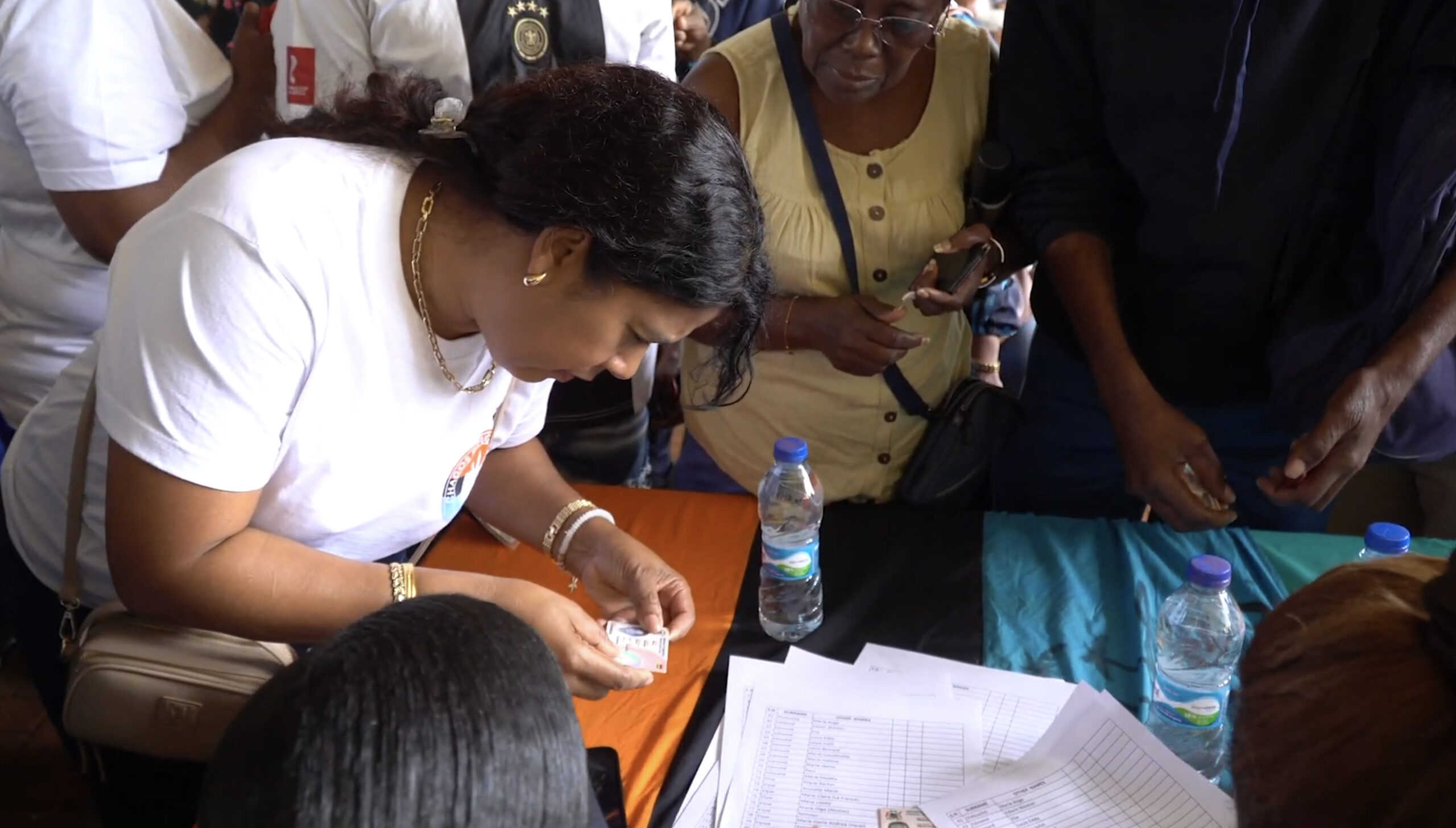
That June morning, Chagossians young and old milled around in the compound of the Marie Lisette Talate Chagossian Community Centre to embrace, to exchange news, to partake in the festive feel. They had come for the annual general meeting of the Chagos Refugees Group (CRG) to hear about the deal struck between the U.K. and Mauritius, and to register with the CRG in preparation for a potential return to their ancestral archipelago.

At the center of the morning’s proceedings, which took place outdoors in the community center’s expansive back compound, was Olivier Bancoult, who heads the Mauritius-based CRG.
“My mom was my inspiration,” Bancoult, 61 , told Mongabay. “She would have been 100 years old [this year].” Rita Élysée Bancoult, CRG’s co-founder, was born on the Chagossian island of Peros Banhos. She died in 2016 in Mauritius, more than a thousand miles away, aged 91.
Of the around 2,000 Chagossians the U.K. uprooted, fewer than 600 are still alive . Several deportees in their 80s and 90s came for the June meeting, flanked by their children and grandchildren, many of whom have never set eyes on their native land and sea. Chagossian elders Mongabay spoke to at the gathering said they wanted to return so they can be laid to rest on the islands of their birth.
The deal could not only shape the fate of the exiled Chagossian community but also the future of a marine space larger than France in the middle of the Indian Ocean that is currently managed as a protected area by the U.K. government, the largest no-fishing zone in the world.

A painful history of displacement
Chagos encompasses a cluster of more than 55 islands and a marine area of 640,000 square kilometers (247,000 square miles). It is home to nearly 800 fish species, including 50 species of sharks, some 18 species of seabirds, and around 300 species of reef-building corals, considered some of the healthiest reefs in the world.
The archipelago was once administered as a British colony alongside Mauritius, about 2,000 kilometers (1,250 miles) to the southwest. But in 1965, the U.K. carved it out as the British Indian Ocean Territory (BIOT) as part of a deal for Mauritian freedom. Mauritius gained independence in 1968, but the U.K. retained control of Chagos, so that its ally, the U.S., could install a military base on the largest island: Diego Garcia.
Between 1968 and 1973, the British forcibly deported Chagossians living on the islands and prevented others from coming back.
Olivier Bancoult’s family had traveled to Mauritius when he was 4 to seek treatment for one of his sisters, who had had an accident on Peros Banhos. The British administration prevented the family from returning. Bancoult’s sister died in Mauritius.
Horrifying details of the expulsion would emerge over time. A Human Rights Watch report alleged that the U.K. authorities curtailed the supply of food, provisions and medical assistance to the Chagossians. The colonial authorities also ordered the killing of around 1,000 dogs, including pets, according to the report, which described the expulsion of Chagossians as a “crime against humanity.”
Exiled Chagossians were sent to Mauritius or Seychelles; some later made their way to the U.K. Many have been trying to return ever since.
Now, with the signing of the deal, the work on resettlement plans is gathering momentum.

Chagossian natives born on the Chagos Islands and their descendants registered themselves with the CRG during the June meeting, so the group has an up-to-date community list. The registry will help answer questions like who should be given preference in resettlement and who qualifies for the compensation agreed upon under the U.K.-Mauritius deal.
Over the years, Chagossians have petitioned the U.K. government to allow them to return and resettle in Chagos, without success. Chagossians have only been able to visit the islands during a handful of trips over the decades, sanctioned and supervised by the British authorities.
Including U.S. and U.K. military personnel at the base on Diego Garcia and itinerant laborers contracted by the U.S. military, there are around 4,000 people living as temporary residents in Chagos . There are also researchers, many from the U.K. Private yachts can moor on the Chagos with permission.
“If there is space for Filipinos, Singaporeans, Sri Lankans, the British, Americans, why not Chagossians?” Bancoult said.
“I’m a native born in Diego Garcia, uprooted, deported and dumped in the Seychelles,” Bernadette Dugasse told Mongabay. In 2005 , Dugasse moved to the U.K. and continued to campaign for Chagossian rights there, co-founding the advocacy group Chagossian Voices . She visited the islands in 2011 and 2019 on those supervised visits, and told of how the minders forbade her from collecting any mementos from the islands.
“They are foreigners who have souvenirs from my birthplace,” she said. “You kill me if you want, I got seashells, I collected sand, I took the souvenirs.” Dugasse displays these keepsakes in her London home.
In 2010, the U.K. unilaterally established a marine protected area in Chagos, covering the entire archipelago except Diego Garcia and the sea extending 3 nautical miles (5.6 km) around it . Chagossians and human rights activists criticized the MPA creation as an ocean grab, an attempt to keep Chagossians from returning to the islands and deny them access to their traditional fishing grounds.
Documents published by WikiLeaks and The Guardian showed that British government officials did indeed see establishing the MPA as a way of shutting out the Chagossians for good. Mauritius challenged the MPA’s validity in 2011 at the Permanent Court of Arbitration in The Hague, and the court declared it illegal in 2015. Nevertheless, the BIOT administration continues to patrol its waters.
Mauritius also brought a case to the International Court of Justice (ICJ) challenging British control of Chagos in 2017. In 2019, the ICJ gave an advisory opinion in favor of Mauritius. However, the U.K. continued to deny Mauritian claims until October 2024, when it and Mauritius jointly announced they’d reached an agreement. Under the accord signed in May, the countries agree the U.K. will cede sovereignty of Chagos to Mauritius, but will continue to exercise authority over Diego Garcia for an initial period of 99 years.
An agreement that opened up a divide

The agreement, though long-awaited, opened up a divide among Chagossians. Most live in Mauritius and largely favor that country’s claim over the Chagos Archipelago. A smaller but vocal contingent, including Dugasse, many of them based in the U.K., reject Mauritian claims to the islands while also denouncing British treatment of Chagossians.
“I don’t want Chagos to go to the Mauritian government. We are not Mauritian, we are Chagossian,” Dugasse said.
“If it was a choice between Mauritius and the UK running the islands, I would choose the UK if I had to,” Dugasse wrote in a post on the Chagossian Voices website. For her, the question of what ultimately happens to Chagos must be decided by Chagossians.
Where the U.K. government repeatedly denied the Chagossians’ right to return, the Mauritius government appears supportive. “The Government of Mauritius is committed to implementing a resettlement plan in the Chagos Archipelago,” states an official Mauritius government website dedicated to the Chagos issue, and they would be able to do so as Mauritian citizens.
Under the May deal, Mauritius can implement a plan to resettle Chagossians on the two of the three main islands, Peros Banhos and Salomon, but Diego Garcia remains off-limits.
The U.S. military base on Diego Garcia will outlast the Chagossians who ever called that island home. Ninety-nine years — the length of time it remains promised to the U.K. and the U.S. under the recent deal — is a long time.
“I’m against the deal because Diego Garcia won’t be handed over and I won’t be able to go and live there,” Dugasse said. “Am I going to live for 99 years? Are my children going to be around for 99 years?”
One of the most troubling aspects of the negotiations between the U.K. and Mauritius, according to Chagossian activists across the divide, is that Chagossians didn’t have a seat at the table for the Chagos talks. “They say the negotiation is between states and we are not a state,” Dugasse said. “Who made us stateless in the first place?”

The silent constituency of Chagos
One constituency that had no say in either British colonization of the Chagos or its unfolding retreat is the vast area’s wild inhabitants.
Currently, Mauritius’s undisputed exclusive economic zone (EEZ) is 1.3 million km2 (0.5 million mi2). The Chagos EEZ is about half that size. It will be a massive addition to the sovereign reach of a small island state. With the marine expanse will come the responsibility of conserving a seascape that everyone — from British marine biologists to expelled Chagossians — agrees is a place of unparalleled natural beauty.
“As a marine biologist, the Chagos Archipelago is one of those places you dream of visiting because there’s almost nowhere like it on the planet,” Bryan Wilson, a marine biologist at the University of Oxford, told Mongabay. Wilson is also a trustee and scientific adviser at the Chagos Conservation Trust (CCT), the British charity established to oversee the disputed MPA.
Wilson first visited the archipelago in 2019 to study coral diseases. “I dived twice a day for a month, and didn’t find a single coral that had a disease,” he said of that first foray. “It blew my mind.”
Its troubling history and legal challenges notwithstanding, the U.K.-installed BIOT administration maintains one of the world’s largest no-fishing zones in the ocean surrounding the Chagos. This protection against fishing pressure has allowed sharks and other marine life facing perilous conditions elsewhere in the Indian Ocean and across the world to thrive.
“I would have seen more sharks on my first expedition to Chagos than I saw in the rest of my career,” Wilson said. He added that the “reasonably healthy” shark population was “another sign of a healthy reef system.”
But even Wilson hesitates to use the word “pristine” to describe the Chagos Islands. When the British seized control, they did so to establish coconut plantations. Initially, they enslaved people from the African mainland and nearby islands to work on these plantations; later, when slavery ended, plantation owners brought indentured laborers, mostly from the Indian subcontinent, to replace them.
“We cleared huge areas of these pristine islands and planted coconut. We brought rats, we brought cats onto the islands,” Wilson said of the British. “They were already severely impacted before the [U.S.] military arrived.”
Access to the U.S. military facility is strictly controlled. Little is known about its operations or their impact on the surrounding environment. “The lagoon within Diego Garcia has been developed to support the U.S. Navy,” Wilson said.
The press office of the U.S. Department of Defense had not shared its response to Mongabay’s questions by the time this article was published.
Chagos’s remote sandy shores have become a resting place for all manner of waterborne trash, from fishing gear to plastic waste. Its treasured coral reefs are still vulnerable to the biggest human-made stressor: climate change. The archipelago experienced back-to-back coral bleaching in 2015 and 2016. Another bleaching episode in 2024 impacted about a third of its coral cover.
The protection offered by the current disputed MPA is far from perfect, with just one patrol boat for an area larger than France. In the past, the patrol boat has intercepted fishing boats from Sri Lanka carrying dead sharks and skipjack tuna. The CCT says reef shark populations “declined by 90 percent thanks to illegal fishing in the 30 years before the marine reserve was established.”
When COVID-19 hit in 2020 and surveillance by coastal states took a back seat, managing the massive area became an even greater challenge. “When we went back in 2021, it was heartbreaking,” Wilson said. “The sharks had just been smacked.”
Still, compared with other sites of ecological importance, Chagos’s middle-of-the-ocean location and enforced isolation have kept human influences largely at bay.
The future of a marine refuge
With the U.K.-Mauritius deal, the future of this MPA, like the fate of Chagossians, is uncertain. The accord talks about the establishment of a Mauritian MPA, and Mauritian leaders have publicly supported this idea.
“The Government of Mauritius is committed to preserving the terrestrial and marine environment of the Chagos Archipelago,” a Mauritian government website states, adding that “it falls to the Government of Mauritius to establish a Marine Protected Area in the waters of the Chagos Archipelago, in accordance with national policies.”
However, the contours of that protection are hazy.
For example, will Mauritius reopen the area to commercial fisheries? A lucrative multibillion-dollar tuna fishery exists in the expanse of the Indian Ocean to the west of Chagos, including in the island nations of Maldives and Seychelles. Industrial fishing, seabed mining and other forms of commercial extraction are currently banned, but Mauritius could reverse course.
While Chagossians, along with many other observers, reject the exclusionary motivations for the formation of the existing MPA, they emphasize the need to protect the site from destruction by vested interests not aligned with Chagossian well-being.
“We have plenty of fish. We want to take advantage, but we will protect the environment,” Bancoult said. “We want to keep the way of living simple without having lots of big building. We don’t want to make waste. We don’t want to destroy.”
There’s also the question of development.
Adam Moolna, a Mauritian-British lecturer in environment and sustainability at Keele University, U.K., advocates for low-impact tourism and sustainable development. “The Mauritian government needs to do a thorough environment impact assessment, and consultations with experts and stakeholders across the board; Chagossians and those in the U.K. with the expertise,” he said.
Moolna said it’s important for Mauritius to be transparent in governing the islands to avoid capture by private parties interested in exploiting the natural riches of Chagos rather than preserving them.
Some like Moolna see money promised by the U.K. under the May accord as a “great opportunity” to adequately fund the protection of the natural wealth that could soon come under Mauritian and Chagossian stewardship.
The U.K. agreed to establish a trust fund for the Chagossians of 40 million pounds ($53 million) and to pay an annual grant of 45 million pounds ($60 million) for 25 years to Mauritius. It will make lease payments to Mauritius for Diego Garcia averaging 101 million pounds ($135 million) every year for 99 years.
“It is a historic treaty,” said David Vine, a political anthropologist and author of Island of Shame, a book about the Chagos Archipelago. But, he added, “it is an incomplete victory, it prevents people from going to Diego Garcia and provides an embarrassingly small amount of compensation.”
The Mauritian government did not respond to repeated requests from Mongabay for a comment.
There are reasons to question Mauritius’s capacity to safeguard the vast Chagossian marine territory. The most recent Environmental Performance Index published by researchers at Yale and Columbia universities in the U.S. ranks Mauritius 77th out of 180 countries. And there are numerous tempting development opportunities.
“If the Chagos Archipelago was opened up to commercial exploitation of any kind, whether it be deep-sea mining, commercial fishing or unsustainable tourism, that would have a truly catastrophic effect on this environment,” Wilson said. “If we aren’t careful, what happens to the Chagos Archipelago could be one of the greatest environmental crises we see on our planet.”
Wilson echoed support for establishing low-impact settlements on the islands, arguing that resettlement by Chagossians could prove to be an environmental win. The presence of vigilant permanent residents could act as a deterrent for illegal, unreported and unregulated (IUU) fishing activity.
But some members of the Chagossian community are wary. “They are not discussing the Chagossians, they are discussing what they can get from the islands,” Dugasse said of talks happening in Mauritius.
The future of the Ilois

Bancoult, who has spent decades working alongside the Mauritius government, struck a more upbeat note.
“People think we don’t have any plans. We have lots of plans,” Bancoult said of the Chagos islanders, also known as Ilois. He described how they would like to see jobs created in fishing, the production of copra, a coconut product, and ecotourism.
“Everyone has heard about Chagos but never been. It will be a new destination,” Bancoult said. He gave the example of Maldives, another Indian Ocean archipelago, which is a popular travel destination.
Bancoult shared some of these plans at the CRG meeting in June. As the speeches winded down in the late afternoon, people flocked to the community center’s main building, where a feast awaited, centered on traditional coconut curries of chicken and fish. Volunteers had been up since 5 in the morning cooking at the CRG’s office nearby, much of that time spent grating coconuts (31 coconuts, a volunteer informed us proudly).
Lunch was a welcome relief from the hours attendees had spent sitting patiently in rows of plastic chairs in a shaded section of the compound behind the building. They had listened attentively to details of the deal, and braved brief spells of rain. Occasionally they broke into applause and cheers, or turned solemn as tributes were paid to those no longer around.
But the note that struck joy came during the meal, when children cradling traditional Chagossian tambourines took the stage. They sang of their shared homeland in their native tongue, Chagossian creole, moving many to join in, to hum, to tap and sing along.
“This moment is the most integral moment in our society, in our history,” Allena Vincatassin, a second-generation Chagossian born in the U.K., told Mongabay. “Now it is time to just power forward, and to be proud of being a Chagossian.”
Beside her, lining the compound’s front wall, flags of countries that supported the Chagossian cause over the years blustered in the wind. Occupying pride of place among them: the Mauritian flag, and a rendition of the Chagossian flag in orange, black and blue.
The orange represents “the exile of people from Chagos which happened at sunset to prevent people from knowing what they were leaving behind,” Bancoult said. The black symbolizes the injustices suffered by the Chagossians.
For some, justice remains elusive and the promise of return has come too late. On Rita Bancoult’s headstone in Saint Georges Cemetery in Mauritius are the words: “Before I die, I am afraid that my wish cannot be fulfilled to see my birthplace, Peros Banhos.”

For others, the dream of Chagos remains alive.
The blue in the flag, Bancoult told Mongabay, represents “the future generations and the blue of the sea of Chagos that we consider not polluted.”
Banner image: A turtle in the Chagos Archipelago. Image courtesy of YiFeiBot via Wikimedia Commons (Open Government Licence version 1.0)
Credits