
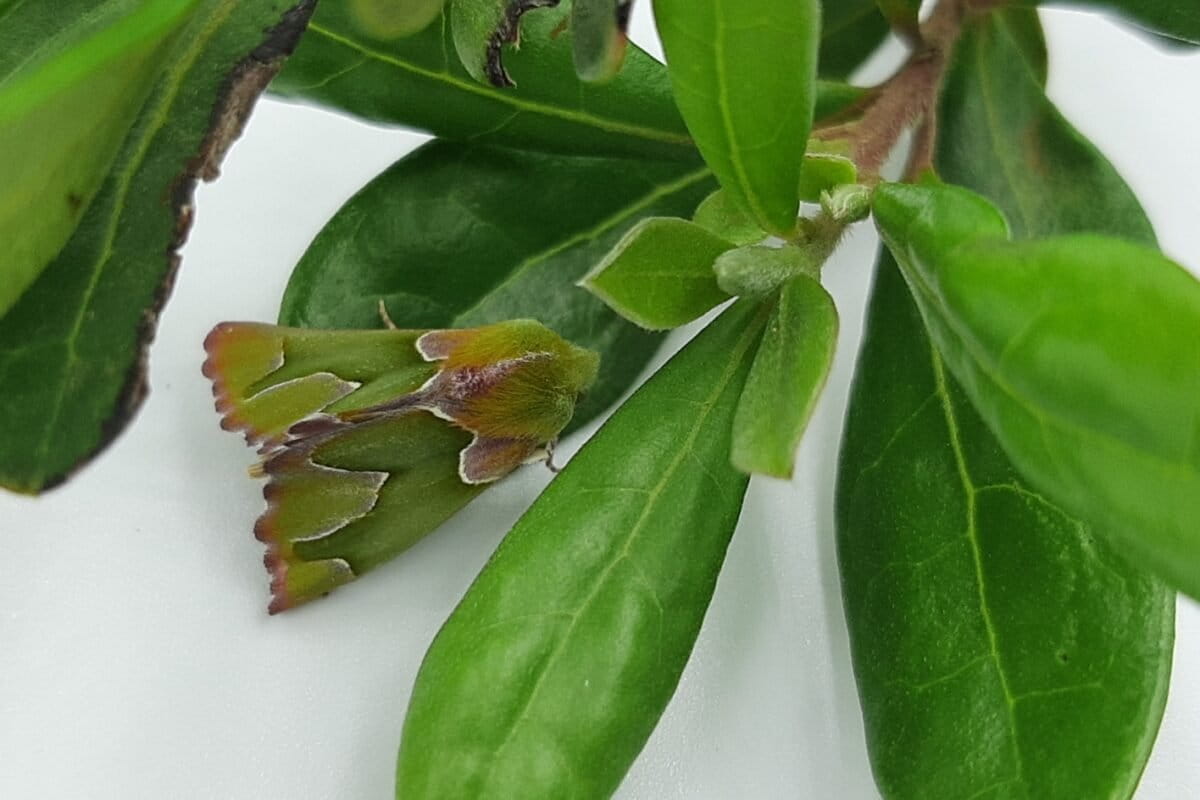
- Citizen scientists in South Africa have rediscovered an emerald-green moth that’s been missing for nearly one-and-a-half centuries.
- A dozen male moths had their photographs posted online from 2020 to 2023, providing proof-of-life for Drepanogynis insciata.
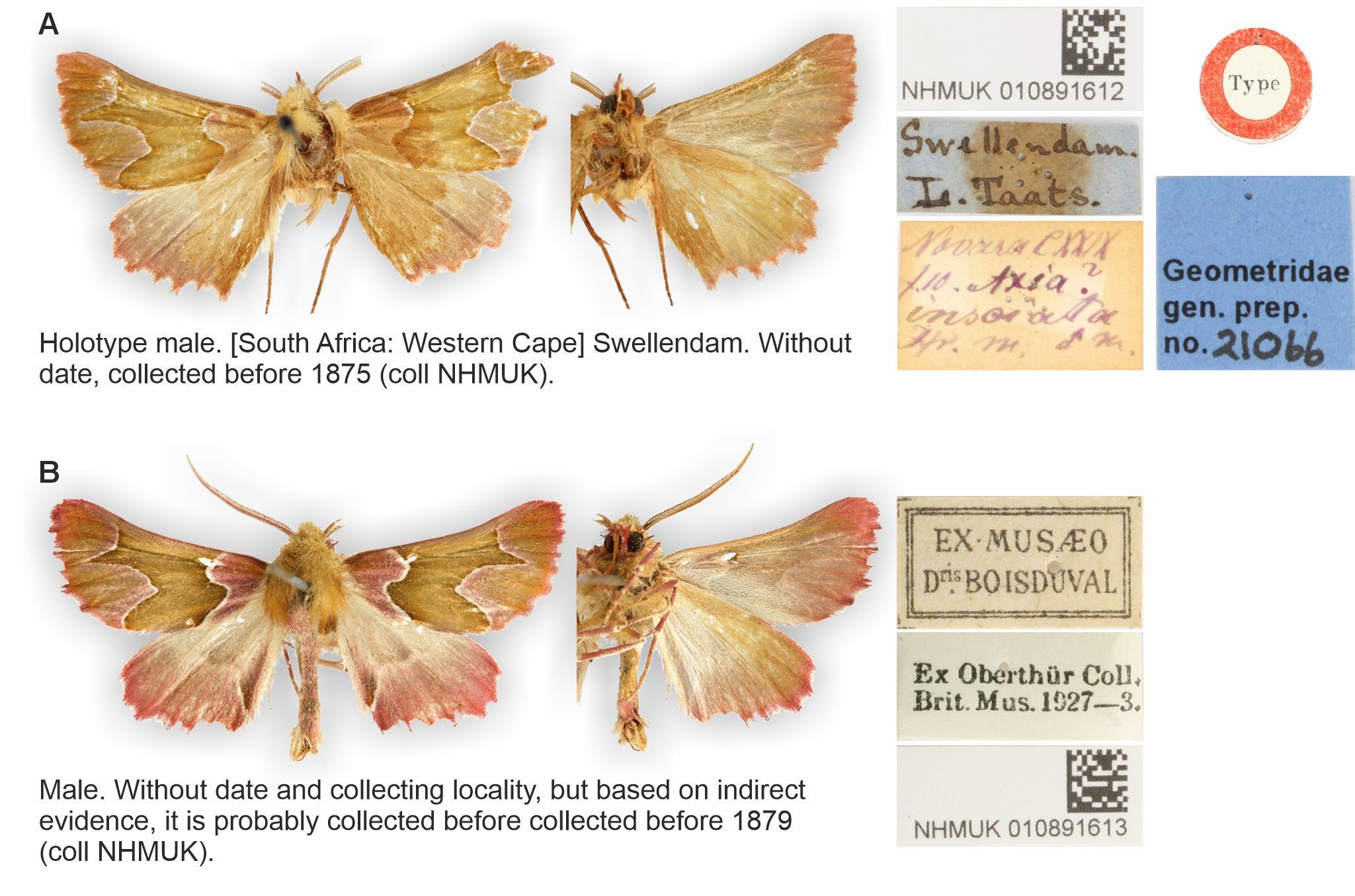
- Until now, scientists only knew of the moth from illustrations and two faded specimens, collected around 1875 in the Western Cape town of Swellendam, and kept in London’s Natural History Museum.
- Experts say websites like iNaturalist provide many additional eyes and a virtual workforce to produce the treasure trove of information aiding rediscoveries like this one.
A strikingly handsome emerald-green moth, lost to science for nearly one-and-a-half centuries, has been rediscovered in South Africa by citizen scientists who posted photographs of it online.
The moth, Drepanogynis insciata, whose body and wing margins look as though they’ve been stained with red wine, was thought to be extinct. The species hadn’t been recorded since two male specimens were collected near the Western Cape town of Swellendam around 1875.
Scientists only knew of the moth from those two faded specimens, which are kept in London’s Natural History Museum.
However, according to a recent article in ZooKeys, a dozen separate sightings were recorded in four different locations between 2020 and 2023 and uploaded onto iNaturalist, the citizen science website. They were the first photographs ever taken of live specimens.

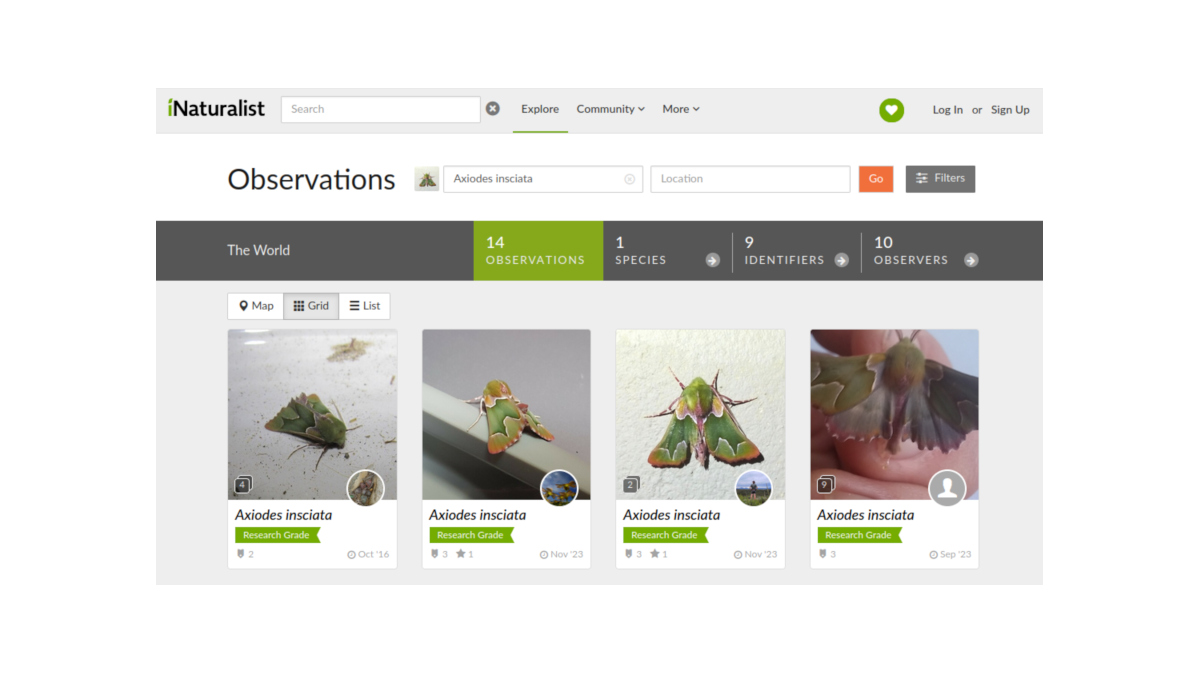
When the first of those photographs, taken by Cameron Scott in the Gondwana Private Game Reserve, around 160 kilometers (100 miles) west of Swellendam, was uploaded to the site in September 2020, South African lepidopterist Hermann Staude got a tip-off about his intriguing picture.
“I looked, and there it was — insciata — [a] living animal,” Staude told Mongabay. “That was quite an incredible feeling, to all of a sudden see something that you thought might have been extinct.”
Staude asked Scott to catch a moth if he saw another, which he did. The specimen was kept in a freezer until Staude and his colleague, zoologist Pasi Sihvonen from the Finnish Museum of Natural History, in Helsinki, could collect it for analysis. Sihvonen, who had examined the original museum specimens, likens the rediscovery to an ornithologist being handed proof-of-life for an ivory-billed woodpecker (Campephilus principalis), a U.S. bird not reliably recorded in the wild since 1944.
“When the actual specimen was handed over to us, I was like, ‘Wow, it’s so green’,” he told Mongabay, adding that the wings of the museum specimens have now faded to a salmon pink. “It’s difficult to describe how you feel that you have something so extraordinary in front of you; something that you thought doesn’t exist anymore.”
Both he and Staude are yet to see live individuals, which so far have only been males. Like many insects, the males of D. insciata are more mobile than the egg-laden females and more attracted to light, making them more likely to be seen. The moths also likely produce just two broods per year and are active for an extremely short window of time.
“I think it’s just a matter of people being in the right place at the right time,” Staude said.
The research team admitted that, without the aid of citizen scientists, the rediscovery of this long-lost species might have gone unrecorded. The number of people studying moths is so small, Sihvonen said, that professionals alone would only achieve a fraction of what is accomplished with the help of non-entomologists armed with cameras.
“For people like me, it’s really a treasure trove,” he said. “Occasionally, if I just browse through the pictures [online], something like this [moth] surfaces and you think, ‘Wow, this cannot be true’.”
The next steps will be to undertake more comprehensive surveys to determine which plant the caterpillars of D. insciata feed on.
But finding the host plant is easier said than done. It could be a grass, a herb or the leaf of a tree. It’s also possible the caterpillars feed on more than one type of plant.

Staude has been searching in suitable-looking patches of fynbos — a globally significant South African floral biome unique to this part of South Africa — beating bushes with a stick to see what caterpillars fall out, then raising them in captivity to identify the moths that emerge.
The work is labor intensive. Staude likens it to searching for a needle in a haystack, but it is also vital. Identifying the plant D. insciata depends on for its life cycle — and the condition of the habitat in which that plant occurs — will be key to aiding the moth’s conservation.
All the records of D. insciata were made relatively near to Swellendam, suggesting a shortage of good, intact fynbos elsewhere along this part of South Africa’s southern coastline after more than two centuries of degradation from agriculture, urbanization, invasive plants and uncontrolled burning.
One person acutely aware of human pressure on renosterveld, an equally rich yet less showy part of the fynbos biome, also happens to be among the few people to have seen this rare moth.
Ornithologist and conservationist Odette Curtis-Scott, CEO of the Overberg Renosterveld Trust, came across the moth while taking part in the 2021 Great Southern BioBlitz at ORT’s research center at Haarwegskloof, some 40 km (25 mi) south of Swellendam. The bioblitz is an intensive springtime survey of species in designated areas across the southern hemisphere, and Curtis-Scott and conservation manager Grant Forbes were photographing every moth they saw perched on a wall at the center on one of the survey nights. And D. insciata was one of them.

Like other bioblitz participants, they uploaded their photographs to iNaturalist, providing additional records of the lost moth, much to the delight of Staude and Sihvonen.
Curtis-Scott, who was not part of the ZooTaxa study, said she believes that protecting more visible species, such as the black harrier (Circus maurus) — long a research focus of hers and South Africa’s bird of the year for 2026 — can also safeguard lesser-known species like the moth and countless other animals that persist in this threatened ecosystem.
“That’s really what we’re doing this for — these small, overlooked, incredible creatures that are probably important pollinators for certain species,” she told Mongabay.
“These tiny critters are some of the most important parts of these ecosystems, and we really need to get to grips with how they’re being impacted by all this loss and what we can do to support them and keep them there.”
Banner image:One of the specimens of Drepanogynis insciata photographed by Cameron Scott in Mossel Bay, South Africa. Image by cyamscott via iNaturalist (CC BY-NC 4.0).
For South Africa’s dwindling renosterveld, there’s now a ‘panic button’ app
Feedback: Use this form to send a message to the author of this post. If you want to post a public comment, you can do that at the bottom of the page.