- Between 2022 and 2025 at least 62 kilometers (39 miles) of roads were opened in Achuar territory in southern Ecuador, several without environmental permits or technical studies.
- Global Forest Watch documented the loss of thousands of hectares of primary forest. Community monitoring found that a lack of control on the part of the authorities has facilitated illegal logging.
- The arrival of illegal loggers led to confrontations between communities, which resulted in two murders of Indigenous people.
- The area is one of the poorest in the country with few basic services: Some communities complain about the lack of roads, but others are concerned about their social and environmental impacts.
Between March and May 2025, at least eight children from the Achuar Indigenous community died of leptospirosis in the southern Ecuadorian Amazon. The disease is preventable with access to safe drinking water and timely treatment. But these two conditions are absent in Taisha, one of the poorest five cantons in Ecuador and the one with lowest coverage of basic services. Months earlier, provincial and canton authorities built access roads to Taisha, promising to address this neglect. But these projects — implemented without the full consent of the Achuar, environmental control strategies and, in some cases, technical criteria or permits — had fatal consequences.
Two Achuar people were murdered.
Illegal loggers used the roads and took advantage of the lack of control on the part of authorities to reach Achuar territory. The demand for timber quickly found supply in a canton where almost eight out of 10 people live in poverty or extreme poverty, according to the National Institute of Statistics and Census (INEC). Taisha also makes up a large part of Achuar territory, which is home to “one of the best-preserved and most biodiverse forests in Ecuador,” according to a recent report by the organization Amazon Conservation’s Andean Amazon Monitoring Program (MAAP).
Several Achuar sold the illegal loggers timber from the cedro (Cedrelo odorata) and chuncho (Cedrelinga cateniformis) tree species from their land, says Waakiach Kuja, president of the Achuar Nation of Ecuador (NAE), who gave an interview to Mongabay Latam after coordinating the transfer of a sick community member to a clinic by air, the only means available in the area.
Kuja says that the logging and new roads violated the territorial resolutions made by Achuar elders. This led to disagreements.
In May 2025, the community of Pumpuentsa blocked a truck carrying timber from Patukmai from passing through the village. This led to a confrontation culminating in the death of a local leader after he was run over by the truck. In retaliation, community members killed the person who had allegedly sold the timber, according to reports by local media which were corroborated by sources.
“Some people say, ‘it’s my land, it’s my property, I can cut down and sell the timber.’ This caused a serious problem in Pumpuentsa and Patukmai, which has yet to be resolved,” says the Achuar president. On Sept. 17, the Achuar governing council held a round of assemblies to discuss reparation measures for the victims’ families.
“Our elders were wise. They resolved to prohibit logging, mining, oil drilling and road building to prevent conflicts between neighbors and to preserve the forest,” says Kuja. However, some communities, isolated except for expensive flights or journeys of up to a day on foot, asked the authorities of Taisha canton and Morona Santiago province to build access roads.

Roads that bring deforestation
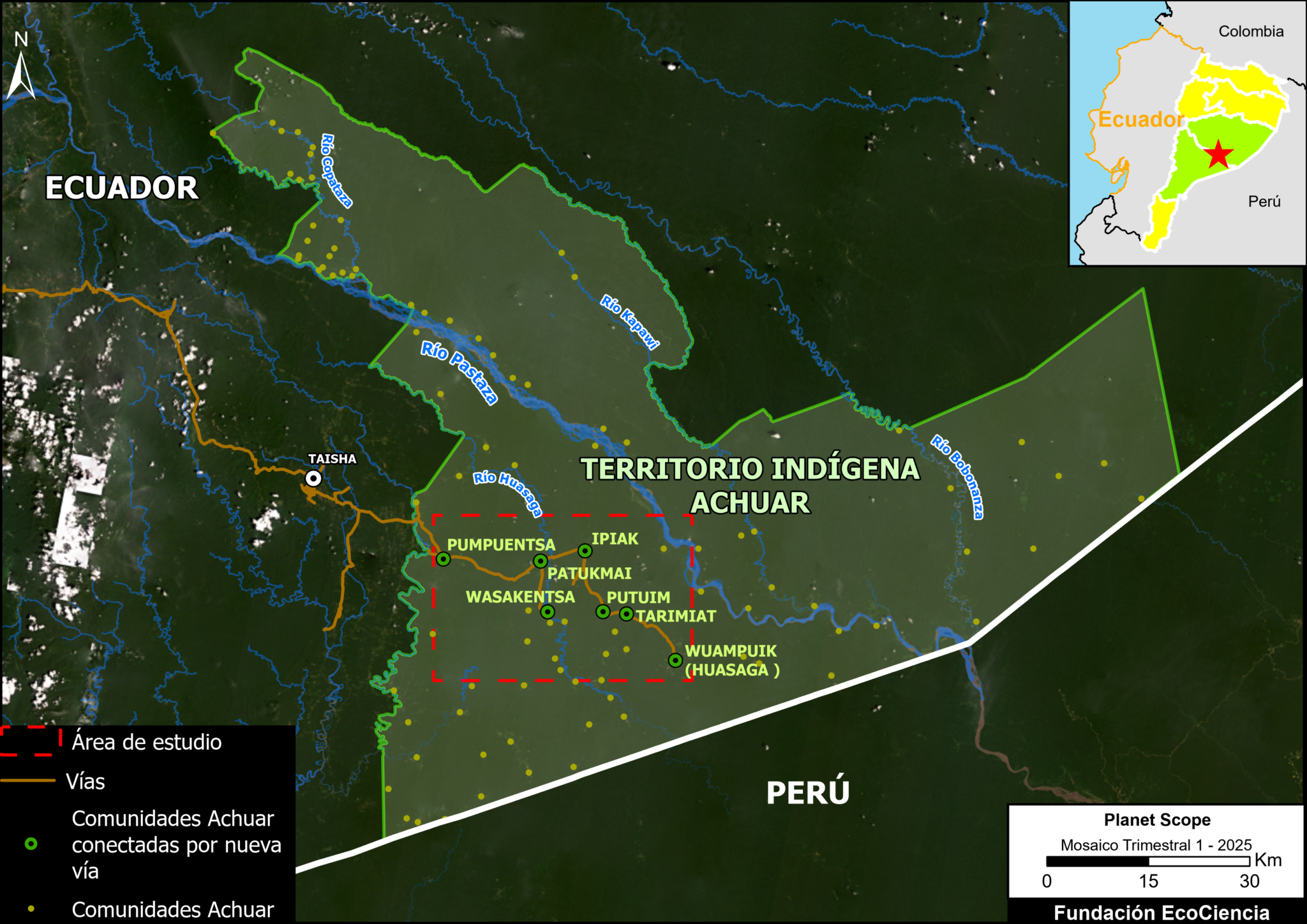
Approximately 50 kilometers (31 miles) of roads were opened in primary forests in Achuar territory between April 2022 and April 2025, according to MAAP report #231, to which the nonprofit Pachamama Foundation, working in support of the Achuar, contributed information about the territory and recommendations for public policy. At least two roads, totaling 39 km (24 mi), do not have environmental records in the Unified Environmental Information System (SUIA), a platform managed by the Ministry for Environment and Energy (MAE). In other words, they were built without permits, according to the report.
Mongabay Latam contacted the MAE, the Morona Santiago Prefecture and Taisha mayor’s office regarding their position on the report as well as the complaints made by Indigenous leaders and experts but did not receive any response before this article was published.
“Our quality of life hasn’t improved, our needs haven’t been met, prioritizing healthcare. We need a functioning health center, medicine, drinking water,” says Agustín Tentets, coordinator of the Indigenous youth-based Amazank monitoring group and former president of the NAE. He also says that the roads lack bridges, which means they can only be traversed when the water level is low and, when they do, they contaminate the water the communities depend on with fuel.
These roads “threaten” conservation, says Jorge Villa, a specialist in geographical information systems and remote censors at the EcoCiencia Foundation, an Ecuadorian organization that supports MAAP monitoring.

In the last 24 years, deforestation of primary forests in Taisha peaked in 2022 and 2024, with 2,000 and 1,800 hectares (4,942 and 4,448 acres) cut down, respectively, according to Global Forest Watch. In total, 3,800 hectares (9,390 acres) were deforested, equivalent to an area larger than Central Park in New York City.
Additionally, 2022 and 2024 had the greatest loss of forest cover in this area, with 3,200 hectares (7,907 acres) of annual reduction. Between Sept. 15, 2023, and Sept. 14, 2025, Global Forest Watch also logged over 120,000 high-confidence deforestation alerts, covering an area of 4,161 hectares (10,282 acres). Deforestation alerts indicate a possible recent change in forest cover and serve to monitor forests in near real time.
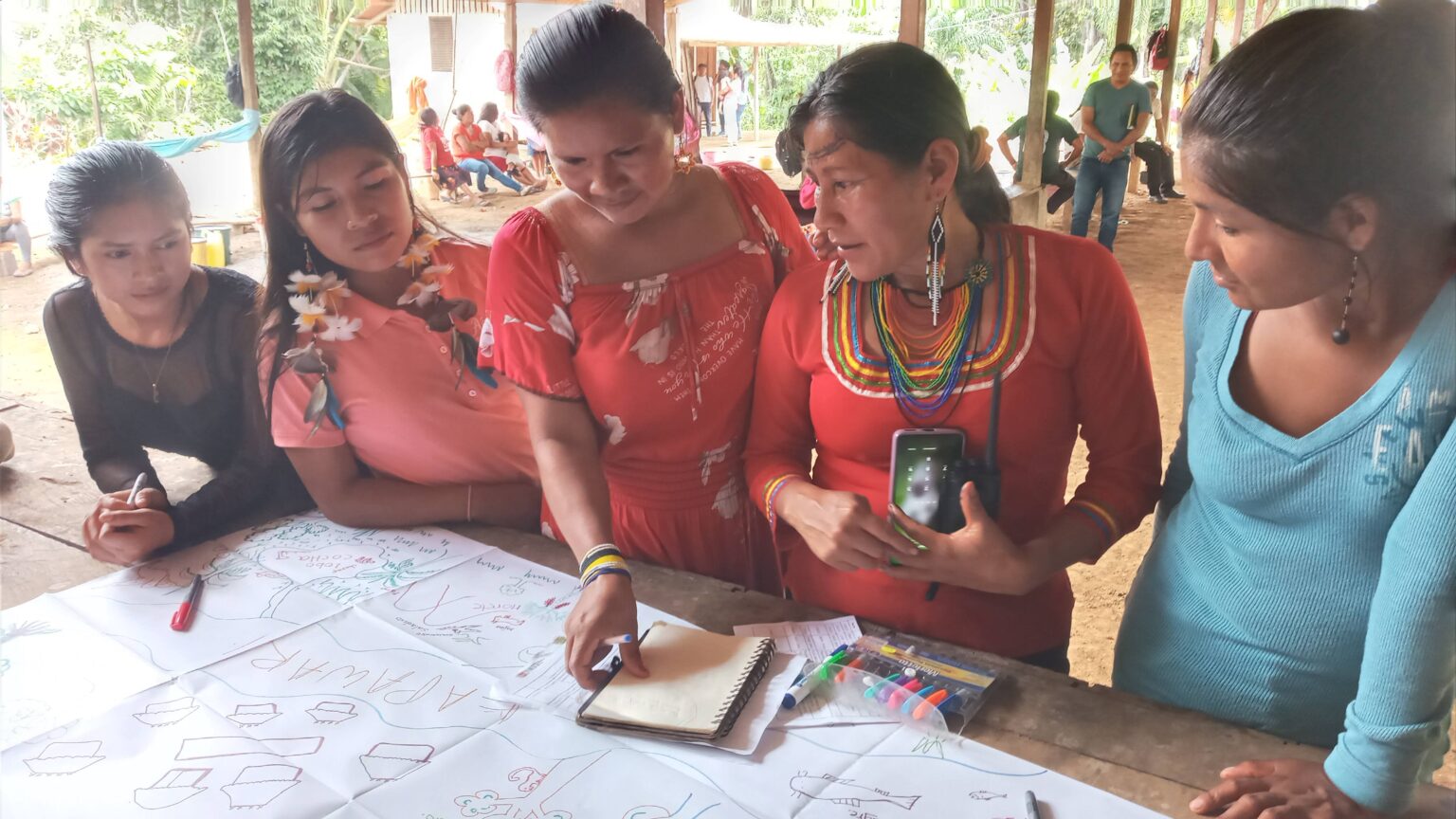
Community monitoring by the Achuar group Ikiama Yapii, which means “face of the forest,” identified Pumpuentsa and Patukmai as the communities with the highest forest utilization along the new roads, according to the MAAP report.
Calls for control and permits
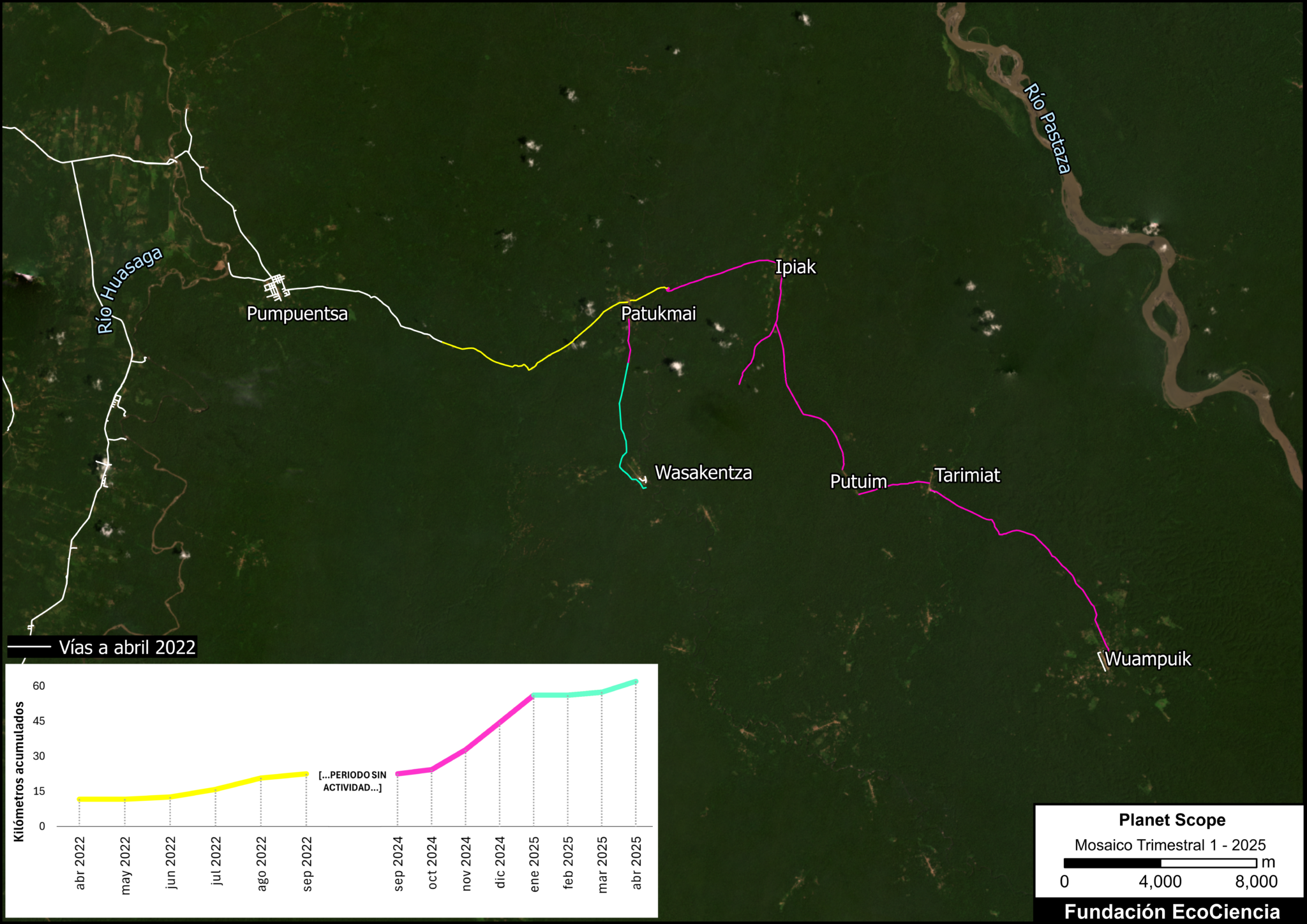
The first road in the history of Achuar territory is12 km (7 mi) long and was completed in April 2022, according to the MAAP report. It connects the community of Pumpuentsa with the village of Taisha. The project, overseen by Morona Santiago Prefecture, was completed in September 2022, adding a further 11 km (7 mi) to reach the community of Patukmai.
This latter section is the only road with an active environmental record in the SUIA. Despite this permit requiring an environmental management plan, data from Global Forest Watch and surveillance by Achuar monitoring groups indicate that no such plan has been implemented.
“The MAE is responsible for making sure that the environmental record is in order and the Provincial Decentralized Autonomous Government (GADP) should control and monitor the road to prevent extraction of natural resources. There should be coordination between the GADP and the MAE,” Villa says.
In addition to the lack of control, there is also a lack of maintenance.
“It’s a badly paved road. The surface gets damaged easily. They didn’t build any bridges, only rudimentary crossings, and the results are disastrous,” Agustín Tentets says. “When the river is low, cars drive through the water and the grease, oil and fuel affect the rivers,” he adds. This section of road crosses at least two tributaries.
In September 2024, Taisha mayor’s office resumed the project, opening 33 km (21 mi) of new road from Patukmai to Wampuik. Mayors’ offices do not have jurisdiction over rural roadbuilding, according to the MAAP report. Although this section is not registered in the SUIA, the mayor’s office announced the conclusion of the project in December 2024 on its website.
Tentets says that the mayor, Hugo Molina, opened the road without technical studies as part of his re-election campaign. The road is unpaved and communities are responsible for clearing vegetation so that, at least, motorbikes and four-by-fours can use it in dry periods, he says.
“In winter, it floods; it’s like a swamp,” he says.

Patricio Awarmas, technical coordinator of the Ikiama Yapii monitoring group, says that the “biggest flaw” in the project is that the road blocks the streams, diverting them or causing them to form pools that overflow and threaten to erode the surrounding area.
In January 2025, Morona Santiago Prefecture opened a new section of road from Patukmai to Wasakentsa. By April 2025 they had deforested 6 km (4 mi), bringing the total of roads in Achuar territory up to 62 km (39 mi). According to the MAAP report, the prefecture plans to continue building roads deeper into the rainforest to connect the communities of Nases, Kuchints, Tsurik Nuevo and Wampuik.
More impacts among the Achuar
“This is what’s been happening and as a result there has been death among brothers,” says Awarmas.
There have also been other social impacts. The coordinator of the Ikiama Yapii group says that the roads, which penetrate the Ecuadorian Amazon in the direction of the border with Peru, are facilitating gas and fuel smuggling.
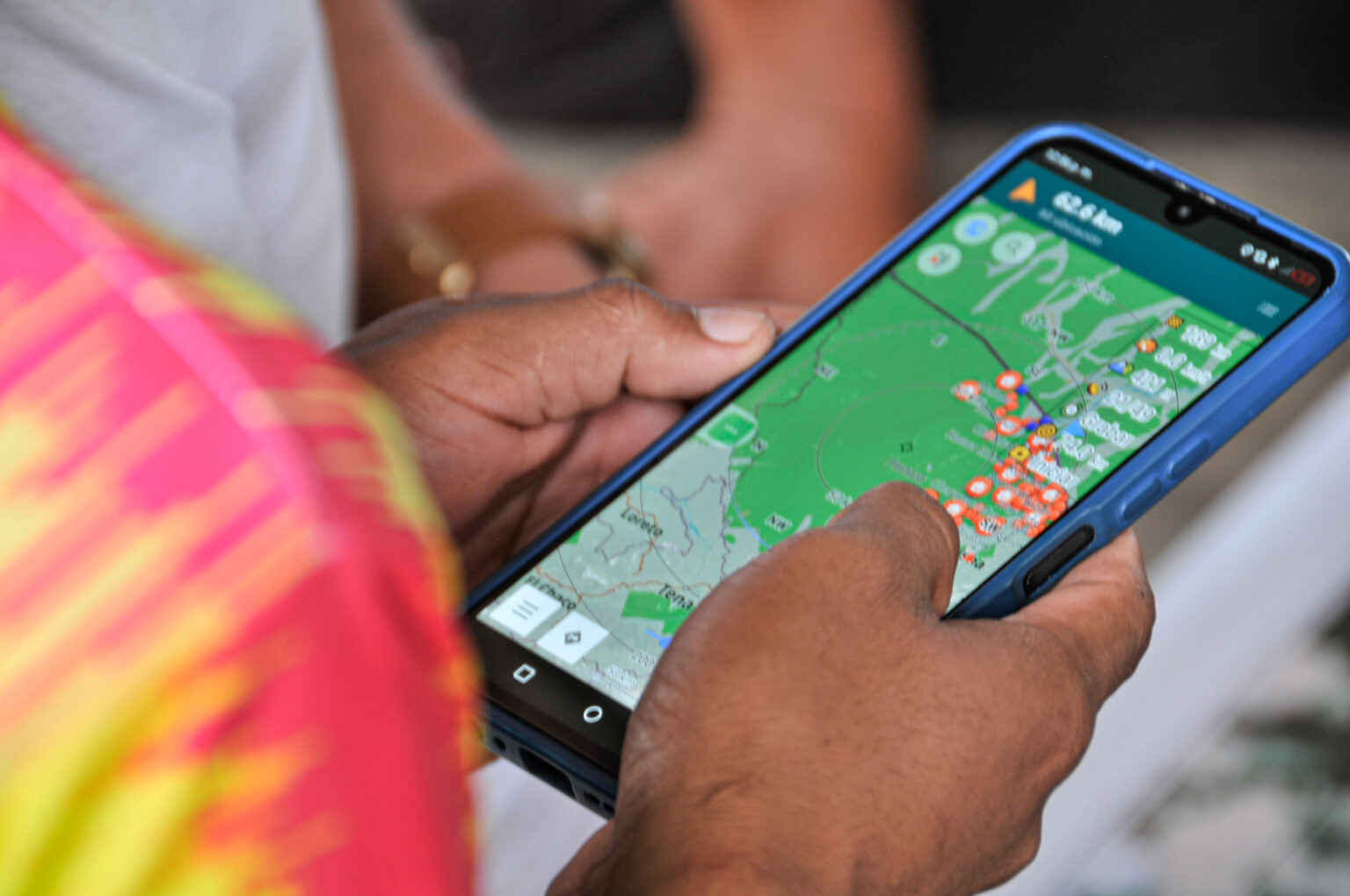
The new border connections will be very difficult to control, according to Fernando Espíndola, a geographer from Morona Santiago.
“We are already aware of the presence of groups carrying out illicit activities in these sectors linked to the trafficking of fuel, gold and narcotics,” he says.
Awarmas and Tentets share the same concern: Community members are selling wood to illegal traders without operating permits and without receiving fair payment. They have also seen an increase in illegal hunting.

The poor state of the roads has prevented more environmental crimes from being committed, Tentets says. However, as the road network grows, so does the risk.
While the roads were built at the request of certain communities, there needs to be free, prior and informed consent (FPIC), Villa says.
“The goal is for the communities to be fully aware of and benefit from the projects without increasing threats,” he says.
Tentets says decisions should be made with conservation in mind, to protect the culture and health of the Achuar. NAE president Kuja says that if canton or provincial authorities have the funds, instead of building new roads, they should invest in the creation and strengthening of bioeconomic projects that meet local needs, primarily those related to health.
Banner image: Drone capture showing a road cutting through flood prone areas. Image courtesy of Achuar community monitors.
This article was first published here in Spanish on Sep. 16, 2025.
Credits