

You may have heard her songs, seen her videos, maybe even attended one of her concerts … but have you seen the new genus of Australian plant bugs named after Taylor Swift?
Scientists at the University of California, Riverside recently described a new genus of plant bugs, they’ve named Swiftiephylus, in honor of the Grammy-winning U.S. singer. The genus contains 12 new species of plant bugs. Four of the insects are named after Taylor Swift or her albums: Swiftiephylus taylorae, Swiftiephylus amator, Swiftiephylus intrepidus, and Swiftiephylus poetorum. The first is a Latinized version of Taylor; the others are references to her albums “Lover,” “Fearless” and “The Tortured Poets Department.”
The authors write that the insects were named after Taylor Swift, “in recognition of her show-stopping talent, heart-wrenching lyrics, and the joy and comfort she has brought to many. The term ‘Swifitie’ refers to Swift’s loving fanbase,” the study notes.
Study author and “Swiftie” Sarah Schroeder said in a press release that she named the insects after Taylor Swift’s appearance. “Taylor Swift’s iconic look is her blonde hair and red lips. These insects are pale yellow with accents of red throughout,” Schroeder said. “In the paper I refer to them as blonde.”
Schroeder believes that their coloring helps the bugs camouflage in the flowers they live on, which feature spindly red to orange flowers.
Though many species of insects are broadly called bugs, Swiftiephylus plant bugs are part of the Miridae family, the largest family of true bugs. There are more than 11,000 described species of true bugs in the Miridae family worldwide. The bugs in this study were collected between 1995 and 2004 and borrowed from museum collections to be formally described.
Swiftiephylus plant bugs feed on trees and shrubs in Australia, though they are relatively harmless to their host plants and aren’t known agricultural pests. Unlike their namesake, the Swiftiephylus are silent bugs and have no known musical talent.
Akito Kawahara, director of the McGuire Center for Lepidoptera and Biodiversity in Florida, U.S., has written about the taxonomic use of naming insects after celebrities, which he thinks is, “generally good for science,” especially for insects which often don’t get much attention.
“Currently many insects are disappearing and potentially going extinct. The naming for celebrities helps generate more attention to them, and their importance to the environment and in many cases, to humankind,” Kawahara told Mongabay in an email.
Banner image: Of Swiftiephylus taylorae. Image courtesy of Sarah Schroeder/UC Riverside.

LONDON (AP) — How does a grizzly bear cross the road? With the help of Indigenous people, ranchers and governments.
That’s the idea behind the Yellowstone to Yukon Conservation Initiative, which is working to keep the Rocky Mountains an unfettered migration route for wildlife from Wyoming to northwestern Canada. To do so, the group works with local people and governments throughout the region to protect wild lands and build overpasses, underpasses and fencing to help animals cross busy roads.
The charity is one of the 15 finalists announced Friday for the 2026 Earthshot Prize, created by Britain’s Prince William to support conservationists and entrepreneurs developing solutions to climate change, pollution, habitat loss and other environmental threats. The winners in each of five categories receive 1 million pounds ($1.34 million) and assistance in expanding their projects.
William launched the prize in 2020, inspired by U.S. President John F. Kennedy’s 1962 “Moonshot” speech that challenged Americans to go to the moon by the end of that decade. The prince’s goal is to accelerate the pace of environmental innovation and “repair the planet” by 2030.
Other nominees for this year’s prize include an Argentine project that uses artificial intelligence and satellite data to spot and track wildfires across Latin America; the Zero Emission Maritime Buyers Alliance, which aims to cut carbon emissions from shipping, and Orsted, one of the world’s biggest developers of offshore wind farms.
The winners will be announced Nov. 17 during a televised awards show in Mumbai.
Jason Knauf, chief executive of the Earthshot Prize, said finalists such as Yellowstone to Yukon work to transcend barriers like the ones that have grown up between Canada and the United States during their recent trade war.
“People want to protect nature for the sake of future generations. That is what the vast majority of people want in the U.S., in Canada, and everywhere in the world,” Knauf said. “This is a really, really popular agenda, and we cannot allow ourselves to get distracted by short-term political noise, as noisy as it may be.”
Yellowstone to Yukon, which is based in Canmore, Alberta, with U.S. offices in Bozeman, Montana, has been pursuing its goal of creating an interconnected system of wild lands and waterways along the spine of the Rocky Mountains since 1993.
Jodi Hilty, the group’s president and chief scientist, said in a video statement that it works with governments to identify wildlife crossings, consulting ranchers to keep predators and livestock away from one another and supporting Indigenous peoples’ plans for protected areas.
From Wyoming to the Yukon Territory there are now 204 wildlife crossings and some 24 million hectares (59 million acres) of protected lands, as campaigners seek to counteract problems caused by human development.
“The solution is surprisingly simple,” Hilty said. “Animals need space to move, and they don’t recognize borders. So we bring people together in this landscape to the same table …. We work with them all to come up with the solution in order for animals to be able to move freely across the landscape.”
By Danica Kirka, Associated Press
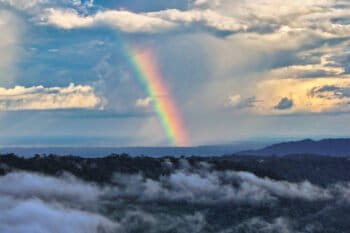
Banner image: Rainbow over the Amazon rainforest. Photo by Rhett Ayers Butler
Anslem de Silva is widely regarded as the father of modern herpetology in Sri Lanka. He has spent more than six decades documenting the island’s rich reptile and amphibian diversity while mentoring generations of researchers.
De Silva spoke with Mongabay contributor Malaka Rodrigo as he, at 86 years old, prepares to host the first World Congress on Snakes. The conference in October in Sri Lanka’s hill city of Kandy will be an international gathering specifically dedicated to snake conservation and research.
Over the course of a distinguished career, de Silva has authored more than 350 scientific papers and more than 25 books. His work began in the 1960s when only a small handful of Sri Lankan researchers were studying the country’s reptiles and amphibians. To build local scientific capacity, he organized the country’s first one-day herpetological conference in the 1960s. He also launched Sri Lanka’s first herpetological research journal, Lyriocephalus, and established the Amphibia and Reptile Research Organization of Sri Lanka in 1990.
De Silva’s mentorship has left a lasting legacy across the region. Ruchira Somaweera, a Sri Lankan-born conservation biologist, recalled receiving an inscribed copy of the journal from de Silva when he was just 13. “Most of the herpetologists of my generation were groomed by de Silva, and hundreds, if not thousands, of students have been inspired by him, just like I was,” Somaweera told Mongabay.
Born in 1940 in the southern coastal city of Matara, de Silva developed his passion for snakes as a child after rescuing a rat snake (Ptyas mucosa) that was being abused by other students. Before becoming a leading scientist, he was an accomplished magician who won the national title of Best Magician in 1965. He credits magic with honing his public communication skills.
“Communicating the value of conservation to the public is an art; a matter of good storytelling,” de Silva, who currently serves as co-chair of the IUCN Amphibian Specialist Group, told Rodrigo. “I believe my experience as a magician helped me to reveal the true magicians of nature — reptiles and amphibians.”
A key priority for de Silva is countering public fear and misperceptions about snakes. While Sri Lanka is home to more than 100 snake species, only about five species can cause fatal bites, according to de Silva.
In recognition of his lifetime of contributions, the IUCN awarded de Silva the IUCN Sir Peter Scott Award of Conservation Merit in 2019.
For de Silva, his primary legacy is the young scientists he has mentored. “For me, it is not only about the species I have studied or documented,” de Silva said. “I am especially happy to see the growth of herpetology in Sri Lanka and the younger generations who are now continuing this work.”
Read the full interview by Malaka Rodrigo here.
Banner image: Anslem de Silva, Sri Lanka’s pioneering herpetologist. Image courtesy of Anslem de Silva.

HANOI, Vietnam (AP) — Heavy rain caused flooding across parts of northern Vietnam on Thursday, disrupting travel, inundating homes and pushing several rivers above dangerous levels, authorities and state media said.
Rain has fallen across northern and north-central Vietnam this week, with some areas receiving more than 50 centimeters (19.7 inches), according to the disaster prevention department.
More than 2,000 homes have been submerged, many key transportation routes blocked and more than 1,000 households isolated. Ninh Binh and Thanh Hoa provinces, which include lowland and hilly areas south of the capital Hanoi, have been among the hardest hit.
Vietnam is among the world’s most climate-vulnerable countries and prone to flooding. A series of severe storms last year spurred the country to find new ways to prepare for and manage floods.
In Thanh Hoa province, authorities told students to stay home because flooding had made travel to school dangerous, state media said.
Heavy rains and flooding have submerged or damaged about 10,014 hectares (24,745 acres) of rice and other crops, with the largest losses reported in Ninh Binh, Thanh Hoa and Nghe An provinces. Thousands of livestock and poultry also have been killed.
“The flood happens every year,” Ninh Binh resident Tran Ngoc Tai told national broadcaster VTV, adding that people were prepared with fresh water and food.
Many streets in Hanoi were deeply flooded Thursday morning, with water nearly a meter (3.2 feet) deep in some places, disrupting traffic and making it difficult for residents to get to work, take children to school or leave their homes.
Rainfall from Wednesday night to Thursday morning exceeded 15 centimeters (5.9 inches) in some areas, state media said.
Many high schools and universities in Hanoi remained closed or switched to online classes Thursday afternoon as heavy rain caused widespread flooding.
The rising waters of Bui River in the southwest outskirts of Hanoi threatened to flood homes, prompting authorities to deploy hundreds of soldiers to help residents move belongings to higher ground, state media said.
A cold air mass moving south is expected to bring five days of heavy rain to southern Vietnam, including flood-prone Ho Chi Minh City, Vietnam’s financial capital, starting Sept. 17, according to the Southern Regional Hydro-Meteorological Center.
Forecasters predict widespread rain through Sept. 21. Authorities have warned of flooding in low-lying areas and along waterways. Ho Chi Minh City is forecast to receive 10 to 20 centimeters (4 to 8 inches) of rain, with some areas getting more.
Vietnam experienced repeated severe flooding in 2025. Tropical Storm Wipha brought heavy rain and flooding in July, followed by more flooding and landslides in August when Tropical Storm Kajiki struck. Typhoon Bualoi killed at least 26 in September. In October, the historic cities of Hue and Hoi An in central Vietnam flooded, along with much of northern Vietnam.
By Aniruddha Ghosal, Associated Press
Banner image: Local residents commute by boat through a flooded village on the outskirts of Hanoi, Vietnam Thursday, Sep. 17, 2026. Image courtesy of Pham Tuan Anh, Associated Press

In India, the exotic pet trade is increasing the risk of zoonotic disease spillovers, as close contact with imported wild animals creates repeated opportunities for dangerous pathogens to jump to humans and vice versa, reports Mongabay India’s Arathi Menon.
Dr. Rina Dev, an avian and exotic animal veterinarian in Mumbai who treats imported and seized wildlife, experienced the potential danger firsthand when she was hospitalized with a lung infection. “I hope it’s not something from the parrots I was treating,” Dev told Mongabay India after she was released from the hospital. Her concerns are warranted: diseases like avian chlamydiosis (psittacosis) are commonly contracted by people who handle birds, earning it the nickname “bird handler’s disease.”
Dev noted that traded animals can carry a wide array of infections, including salmonellosis from reptiles, tuberculosis from primates, and avian influenza from birds. “Tuberculosis is increasingly being detected among primates, which is a big zoonotic concern,” she said.
Uttara Mendiratta, a conservation researcher working on illegal wildlife hunting and trade, said disease transfer between humans and other primates is especially easy because we’re so closely related. Ebola and HIV can both pass from nonhuman primates to people, for example.
Human diseases can also be deadly for wildlife. A global analysis revealed that traded mammals are 1.5 times more likely to share pathogens with humans than nontraded mammals. On average a traded species shares one additional pathogen with humans for every decade it’s traded. Additionally, a 2026 report by Humane World for Animals, a global nonprofit working to protect animals, estimates that 75% of emerging infectious diseases are zoonotic and roughly 850,000 unknown viruses in birds and mammals have the potential to infect people.
Zoonotic risks are further heightened by animals in public places such as pet cafes, petting zoos, and interactive public events. “It is very risky, particularly from a public health perspective,” said Sumanth Bindumadhav, director of Humane World for Animals India and co-author of the 2026 report.
Mendiratta said first responders like customs officials often lack disease-prevention equipment during wildlife seizures, and illegally trafficked animals bypass mandatory quarantine procedures entirely.
“We have tried to raise this issue with people working on One Health because we believe exotic pets represent an important potential disease pathway,” she said, referring to the One Health framework that advocates for a holistic approach to health recognizing the interconnectedness of human, wildlife, and environmental health. “So far, we have not seen the level of response of investment we had hoped for,” Mendiratta added.
Read the full story by Arathi Menon here.
Banner image: A red-lored amazon, a parrot native to Central and South America. Those who handle exotic birds are often at risk of contracting avian chlamydiosis or psittacosis, an infection so common within the profession that it’s earned the nickname “bird handler’s disease.” Image courtesy of Humane World for Animals India.

Wild grass now grows around the abandoned wooden houses of Tengjhih, a high-mountain hamlet in southern Taiwan, once a key settlement of the Bunun Indigenous people. Now, little remains except for the memories it holds.
Around 150 Bunun Indigenous residents of Tengjhih were permanently resettled in lowland areas after the deadly Typhoon Morakot in 2009 destroyed the only access road to their village, contributor Aylin Ho reports for Mongabay.
Typhoon Morakot killed 755 people across Taiwan, triggering catastrophic floods and landslides. While Indigenous peoples represented just 2.1% of Taiwan’s population at the time, approximately 70% of the land declared unsafe by authorities was located within Indigenous territories.
Efforts to rebuild the road to Tengjhih in 2012, 2021 and 2023 faced setbacks due to climate change-amplified rainfall and landslides. More recently, a typhoon in 2025 also devastated one section of the mountain, Ho reports. The indefinite closure of the surrounding Tengjhih National Forest Recreation Area has wiped out the local ecotourism and agricultural economy.
“When a major typhoon hits us, I have no income for the entire year,” said Bi’ Ismahasan, 70, a tea and coffee farmer who now relies on government assistance. “In 2026, I lost my entire harvest. Every year is worse than the previous one.”
Displacement has severed connections to ancestral land, threatening the transmission of cultural practices and language to younger generations.
“Today, when [young people] come back, there is no village and no work,” said Saminat Maliklan, 55, a Bunun cultural guide and one of five residents remaining in Tengjhih. “They have to adapt to an unfamiliar environment, and their ties with elders gradually fade. Our rituals and ceremonies are disappearing.”
The Taiwanese government’s resettlement program has drawn sharp criticism. Under the program, displaced families received ownership of lowland apartments but not the land beneath them, preventing residents from selling, expanding, or rebuilding their homes, according to news reports.
Tunkan Tansikian, a Bunun Indigenous rights and policy scholar at National Dong Hwa University, highlighted that relocation occurred without prior consultation, violating Taiwan’s 2005 Indigenous Peoples Basic Law.
“The purpose of the resettlement program was to persuade residents to abandon their mountain villages, which were considered dangerous, to reduce safety risks,” Tunkan said. “For Indigenous peoples, however, land is a core part of their culture, rather than being treated as a tradable and easily relinquished commodity.”
While local officials at the Taoyuan District Office have ruled out permanent resettlement due to landslide risks, an alternative access road is scheduled to open in January 2027 thanks to years of campaigning by Dahu Ismahasan, president of the Bunun tribal council.
“We still have hope … One day, the road will be better, and the lives of the people here will be better too,” Dahu said.
Read the full story by Aylin Ho here.
Banner image: Abandoned houses in Tengjhih, a settlement of the Bunun Indigenous people, in Taiwan, on Aug. 6, 2026. Image by Aylin Ho for Mongabay.

Bolivia recently began overhauling one of its principal mining laws, with the goal of modernizing the industry and improving oversight. Civil society and Indigenous groups have raised concerns about the process, but officials say the new mining code will promote economic development and include environmental protections.
“We want a mining code that responds to the current needs of the sector, generates legal certainty, and establishes clear rules to support the development of Bolivian mining,” Marco Antonio Calderón de la Barca Quintanilla, the minister of mining and metallurgy, said in a statement.
The ministry says it’s held weekly meetings with key mining stakeholders about their concerns and proposals for the new mining code. This month, their ideas were given to a technical committee to consider while drafting a preliminary bill, which will be delivered to the national legislature for approval. The government hasn’t announced when the bill will be completed.
The current code was passed in 2014 and establishes the mechanisms for mining development, environmental oversight, and the participation of local and Indigenous communities, among other things. Updates will focus on strengthening mining rights, promoting investment, formalizing mining activity, and improving transparency, a ministry statement said. Updates will also involve “consolidating responsible environmental management.”
The details of potential changes haven’t been finalized or released. But local reports said some ideas have included new tax and royalty structures, removing the 30-year limit on mining contracts to extend them indefinitely, and restructuring the ministry and other mining institutions.
Other ideas include protections for people reporting illegal mining, and removing prior consultation of local and Indigenous communities as a restriction for accessing mining contracts.
For years, local and Indigenous communities have spoken out against foreign-backed mining projects that use too much freshwater and don’t provide adequate royalites to local communities. Others have denounced the illegal mining, mercury pollution, and deforestation that can result.
In the early stages of reviewing the mining code, civil society groups and Indigenous communities accused the government of excluding them from the process. They said their absence could ultimately weaken environmental reforms that the law needs.
They also expressed concern that the government’s priority is to increase the profitably of the mining sector, not to impose proper regulations.
“The environmental focus is just talk, because they are seeking to discuss a new mining code only with mining actors and not with actors who can contribute from the perspective of the serious environmental and public health impacts for which gold mining is responsible,” Ruth Alipaz, a representative for the National Coordinator for the Defense of Indigenous and Peasant Territories and Protected Areas, said in a July statement.
The Unified Confederation of Peasant Workers of Bolivia has been included on the technical committee, the government announced. Other representatives on the committee are from the government, mining cooperatives, and private companies.
Banner image: Bolivian miners during a march against illegal mining. Image by AP Photo/Juan Karita.

BRUSSELS (AP) — A scorching summer that dried up rivers and killed tens of thousands across the European Union from Portugal to Hungary has shown that the bloc needs to develop new tools to meet a worsening climate, European Commission President Ursula von der Leyen said Wednesday.
She said that this instability led her to propose a new European Heatwave Plan as well as a future European firefighting fleet of airplanes. Currently, the EU operates a small fleet itself but coordinates a network of aircraft, water trucks and volunteers that move across the 27-nation bloc as fires ignite.
“This summer was the summer of truth. Almost no part of our continent was spared,” said the EU executive during her annual State of the European Union address in Strasbourg.
“Key rivers like the Danube, the Rhine or La Garonne are disappearing before our eyes. More than 35,000 additional deaths during the heat waves. Care homes and hospitals dangerously overheated.”
The extreme heat, which hit Europe exceptionally hard and early this year appears to have led to a much higher spike in deaths than expected. Where Von der Leyen’s figure of 35,000 comes from is unclear, but it is triple the estimates of “excessive deaths” by monitoring groups in July.
Fires in France and Spain drove hundreds of thousands of people to flee their homes, shut down nuclear reactors in Hungary and France, ignited century-old munitions on Belgium’s border with Germany and revealed previously lost ships sunk on riverbeds like a tugboat in Serbia.
The heat and humidity that broke many records during the summer would not have been possible without climate change, according to a study by the World Weather Attribution group.
“All of this is a mere preview. These were the hottest summer months ever, but probably the coolest of the years to come,” von der Leyen said. “Science is clear: Europe is warming at double the global rate.”
While commending those who battled blazes this summer, von der Leyen said that she’s asked emergency responders and senior firefighters to “think bigger and learn faster” to design “new capabilities” for the EU to tackle climate instability.
When she praised a Danish helicopter pilot named Rune Kyndal, who died in August while fighting fires in Greece, the assembly erupted in applause.
“Rune gave his life to save others and today, all of Europe owes him,” von der Leyen said.
By Sam McNeil, Associated Press
Banner image: Firefighters battle a forest fire near Blagon during wildfires in southwestern France, July 29, 2026. Image courtesy of Emma Da Silva, Associated Press.

you're currently offline


