• Features
  • Videos
  • Podcasts
  • Specials
  • Articles
  • Shorts
Donate
  • English
  • Español (Spanish)
  • Français (French)
  • Bahasa Indonesia (Indonesian)
  • Brasil (Portuguese)
  • India (English)
  • हिंदी (Hindi)
  • বাংলা (Bengali)
  • Swahili
  • Videos
  • Podcasts
  • Articles
  • Short News
  • Feature Stories
  • The Latest
  • Explore All
  • About
  • Team
  • Contact
  • Donate
  • Subscribe page
  • Submissions
  • Privacy Policy
  • Terms of Use
  • Advertising
  • Wild Madagascar
  • For Kids
  • Mongabay.org
  • Reforestation App
  • Planetary Health Check
  • Conservation Effectiveness
  • Mongabay Data Studio

Latest

Muskoxen on Ellesmere Island. As a species, muskoxen have been around for a million years and are often called “ice-age survivors.” Though they have one of the lowest levels of genetic diversity of any mammal, the full suite of immune-related genes are intact in the species, says muskox expert Anne Gunn.

Canadian muskoxen hit by double punch of novel diseases and climate change

Ruth Kamnitzer 3 Apr 2026

How an engineer brought degraded wetlands back to life in drought-hit Bangladesh

Sadiqur Rahman 3 Apr 2026

Pyrenees brown bear population climbs to an estimated 130 in latest census

Shanna Hanbury 3 Apr 2026

Indonesian geothermal projects stall amid Indigenous concerns over justice

Mongabay.com 3 Apr 2026

Indonesia’s deforestation surges 66% in 2025, reversing years of decline

Hans Nicholas Jong 3 Apr 2026

Today is Jane Goodall Day. Her movement continues.

Rhett Ayers Butler 3 Apr 2026
All news

Top stories

Railroad & tariff war boost soy in Brazil’s Cerrado, endangering Indigenous lands

Banteng

How wild cattle recovery is transforming local livelihoods near key Thai reserve

Carolyn Cowan 2 Apr 2026

Thai court rules gold mine liable, but villagers face uncertain justice

Kannikar Petchkaew 1 Apr 2026

Peru-Brazil Bioceanic Railway brings too much risk to the Amazon, experts warn

Yvete Sierra Praeli 31 Mar 2026

Conservation depends on rangers. Their wellbeing is often an afterthought

Rhett Ayers Butler 31 Mar 2026

Subscribe

Stay informed with news and inspiration from nature’s frontline.
Newsletter

We’re a nonprofit

Help us tell impactful stories of biodiversity loss, climate change, and more
Donate

News and Inspiration from Nature's Frontline.

Collage of a cloned jaguar
Videos
Muskoxen on Ellesmere Island. As a species, muskoxen have been around for a million years and are often called “ice-age survivors.” Though they have one of the lowest levels of genetic diversity of any mammal, the full suite of immune-related genes are intact in the species, says muskox expert Anne Gunn.
Articles
Wallace's Passage between Gam and Waigeo islands in Raja Ampat, Indonesia. Image by Rhett A. Butler/Mongabay.
Podcasts

Special issues connect the dots between stories

Who controls Mexico’s Yaqui River?

Behind Mario Luna Romero, a Yaqui spokesperson and water defender is the Plutarco Elías Calles (El Novillo) on the left and the Independencia Aqueduct on the right. Image by Abimael Ochoa Hernández.

Despite court ruling, Yaqui water rights abuses ignored

Aimee Gabay 10 Oct 2024
A traditional Yaqui ceremonial hut in Vícam which is made from alamo

Lack of research as contaminated Yaqui River poses health risks

Aimee Gabay 10 Sep 2024
Young traditional dancers wearing ténabari around their ankles perform the danza del pascola y venado (the dance of the pascolas and the deer).

Loss of water means loss of culture for Mexico’s Indigenous Yaqui

Aimee Gabay 16 Jul 2024
Guasimas Bay has been contaminated by agrochemicals and waste that is released from shrimp farms not far from the coast.

As drought parches Mexico, a Yaqui water defender fights for a sacred river

Aimee Gabay 9 Jul 2024

Water has shaped the identity, livelihoods and governance of the Yaqui Indigenous people in northern Mexico for centuries. Today, the Yaqui River faces mounting pressure as drought intensifies, pollution persists and water is increasingly diverted to agriculture and cities. In this award-winning series, staff writer Aimee Gabay explores how climate change is sharpening long-standing disputes […]

Who controls Mexico’s Yaqui River? series

More specials

12 stories

Beyond the screen: DCEFF

A dairy cow in a farm in the Netherlands.
5 stories

The Dutch Nitrogen Crisis

10 stories

Mongabay Explains

Free and open access to credible information

Learn more

Listen to Nature with thought-provoking podcasts

Wallace's Passage between Gam and Waigeo islands in Raja Ampat, Indonesia. Image by Rhett A. Butler/Mongabay.

Meaningful conservation demands truth, not just facts, says political ecologist

Mike DiGirolamo 31 Mar 2026

Watch unique videos that cut through the noise

Collage of a cloned jaguar

Lab-made jaguar: Is cloning a solution to extinction?

Collage of a red-bellied toad and a bridge broken by flood

In search of the tiny toad that stopped a dam

Thamys Trindade, Felipe Rosa, Julia Lima 14 Mar 2026
Collage featuring cockfighting and a largetooth sawfish

Why is cockfighting a risk to Peru’s rarest fish?

Romi Castagnino 25 Feb 2026
Collage featuring a white-rumped shama (Copsychus malabaricus) and a poacher

The most desirable songbird in Indonesia is disappearing from the wild

Rizky Maulana Yanuar, Sandy Watt 18 Feb 2026
Collage featuring Jeffrey Lendrum

The man who risked everything to steal bird eggs

Sandy Watt 11 Feb 2026

We’re a nonprofit

Help us tell impactful stories of biodiversity loss, climate change, and more
Donate

In-depth feature stories reveal context and insight

Visitors are silhouetted against a dolphin exhibit on Tuesday, June 11, 2013 at the Marine Life Park at Resorts World Sentosa in Singapore.
Feature story

Singapore resort said to halt controversial dolphin sourcing, breeding

Robin Hicks 31 Mar 2026
A gemsbok (Oryx gazella), also known as the South African oryx, in a mixed herd of herbivores at Tswalu. Image by John Cannon/Mongabay.
Feature story

A South African reserve shows how carbon can catalyze rewilding conservation

John Cannon 27 Mar 2026
Silhouette of a woman standing in a California redwood forest. Photo by Rhett Ayers Butler
Feature story

A profession built on hope, strained by loss

Rhett Ayers Butler 26 Mar 2026
Feature story

China’s deep-sea mining fleet may also track US submarines

Elizabeth Claire Alberts, Kara Fox 24 Mar 2026

Quickly stay updated with our news shorts

Pyrenees brown bear population climbs to an estimated 130 in latest census

Shanna Hanbury 3 Apr 2026

The annual census of brown bears in the Pyrenees mountain range of Spain, France and Andorra estimated that 130 bears are now living in the region with an average annual population growth rate of more than 11% over the last 18 years.

The subpopulation of Pyrenees brown bear (Ursus arctos arctos) has been steadily increasing in the mountain range since it reached near extinction in the mid-1990s, when the local population reached a low of just five individuals.

Since 1996, 11 bears have been reintroduced from Slovenia to help save the population. But just three of those bears had most of the babies: 85-90% of the Pyrenees bears alive today descend from two females and one male. Inbreeding is a growing risk as the bears enter their third or fourth generation with few unrelated bears available to mate with.

“We can no longer turn a blind eye, it is urgent to stop inbreeding, at the risk that it will become uncontrollable and permanently harmful to the population of brown bears,” Alain Reynes, director of Pays de l’Ours – Adet, a French conservation organization focused on bears, wrote in a statement. “There is still time, but inaction is no longer an option.”

In 2025, eight cubs were born, down from 24 cubs the year before. Only two are not related. The other identified cubs have an inbreeding rate of 20-28%, similar to that of first cousins.

The inbreeding rate shows us high levels of consanguinity which may affect the future of the species by lowering the birth rate and making cubs more vulnerable and susceptible to disease,” Pau Vázquez, a spokesperson with ADLO Pirineo, a Catalan bear and wolf association, told Mongabay by email. “This decline in the birth rate is a warning.”

Pays de l’Ours has suggested that the French government introduce an additional 30 bears into the Pyrenees by 2040 to improve the subpopulation’s genetic health.

Researchers estimated the 2025 population and determined the inbreeding problem using genetic analyses of 801 hair and excrement samples collected across the Pyrenees Mountains of France, Spain and Andorra.

They also mapped the location of the bears: While 30% of them appear to cross national borders, 41% were detected only in France and 29% only in Spain or Andorra.

Another concern closely monitored by the government agencies are attacks on cattle and beekeeping facilities. A total of 321 bear attacks on cattle were counted across the Pyrenees in 2025, mostly in France.

According to ADLO Pirineo, Spain had 48 bear attacks, 32 on cattle and 16 on beehives in 2025. The local governments compensated farmers for losses, spending around 12,500 euros ($14,420) for injury and losses to cattle and another 3,412 euros ($3,940) paid for damages to beekeeping.

Banner image: Young bear seen via a camera trap. Image courtesy of ADLO Pirineo

Young bear seen via a camera trap. Image courtesy of ADLO Pirineo.

Indonesian geothermal projects stall amid Indigenous concerns over justice

Mongabay.com 3 Apr 2026

An island in eastern Indonesia was meant to lead the country’s transition into renewable energy. But nearly a decade later, the “geothermal island” has suspended projects due to local resistance and concerns for justice and safety.

Mongabay’s Basten Gokkon reports that, back in 2017, up to 21 geothermal sites were identified on the island of Flores. Backed by international lenders such as the World Bank and the German Development Bank (KfW), the initiative was presented as a global showcase for clean energy.

But a recent study found that, eight years later, key projects remain suspended due to sustained resistance from Indigenous Manggarai communities. They described unjust implementation, including health risks from geothermal emissions, threats to farmland, loss of livelihoods, and vague decision-making processes.

“In the Flores case, as in many other places, people are not rejecting the energy transition,” said Cypri Jehan Paju Dale, corresponding author of the study and a social anthropologist with Kyoto University in Japan and the University of Wisconsin-Madison in the U.S. “What they reject is when justice is absent and their living space is disrupted.”

The conflict has centered on the communities of Wae Sano and Poco Leok, where residents argue the projects threaten their ruang hidup, or living space. This concept goes beyond mere land ownership, encompassing the economic, cultural, and spiritual ties to ancestral graves, ritual sites, and farmland.

The resistance gained significant leverage by articulating these concerns through the lens of customary law, or adat. By demonstrating that their ruang hidup was inseparable from their identity, the communities forced international lenders to take notice. In December 2023, the World Bank withdrew funding for exploratory drilling in Wae Seno, citing failures in the process to obtain the communities’ free, prior and informed consent (FPIC) for the development. By November 2024, KfW followed suit, recommending the project in Poco Leok also be suspended, citing similar reasons.

Despite the communities’ victories, the struggle has come at a cost. Villagers reported dozens of confrontations with security forces. In October 2024, four residents were beaten and detained while protesting road construction; a journalist covering the scene was also beaten and detained. Researchers suggest this reflects a recurring pattern of “green extractivism,” in which risks are externalized but profits are privatized.

Cypri said this is a recurring pattern in Indonesia’s development model.

“Whether projects are extractive or branded as ‘green’ or ‘sustainable,’ they tend to rely on what are effectively sacrifice zones,” Cypri said. These “sacrifice zones” are created to support national development or tourism interests, such as those in the nearby community of Labuan Bajo.

As of 2025, the geothermal exploration activities in Wae Sano and Poco Leok remain paused but not officially cancelled.

Read the full story by Basten Gokkon here.

Banner image: Villagers opposing geothermal development report dozens of confrontations, including a 2024 incident in which protesters and a journalist were beaten and detained by security forces. Image courtesy of Sunspirit Flores/Floresa.co.

Brazilian banks to verify satellite deforestation data for rural credit

Associated Press 2 Apr 2026

SAO PAULO (AP) — Brazil’s banks will be required to verify official satellite deforestation data before approving rural credit beginning on Wednesday in the South American country.

Under the new rule, financial institutions must check whether a property appears in a government registry of areas with potential illegal deforestation after July 31, 2019. The database, maintained by the Ministry of Environment and Climate Change, is based on satellite data from Brazil’s National Institute for Space Research, or INPE.

If a property is flagged, farmers may challenge the designation by demonstrating that the deforestation was legal. They can submit authorization documents, restoration plans for altered or degraded areas, or a technical remote‑sensing report.

When the resolution was approved in December, the Finance Ministry said that the new requirements were intended to align rural credit with conservation and sustainability policies.

Brazil is a global agribusiness powerhouse. The country is the world’s largest exporter of beef and the biggest soybean producer. Agriculture, however, is the leading driver of deforestation across all of Brazil’s biomes, including the Amazon rainforest. The Amazon plays a critical role in regulating the global climate, and scientists warn that continued forest loss could accelerate global warming.

The new rule represents a significant step in integrating agricultural policy, the financial system and sustainability, said Paulo Camuri, climate and territorial intelligence manager at Imaflora, a nonprofit that tracks deforestation.

Linking access to credit to environmental requirements, Camuri added, encourages more sustainable production and strengthens the agribusiness sector’s environmental responsibility.

“It is an intelligent incentive mechanism that uses credit — the main driver of agribusiness development — as a lever for good practices,” he said.

The Confederation of Agriculture and Livestock of Brazil, or CNA, the country’s main farm lobby, said that the measure adds a new verification step to rural lending, but doesn’t automatically distinguish between legal and illegal deforestation.

“This scenario may create uncertainty in the credit analysis process and increase the risk of restricting access to financing for producers who comply with environmental legislation,” the group said. CNA is now backing legislation in Congress to block the measures.

The Brazilian Federation of Banks said that the country’s financial institutions made needed adaptations.

“The overall assessment is that the measure strengthens governance and ensures the proper allocation of rural credit based on technical and publicly available information,” the banking body said. In case there is an alert, they said, loans can proceed upon proof of compliance by farmers. “The flow of credit granting will continue, with the necessary adjustments to ensure socio-environmental compliance and legal certainty,” they said.

By Gabriela Sá Pessoa,  Associated Press

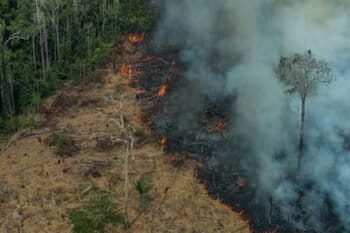
Banner image: Forest fires in Candeiras do Jamari, Rondônia state, 2019. Image © Victor Moriyama / Greenpeace.

New species discovered in Cambodia’s rare rocky ecosystems

Shanna Hanbury 2 Apr 2026

Scientists have discovered at least 11 new species in the caves and rocky outcroppings of northern Cambodia’s Battambang and Stung Treng provinces. The findings were compiled into a new biodiversity report.

Seven new species have already been formally described and another four are in the process. To map the biodiversity in the nation’s karst ecosystems, dramatic landscapes of caves and large protruding rocks on both land and water that create isolated habitats, researchers surveyed 64 caves and 10 hills over the last three years.

“The survey uncovered a treasure trove of extraordinary creatures,” wrote Fauna & Flora, the conservation nonprofit behind the report. “Surrounded by a sea of inhospitable, human-made landscapes, many of these creatures are, in effect, trapped. Over time, they have continued to evolve in complete isolation.”

Among the new species is a turquoise-colored pit viper (Trimeresurus sp. nov.) which is still being formally described after it was spotted in Phnom Prampi, a protected natural heritage site, in July 2025.

A terrestrial micro snail (Clostophis udayaditinus) is a new species smaller than 2 millimeters (0.1 inches) wide and is the first of its genus recorded in Cambodia. And a dark orange millipede discovered in a cave was just one of three new species in its genus.

  • Website Use-CBD-0169-PCY
    Images of karst hills and caves courtesy of Fauna & Flora.
  • Website Use-CBD-0171-PCY
    Images of karst hills and caves courtesy of Fauna & Flora.
  • Website Use-CBD-0105-PCY
    Images of karst hills and caves courtesy of Fauna & Flora.
  • Website Use-CBD-0618-NIT
    Images of karst hills and caves courtesy of Fauna & Flora.
  • Website Use-CBD-0109-PCY
    Images of karst hills and caves courtesy of Fauna & Flora.

Website Use-CBD-0169-PCYWebsite Use-CBD-0171-PCYWebsite Use-CBD-0105-PCYWebsite Use-CBD-0618-NITWebsite Use-CBD-0109-PCY

“Each one of these isolated karst areas act as their own little laboratory,” Lee Grismer, a biology professor at La Sierra University, U.S., said in a statement. “The results are species that exist nowhere else — not just nowhere else in the world, or that country — but in no other cave.”

Researchers also detected the presence of several animals threatened with extinction living in the region. For example, the Sunda pangolin (Manis javanica), a critically endangered species, was spotted twice via camera traps.

The long-tailed macaque (Macaca fascicularis) and green peafowl (Pavo muticus), both endangered, were also spotted multiple times.

Karst habitats are largely unprotected, with only 1% of these ecosystems under any kind of protection worldwide. Limestone quarrying, for example, has ground down huge areas of karst hills to feed the region’s cement industry.

Wildlife camera traps also documented a small forest fire set by humans, as well as an image of a poacher with a gun. The biodiversity survey’s findings, documenting a richness of species in the area, may help bolster efforts to protect some karst hills as natural heritage sites. 

“Biologically significant species could go extinct before they have even been discovered,” Sothearen Thi, the karst biodiversity coordinator at Fauna & Flora, said in a statement. “We are working with the Cambodian government and local partners to increase protection of the landscapes.”

Banner image: A new species of pit viper was discovered and is still in the process of being described. Image courtesy of Fauna & Flora.

A new species of pit viper was discovered and is still in the process of being described. Image courtesy of Fauna & Flora.

Australia’s flying foxes offer valuable services & deserve better reputation: Study

Megan Strauss 1 Apr 2026

Each night, a dark cloud of flying foxes, or fruit bats, moves through the skies of eastern Australia on their way to gorge on nectar and fruits. With a meter-wide (3.2-foot) wingspan, they transport large quantities of pollen and rain down seeds in their poop, helping establish new trees. A new study in Scientific Reports provides the first economic valuation of the ecosystem services provided by flying foxes in Australia, focusing on their significant contribution to the timber industry.

Recent fires and heat stress events have led to colony loss and a dramatic drop in bat numbers; more than 80% of some populations have been wiped out amid extreme heat events. Justin Welbergen, an animal ecology professor at Western Sydney University who was not part of the study, told The New York Times, “A single hot afternoon can result in mortality on a regional scale and in biblical proportions, with tens of thousands of dead flying foxes.”

Flying foxes can travel thousands of kilometers per year, spreading pollen and seeds over large distances, making their economic value immense. First author Alfredo Ortega González, a University of Sydney scientist, said in a video interview with Mongabay, “There is no bird that can move the distance, on average, that a flying fox can move in a night.”

The study authors calculated the spatial extent of the bats’ nightly foraging, based on the locations of 1,209 roosts of four mainland Australian flying fox species (Pteropus poliocephalus, P. Alecto, P. scapulatus and P. conspicillatus). They used data compiled by Australia’s national science agency.

They combined that foraging data and estimates of the distances they travel with maps of suitable habitat to find the overall “Bat Ripple,” the spatial extent of ecosystem services the mammals provide. They found an overall area of influence up to 41.4 million hectares (102 million acres), nearly the size of Sweden.

To work out the value of bats for the timber industry, the authors focused on 465 roosts of the more well-studied grey-headed flying fox (P. poliocephalus). They found the 700-gram (1.5-pound) mammals overlapped with the eucalypt timber industry across 36,038 square kilometers (13,914 square miles) and may help regenerate up to 91.6 million trees per year.

Author Alexander Braczkowski said in an email to Mongabay that Australia’s flying foxes “may be responsible for generating between AUD $271 million and $955 million [$190 million to $668 million] annually for the Australian timber industry through their pollination services alone.”

The authors emphasize that these estimates are conservative and don’t include the broader value of bats for ecosystem health or their specific contributions to carbon sequestration.

Flying foxes deserve to be a conservation priority, said Ortega González, and he hopes the research helps dispel their reputation as noisy, smelly pests. “They are really important, much more important than the general public can imagine.”

Banner image: A grey-headed flying fox. Image by Lawrence Hylton, via iNaturalist (CC-BY).

A grey-headed flying fox in flight

Who gives up land for the world’s climate fixes?

Rhett Ayers Butler 1 Apr 2026

Founders briefs box
Planting trees has become one of the most widely promoted responses to climate change. As forests grow, they absorb carbon dioxide from the atmosphere while offering habitat for animals, plants and other organisms. The idea is straightforward: Expand forests, and the planet gains both climate mitigation and renewed biodiversity.

Yet the land required to remove large quantities of carbon from the atmosphere may place these goals in tension. Efforts to plant forests or cultivate bioenergy crops with carbon capture need vast areas. In some places, those projects could displace ecosystems that already support rich biodiversity. A recent analysis suggests that roughly 13% of globally important biodiversity areas overlap with land that climate models designate for carbon-removal projects, reports John Cannon.

The research, published in Nature Climate Change, examined five widely used models that outline pathways to limit global warming to 1.5° Celsius (2.7° Fahrenheit) above preindustrial levels. Ruben Prütz of the Potsdam Institute for Climate Impact Research and his colleagues mapped where these models anticipate land-intensive carbon dioxide removal, such as new forests or bioenergy plantations. They then compared those locations with important wildlife habitats.

Previous work tended to analyze a single model and a narrower set of species. The new study expanded the scope to roughly 135,000 species, including fungi and invertebrates alongside plants and vertebrates. That broader view offers a more detailed sense of how climate mitigation plans might affect life on Earth.

Avoiding biodiversity hotspots entirely would sharply limit the land available for carbon-removal projects. According to the study’s calculations, the potential area for such efforts would fall by more than half by mid-century.

Scientists say the results should not be read as an argument against carbon removal. Forests can help slow warming and reduce climate stress on ecosystems. The researchers estimate that large-scale carbon removal could ultimately leave as much as a quarter more habitat available for biodiversity than in scenarios without it. The outcome depends on whether ecosystems recover as temperatures stabilize.

The study also highlights an uneven geography. Many of the lands identified for carbon removal lie in the Global South. That distribution raises questions about fairness, since wealthy countries have produced most of the emissions now warming the planet.

For many researchers the message is simple. Carbon removal may play a role, but reducing emissions remains the central task.

Read the full article by John Cannon here

Banner image: Agroforestry in Ethiopia. Image by Trees ForTheFuture via Flickr (CC BY 2.0).


Agroforestry in Ethiopia. Image by Trees ForTheFuture via Flickr (CC BY 2.0).

Share Short Read Full Article

Share this short

If you liked this story, share it with other people.

Facebook Linkedin Threads Whatsapp Reddit Email

Subscribe

Stay informed with news and inspiration from nature’s frontline.
Newsletter

News formats

  • Videos
  • Podcasts
  • Articles
  • Specials
  • Shorts
  • Features
  • The Latest

About

  • About
  • Contact
  • Donate
  • Impacts
  • Newsletters
  • Submissions
  • Terms of Use

External links

  • Wild Madagascar
  • For Kids
  • Mongabay.org
  • Reforestation App
  • Planetary Health Check
  • Conservation Effectiveness
  • Mongabay Data Studio

Social media

  • LinkedIn
  • Instagram
  • Youtube
  • X
  • Facebook
  • Tiktok
  • Reddit
  • BlueSky
  • Mastodon
  • Android App
  • Apple News
  • RSS / XML

© 2026 Copyright Conservation news. Mongabay is a U.S.-based non-profit conservation and environmental science news platform. Our EIN or tax ID is 45-3714703.

you're currently offline