An island in eastern Indonesia was meant to lead the country’s transition into renewable energy. But nearly a decade later, the “geothermal island” has suspended projects due to local resistance and concerns for justice and safety.
Mongabay’s Basten Gokkon reports that, back in 2017, up to 21 geothermal sites were identified on the island of Flores. Backed by international lenders such as the World Bank and the German Development Bank (KfW), the initiative was presented as a global showcase for clean energy.
But a recent study found that, eight years later, key projects remain suspended due to sustained resistance from Indigenous Manggarai communities. They described unjust implementation, including health risks from geothermal emissions, threats to farmland, loss of livelihoods, and vague decision-making processes.
“In the Flores case, as in many other places, people are not rejecting the energy transition,” said Cypri Jehan Paju Dale, corresponding author of the study and a social anthropologist with Kyoto University in Japan and the University of Wisconsin-Madison in the U.S. “What they reject is when justice is absent and their living space is disrupted.”
The conflict has centered on the communities of Wae Sano and Poco Leok, where residents argue the projects threaten their ruang hidup, or living space. This concept goes beyond mere land ownership, encompassing the economic, cultural, and spiritual ties to ancestral graves, ritual sites, and farmland.
The resistance gained significant leverage by articulating these concerns through the lens of customary law, or adat. By demonstrating that their ruang hidup was inseparable from their identity, the communities forced international lenders to take notice. In December 2023, the World Bank withdrew funding for exploratory drilling in Wae Seno, citing failures in the process to obtain the communities’ free, prior and informed consent (FPIC) for the development. By November 2024, KfW followed suit, recommending the project in Poco Leok also be suspended, citing similar reasons.
Despite the communities’ victories, the struggle has come at a cost. Villagers reported dozens of confrontations with security forces. In October 2024, four residents were beaten and detained while protesting road construction; a journalist covering the scene was also beaten and detained. Researchers suggest this reflects a recurring pattern of “green extractivism,” in which risks are externalized but profits are privatized.
Cypri said this is a recurring pattern in Indonesia’s development model.
“Whether projects are extractive or branded as ‘green’ or ‘sustainable,’ they tend to rely on what are effectively sacrifice zones,” Cypri said. These “sacrifice zones” are created to support national development or tourism interests, such as those in the nearby community of Labuan Bajo.
As of 2025, the geothermal exploration activities in Wae Sano and Poco Leok remain paused but not officially cancelled.
Read the full story by Basten Gokkon here.
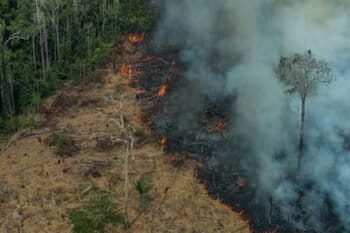
Banner image: Villagers opposing geothermal development report dozens of confrontations, including a 2024 incident in which protesters and a journalist were beaten and detained by security forces. Image courtesy of Sunspirit Flores/Floresa.co.