• Features
  • Videos
  • Podcasts
  • Specials
  • Articles
  • Shorts
Donate
  • English
  • Español (Spanish)
  • Français (French)
  • Bahasa Indonesia (Indonesian)
  • Brasil (Portuguese)
  • India (English)
  • हिंदी (Hindi)
  • বাংলা (Bengali)
  • Swahili
  • Videos
  • Podcasts
  • Articles
  • Short News
  • Feature Stories
  • The Latest
  • Explore All
  • About
  • Team
  • Contact
  • Donate
  • Subscribe page
  • Submissions
  • Privacy Policy
  • Terms of Use
  • Advertising
  • Wild Madagascar
  • For Kids
  • Mongabay.org
  • Reforestation App
  • Planetary Health Check
  • Conservation Effectiveness
  • Mongabay Data Studio

Latest

Researchers uncover 10 new moth species and 7 new genera in Hawaiʻi

Bobby Bascomb 4 Apr 2026

Orcas never seen before in Seattle delight whale watchers with a visit

Associated Press 3 Apr 2026

Kenya to receive 4 mountain bongos from European zoos

Lynet Otieno 3 Apr 2026

Canadian muskoxen hit by double punch of novel diseases and climate change

Ruth Kamnitzer 3 Apr 2026

How an engineer brought degraded wetlands back to life in drought-hit Bangladesh

Sadiqur Rahman 3 Apr 2026

Pyrenees brown bear population climbs to an estimated 130 in latest census

Shanna Hanbury 3 Apr 2026
All news

Top stories

Railroad & tariff war boost soy in Brazil’s Cerrado, endangering Indigenous lands

Banteng

How wild cattle recovery is transforming local livelihoods near key Thai reserve

Carolyn Cowan 2 Apr 2026

Thai court rules gold mine liable, but villagers face uncertain justice

Kannikar Petchkaew 1 Apr 2026

Peru-Brazil Bioceanic Railway brings too much risk to the Amazon, experts warn

Yvete Sierra Praeli 31 Mar 2026

Conservation depends on rangers. Their wellbeing is often an afterthought

Rhett Ayers Butler 31 Mar 2026

Subscribe

Stay informed with news and inspiration from nature’s frontline.
Newsletter

We’re a nonprofit

Help us tell impactful stories of biodiversity loss, climate change, and more
Donate

News and Inspiration from Nature's Frontline.

Collage of a cloned jaguar
Videos
Muskoxen on Ellesmere Island. As a species, muskoxen have been around for a million years and are often called “ice-age survivors.” Though they have one of the lowest levels of genetic diversity of any mammal, the full suite of immune-related genes are intact in the species, says muskox expert Anne Gunn.
Articles
Wallace's Passage between Gam and Waigeo islands in Raja Ampat, Indonesia. Image by Rhett A. Butler/Mongabay.
Podcasts

Special issues connect the dots between stories

Who controls Mexico’s Yaqui River?

Behind Mario Luna Romero, a Yaqui spokesperson and water defender is the Plutarco Elías Calles (El Novillo) on the left and the Independencia Aqueduct on the right. Image by Abimael Ochoa Hernández.

Despite court ruling, Yaqui water rights abuses ignored

Aimee Gabay 10 Oct 2024
A traditional Yaqui ceremonial hut in Vícam which is made from alamo

Lack of research as contaminated Yaqui River poses health risks

Aimee Gabay 10 Sep 2024
Young traditional dancers wearing ténabari around their ankles perform the danza del pascola y venado (the dance of the pascolas and the deer).

Loss of water means loss of culture for Mexico’s Indigenous Yaqui

Aimee Gabay 16 Jul 2024
Guasimas Bay has been contaminated by agrochemicals and waste that is released from shrimp farms not far from the coast.

As drought parches Mexico, a Yaqui water defender fights for a sacred river

Aimee Gabay 9 Jul 2024

Water has shaped the identity, livelihoods and governance of the Yaqui Indigenous people in northern Mexico for centuries. Today, the Yaqui River faces mounting pressure as drought intensifies, pollution persists and water is increasingly diverted to agriculture and cities. In this award-winning series, staff writer Aimee Gabay explores how climate change is sharpening long-standing disputes […]

Who controls Mexico’s Yaqui River? series

More specials

12 stories

Beyond the screen: DCEFF

A dairy cow in a farm in the Netherlands.
5 stories

The Dutch Nitrogen Crisis

10 stories

Mongabay Explains

Free and open access to credible information

Learn more

Listen to Nature with thought-provoking podcasts

Wallace's Passage between Gam and Waigeo islands in Raja Ampat, Indonesia. Image by Rhett A. Butler/Mongabay.

Meaningful conservation demands truth, not just facts, says political ecologist

Mike DiGirolamo 31 Mar 2026

Watch unique videos that cut through the noise

Collage of a cloned jaguar

Lab-made jaguar: Is cloning a solution to extinction?

Collage of a red-bellied toad and a bridge broken by flood

In search of the tiny toad that stopped a dam

Thamys Trindade, Felipe Rosa, Julia Lima 14 Mar 2026
Collage featuring cockfighting and a largetooth sawfish

Why is cockfighting a risk to Peru’s rarest fish?

Romi Castagnino 25 Feb 2026
Collage featuring a white-rumped shama (Copsychus malabaricus) and a poacher

The most desirable songbird in Indonesia is disappearing from the wild

Rizky Maulana Yanuar, Sandy Watt 18 Feb 2026
Collage featuring Jeffrey Lendrum

The man who risked everything to steal bird eggs

Sandy Watt 11 Feb 2026

We’re a nonprofit

Help us tell impactful stories of biodiversity loss, climate change, and more
Donate

In-depth feature stories reveal context and insight

Visitors are silhouetted against a dolphin exhibit on Tuesday, June 11, 2013 at the Marine Life Park at Resorts World Sentosa in Singapore.
Feature story

Singapore resort said to halt controversial dolphin sourcing, breeding

Robin Hicks 31 Mar 2026
A gemsbok (Oryx gazella), also known as the South African oryx, in a mixed herd of herbivores at Tswalu. Image by John Cannon/Mongabay.
Feature story

A South African reserve shows how carbon can catalyze rewilding conservation

John Cannon 27 Mar 2026
Silhouette of a woman standing in a California redwood forest. Photo by Rhett Ayers Butler
Feature story

A profession built on hope, strained by loss

Rhett Ayers Butler 26 Mar 2026
Feature story

China’s deep-sea mining fleet may also track US submarines

Elizabeth Claire Alberts, Kara Fox 24 Mar 2026

Quickly stay updated with our news shorts

Researchers uncover 10 new moth species and 7 new genera in Hawaiʻi

Bobby Bascomb 4 Apr 2026

Researchers in Hawai’i have described 10 new species and seven new genera of moths, highlighting how much remains unknown about the Pacific archipelago’s biodiversity.

Hawai’i is home to a large number of endemic species, plants and animals found nowhere else on Earth. Discovery of a new species is so common, “nobody turns their head,” study co-author Daniel Rubinoff, an entomologist with the University of Hawaiʻi, told Mongabay in a video call. He said finding a new genus is considered “kind of interesting, but to find so many really reflects how poorly known Hawaii’s fauna still is.”

Genus is a broader grouping than species, so species in different genera typically diverged much earlier in their evolutionary history than species of the same genus.

“Hawaiʻi is a world-renowned laboratory for evolution ,” lead author Kyhl Austin of the University of Hawai’i said in a press release. “By identifying these seven new genera, we are showing that these insects crossed thousands of miles of open ocean to reach Hawai’i far more frequently than we ever imagined.”

Karl Magnacca, an entomologist with the O‘ahu Army Natural Resources Program, not involved with the study told Mongabay in an email that “this is a really important contribution, as many of our native insect groups haven’t been looked at in around 100 years.”

In their search for new moths, researchers examined century-old museum collections and conducted field surveys in remote areas. They combined detailed anatomic examination with high-resolution imaging and genetic testing to reveal a hidden diversity of moths.

Among the discoveries is Paalua leleole, a species in which the female moths appear unable to fly. Several of the new moths were named to honor Hawai’ian culture, including Iliahia lilinoe, named for Lilinoe, the goddess of mists on the Haleakalā volcano, on the island of Maui.

Researchers also described six new species in the new genus Iliahia, named for its host plant, ʻiliahi, the Hawaiian name for sandalwood (Santalum spp.), a tree famous for its fragrant wood. Sandalwood was devastated in Hawai’i in the early 19th century in the Sandalwood Wars. Hawiian kings “forced people to go up into the woods and cut out all the sandalwood,” Rubinoff said. The wood was traded to the English for guns and cannons and ultimately exported to China.

As a result, sandalwood became rarer, as did the moths that depended on them. Today, one such sandalwood-dependent moth, I. pahulu, is considered critically endangered, as it is only known to exist in a small stand of 30 sandalwood trees on the island of Lānaʻi, the press release notes.

Some of the new species, which were described from museum collections, are already considered extinct, since they haven’t been seen in the wild in more than 100 years.

The discoveries are a testament to Hawai’i’s abundant endemic biodiversity and fragility, Rubinoff said. “We are naming species just as they are disappearing.”

Banner image: Newly described moths. Image courtesy of Kyhl Austin et al. (2026).

Orcas never seen before in Seattle delight whale watchers with a visit

Associated Press 3 Apr 2026

Seattle (AP) — When tourists travel to Seattle, it’s common to take in the Space Needle and the downtown skyline from Puget Sound.

It’s an itinerary that a newly arrived pod of killer whales appears to be following too.

Three orcas that had not previously been recorded in the Seattle area have delighted whale watchers with several visits just off downtown this past month. They’ve also cruised by other shorelines in the region.

“People … are all very happy to see this,” said Hongming Zheng, who photographs whales in his spare time. It took him 10 hours of driving to find the mysterious pod. “It was epic.”

Researchers keep detailed records of killer whales that frequent the Salish Sea, the waters between Washington state and Canada, by identifying their fins and saddle patches — the grayish markings on their sides.

So it was a surprise when this pod of three orcas showed up in Vancouver, British Columbia, in March. The three weren’t in any catalogs of local whales.

After some digging, researchers located photos of the pod in Alaska waters last year, said Shari Tarantino of the Washington-based Orca Conservancy. The pod includes an adult female and what are believed to be her two offspring, including a large young adult male.

They have now been designated as T419, T420 and T421 — the T standing for “transient,” not “tourist.”

The visiting orcas have something that local whales don’t: circular scars left by cookie-cutter sharks, which latch on to larger animals and slice a chunk off them. It was evidence they’ve spent time in the open ocean, because that’s where the sharks live.

“We don’t know their exact origin with 100% certainty yet, but the leading hypothesis is that they’re from Alaska, possibly the Aleutian region, given their appearance and the fact that some Alaskan populations range widely across the North Pacific,” Tarantino wrote in an email.

As for why these three are thousands of miles from their home range? Tarantino said it’s possible they’re on a culinary field trip. This pod feeds on sea mammals — unlike the endangered salmon-eating resident orcas — and there are plenty of harbor seals, sea lions and porpoises in the Salish Sea.

“They have quickly become a crowd favorite,” Tarantino wrote. “People spend a lifetime hoping to see a killer whale from shore, and these three have more than delivered.”

By Manuel Valdes, Associated Press

Banner image: A killer whale swims in Elliott Bay in front of the downtown Seattle skyline on Wednesday, April 1, 2026. The orca is a part of a pod that had not been recorded by researchers in this region until this past month when three whales appeared in waters off British Columbia and Washington state. (AP Photo/Manuel Valdes)

Kenya to receive 4 mountain bongos from European zoos

Lynet Otieno 3 Apr 2026

The Mount Kenya Wildlife Conservancy (MKWC) is on track to receive four male mountain bongos from European zoos, a move aimed at helping boost the population of one of Africa’s most endangered antelope.

The transfer was led by experts from Chester Zoo, in England, in collaboration with Kenya Wildlife Service (KWS) and the European Association of Zoos and Aquariums.

In a statement sent to Mongabay, the Chester Zoo said its experts spent more than 11 years coordinating a breeding program across European conservation zoos. “The four males now selected – chosen on the basis of age, health and genetics – will be the first to ever be transferred from European zoos to Kenya as part of a rewilding effort.”

“Collaborations like this are absolutely essential if we are to prevent this magnificent species disappearing altogether,” Nick Davis, mammals general manager at Chester Zoo and coordinator of the European breeding program, said in a statement. “They demonstrate how modern, science-led zoos play an important role in bringing species back from the brink.”

The most recent IUCN assessment in 2016 found the forest-dwelling antelope were critically endangered with just 70-80 adults remaining in the wild at the time, all of them in Kenya.

In the last decade, mountain bongos (Tragelaphus eurycerus ssp. isaaci) briefly experienced a surge in the wild population. The Kenyan national wildlife census report states that in 2021, there were roughly 150 wild mountain bongos, but by 2025, there were just 66.

Kenyan experts attribute the species’ decline to a combination of habitat loss and poaching.

While wild populations have crashed, captive bongos are on the rise, “from 54 in 2021 to 93 by 2025,” according to the wildlife census. Another 17 individuals were repatriated from the United States.

According to Chester Zoo, once four male bongos clear “rigorous health checks and quarantine” they can be flown to Kenya where they will be closely monitored before being introduced to the breeding program.

“These males are a critical component of our rewilding program,” Robert Aruho, MKWC head of conservancy, said in a statement. Now that MKWC has more than 100 animals in the captive breeding program their “focus is on sustained growth, with a long-term national target of establishing at least 750 individuals by 2050,” Aruho said in a statement sent to Mongabay.

Technology is also supporting conservation. Chester Zoo said in a statement that it worked with partners, including Liverpool John Moores University, “to develop the world’s first AI-powered detection system for mountain bongos – cameras that provide real-time data on the animals’ behavior, movement and health without disturbing them.”

Such advances in conservation technology, successful captive breeding programs and international reintroduction efforts “will change the tide for mountain bongos,” Stuart Nixon, the Chester Zoo’s regional field program senior manager for Africa, said in a statement sent to Mongabay.

Banner image: Critically endangered mountain bongo at Chester Zoo in Cheshire, England. Photo courtesy of Chester Zoo.

Pyrenees brown bear population climbs to an estimated 130 in latest census

Shanna Hanbury 3 Apr 2026

The annual census of brown bears in the Pyrenees mountain range of Spain, France and Andorra estimated that 130 bears are now living in the region with an average annual population growth rate of more than 11% over the last 18 years.

The subpopulation of Pyrenees brown bear (Ursus arctos arctos) has been steadily increasing in the mountain range since it reached near extinction in the mid-1990s, when the local population reached a low of just five individuals.

Since 1996, 11 bears have been reintroduced from Slovenia to help save the population. But just three of those bears had most of the babies: 85-90% of the Pyrenees bears alive today descend from two females and one male. Inbreeding is a growing risk as the bears enter their third or fourth generation with few unrelated bears available to mate with.

“We can no longer turn a blind eye, it is urgent to stop inbreeding, at the risk that it will become uncontrollable and permanently harmful to the population of brown bears,” Alain Reynes, director of Pays de l’Ours – Adet, a French conservation organization focused on bears, wrote in a statement. “There is still time, but inaction is no longer an option.”

In 2025, eight cubs were born, down from 24 cubs the year before. Only two are not related. The other identified cubs have an inbreeding rate of 20-28%, similar to that of first cousins.

The inbreeding rate shows us high levels of consanguinity which may affect the future of the species by lowering the birth rate and making cubs more vulnerable and susceptible to disease,” Pau Vázquez, a spokesperson with ADLO Pirineo, a Catalan bear and wolf association, told Mongabay by email. “This decline in the birth rate is a warning.”

Pays de l’Ours has suggested that the French government introduce an additional 30 bears into the Pyrenees by 2040 to improve the subpopulation’s genetic health.

Researchers estimated the 2025 population and determined the inbreeding problem using genetic analyses of 801 hair and excrement samples collected across the Pyrenees Mountains of France, Spain and Andorra.

They also mapped the location of the bears: While 30% of them appear to cross national borders, 41% were detected only in France and 29% only in Spain or Andorra.

Another concern closely monitored by the government agencies are attacks on cattle and beekeeping facilities. A total of 321 bear attacks on cattle were counted across the Pyrenees in 2025, mostly in France.

According to ADLO Pirineo, Spain had 48 bear attacks, 32 on cattle and 16 on beehives in 2025. The local governments compensated farmers for losses, spending around 12,500 euros ($14,420) for injury and losses to cattle and another 3,412 euros ($3,940) paid for damages to beekeeping.

Banner image: Young bear seen via a camera trap. Image courtesy of ADLO Pirineo

Young bear seen via a camera trap. Image courtesy of ADLO Pirineo.

Indonesian geothermal projects stall amid Indigenous concerns over justice

Mongabay.com 3 Apr 2026

An island in eastern Indonesia was meant to lead the country’s transition into renewable energy. But nearly a decade later, the “geothermal island” has suspended projects due to local resistance and concerns for justice and safety.

Mongabay’s Basten Gokkon reports that, back in 2017, up to 21 geothermal sites were identified on the island of Flores. Backed by international lenders such as the World Bank and the German Development Bank (KfW), the initiative was presented as a global showcase for clean energy.

But a recent study found that, eight years later, key projects remain suspended due to sustained resistance from Indigenous Manggarai communities. They described unjust implementation, including health risks from geothermal emissions, threats to farmland, loss of livelihoods, and vague decision-making processes.

“In the Flores case, as in many other places, people are not rejecting the energy transition,” said Cypri Jehan Paju Dale, corresponding author of the study and a social anthropologist with Kyoto University in Japan and the University of Wisconsin-Madison in the U.S. “What they reject is when justice is absent and their living space is disrupted.”

The conflict has centered on the communities of Wae Sano and Poco Leok, where residents argue the projects threaten their ruang hidup, or living space. This concept goes beyond mere land ownership, encompassing the economic, cultural, and spiritual ties to ancestral graves, ritual sites, and farmland.

The resistance gained significant leverage by articulating these concerns through the lens of customary law, or adat. By demonstrating that their ruang hidup was inseparable from their identity, the communities forced international lenders to take notice. In December 2023, the World Bank withdrew funding for exploratory drilling in Wae Seno, citing failures in the process to obtain the communities’ free, prior and informed consent (FPIC) for the development. By November 2024, KfW followed suit, recommending the project in Poco Leok also be suspended, citing similar reasons.

Despite the communities’ victories, the struggle has come at a cost. Villagers reported dozens of confrontations with security forces. In October 2024, four residents were beaten and detained while protesting road construction; a journalist covering the scene was also beaten and detained. Researchers suggest this reflects a recurring pattern of “green extractivism,” in which risks are externalized but profits are privatized.

Cypri said this is a recurring pattern in Indonesia’s development model.

“Whether projects are extractive or branded as ‘green’ or ‘sustainable,’ they tend to rely on what are effectively sacrifice zones,” Cypri said. These “sacrifice zones” are created to support national development or tourism interests, such as those in the nearby community of Labuan Bajo.

As of 2025, the geothermal exploration activities in Wae Sano and Poco Leok remain paused but not officially cancelled.

Read the full story by Basten Gokkon here.

Banner image: Villagers opposing geothermal development report dozens of confrontations, including a 2024 incident in which protesters and a journalist were beaten and detained by security forces. Image courtesy of Sunspirit Flores/Floresa.co.

Brazilian banks to verify satellite deforestation data for rural credit

Associated Press 2 Apr 2026

SAO PAULO (AP) — Brazil’s banks will be required to verify official satellite deforestation data before approving rural credit beginning on Wednesday in the South American country.

Under the new rule, financial institutions must check whether a property appears in a government registry of areas with potential illegal deforestation after July 31, 2019. The database, maintained by the Ministry of Environment and Climate Change, is based on satellite data from Brazil’s National Institute for Space Research, or INPE.

If a property is flagged, farmers may challenge the designation by demonstrating that the deforestation was legal. They can submit authorization documents, restoration plans for altered or degraded areas, or a technical remote‑sensing report.

When the resolution was approved in December, the Finance Ministry said that the new requirements were intended to align rural credit with conservation and sustainability policies.

Brazil is a global agribusiness powerhouse. The country is the world’s largest exporter of beef and the biggest soybean producer. Agriculture, however, is the leading driver of deforestation across all of Brazil’s biomes, including the Amazon rainforest. The Amazon plays a critical role in regulating the global climate, and scientists warn that continued forest loss could accelerate global warming.

The new rule represents a significant step in integrating agricultural policy, the financial system and sustainability, said Paulo Camuri, climate and territorial intelligence manager at Imaflora, a nonprofit that tracks deforestation.

Linking access to credit to environmental requirements, Camuri added, encourages more sustainable production and strengthens the agribusiness sector’s environmental responsibility.

“It is an intelligent incentive mechanism that uses credit — the main driver of agribusiness development — as a lever for good practices,” he said.

The Confederation of Agriculture and Livestock of Brazil, or CNA, the country’s main farm lobby, said that the measure adds a new verification step to rural lending, but doesn’t automatically distinguish between legal and illegal deforestation.

“This scenario may create uncertainty in the credit analysis process and increase the risk of restricting access to financing for producers who comply with environmental legislation,” the group said. CNA is now backing legislation in Congress to block the measures.

The Brazilian Federation of Banks said that the country’s financial institutions made needed adaptations.

“The overall assessment is that the measure strengthens governance and ensures the proper allocation of rural credit based on technical and publicly available information,” the banking body said. In case there is an alert, they said, loans can proceed upon proof of compliance by farmers. “The flow of credit granting will continue, with the necessary adjustments to ensure socio-environmental compliance and legal certainty,” they said.

By Gabriela Sá Pessoa,  Associated Press

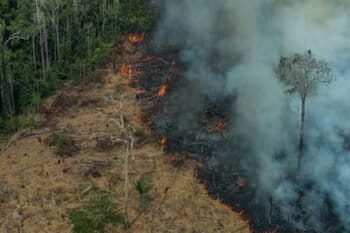
Banner image: Forest fires in Candeiras do Jamari, Rondônia state, 2019. Image © Victor Moriyama / Greenpeace.

Share Short Read Full Article

Share this short

If you liked this story, share it with other people.

Facebook Linkedin Threads Whatsapp Reddit Email

Subscribe

Stay informed with news and inspiration from nature’s frontline.
Newsletter

News formats

  • Videos
  • Podcasts
  • Articles
  • Specials
  • Shorts
  • Features
  • The Latest

About

  • About
  • Contact
  • Donate
  • Impacts
  • Newsletters
  • Submissions
  • Terms of Use

External links

  • Wild Madagascar
  • For Kids
  • Mongabay.org
  • Reforestation App
  • Planetary Health Check
  • Conservation Effectiveness
  • Mongabay Data Studio

Social media

  • LinkedIn
  • Instagram
  • Youtube
  • X
  • Facebook
  • Tiktok
  • Reddit
  • BlueSky
  • Mastodon
  • Android App
  • Apple News
  • RSS / XML

© 2026 Copyright Conservation news. Mongabay is a U.S.-based non-profit conservation and environmental science news platform. Our EIN or tax ID is 45-3714703.

you're currently offline