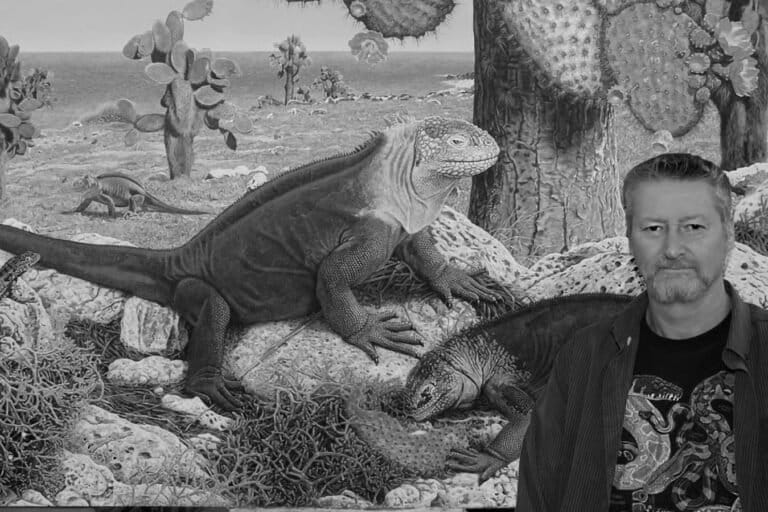
- Tell Hicks helped bring reptiles and amphibians into serious artistic view, treating snakes, lizards, and turtles as subjects worthy of close, unsentimental attention rather than symbols or curiosities. His paintings emphasized accuracy, individuality, and restraint.
- Largely self-taught, he traveled widely and worked directly from field observation, developing meticulous techniques in egg tempera and later fast-drying oils to support highly detailed work, often produced in public settings.
- He became a central figure in herpetological communities in Britain and the United States, helping found the International Herpetological Society, serving as its president, and contributing artwork that circulated through museums, shows, and educational spaces.
- After a life-altering accident left him paralyzed, he adapted his practice and returned to painting, continuing to attend reptile shows and engage with the community that had long formed around his work.
Founder’s Briefs: An occasional series where Mongabay founder Rhett Ayers Butler shares analysis, perspectives and story summaries.
For much of the late 20th century, reptiles occupied an awkward place in the public imagination. They were admired by specialists, feared or misunderstood by many others, and rarely treated with the same aesthetic seriousness afforded to birds or mammals. Field guides existed, but art that lingered on texture, posture, and individuality was scarce. The people who cared most about snakes, lizards, and turtles tended to find one another at the margins: in societies, at shows, or out in the field, comparing notes.
One figure moved easily among those worlds. At reptile expos, he could often be found at an easel, quietly building an image layer by layer while conversations unfolded around him. In museums and private collections, his work carried the same animals into spaces where they were more often absent. The paintings did not dramatize their subjects. They paid attention to them.
That artist was Tell Hicks, a British wildlife painter whose name became familiar to herpetologists on both sides of the Atlantic. He specialized in reptiles and amphibians, not as symbols or curiosities, but as organisms worth close, patient study. His snakes were not coiled for effect. His turtles were not softened for charm. They appeared as they were, alert and particular.
Hicks was largely self-taught. As a child in England, he drew constantly, filling sketchbooks with animals. A book of prehistoric illustrations by Zdeněk Burian left a lasting impression, as did early television programs by David Attenborough and the tradition of traveling naturalist-artists such as Audubon and Gould. Formal training mattered less to him than observation. As a teenager, he chose travel over college, moving overland through Europe and Asia with little money, sketching wildlife as he went, before reaching Australia. The habit stuck. He would continue to travel widely, from Arizona to the Galápagos, gathering material directly from the field whenever possible.
Although best known for his reptile work, Hicks considered himself a naturalist first. He painted birds, mammals, plants, and people, and he cared about accuracy at every level. A background plant needed to be the right species. A scale pattern had to match the individual animal. To achieve this, he developed techniques first in egg tempera and later in fast-drying alkyd oils, allowing him to work slowly and precisely, even in public settings.
He was a founding member of the International Herpetological Society and later served as its president, part of a broader effort to raise the profile of reptiles within British natural history. His work also circulated widely in the United States, where it appeared on educational displays, museum installations, and the shirts and prints that became fixtures at North American reptile shows. A large mosaic of a Gila monster and a towering metal sculpture of a rattlesnake’s tail at the Chiricahua Desert Museum reflected his willingness to work across formats when the subject demanded it.
Late in life, a serious accident left Hicks paralyzed. The interruption was profound, but not final. He eventually returned to painting, adapting his methods and continuing to attend shows when he could. Visitors recall that the conversations resumed easily, as if little essential had changed.
He once described his paintings as pages from a diary, each tied to a place or encounter. Taken together, they form a record of sustained attention, built over decades, to animals that rarely receive it. In that sense, the work stands less as a statement than as a practice, patiently carried out.
Credits