• Features
  • Videos
  • Podcasts
  • Specials
  • Articles
  • Shorts
Donate
  • English
  • Español (Spanish)
  • Français (French)
  • Bahasa Indonesia (Indonesian)
  • Brasil (Portuguese)
  • India (English)
  • हिंदी (Hindi)
  • বাংলা (Bengali)
  • Swahili
  • Videos
  • Podcasts
  • Articles
  • Short News
  • Feature Stories
  • The Latest
  • Explore All
  • About
  • Team
  • Contact
  • Donate
  • Subscribe page
  • Submissions
  • Privacy Policy
  • Terms of Use
  • Advertising
  • Wild Madagascar
  • For Kids
  • Mongabay.org
  • Reforestation App
  • Planetary Health Check
  • Conservation Effectiveness
  • Mongabay Data Studio

Latest

The first sign demarcating the Rio Pardo Kawahiva Indigenous Territory. Image courtesy of FUNAI.

Brazil marks borders for isolated Indigenous group in the Amazon after decades

Shanna Hanbury 19 Aug 2026

New leadership initiative carries on legacy of late Indonesian environmental activist

Hans Nicholas Jong 19 Aug 2026

Why carbon markets alone won’t save Southeast Asia’s concessions forests

Mongabay.com 19 Aug 2026
Feature story

Tapirs, bats and nests: How plastic infiltrates Amazonian wildlife

Tiago da Mota e Silva 18 Aug 2026

Elders, conservationists race to record fading sacred ties to Philippines’ endemic birds

Keith Anthony Fabro 18 Aug 2026

On the Great Barrier Reef, management by Traditional Owners is growing

Cat Williams 18 Aug 2026
All news

Top stories

Tapirs, bats and nests: How plastic infiltrates Amazonian wildlife

Anden Condor

The king of the Andes: How a village learned to coexist with condors

Christina Noriega, Monica Wise Robles, Julia Lima 15 Aug 2026
A Timor green pigeon (Treron psittaceus).

Timor green pigeon nears extinction after decades of inaction, study warns

Timothy Mihocik 13 Aug 2026
Dead fish in the Kafue River near the town of Luanshya, Zambia, a day after the tailings dam spill, Feb. 19, 2025. Image by AP Photo/Richard Kille.

A mine polluted a Zambian river in 2025: Residents continue to live with the impacts

Victoria Schneider 13 Aug 2026
Hemerson Dantas dos Santos Pataxó HaHaHãi and elders recorded their people’s medicinal knowledge in Brazil. From left to right: Marta Xavier de Oliveira, Maura Rosa Titiah Vieira, Hemerson Dantas dos Santos Pataxó HaHaHãi, Aniraldo Xavier Kariri-Sapuyá and Maria Creuza Fernandes Rodrigues Kariri-Sapuyá. Photos by Karla Mendes. Graphic design by Marilia Ferrari.

How a Brazilian Indigenous ethnobotanist & elders recorded their people’s medicinal knowledge

Karla Mendes 13 Aug 2026

Subscribe

Stay informed with news and inspiration from nature’s frontline.
Newsletter

We’re a nonprofit

Help us tell impactful stories of biodiversity loss, climate change, and more
Donate

News and Inspiration from Nature's Frontline.

Anden Condor
Videos
Articles
Podcasts

Special issues connect the dots between stories

Forest Restoration Solutions

Seatrees and project partner COBEC with local community members in Marereni, Kenya.

How intermediaries are reshaping mangrove restoration

Marina Martinez 6 Feb 2026

Measuring biodiversity in a world of tree-planting pledges

Ruth Kamnitzer 12 Jan 2026
Giant conebird in Peru.

Project sees long-term success restoring forests in the high Andes: Study

Ruth Kamnitzer 22 Dec 2025
Tree Aid’s efforts as part of the Great Green Wall has resulted in planting nearly 28 million trees in the region so far.

New directory helps donors navigate the complex world of global reforestation

Liz Kimbrough 12 Nov 2025

Tree growing has become one of the most widely promoted responses to climate change and ecosystem degradation, with governments, companies and nonprofits pledging to restore hundreds of millions of hectares of forests worldwide. But restoring ecosystems is far more complex than putting seedlings in the ground. This Special examines what it takes to rebuild forest […]

Forest Restoration Solutions series

More specials

8 stories

Finning the High Seas

Mamá Conchita in her chagra with her dogs.
9 stories

Women Defenders of the Colombian Amazon

7 stories

The Ideas Shaping Environmental Action

Free and open access to credible information

Learn more

Listen to Nature with thought-provoking podcasts

‘Remembering Wildlife’ shines a spotlight on the species we risk losing forever

Mike DiGirolamo 18 Aug 2026

Watch unique videos that cut through the noise

Anden Condor

The king of the Andes: How a village learned to coexist with condors

How rescued orangutans are rebuilding a new wild population in Sumatra

Nanang Sujana, Sandy Watt 3 Aug 2026
A collage featuring Ashoka Mukpo, a Mongabay reporter, and a cocoa bean

Why are forests vanishing in southeastern Liberia?

Juan Maza, Ashoka Mukpo 18 Jul 2026

Mongabay, Scientific American, and Project Multatuli release a documentary on Indonesia’s new capital

Leah Varjacques, Rizky Rahad, Sandy Watt 15 Jul 2026
Collage, Fritz Pinnow, contributor, and a soldier

Honduras taps armed forces to eliminate deforestation by 2029. Is it working?

Fritz Pinnow 27 Jun 2026

We’re a nonprofit

Help us tell impactful stories of biodiversity loss, climate change, and more
Donate

In-depth feature stories reveal context and insight

Rokar Koang Commune, Kandal Province (Cambodia). Sand mining barges extract sand from the Mekong, May 2022.
Feature story

Cambodia’s banned sand trade with Singapore appears to be back

Andy Ball 11 Aug 2026
Crows, in particular, have found themselves in the crosshairs of late.
Feature story

As Singapore culls ‘nuisance’ birds, rapid urbanization continues to fuel an avian boom

Robin Hicks 11 Aug 2026
Adam Falk at Jahoo Gibbon Camp within Keo Seima Sanctuary in Cambodia. Photo courtesy of WCS.
Feature story

What conservation looks like from the outside: A conversation with Adam Falk after his first year as CEO of WCS

Rhett Ayers Butler 11 Aug 2026
Feature story

In Amazon rivers, fish breathe and ingest plastics

Tiago da Mota e Silva 10 Aug 2026

Quickly stay updated with our news shorts

Brazil marks borders for isolated Indigenous group in the Amazon after decades

Shanna Hanbury 19 Aug 2026

Agents of Brazil’s Indigenous agency, FUNAI, spent 60 days in June and July 2026 physically marking the borders of the Rio Pardo Kawahiva Indigenous Territory. The 411,000-hectare (1 million-acre) area in the Amazon biome of Mato Grosso state is home to the Kawahiva, an isolated Indigenous group.

The government agency confirmed the presence of the Indigenous group in 1999 and began demarcating its territory in 2001.

“The uncontacted Kawahiva have been under threat in their own forest home for decades, while simply trying to exercise their right to live as they choose without contact,” Caroline Pearce, director of the UK-based NGO Survival International, said in a statement.

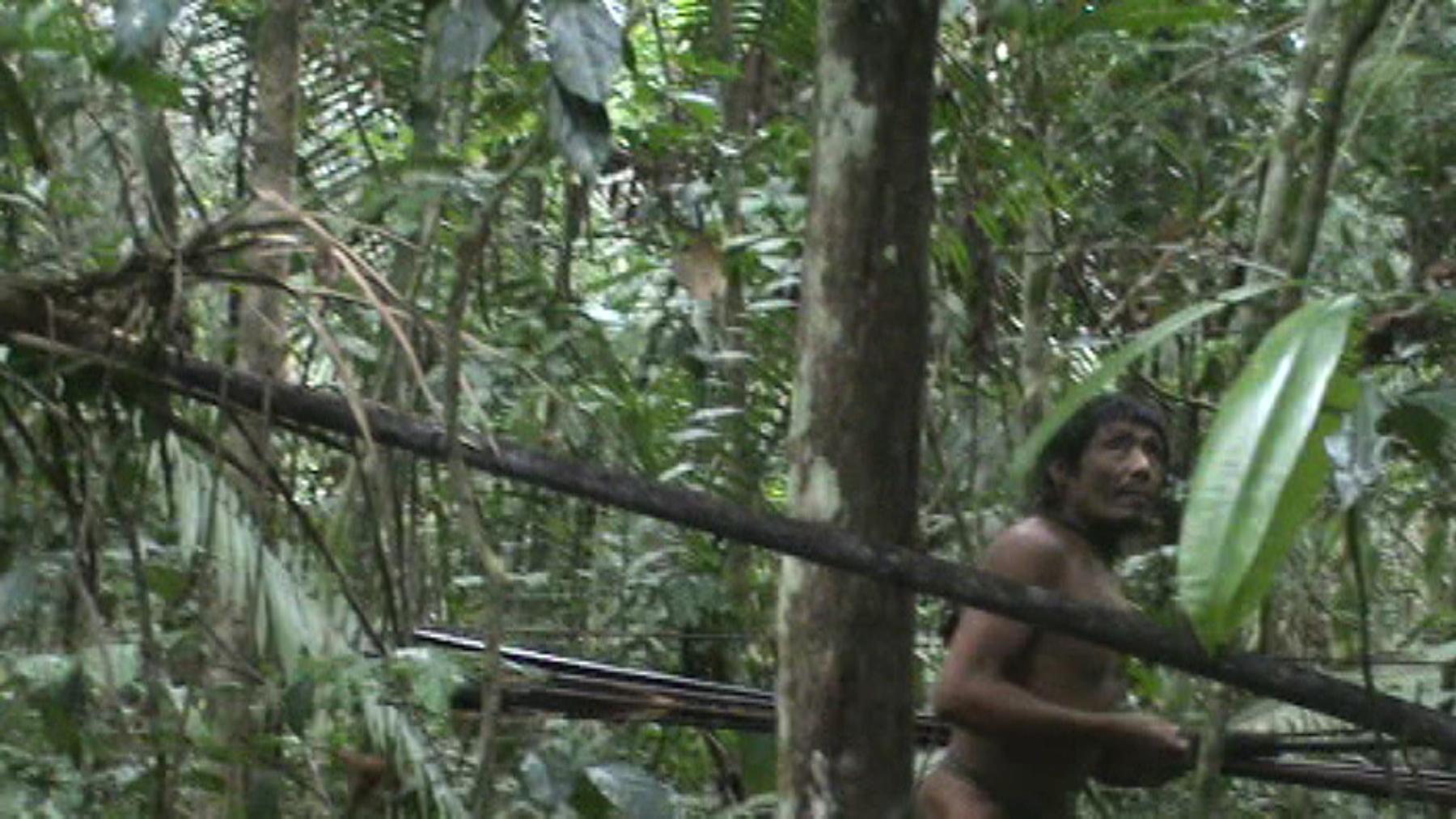
Still image of a Kawahiva individual taken by federal agents in August 2013. Image courtesy of FUNAI.

The territory has been invaded by land-grabbers and loggers, causing deforestation. Historically, the Kawahiva territory was intermittently protected via temporary land protection orders, which faced opposition from logging companies.

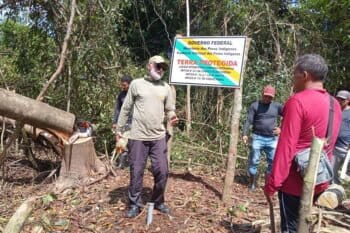
To officially demarcate the territory, FUNAI agents opened a path around the land and installed roughly 140 signs at strategic locations, FUNAI agents told Mongabay. 

“Here in our region, all owners of plots of land do this,” Jair Candor, coordinator of the FUNAI unit that safeguards the Kawahiva, told Mongabay in an audio message. “The limits of land are marked by opening a path around that territory, whether it belongs to the white man or to an Indigenous person.”  

The last of more than 100 signs was placed on July 3, 2026. Image courtesy of Kenedy Vicente da Silva.

The last known invasion of the territory was in 2023 when a farmer cleared 4-5 hectares (10-12 acres) of Kawahiva land, Candor said. When confronted, the farmer noted that there were no physical markers identifying the Indigenous land.

“The physical demarcation is for this purpose,” Candor said. “So that people can identify that there is an Indigenous land there and a people who inhabits it and needs that territory.”

An abandoned Kawahiva camp. Image courtesy of FUNAI.

Physically marking the territory is the penultimate step to full legal recognition. The only thing remaining is for President Luiz Inácio Lula da Silva to sign a decree formally creating the Indigenous territory.

The president’s office told Mongabay by email that the administration is awaiting Supreme Court decisions concerning the marco temporal, a controversial cutoff date for Indigenous land claims, before proceeding with further land recognition to ensure legal certainty.

“If we can keep it the way it is there, without invasions, they will be OK,” Candor said, adding that monitoring expeditions indicate the forest still provides sufficient game, fish, honey and other food sources for the Kawahiva to survive on the land. “They are also human and just need a place where they can live in peace, like everyone else.”

Banner image: The first sign demarcating the Rio Pardo Kawahiva Indigenous Territory. Image courtesy of FUNAI.

The first sign demarcating the Rio Pardo Kawahiva Indigenous Territory. Image courtesy of FUNAI.

Why carbon markets alone won’t save Southeast Asia’s concessions forests

Mongabay.com 19 Aug 2026

New research suggests a “massive and untapped” opportunity for conservation within commercial concessions in Southeast Asia, reports Mongabay’s Carolyn Cowan.

Using satellite data, researchers identified roughly 42 million hectares (104 million acres) of intact forest still standing inside logging, timber, rubber and oil palm concessions across Cambodia, Indonesia, Malaysia and Myanmar. The study suggests that clearing these forests — an area larger than the whole of Malaysia — could release 1.2 gigatons of carbon dioxide emissions over the next 30 years.

Incentivizing concession holders to protect these forests instead of converting them for commodity production presents a big opportunity for conservation, the study says.

“A substantial portion of Southeast Asia’s remaining forest lies within concession landscapes,” study lead author Annabel Lim, a Ph.D. student at the National University of Singapore, said in an interview with Mongabay. “Meeting climate and biodiversity goals will, therefore, require engaging the concession owners as potential conservation partners”.

However, the study notes that relying strictly on carbon markets to incentivize concession holders to choose conservation is economically unviable at current carbon prices.

Currently, carbon credits issued for avoided deforestation in Southeast Asia, trade at just $5 to $12 per metric ton, according to the World Bank’s 2026 State and Trends of Carbon Pricing report. To make conservation financially competitive with agricultural or logging, the researchers calculated that carbon prices would need to reach between $33 and $1,677 per metric ton of carbon dioxide.

Yiwen Zeng, a conservation scientist at Nanyang Technological University in Singapore and senior author of the study, said in an email to Mongabay that while carbon finance has an important role to play, “it will not be sufficient on its own to protect all remaining forests in concessions”.

Instead, the study highlights the need for a broader mix of green finance, including blended finance, green bonds, payments for ecosystems services and biodiversity credits.

Matthew Struebig, a conservation scientist at the University of Kent in the U.K., who was not involved in the research, said several regulatory barriers must be overcome to achieve conservation. Many regional governments in Southeast Asia require concession holders to develop land to retain their licenses and they might hesitate to protect forests if it could trigger land forfeiture.

“Without regulatory reform that allows companies to re-categorise their land, even the highest carbon price in the world won’t convince a company to risk their underlying land tenure,” Struebig told Mongabay. 

For conservation to succeed, the authors said that governments, banks and corporations must reform concession policies and redirect harmful financial flows, such as agricultural subsidies and industrial logging loans, toward forest preservation.

Read the full story by Carolyn Cowan here.

Banner image: Oil palm and rubber plantations dominate landscapes across many parts of Southeast Asia as photographed here in Thailand. Image by Carolyn Cowan/Mongabay.

A looming rock collapse threatens a Swiss village as thawing permafrost destabilizes the Alps

Associated Press 18 Aug 2026

KANDERSTEG, Switzerland (AP) — An unstable mountain rock formation looming above the Swiss village of Kandersteg threatens a landslide that could rival the disaster that destroyed nearby Blatten last year, a collapse scientists linked to thawing permafrost and glacier dynamics.

The 1,300 residents of Kandersteg, in Switzerland’s Bern canton, live amid a quintessential Alpine landscape of sharp peaks, white glaciers, steep green valleys and the distant sound of cowbells.

But a catastrophe looms over the quiet village: a mountainside rock formation called Spitze Stei, part of a mountain landscape increasingly affected by thawing permafrost, threatens to collapse into the valley in a massive landslide.

“You are aware that it’s happening, but not afraid,” said Brigitte Jüni, an inhabitant of Kandersteg. She said authorities took all the precautions they could.

“But then it’s nature. It’s nature and you never know,” Jüni added.

As glaciers and permafrost — the frozen soil sediment and rock that acts like a glue holding mountains together — melt due to higher temperatures caused by climate change, the threat of landslides is rising in the Swiss Alps.

In May 2025, a huge mass of rock and ice from a glacier thundered down the mountainside in the nearby Loetschental valley, sending plumes of dust skyward and coating with mud nearly all of Blatten, which had been evacuated earlier as a precaution.

Markus Stoffel, professor for climate change and natural risks at the University of Geneva, said climate change leads to the melting of both glaciers and permafrost.

“In the mountains and in the unconsolidated debris, there is lots of ice,” Stoffel said. “Once this ice is melting, it acts like a cement. These mountain slopes will become increasingly unstable.”

Locals in Kandersteg say their situation is different from Blatten and that preparations made already allow them to live calmly.

“This isn’t the same case as in Blatten. It’s a different situation,” said local resident Rudolf Isler. “We are not afraid of the Spitze Stei rock. It’s been many years seeing stones falling from up there. The problem here is about global warming and rising temperatures.”

If the entire unstable section of the Spitze Stei — estimated at roughly 15–20 million cubic meters — were to collapse, it would trigger a massive natural disaster. But the rock is under constant monitoring, evacuation plans are prepared and experts say the rock is more likely to break down gradually than in one huge chunk.

Nathan Solothurnmann, a climate and energy expert for Greenpeace Switzerland, says that climate change means landslides or avalanches will become more common.

“Maybe even one day we will have to abandon certain valleys or certain villages because it’s becoming impossible to live there,” Solothurnmann said. “Or the measure you will need to take to protect infrastructure is so expensive, the efforts are so big, that it’s not worthwhile anymore living there.”

By Hernán Muñoz, Associated Press

Banner image: Areal view of the village center of Kandersteg, Switzerland, Tuesday, Aug. 4, 2026. Image courtesy of Hernán Muñoz, Associated Press.
‘Cocoa fever’ in Liberia’s Grand Gedeh is wiping out native forests

Mongabay.com 18 Aug 2026

Until 2020, 99% of Liberia’s Grand Gedeh county was covered by natural forests. Since then, cacao farms have rapidly encroached on those forests, reports Mongabay’s Ashoka Mukpo.

Grand Gedeh in southeastern Liberia borders Côte d’Ivoire, the world’s largest exporter of cacao beans. Much of Côte d’Ivoire’s forests have been cleared for cacao and many of its cacao plantations are now ageing and nutrient poor. That’s prompted cacao workers from Côte d’Ivoire to turn their attention to Liberia, where landowners have offered them their land in exchange for a share in cocoa earnings.

Data from Global Forest Watch show that in 2025, Grand Gedeh lost more forest than any other Liberian county in a single year since 2002.

“In Côte d’Ivoire there are no forests, that’s why I came to Liberia,” said Mohammed, a cacao farm worker near the town of Zleh in Grand Gedeh’s Gbarzon district.

Around Zleh, roughly 82% of the community’s 6,900 hectares (17,000 acres) of customary forest land have been given over to cacao, Zleh’s town chief said.

Yei Neagor, in charge of the regional headquarters of Liberia’s Forestry Development Authority (FDA) in Zwedru, Grand Gedeh’s capital, told Mongabay that Gbarzon has seen the worst forest loss in the county. “I will be honest to tell you that about 70% of the forest there is gone,” she said.

Forests in southeastern Liberia are communally owned, and laws regulate how private individuals can lease them for commercial agriculture. In practice, those laws aren’t being followed, said Ashai Wulu Gaye, chair of a community forest in Grand Gedeh.

Commercial cacao farming is also currently banned inside most FDA-registered community forests.

Still, residents of Boundary, a town inside a 48,600-hectare (120,000-acre) FDA-registered community forest in Konobo, a district neighboring Gbarzon, told Mongabay they recruited migrant workers to cultivate cacao after they saw it transforming lives in other communities. Boundary residents have used the income to fix the roofs of their homes and send their children to school abroad.

“It is not legal, I agree. But I live on the land,” said Prince Tarley, a youth leader in Boundary. “If you say I shouldn’t do cocoa, what do you expect me to do? I need something to live.”

In 2025, an investigation by the Liberian environmental news outlet The Daylight found government officials in Grand Gedeh had been involved in an illegal land transaction with a cocoa entrepreneur from Côte d’Ivoire.

“My experience with these situations is that there is always a line from that local guy who’s making the case about his livelihood being in jeopardy that comes up to some big shot somewhere up the chain,” Silas Siakor, a long-time environmentalist and community rights advocate, told Mongabay.

Read the full story by Ashoka Mukpo here.

Banner image: A migrant worker in a cacao farm in Grand Gedeh, Liberia. Image by Ashoka Mukpo/Mongabay.

A migrant worker in a cacao farm in Grand Gedeh, Liberia. Photo by Ashoka Mukpo for Mongabay.

Nepal’s newest national parks drive tiger recovery, but emerging concerns threaten progress

Mongabay.com 18 Aug 2026

In the last four years, Nepal’s wild tiger population has experienced a historic increase.

In 2022, the tiger (Panthera tigris tigris) population was numbered at 355 individuals. Now, it has reached an estimated 429 individuals — nearly a four-fold jump from 16 years ago, reports Mongabay’s Abhaya Raj Joshi.

Bed Kumar Dhakal, spokesperson for the Department of National Parks and Wildlife Conservation, said that the department’s latest tiger monitoring survey results “reflect the positive outcomes of ongoing efforts in the field of tiger conservation in Nepal, such as habitat conservation and management, poaching control, conservation of prey species, and biological corridor conservation.”

However, a closer look at the latest numbers reveals an uneven recovery. Growth is concentrated almost entirely within the country’s newest national parks, Banke, Parsa and Shuklaphanta, while Bardiya, the country’s second-oldest park, experienced a population decline.

Shant Raj Jnawali, a researcher and conservationist, said the uneven growth of tiger numbers across Nepal’s parks is due to water availability, spread of weed species and improved connectivity with potential habitats in India, rather than administrative or management changes.

“We have seen some areas of Bardiya, especially the banks of the Geruwa River, and Chitwan (west) are facing droughts due to changing river course,” Jnawali said. This dry spell, he added, may be pushing tigers toward parks with better water infrastructure, such as Banke and Parsa, where officials have heavily invested in artificial ponds.

Additionally, older parks are suffering from invasive weeds such as bitter vine (Mikania micrantha) and common lantana (Lantana camara), Jnawali said. “The younger national parks, to some extent, don’t face the problem, as until recently their grasslands were used for livestock grazing, which helped keep the invasives out,” he added. This grazing history preserved high-quality grasslands for deer, drawing tigers to follow their prey, Jnawali said.

A 2025 study also suggests water availability, specifically proximity to artificial waterholes, is a stronger predictor of tiger distribution than prey abundance. Bardiya’s prey density actually rose by 74% between 2022 and 2026, the highest gain of any park, even as tiger numbers fell.

The increase in tiger numbers in the new national parks may not only lead to more tiger-human conflict, but also more conflict between people and leopards, studies have found. As tiger populations expand, they displace common leopards (Panthera pardus) from core habitats, pushing them into surrounding human settlements, said researcher Saneer Lamichhane, a PhD candidate at the wildlife ecology and conservation department at the University of Florida.

Read the full story by Abhaya Raj Joshi here.

Banner image: Bardiya National Park is among the many protected areas in Nepal that are known for their tigers. Authorities here focus on keeping the habitat suitable for tigers. Image by The Advocacy Project via Flickr (CC BY-NC-SA 2.0).

Texas activist’s claims of Indigenous ancestry face scrutiny

Mongabay.com 17 Aug 2026

A recent investigation from Grist, a U.S.-based nonprofit media organization, raises questions about environmental activist Juan Mancias’ Indigenous claim to the land he works to protect in the U.S. state of Texas.

In 2017, Mancias traveled to France and helped pressure French banks to withdraw support for oil and gas projects that he said threatened ancestral Indigenous lands and a rare coastal ecosystem. Since that success, the Carrizo/Comecrudo tribe, which Mancias is the chairman of, has received recognition in the United Nations and financing for environmental work.

The Carrizo/Comecrudo tribe isn’t currently recognized by U.S. federal or state governments; Indigenous groups seeking recognition, as Mancias has, must establish a substantially continuous tribal existence as an autonomous entity. Experts believed “Carrizo” or “Comecrudo” people disappeared from the area after violence, disease or assimilation dramatically reduced their populations.

For years, Mancias has said that his grandfather and dozens of tribal families fled their Rio Grande homeland in the 1940s and moved north to the Texas panhandle where they blended in with Mexican farm workers. According to Mancias, they kept their culture alive, secretly speaking their native language and sharing oral histories.

Mancias says he lives by two guiding principles from his grandparents. His grandmother told him, “Know your people, know who you are,” while his grandfather told him, “Go get our land back,” according to news reports.

However, Grist found inconsistencies in Mancias’ account that raise questions about the accuracy of his family history. For example, he has repeatedly cited an alleged 1871 document he discovered describing a massacre of the Carrizo/Comecrudo people. However, the original document to corroborate that event has never been produced, according to Grist.

“I know that it exists somewhere, and maybe they changed it,” said Mancias. “I didn’t make it up.”

Grist examined genealogical records for Mancias and found his Indigenous ancestors likely lived six to seven generations ago in Mexico’s Sierra Madre Oriental mountains, not the Rio Grande delta, the historic territory of the Carrizo/Comecrudo.

In the 1990s, Mancias established a nonprofit under the Carrizo/Comecrudo tribal name and raised more than $5 million for environmental work opposing the U.S.-Mexico border wall, oil and gas development and SpaceX operations in the region.

Andrea Carmen, executive director of the International Indian Treaty Council, told Grist that funding for unsubstantiated Indigenous groups, “may be taking funding, time, representation, and resources away from Indigenous Peoples’ and their organizations that are really struggling to participate [at the United Nations].”

The Schmidt Family Foundation, First Nations Development Institute, Rockefeller Family Fund, Sierra Club and others have helped fund the Carrizo/Comecrudo’s environmental work.

“We do not fund based on identity,” Joseph Sciortino, executive director of the Schmidt Family Foundation, told Grist. “Our job as a philanthropy is to support important work, not to serve as the arbiters of who does and doesn’t get to be Indigenous.”

Banner image: Juan Mancias. Image courtesy of Sharon Ellman, Associated Press.
Share Short Read Full Article

Share this short

If you liked this story, share it with other people.

Facebook Linkedin Threads Whatsapp Reddit Email

Subscribe

Stay informed with news and inspiration from nature’s frontline.
Newsletter

News formats

  • Videos
  • Podcasts
  • Articles
  • Specials
  • Shorts
  • Features
  • The Latest

About

  • About
  • Contact
  • Donate
  • Impacts
  • Newsletters
  • Submissions
  • Terms of Use

External links

  • Wild Madagascar
  • For Kids
  • Mongabay.org
  • Reforestation App
  • Planetary Health Check
  • Conservation Effectiveness
  • Mongabay Data Studio

Social media

  • LinkedIn
  • Instagram
  • Youtube
  • X
  • Facebook
  • Tiktok
  • Reddit
  • BlueSky
  • Mastodon
  • Android App
  • Apple News
  • RSS / XML

© 2026 Copyright Conservation news. Mongabay is a U.S.-based non-profit conservation and environmental science news platform. Our EIN or tax ID is 45-3714703.

you're currently offline