Once upon a time, flocks of passenger pigeons were so dense they blocked the sun like great gray thunderclouds flying overhead. Composer Stephanie Ann Boyd imagines this with music.
“You will feel this movement before you hear it: a deep rumble in the low voices of the orchestra suddenly crescendo and explode into a grand, flying murmuration of sound and flurry,” Boyd writes.
The passenger pigeon movement is part of Carnival of the Nearly Extinct Animals, a work honoring species facing extinction and a few that have already crossed the threshold. This staged production pairing music with puppetry, dance, and spoken word opens at the historic Hawaii Theatre in Honolulu on Sept. 18 and 19, produced by Ocean Music Action in partnership with the Hawaii Theatre Center.
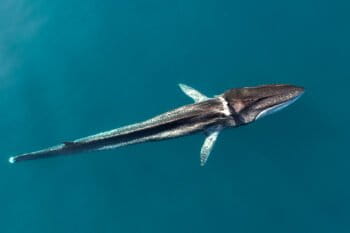
Carnival of the Nearly Extinct Animals has 14 movements covering 13 species: tigers, bees and butterflies, polar bears, hawksbill turtles, elephants, black rhinos, coral, blue whales, ivory-billed woodpeckers, passenger pigeons, gray wolves, American buffalo and kāhuli, snails native to Hawai‘i, with a finale.
Boyd designed the orchestral piece as a sister work to an older, famous piece of music called Carnival of the Animals, written by French composer Camille Saint-Saëns in the 1880s. The two pieces share the same number of movements and are roughly the same length.
Musicians from the Hawai‘i Symphony Orchestra play the score in Honolulu, with dancers from Ballet Hawaii and guest artists from New York. Obie Award-winning puppeteer Greg Corbino built dozens of the animals by hand. Hawaiian actor Moses Goods narrates, reading poems written by local students.
First up is the tiger, a movement that begins with a roar of cellos, basses and trombones, and ends with a chuff, the sound tigers make instead of purring, played on the harp. The bees and butterflies are floating violins. The hawksbill turtle movement is led by bassoons to convey a turtle enjoying a swim.
“Separately-muted trumpets sing the song of one of the last Ivory-Billed Woodpeckers to ever be recorded on tape, while cellos and basses tap out their wood-pecking rhythms on the bodies of their instruments,” Boyd writes.
Gray wolves and American buffalo both came back from near-total destruction, turning their howling and booming songs into a celebration.
Just one of the animals, the kāhuli snail, is native to Hawai‘i. “Their ornate shells once covering the trees of Hawai‘i … so abundantly that you could hear an eerie, magical song arising from the forests — possibly made by wind swirling through their shells or the shells bumping against each other,” Boyd writes.
Hawai‘i once held roughly 750 species of land snails, but state biologists estimate up to 90% of that diversity is gone. Every surviving kāhuli in the genus Achatinella is federally listed as endangered.
Cellos carry the snails’ song now, over a bed of harp and string harmonics.
Banner Image: Elephant puppet created by Greg Corbino created for Carnival of the Nearly Extinct Animals by Stephanie Ann Boyd. Photo courtesy of Ocean Music Action.