
- The IMF provides financial assistance to countries to balance their books but recent research by the co-authors of a new commentary shows this support comes at an environmental cost: an increase in deforestation.
- The co-authors reveal countries experience 9.2% higher annual tree cover loss during years in which they are under such programs, which is an unnecessary cost; and thus, the IMF should consider how to fix this issue while it’s currently reviewing the design of its lending programs, they argue.
- As the IMF rethinks its lending approach, these groundbreaking new findings underscore the need to deepen understanding of the impacts of forest and biodiversity loss on economic systems, the co-authors write.
- This article is a commentary. The views expressed are those of the authors, not necessarily of Mongabay.
The price of financial stability should not be environmental destruction. Yet when countries turn to the International Monetary Fund (IMF) for help, their forests may quietly suffer.
The IMF is currently reviewing the design of its lending programs, and it is time for change. Its recipe for getting economies back on track often features required reforms such as cutting government expenditure, increasing revenue collection through taxes or utility tariff increases, winding down public ownership of state-owned enterprises and encouraging the private sector to step up: austerity in other words.
These policies are meant to restore stability in times of crisis, but growing evidence shows that IMF programs often fall short in helping countries break out of the cycle of economic and financial distress. Instead, they can trigger collateral damage in the form of negative health outcomes, worsened poverty and inequality and eroded social protection.

Our new research provides evidence that these programs also have an important and often overlooked environmental dimension, revealing that countries experience 9.2% higher annual tree cover loss during years in which they are under an IMF program. In a typical three-year IMF program, this amounts to forest loss the size of Barbados.
This finding comes as no surprise as IMF programs are known to generally cut government spending, and environmental protections are often the first to go. These conditions that come in exchange for financial assistance are a major shortcoming when it comes to effects on forests, even though forests are rarely explicitly addressed in loan conditions. In fact, only 34 policy reforms of nearly 36,000 administered to low- and middle-income countries since 1980 explicitly target the forestry sector. For example, in 1995 Albania agreed to “eliminate export licensing requirement[s] for wood” as part of an IMF loan, which made it easier to profit from timber and increased deforestation.
Although this pattern may not be the result of deliberate anti-environmentalism at the IMF, the fund has long been aware of the importance of considering environmental risks. A 1996 book chapter by then-IMF first deputy managing director Stanley Fischer acknowledged that “environmental issues must be taken into account in trying to attain … growth that is sustainable.” Under the management of current IMF managing director Kristalina Georgieva, the fund has sought to position itself as a climate champion. Its own research and mapping now recognizes how nature-related risks can have important macroeconomic and financial dimensions that fall under the IMF’s mandate.
Despite the IMF’s stated sensitivity to climate issues and the fact that it does not tell countries to cut down forests or deliberately design programs that drive deforestation, its policy conditions can inadvertently push governments in that direction. To comply with IMF conditions, countries end up instituting policies that allow them to extract economic value from accessible natural resources, such as forests. For example, Ghana significantly increased deforestation to export wood in the late 1980s and 1990s and cut funding for environmental protection.
In 2022, the Kunming-Montreal Global Biodiversity Framework (GBF) was adopted by the Conference of the Parties (COP) to the Convention on Biological Diversity, whereby 196 countries agreed to halt forest loss by 2030. The signatories include all IMF members, creating a clear tension between their commitments under the GBF and the design of IMF-supported reform programs.

This issue is more urgent now than ever, as forests absorb greenhouse gases, which helps to slow climate change, whereas clearing them releases carbon into the atmosphere. Their value also goes beyond climate, as tree cover is central to conservation strategies, and millions of households in forest-adjacent communities rely on them for household income.
Therefore, forests and macroeconomic policymaking cannot be relegated to separate silos. The link between them provides opportunities for the IMF to expand its conceptual model for how policies can shape nature-related outcomes, and how environmental risks ripple into the macroeconomic and financial sectors. The World Economic Forum estimated in 2020 that more than half of global GDP — $44 trillion — is dependent on nature, annually. Destroying forests not only violates global treaty obligations but undermines the underpinnings of the global economy.
As the IMF rethinks its lending approach, these groundbreaking new findings underscore the need to deepen understanding of the impacts of forest and biodiversity loss on economic systems. Lending programs should enable member countries to invest in nature and put their economies on more resilient footing, not push countries toward short-term fixes that deplete national resources.
Financial and environmental stability are not competing goals, but rather depend on each other for sustained growth and protection.
Timon Forster, Ph.D, is an assistant professor at the Barcelona Institute of International Studies (IBEI), Spain. Rishikesh Ram Bhandary is a research director for the Task Force on Climate, Development and the International Financial Architecture and concurrently senior academic researcher and team lead for the Climate Development Finance workstream of the Global Economic Governance Initiative at the Boston University Global Development Policy Center, U.S. Kevin P. Gallagher directs the Boston University Global Development Policy Center and is a professor of global development policy at the Frederick S. Pardee School of Global Studies at Boston University.
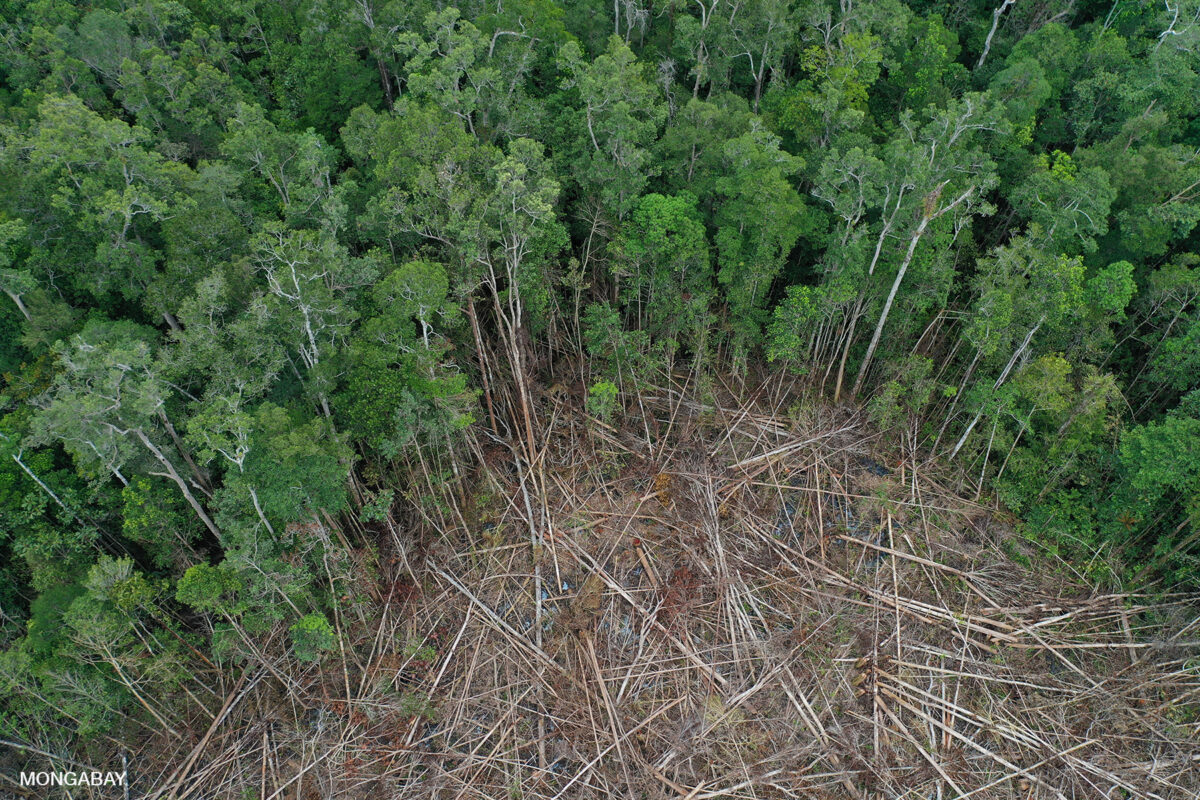
Banner image: Deforestation for oil palm plantation in Borneo, Indonesia. Image by Rhett A. Butler/Mongabay.
See related coverage:
Report alleges élite ties behind logging permits in Cameroon’s Ebo Forest
European Commission linked leather to deforestation, then ignored it
Citations:
Forster, T., Bhandary, R. R., & Gallagher, K. P. (2026). Cutting trees to balance budgets: International Monetary Fund programs are associated with increased deforestation. One Earth, 9(4), 101676. doi:10.1016/j.oneear.2026.101676
Forster, T., Kentikelenis, A. E., Stubbs, T. H., & King, L. P. (2020). Globalization and health equity: The impact of structural adjustment programs on developing countries. Social Science & Medicine, 267, 112496. doi:10.1016/j.socscimed.2019.112496
Stubbs, T., Kentikelenis, A., Ray, R., & Gallagher, K. P. (2021). Poverty, inequality, and the International Monetary Fund: How austerity hurts the poor and widens inequality. Journal of Globalization and Development, 13(1), 61-89. doi:10.1515/jgd-2021-0018
Owusu, J. H. (1998). Current convenience, desperate deforestation: Ghana’s Adjustment Program and the forestry sector. The Professional Geographer, 50(4), 418-436. doi:10.1111/0033-0124.00130