

- Nicaragua’s Bosawás Biosphere Reserve has lost more than a third of its primary forest cover since the turn of the century.
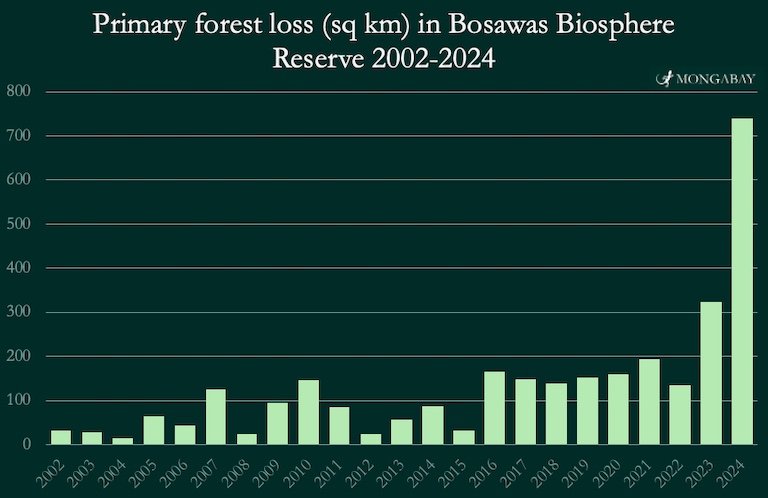
- 2024 marked the biggest year of deforestation, with 10% of Bosawás cleared in just one year.
- Cattle ranching is among the top causes of forest loss, with outsiders encroaching into Bosawás to clear forest for pasture.
- Indigenous advocates and residents say the loss of forest is threatening their way of life, and that they have faced violence due to encroachment.
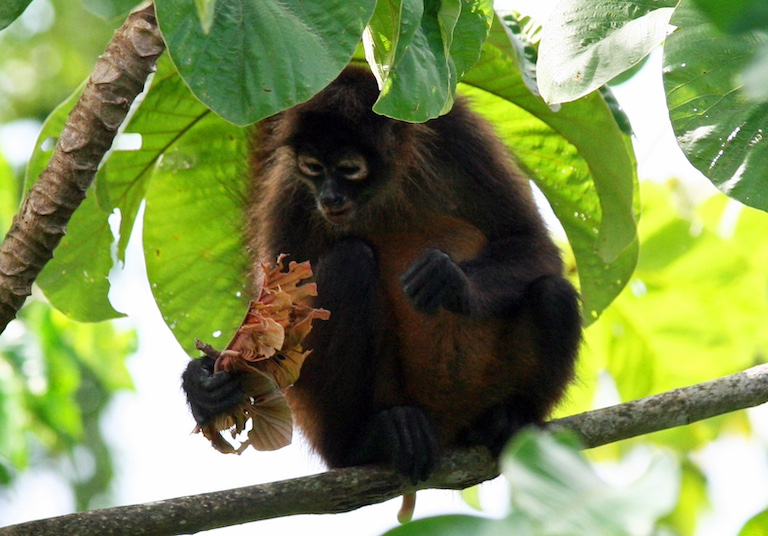
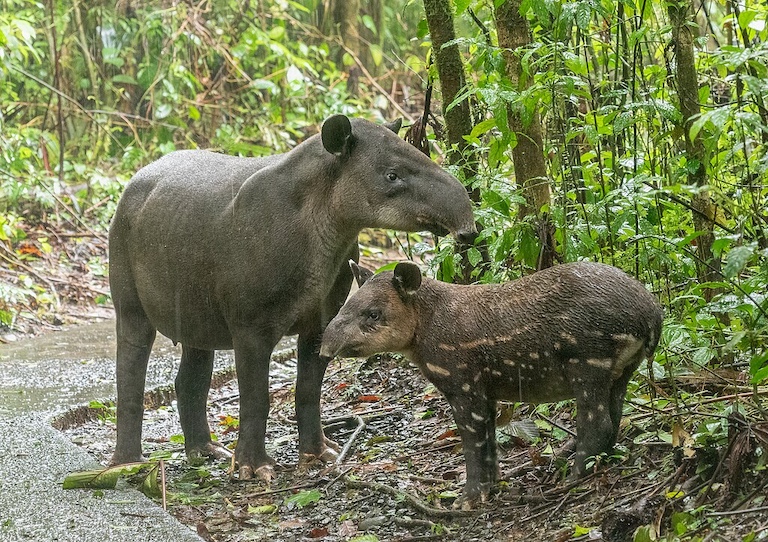
Encompassing some 7,400 square kilometers, or 2,860 square miles, along the Honduran border, Nicaragua’s Bosawás Biosphere Reserve is the largest biosphere reserve in Central America. It’s home to the Miskito and Mayanga Indigenous groups as well as countless species; endangered Geoffrey’s spider monkeys (Ateles geoffroyi) and Baird’s tapirs (Tapirus bairdii) inhabit Bosawas, as do critically endangered Saslaya moss salamanders (Nototriton saslaya), that are found nowhere else in the world.
But, increasingly over the past several decades, Bosawás has also become host to cattle ranches and gold mines, at the cost of its rainforest.
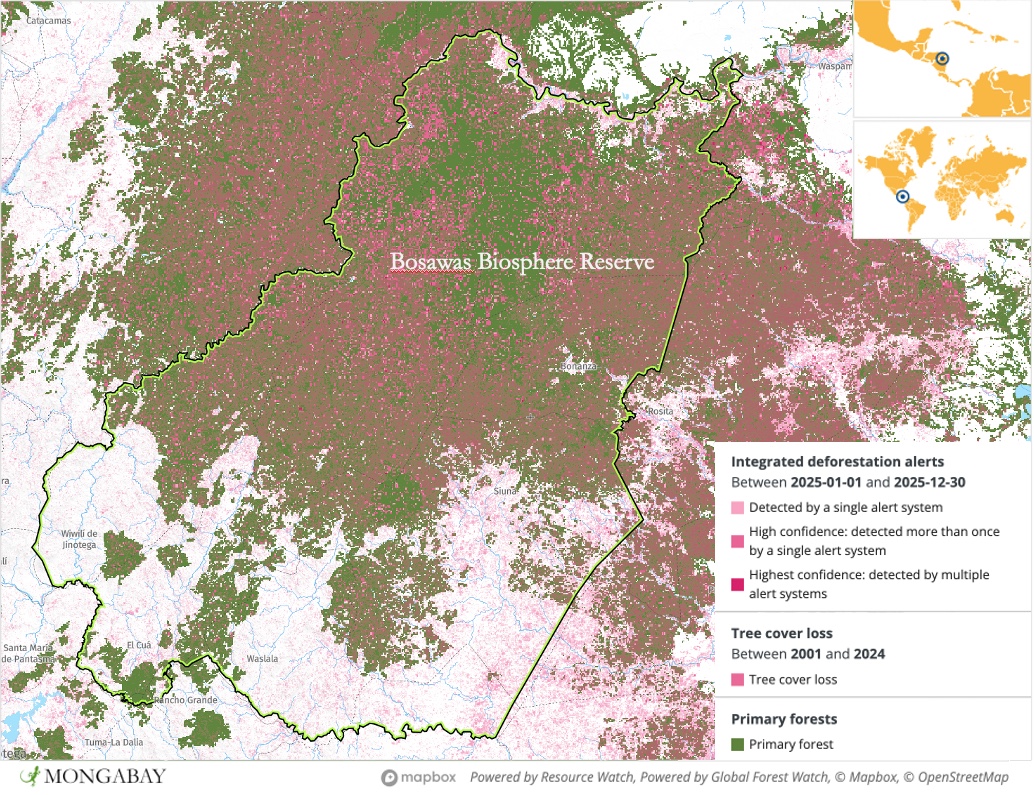
Despite its designation as a UNESCO site, Bosawás Biosphere Reserve has lost more than 30% of its primary forest cover since the turn of the century, according to satellite data from the University of Maryland’s Global Land Analysis and Discovery lab and visualized on the monitoring platform Global Forest Watch. Deforestation surged to a record high in 2024, with 740 km2 (286 mi2) — 10% of the reserve’s land area — cleared in a single year.

The data show fire activity in Bosawás also rose in 2024, with 35% of annual tree cover loss caused by fire, representing a 700% jump from 2023.
Preliminary data for 2025 indicate forest loss has continued this year, with satellite imagery showing telltale patches of brown spreading ever deeper into Bosawás’s remaining old-growth rainforest.
Cattle ranching is one of the main drivers of forest loss in the reserve, according to Indigenous advocates, with ranchers encroaching and felling forest for pasture in Bosawás to feed Nicaragua’s beef industry. The advocates said this deforestation hurts Indigenous communities as well as wildlife.
“If a rancher comes and takes up a thousand acres near a community, that community loses access to hunting, fishing and even clean water sources,” said Wari, an Indigenous rights advocate in Bosawás who spoke to Mongabay in 2023 and asked to be identified only by his first name due to safety concerns.
Gold mining is also a threat to Bosawás, with a 2022 report by Nicaraguan NGO Fundación del Río finding 66% of the reserve is encompassed by metallic mining concessions.
An Indigenous community member who spoke with Mongabay in 2023 under the condition of anonymity said community members have been subjected to violence from outsiders who encroach into Bosawás. In 2024, the United Nations’ Green Climate Fund axed a conservation project aimed at reducing deforestation in Bosawás and Río San Juan biosphere reserves due to escalating human rights violations in both reserves.
“The forest is Mother Earth for us because it’s the mother that provides what you need to survive, to feed and protect yourself,” said an Indigenous leader who asked to remain anonymous due to safety concerns.
An investigation conducted by international environmental groups ReWild and the Patrol Campaign and released October 2025 found that cattle ranchers have continued deforesting Nicaragua’s protected areas and Indigenous territories despite years of industry reforms, and that the resultant “conflict beef” is being mixed into legally produced beef and exported abroad. In an open letter referencing the investigation and signed by ReWild, Patrol and international watchdog organization Environmental Investigation Agency, conservationists urge retailers that import Nicaraguan beef to investigate their beef supplies and enforce strict sourcing policies and traceability measures.
“This ‘conflict beef’ fuels human rights abuses and accelerates deforestation in critical ecosystems such as the Bosawás Biosphere Reserve and the Indio Maíz Biological Reserve,” the letter states. “These areas are not only home to threatened wildlife, but also form part of our planet’s irreplaceable carbon and biodiversity reserves.”
Banner image: A baird’s tapir goes for dip. Image by Bernard Dupont via Wikimedia Commons (CC BY-SA 2.0).
Feedback: Use this form to send a message to the editor of this post. If you want to post a public comment, you can do that at the bottom of the page.