
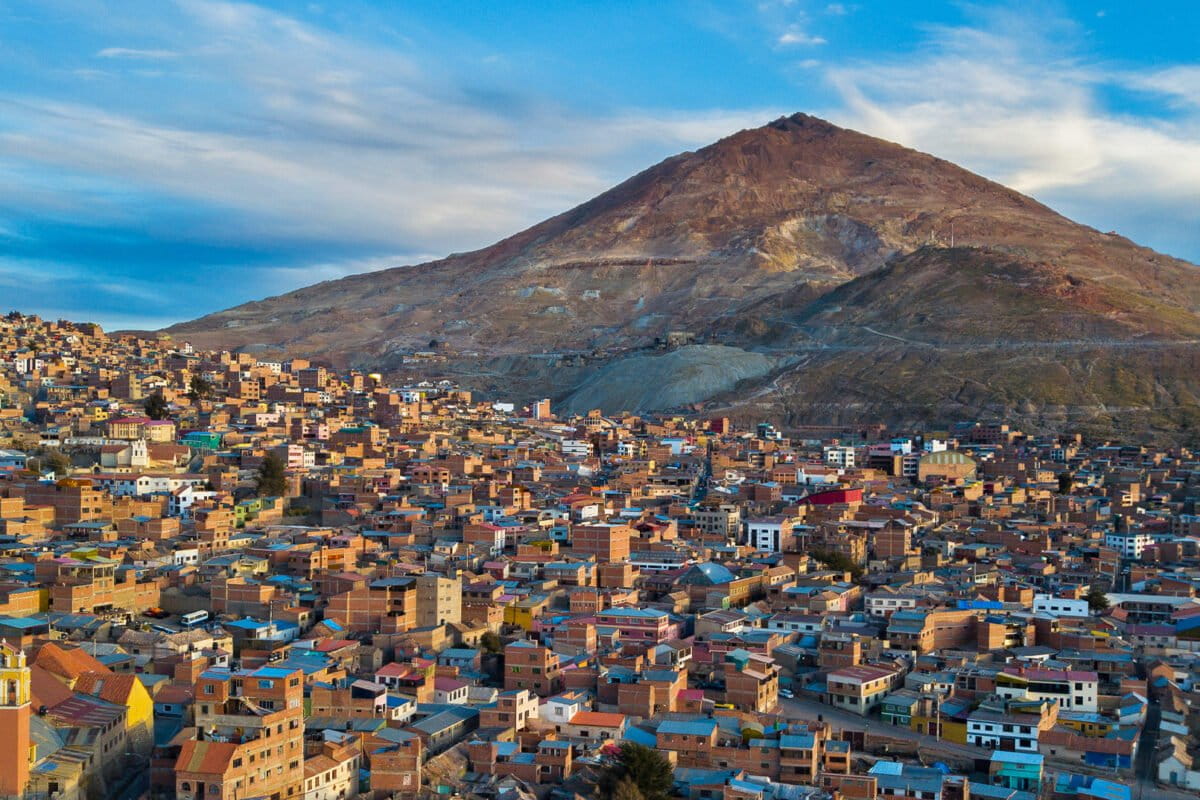
- After nearly 500 years of mining, Cerro Rico, the Bolivian mountain whose silver financed the Spanish Empire, is experiencing increasingly frequent and severe cave-ins.
- With silver prices at decade highs, mining activity on Cerro Rico has surged in recent years.
- The collapses endanger the safety and livelihoods of communities living and working on the mountain, the majority of them Indigenous Quechua.
- Lacking both funding and alternative sites to relocate miners, efforts to preserve the mountain have been delayed and ineffective.
At about 4,800 meters, or nearly 15,800 feet, above sea level, Cerro Rico towers over the city of Potosí, in Bolivia’s southern highlands. Famous for its vast silver reserves, Cerro Rico — whose name means “rich mountain” in Spanish — almost single-handedly financed the Spanish Empire. In 1656, author Antonio de León Pinelo claimed that enough silver had been extracted by Indigenous and African slaves to build a bridge from Bolivia to Madrid. At its peak in the early 17th century, Potosí was one of the world’s most populated cities, bigger even than London and Milan. UNESCO World Heritage Site, today the mountain is still exploited by miners associated with 54 cooperatives for zinc, lead, tin and silver, and continues to fuel the city’s economy.
Now, riddled with tunnels after nearly 500 years of informal mining, the upper part of the mountain is on the brink of collapse, threatening the approximately 180 families who live on the mountain and the roughly 10,000 miners working there, the majority of them Indigenous Quechua.
“All the houses are cracked because everything is sinking,” Silvia Mamani Armijo, 34, who lives on the mountain with her three young children and works as a mine tunnel guard, told Mongabay. “During the rainy season this whole area can collapse,” she added, pointing to the cracks in the adobe walls of several houses near hers. “So many families could die.”

Small collapses have long been part of life at Cerro Rico, whose centuries of mining, dating back to the city’s founding as a Spanish colonial outpost in 1545, have claimed the lives of possibly 8 million miners, according to historical estimates. But in recent years, fueled by rising mineral prices, new extraction techniques and the instability of a hollowed-out mountain, these collapses have become more frequent and severe. In 2010, a major collapse near the mountain’s peak was the first of many. In 2014, UNESCO added Cerro Rico and Potosí to its list of endangered world heritage sites, citing the risk that “continued and uncontrolled mining operations” pose to the area.
The collapse of Cerro Rico
As mountains go, it’s hard to put a number on just how high Cerro Rico is. It’s currently thought to stand at approximately 4,753 meters (15,594 feet), nearly 250 m (820 ft) shorter than its estimated original height before Spanish mining began in the 16th century. “It will probably collapse another 10 or 20 meters [33-66 ft],” Freddy Llanos, a mining engineer at Tomás Frías Autonomous University in Potosí and a member of the technical commission for preserving Cerro Rico, told Mongabay in a phone interview. “It will end up as a truncated cone,” he added.
A result of its unique mineralogy and the brutal exploitation of slave labor by Spanish colonizers, the riches from Cerro Rico were key to propelling global capitalism. “The wealth from Cerro Rico generated the globalization of the world economy,” Llanos said. “During colonial times, the profits went to Europe via Spain, and during World War II our tin supported the war effort.”
Though rich in minerals, the department of Potosí is one of Bolivia’s poorest. “People came to Potosí, got rich, and left,” Hernán Ríos Montero, a geologist at Tomás Frías Autonomous University, told Mongabay, explaining that the capital that didn’t leave the country went to neighboring cities. As mining continues after 480 years of informal extraction and a lack of investment to preserve the mountain, the mountain is crisscrossed with countless tunnels and becoming increasingly unstable.

The collapse of Cerro Rico has also been accelerated by intensified mining activity. In September, state mining company COMIBOL reported that approximately 30,000 miners currently work on the mountain, a sharp increase from the 20,000 reported by mining authorities in 2024, and 12,000 in 2023. Mario Caro, a journalist from Potosí, told Mongabay that the numbers reported by COMIBOL are inflated to increase the political power of the mining sector, and estimated the actual number at around 10,000, though he said mining activity is indeed increasing.
The surge in mining activity is driven by high mineral prices, with silver trading at almost all-time highs in 2025. Soaring global demand for solar panels, which rely on silver, and wind turbines, which require zinc in their manufacturing, has contributed to the recent price surges. “While we bear the brunt of plunder and exploitation, it’s other countries who are talking about a transition,” Alfredo Zaconeta, a mining researcher at Bolivian nonprofit CEDLA, told Mongabay.
Mining in Cerro Rico is run by many independently operating cooperatives, with workers flocking to the mines when prices are high. Though the work is dangerous, miners can earn much more than in most other professions.
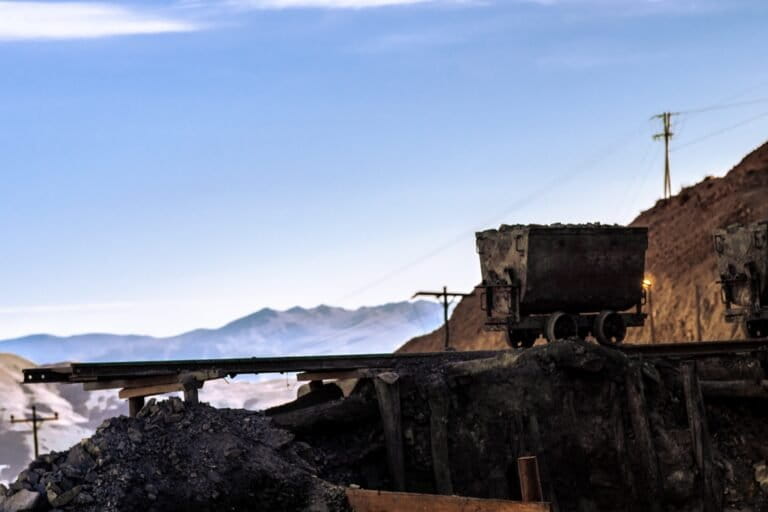
Changes in mining technology have also led to more collapses. “Back then, you had to take the drill bit and hammer, manually dig a hole, and then load it with dynamite,” Basilio Vargas, 35, a miner since he was 11, told Mongabay. Today, pneumatic drills allow miners to work much faster, filling a 20-ton dump truck in days — a job that previously would have taken three to four weeks. Vargas and his family were featured in a 2005 documentary about child miners in Potosí, and he said his house that appears in the film has since disappeared after the ground beneath it caved in. “There are more and more cave-ins every year,” he said.
While the majority of Cerro Rico’s early wealth originated from veins of pure silver, these deposits are now all but gone. Instead, miners now extract large volumes of minerals distributed in small concentrations throughout the rock, requiring them to extract more ore to earn profits. The miners then sell the ore to the Manquiri Mining Company, which runs a processing plant that crushes and leaches it to recover the metals. According to Ríos Montero and Zaconeta, leaching technology has contributed to the mountain’s collapse by increasing the volume of material removed from the mountain.

Though problematic for preserving the mountain, collapses are beneficial to mining cooperatives and refiners like Manquiri, said Zaconeta, pointing out that collapses serve the same function as dynamite. “If there’s a natural collapse, you can save a lot of time, because the cooperatives can directly collect the collapsed material,” he said.
Manquiri and its Canadian parent company, Andean Precious Metals, which miners and experts say help drive demand for disseminated minerals linked to the mountain’s collapses, did not respond to Mongabay’s repeated requests for comment.
Community impacts
As of Oct. 3, 96 people had died while working in mining in Potosí department in 2025, with at least 90 of them having died inside Cerro Rico, according to unpublished police data. Mario Caro, the journalist from Potosí, told Mongabay that many deaths go unreported, and noted that death rates in 2025 have been higher than in previous years.
Most of those killed were men, but women are also at risk, as the increased mining activity gives them more work in and around the mines. As guardabocaminas, or mine-mouth guards, Silvia Mamani Armijo and her mother, Lucía Armijo, defend mine tunnels from thieves with little more than dogs and dynamite, which they light and throw at potential intruders. These women live at the mine entrances, often without electricity or running water, and earn 500 to 1,000 bolivianos per month (about $72-$145 at the official exchange rate), or about 18-36% of Bolivia’s minimum wage. They also sell some mineral waste from the mines to supplement their incomes. If a robbery occurs, cooperative bosses frequently deduct the losses from their wages.

“It’s not nice living on the mountain,” Lucía Armijo, 51, who has been a guardabocamina on Cerro Rico for more than 30 years, told Mongabay. “During the rainy season you have to be worried that any part of the mountain could collapse, that anything could happen,” she added as she passed the area where her daughter Claudia’s house once stood before collapsing. “Where will our children and grandchildren go, where will they work? There isn’t so much as a factory in Potosí.”
Armijo, who like many Potosinos speaks Quechua as her first language, said the dangers of living on Cerro Rico go beyond its structural instability. “That dust — look where it goes,” she said as a gust of wind blew across the mountain. “It goes straight into our rooms, it’s just awful.” Without running water on the mountain, the mining cooperative that employs Armijo periodically fills large metal barrels with water which, contaminated by mining dust, cause frequent diarrhea for her and her children.

Sexual violence and exploitative, often illegal, labor practices are also common for women working on Cerro Rico, Paulina Ibeth Garabito Ovando, founder of MUSOL, an organization that supports women in Potosí’s mining sector, told Mongabay.
The impacts of Cerro Rico’s collapse go beyond the material. A relic of colonial history, the peak remains a powerful symbol of identity and pride for Potosinos and Bolivians in general. Its silhouette dominates the local skyline and features prominently in national iconography, from the country’s coat of arms to banknotes.
“Puntita era pues” (“it used to be a sharp peak”), Petrona Santos Mamani, 82, told Mongabay, recalling the mountain’s shape from her childhood. “It’s a symbol of Bolivia, and now it’s broken,” said the woman who spent her adult life working as a palliri, a Quechua word used to describe women miners who manually crush rocks outside the tunnels in search of minerals. “It hurts to see the Cerro like this, it makes me want to cry.”

Santos Mamani participated in a 1996 action when more than 250 palliris occupied the summit of Cerro Rico to protest the unsustainable exploitation of the mountain driven by a refinery company owned by then-president Gonzalo Sánchez de Lozada. The palliris are now currently considering another collective action to demand the preservation of the national symbol.
It further worries Santos Mamani that the same trends that enriched Europe with little benefits to the Bolivian communities producing raw materials seem likely to continue elsewhere in the department of Potosí, with the Bolivian government recently signing lithium mining contracts with two foreign companies.
What’s next for Cerro Rico?
Efforts to preserve the historic summit have been slow and underfunded. In 2022, a Potosí court ordered COMIBOL to close all mine entrances above 4,400 m (14,436 ft) and move them to lower, more stable ground in an effort to preserve the mountain and allow mining operations to continue safely. But three years later, the relocation remains unfinished, delayed by resistance from mining cooperatives who see the move as a threat to their bottom line, given that the highest concentrations of minerals are near the mountain’s peak. “I wish the authorities would care,” said Mamani Armijo, adding she fears that her home and the mine she guards could collapse. “So many families work here.”

According to Zaconeta and other experts, the close alliance between mining cooperatives and the Bolivian government throughout the last 20 years has also played a role in slowing down preservation efforts. “What they’ve achieved is a great deal of permissiveness,” he said.
Though the department of Potosí is rich in minerals, Llanos said government mining authorities haven’t undertaken the necessary exploration to find new deposits, which would make COMIBOL’s mandate to migrate mine entrances more viable. “We’re still exploiting minerals from the same deposits that were known in colonial times,” he said.
In September, a court ordered that the bank accounts of the mining minister Alejandro Santos Laura, COMIBOL president Reynaldo Pardo Fernández, and COMIBOL’s Potosí regional manager, Iván Guillermo Fuentes, be frozen until they complied with previous orders to preserve the structure of the peak. It gave them 31 days to demonstrate progress. In a press conference after the court decision, Pardo Fernández defended the state mining corporation’s work to preserve the mountain and said it would take “drastic measures” to accelerate the closure of mine entrances above 4,400 m.
In early October, COMIBOL and the Departmental Federation of Mining Cooperatives (FEDECOMIN) instated restrictions that allow mining only during the day and only on weekdays, and prohibit the use of heavy machinery above 4,400 m. Santos Laura also said in a press conference that “we’ve completed more than 60%” of the work to migrate mine entrances, with 20 mines above 4,400 m closed and another 10 remaining. During a miners’ march, FEDECOMIN president Óscar Chavarría told reporters that miners would be willing to stop working on Cerro Rico if authorities granted them concessions to exploit deposits elsewhere, giving officials 30 days to respond to their demands.
Caro said he’s skeptical that the officials’ bank account closures would compel COMIBOL to prioritize the migration of mine entrances, pointing out that only the personal bank accounts of the mining authorities had been closed. “They have money coming in from all over the place,” he told Mongabay in a phone interview.
After speaking about the mine migration process with El País in July, a COMIBOL spokesperson told Mongabay that the state mining company was no longer granting interviews regarding Cerro Rico.

Llanos and colleagues have proposed an initiative to reinforce the peak with concrete and steel, which would both prevent miners from tunneling upward and strengthen the structure of the summit. But lacking $3.5 million in funding amid a deepening economic crisis, some worry the project may never be completed — a reality that Llanos finds ironic.
“We can never know exactly how many billions of dollars Potosí’s Cerro Rico has generated, and continues to generate,” he said. “It should be a moral and material obligation to give back to the Cerro, I don’t know, 0.00001% of the foreign currency that it generated over centuries.”
In early October, the governor of Potosí, Marco Antonio Copa Gutiérrez, held a meeting with local and national authorities, civic leaders and mining cooperatives, in which they signed an agreement to support Llanos’s initiative.
While these developments are important, “there’s still a lot of uncertainty,” said Zaconeta, as stabilizing the mountain would require significant funding and political will. Freddy Llanos said he sees these developments as hopeful and hopes to hold meetings with local and departmental government authorities to discuss technical details and potential for financing in the coming weeks.
“The problem Cerro Rico is facing is a problem for the whole world, since one way or another, the world has benefited from its riches,” he said. “It must be resolved urgently.”
Banner image: Cerro Rico mountain above the city of Potosí, Bolivia. Image by Benjamin Swift.
FEEDBACK: Use this form to send a message to the author of this post. If you want to post a public comment, you can do that at the bottom of the page.