News articles on hunting
Mongabay.com news articles on hunting in blog format. Updated regularly.
Cheetah population stabilizes in Namibia with support from farmers
(10/02/2008) Viewing the world's fastest land animal as a threat to their livestock, in the 1980s farmers killed half of Namibia's cheetah population. The trend continued into the early 1990s, when the population was diminished again by nearly half, leaving less than 2,500 cheetah in the southern African country. Today cheetah populations have stabilized due, in large part, to the efforts of the Cheetah Conservation Fund, an organization founded by Dr. Laurie Marker.
Cheetah population declines 90% in 100 years
(09/30/2008) The planet's fastest land animal is falling behind in its race for survival against habitat encroachment, loss of prey, the illegal wildlife trade, and disease. Once found widely across the African continent to Kazakhstan in the north to Burma in the East, the cheetah has seen a dramatic reduction of its range and numbers in recent centuries as livestock holders have relentlessly killed off the cat as a threat to their livelihoods. Today the cheetah clings to strongholds in only a few African nations. Among these is the southern African country of Botswana, which harbors large expanses of prime cheetah habitat. Still even in Bostwana, the cheetah faces challenges.
Logging, wildlife trade drive sun bears toward extinction
(09/25/2008) Industrial logging, large-scale forest conversion for oil palm plantations, and the illegal wildlife trade have left sun bears the rarest species of bear on the planet. Recognizing their dire status, Siew Te Wong, a Ph.D. candidate at the University of Montana, is working in Malaysia to save the species from extinction. Known as "Sun Bear Man" in some circles, Siew Te Wong is setting up the Bornean Sun Bear Conservation Centre (BSBCC) in Sabah, a Malaysian state on the island of Borneo. The project aims to save sun bears, which have largely overlooked by conservationists, through research, education, rehabilitation, and habitat conservation.
Bushmeat trade "most significant" threat to Africa's wildlife says Richard Leakey
(09/24/2008) Maverick conservationist, Richard Leakey, writes that "commercial bushmeat hunting has become the most significant immediate threat to the future of wildlife in Africa and around the world" in an article on Wildlife Direct. Founded by Leakey, Wildlife Direct is a nonprofit allowing researchers and wildlife organizations in Africa and Asia to connect directly with supporters through blogs.
Commercial bushmeat trade is devastating wildlife
(09/15/2008) Commercial killing of rainforest wildlife is putting biodiversity at risk and reducing sources of protein for rural populations, warns a new report from the Center for International Forestry Research (CIFOR) and the Secretariat of the Convention on Biological Diversity (CDB).
Primate conservation may enhance food availability to humans
(09/15/2008) Primate conservation may have the unintended benefit of enhancing food availability to humans reports a study led by African scientists.
Loss of wildlife is threatening biodiverse forests in northeastern India
(09/15/2008) Logging, agricultural expansion, and hunting of large birds and mammals in the tropical forests of northeastern India may be reducing the capacity of the biologically-rich ecosystem to regenerate itself, report researchers writing in the open-access journal Tropical Conservation Science.
New rainforest sanctuary in Cameroon already at risk from plantations, hunting
(09/15/2008) The forests of southern Cameroon bordering Gabon are biodiversity-rich and harbor important populations of gorillas, chimpanzees, and elephants. In 1998 the government of Cameroon established the Mengamé Gorilla Sanctuary and in 2002, working in close partnership with the government of Cameroon, the Jane Goodall Institute launched a project to protect habitat and biodiversity in the reserve while creating a connection between conservation and socio-economic improvement in communities bordering the sanctuary. The sanctuary now plays an important role in emerging trans-boundary protected area initiatives.
11 species of monkeys discovered in West African biodiversity hotspot
(09/15/2008) Urgent conservation measures are needed to protect some of the world's most endangered primates from the hunting, logging, and oil palm development in a region that has only recently emerged from a period of civil strife, report researchers writing in the open-access journal Tropical Conservation Science.
Whaling Commission issues media blackout on discussions to lift whale killing ban
(09/11/2008) The survival of whales is perhaps the most successful conservation story of the 20th century. Since a moratorium on commercial hunting, some whale species have staged dramatic recoveries. In May it was announced that the humpback whale population has climbed from 1,500 to 20,000 individuals, resulting in it being "downlisted" from vulnerable to least concern, according to the IUCN's Red List. Others, like the blue whale, appear to have stable populations but recovery remains slow.
Rare monkeys double in number in China but remain under threat
(09/08/2008) China's population of the gray snub-nosed monkey, a critically-endangered species endemic to Guizhou Province in southwestern China, has more than doubled in the wild since conservation measures were implemented in 1979, reports Chinese state media.
Indonesian raids on tiger traffickers yielding arrests in Sumatra
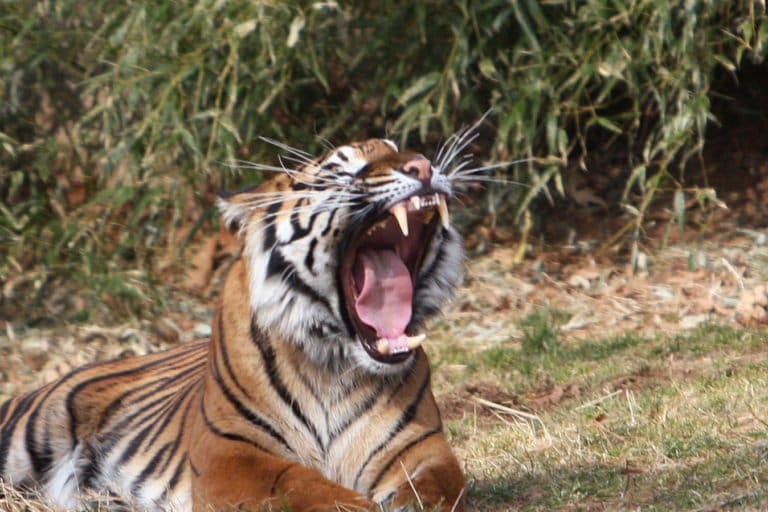
(09/02/2008) A raid on illegal tiger traders in Indonesia resulted in four arrests in Sumatra, reports the Wildlife Conservation Society (WCS). The arrests come under a new crack-down by Indonesian authorities on the sales of tiger parts. 10 traffickers have been arrested in the past 3 months.
Komodo dragon conservation efforts prove controversial in Indonesia
(08/25/2008) Efforts to conserve the world's largest lizard — the Komodo dragon — are proving controversial, and potentially dangerous to villagers, reports the Wall Street Journal.
Humans - not climate - drove extinction of giant Tasmanian animals
(08/11/2008) Humans — not climate change — were responsible for the mass extinction of Australia's megafauna, according to a new study published this week in the journal Proceedings of the National Academy of Sciences.
Massive gorilla population discovered in the Congo
(08/05/2008) The world's known population of critically endangered western lowland gorillas has more than doubled following a new census that revealed some 125,000 in the Republic of Congo.
48% of primates threatened with extinction
(08/05/2008) 48 percent of the world's primate species are at risk of extinction, according to the first comprehensive review of the world's primates since 2003. The results were released as an update to the IUCN Red List at the 22nd International Primatological Society Congress in Edinburgh, Scotland.
Often overlooked, small wild cats are important and in trouble
(08/05/2008) While often over-shadowed by their larger and better-known relatives like lions, tigers, leopards, and jaguars, small cats are important indicators of the health of an ecosystem, says a leading small cat expert who uses camera traps extensively to document and monitor mammals in the wild. Dr Jim Sanderson, a scientist with the Small Cat Conservation Alliance and Conservation International, is working to save some of the world's rarest cats, including the Andean cat and Guigna of South America and the bay, flat-headed, and marbled cats of Southeast Asia. In the process Sanderson has captured on film some of the planet's least seen animals, including some species that have never before been photographed. He has also found that despite widespread criticism, some corporate entities are effectively protecting remote wilderness areas.
African elephants being poached at record rate
(08/01/2008) African elephants are being killed for their ivory at a record pace, reports a University of Washington conservation biologist.
Caribbean Monk Seal is officially declared extinct
(06/10/2008) The NOAA fish service has officially declared the Caribbean Monk Seal extinct. The seal--the first to go extinct by human causes--has not had a confirmed sighting for fifty-six year. Many scientists believe sightings that have followed the last confirmation were probably of Hooded Seals and not the Caribbean Monk.
Major tiger conservation effort gets underway
(06/10/2008) A broad alliance of environmentalits, scientists, and celebrities have teamed with the World Bank Group and the Global Environment Facility (GEF) to help protect wild tigers.
Defaunation, like deforestation, threatens global biodiversity
(05/20/2008) Loss of wildlife is a subtle but growing threat to tropical forests, says a leading plant ecologist from Stanford University. Speaking in an interview with mongabay.com, Dr. Rodolfo Dirzo says that the disappearance of wildlife due to overexploitation, fragmentation, and habitat degradation is causing ecological changes in some of the world's most biodiverse tropical forests. He ranks defaunation — as he terms the ongoing biological impoverishment of forests — as one of the world's most significant global changes, on par with environmental changes like global warming, deforestation, and shifts in the nitrogen cycle.
World's rarest gorilla gets its own forest reserve
(04/18/2008) The government of Cameroon has established the first sanctuary exclusively for the world's rarest type of ape: the Cross River gorilla, according to the Wildlife conservation Society (WCS), which helped support the project.
First wolves killed in Wyoming after species loses ESA protection
(04/02/2008) In one of a series of controversial decisions regarding the Endangered Species Act recently, the federal government has dropped the Rocky Mountain grey wolf from the program. The announcement of the de-listing was made in mid-February, but did not go into effect until Friday when the reins of control were handed over from the federal government to the individual states. Over the weekend wolf-hunting began in Wyoming.
Humans, and global warming, responsible for extinction of mammoths
(03/31/2008) The combination of human hunting pressure and climate change was responsible for the extinction in woolly mammoths, claims new research published in the open-access journal PLoS Biology. Scientists have long debated whether climate change or human hunting were the more important driver in the demise of North America's megafauna towards the end of the last Ice Age. Now new modeling by David Nogues-Bravo, a biologist at the National Museum of Natural Sciences in Madrid, Spain, and colleagues supports the theory that synergistic effects of warming climate and new human predators drove mammoths to extinction.
Africa's lions are disappearing
(03/25/2008) The lion is Africa's best known carnivore. Once widely abundant across the continent, recent surveys show that lion populations have plunged from over 100,000 individuals to around 23,000 over the past century. The reason? Lions are poisoned, shot, and speared by locals who see them as a threat to livestock. While lion populations in protected areas remain relatively healthy, conservationists say that without urgent measures, lions may disappear completely from unprotected areas. The Kilimanjaro Lion conservation Project is working to avoid this fate by developing practical measures to encourage coexistence between people, livestock and predators. Key to the effort is reducing livestock losses to lions. Leela Hazzah, a field researcher with the project, says the "Lion Guardians" program at Mbirikani Ranch in Kenya has proved remarkably successful: not a single lion has been killed since its inception in November 2006. The program employs Maasai warriors to monitor lions and help local communities prevent attacks on livestock.
Sumatran tiger faces extinction due to wildlife trade
(02/12/2008) The critically endangered Sumatran Tiger faces extinction due to the tiger parts trade in Indonesia, reports a new report from TRAFFIC, the wildlife trade monitoring network run by IUCN and WWF.
Rare gorillas use weapons to attack forest-intruding humans
(12/05/2007) Following the first documented cases of the Cross River gorillas -- world's most endangered gorilla -- throwing sticks and clumps of grass when threatened by people, the Wildlife conservation Society (WCS) has announced new research to better protect the species from poaching and encroachment.
Subtle threats could ruin the Amazon rainforest
(11/07/2007) While the mention of Amazon destruction usually conjures up images of vast stretches of felled and burned rainforest trees, cattle ranches, and vast soybean farms, some of the biggest threats to the Amazon rainforest are barely perceptible from above. Selective logging -- which opens up the forest canopy and allows winds and sunlight to dry leaf litter on the forest floor -- and 6-inch high "surface" fires are turning parts of the Amazon into a tinderbox, putting the world's largest rainforest at risk of ever-more severe forest fires. At the same time, market-driven hunting is impoverishing some areas of seed dispersers and predators, making it more difficult for forests to recover. Climate change -- an its forecast impacts on the Amazon basin -- further looms large over the horizon.
Proposed gold mine proves controversial in French Guiana rainforest
(11/07/2007) Commercial gold mining threatens a key forest reserve and wetland in French Guiana say scientists who warn that exploitation could pollute rivers with toxic compounds, threaten wildlife, and put indigenous populations at risk.
Global warming puts primates at greater risk
(10/25/2007) 29 percent of the world's primate species are in danger of going extinct warns a new report from the Primate Specialist Group of IUCN's Species Survival Commission (SSC) and the International Primatological Society (IPS).
Elephants use smell to distinguish hunters from farmers
(10/18/2007) Elephants can determine whether a human is a friend or foe by their scent, reports new research published in Current Biology.
Apology for Whale Shooting given by Tribe
(09/13/2007) The ninth of September saw a gray whale shot and killed by members of the Makah Tribe, off the coast of the Washington Coast, in the Strait of Juan de Fuca.
Chinese demand takes toll on wildlife in Burma (Myanmar)
(09/04/2007) If the market of Mong La is anything to go by, the remaining wild elephants, tigers and bears in Myanmar's forests are being hunted down slowly and sold to China.
Large mammals disappearing from Africa's parks
(08/31/2007) Large mammals are disappearing from Africa's national parks, warn researchers writing in the September 2007 issue of the African Journal of Ecology.
U.S. military attacks illegal wildlife trade in Afghanistan
(08/22/2007) The U.S. military has teamed with the Bronx Zoo-based Wildlife conservation Society (WCS) to attack the illegal wildlife trade in Afghanistan, according to a statement from the Department of Defense.
Rare gorillas slaughtered in mass killing
(07/24/2007) At least four critically endangered gorillas have been killed in Democratic Republic of Congo's Virunga National Park. National Geographic News reports they were shot "execution-style". Illegal charcoal harvesters are leading suspects in the slaying. Two other gorillas are missing and feared dead.
Rare three-legged tiger photographed in Sumatra
(07/06/2007) A WWF camera trap has captured photos of a three-legged Sumatran tiger on the Indonesian island of Sumatra. WWF says the rare tiger likely escaped from a snare. The big cat seems otherwise healthy.
Logging roads rapidly expanding in Congo rainforest
(06/07/2007) Logging roads are rapidly expanding in the Congo rainforest, report researchers who have constructed the first satellite-based maps of road construction in Central Africa. The authors say the work will help conservation agencies, governments, and scientists better understand how the expansion of logging is impacting the forest, its inhabitants, and global climate.
Saving big cats depends on science, practical interventions
(05/21/2007) Big cats are some of Earth's largest and most threatened predators. Long persecuted as perceived threats to livestock and humans, hunted for their skins and purported medicinal values, and losing critical habitat to deforestation and conversion for agriculture, big cat populations have dwindled around the world for the past century. Given these trends, it should come as no surprise that big cats have become the focus of conservation efforts. Not only are large predators often the most vulnerable to human pressures and the first to disappear from ecosystems, but efforts to conserve them effectively help protect thousands of other species that share their habitat. At the forefront of these efforts in Dr. Luke Hunter, a biologist with the Wildlife conservation Society (WCS) where he heads their Great Cats Program. In a May 2007 interview with mongabay.com, Hunter discussed strategies for conserving carnivores and offered insight for students interested in pursuing careers in conservation science.
Congo guerillas threaten to kill rare gorillas
(05/21/2007) Fresh off killing a park ranger, a group of Congo guerillas said they will slaughter highly endangered mountain gorillas in Congo's Virunga National Park if their demands for immunity aren't met, says WildlifeDirect, a wildlife conservation organization active in the region.
Military technology uses satellite signals to catch poachers
(05/02/2007) Wild animals sought by poachers for their skins, meat and bones have a new means of protection developed by a visiting scholar at the SUNY College of Environmental Science and Forestry (ESF). Steve Gulick, an electrical engineer who calls himself a biologist wannabe, has designed a metal detector specifically to pick up the presence of poachers' weapons and send an electronic signal, via satellite, to law enforcement authorities.
Commercial hunting may be biggest threat to tropical rainforests
(05/01/2007) Commercial hunting is decimating wildlife populations across the tropics and may be one of the gravest threats presently facing rainforests, reports a series of studies published in the May issue of the journal Biotropica. The research reveals that large-scale loss of wildlife is already affecting forest health and regeneration.
Scientists capture video of rare Borneo rhino
(04/24/2007) WWF has captured video footage of the rare Borneo rhino. There are only 25-50 of the rhino left in the wild on the island. Video from a camera trap shows the animal eating, walking to the camera and sniffing the equipment. It is first time the beast's behvaior in the wild has been captured on film.
Congo forest elephants declining from logging roads, illegal ivory
(04/02/2007) Fast-expanding logging roads in the Congo basin are becoming 'highways of death' for the fierce but elusive forest elephant, according to a new study published in the journal Public Library of Science. Logging roads both provide access to remote forest areas for ivory poachers and serve as conduits of advancing human settlement.
Biodiversity extinction crisis looms says renowned biologist
(03/12/2007) While there is considerable debate over the scale at which biodiversity extinction is occurring, there is little doubt we are presently in an age where species loss is well above the established biological norm. Extinction has certainly occurred in the past, and in fact, it is the fate of all species, but today the rate appears to be at least 100 times the background rate of one species per million per year and may be headed towards a magnitude thousands of times greater. Few people know more about extinction than Dr. Peter Raven, director of the Missouri Botanical Garden. He is the author of hundreds of scientific papers and books, and has an encyclopedic list of achievements and accolades from a lifetime of biological research. These make him one of the world's preeminent biodiversity experts. He is also extremely worried about the present biodiversity crisis, one that has been termed the sixth great extinction.
Human hunting causes changes in monkey behvaior
(03/08/2007) Human hunting pressure causes significant behvaioral changes in Central Africa monkeys and duiker according to a paper published in the March issue of the journal Biotropica.
Elephant poaching for ivory accelerates
(02/26/2007) Thousands of African elephants are being killed for their ivory tusks, according to a new study led by a biologist from the University of Washington. In a paper published in the online edition of the Proceedings of the National Academy of Sciences, Dr. Samuel Wasser, director of the University of Washington Center for conservation Biology, shows that elephants are being slaughtered at the highest rate since the international ban on the ivory trade took effect in 1989.
Global warming is a threat to fly fishing in the United States
(02/01/2007) An estimated thirty-five million Americans fly fish. George Black is one of them. Black, based in New York City, has written two books on the subject: Casting a Spell: The Bamboo Fly Rod and the American Pursuit of Perfection and The Trout Pool Paradox: The American Lives of Three Rivers. He has also written for the New York Times, the Los Angeles Times, and a number of other publications as well as authoring three books on foreign affairs.
Congo guerillas agree to protect rare gorillas
(01/24/2007) Rebels in eastern Congo have agreed to stop hunting mountain gorillas according to a report from the Associated Press.
Impact of new forest law in India unknown
(12/21/2006) A new law giving land rights to millions of poor Indian forest dwellers is stirring debate in the conservation community according to a report from Reuters.
Page 1 | Page 2 | Page 3 | Page 4 | Page 5 | Page 6 | Page 7